30.2 Convergence
AHL 5.19 Extension
- why a Maclaurin polynomial is most accurate near \(x = 0\)
- what it means for a Maclaurin series to converge, and the interval of convergence
- that the binomial series is a Maclaurin series, valid for \(|x| < 1\)
- the intervals where the standard series are valid
The IB syllabus does not ask for formal tests of convergence. You should know where each standard series is valid (for example \(|x| < 1\) for the binomial series, as in 4.3). The reasons why, and the behaviour at the end points, are marked Extension.
How good is a Maclaurin polynomial?
\(M_n(x)\) is built from \(f(0), f'(0), \ldots, f^{(n)}(0)\) — information at \(x = 0\) only. It is the polynomial of degree \(n\) that fits the curve best at \(x = 0\): it has the same value, the same gradient, the same second derivative, and so on. So \(M_n(x)\) is usually most accurate near \(x = 0\), and less accurate further away.
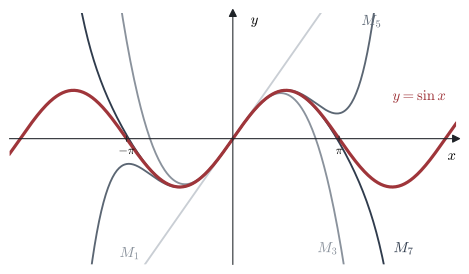
When we add more terms, the polynomial usually stays close to the curve over a wider interval. Figure 1 shows this for \(\sin x\): \(M_7\) follows the curve much further than \(M_1\) or \(M_3\).
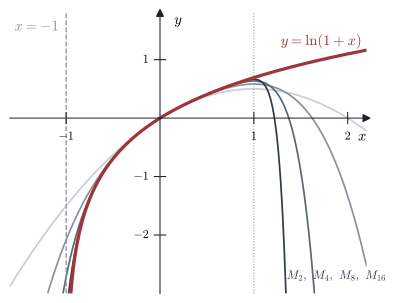
But adding terms does not always help. A polynomial is defined for every \(x\), so no polynomial can follow a vertical asymptote. In Figure 2, the Maclaurin polynomials of \(\ln(1 + x)\) fit well for \(-1 < x \leqslant 1\), but for \(x > 1\) they move away from the curve, and adding more terms makes this worse, not better.
Convergence Not in the formula booklet
The Maclaurin series of \(f\) converges to \(f(x)\) at a value of \(x\) if \[ \lim_{n \to \infty} M_n(x) = f(x) . \] The set of all such \(x\) is the interval of convergence (or interval of validity).
- \(n\): the degree of the Maclaurin polynomial
- \(M_n(x)\): the Maclaurin polynomial of degree \(n\) (the first terms of the series, up to \(x^n\))
The interval of convergence always contains \(x = 0\), because \(M_n(0) = f(0)\) for every \(n\).
Think back to infinite geometric series (2.4): \(1 + r + r^2 + \cdots\) has a sum only when \(|r| < 1\), that is, when the terms get smaller. A Maclaurin series behaves in a similar way: it can only converge for values of \(x\) where the terms eventually get smaller and smaller.
Example 1 Let \(f(x) = (1 + x)^p\), where \(p \in \mathbb{Q}\).
(a) Show that the Maclaurin series of \(f(x)\) is \[ \sum_{k=0}^{\infty}\frac{p(p - 1)(p - 2)\cdots(p - k + 1)}{k!}x^k . \] Compare this with the binomial series of 4.3.
(b) Explain why the series is only valid for \(|x| < 1\) when \(p\) is not a positive integer or zero.
(a) Differentiate again and again; each time the power comes down and drops by 1:
\[ \begin{aligned} f'(x) &= p(1 + x)^{p-1} \\ f''(x) &= p(p - 1)(1 + x)^{p-2} \\ f^{(k)}(x) &= p(p - 1)\cdots(p - k + 1)(1 + x)^{p-k} \end{aligned} \]
At \(x = 0\), \((1 + 0)^{p-k} = 1\), so \(f^{(k)}(0) = p(p - 1)\cdots(p - k + 1)\). Dividing by \(k!\) gives the coefficient of \(x^k\):
\[ (1 + x)^p = 1 + px + \frac{p(p - 1)}{2!}x^2 + \frac{p(p - 1)(p - 2)}{3!}x^3 + \cdots \]
This is exactly the binomial series. So the binomial theorem for \(p \in \mathbb{Q}\) is a special Maclaurin series.
(b) If \(p\) is a positive integer or zero, the factor \((p - p) = 0\) appears and the series stops: it is a polynomial, valid for all \(x\).
Otherwise the series never stops. Compare one term with the next:
\[ \frac{\text{term in } x^{k+1}}{\text{term in } x^k} = \frac{p - k}{k + 1}\,x , \]
and for large \(k\) the fraction \(\frac{p - k}{k + 1}\) is close to \(-1\). So the series behaves like a geometric series with common ratio about \(-x\). The terms get smaller only if \(|x| < 1\).
For example, with \(p = -1\) we get \(1 - x + x^2 - x^3 + \cdots = \dfrac{1}{1 + x}\), a geometric series with \(r = -x\), valid only for \(|x| < 1\).
Example 2 Let \(f(x) = \dfrac{1}{1 + 3x}\).
(a) Show that \(M_n(x) = 1 - 3x + 9x^2 - 27x^3 + \cdots + (-3)^nx^n\).
(b) Find \(M_n(0.5)\) for \(n = 1, 2, \ldots, 6\). Do you think the series converges when \(x = 0.5\)?
(c) Find \(M_n(0.1)\) for \(n = 1, 2, \ldots, 6\). Do you think the series converges when \(x = 0.1\)?
(a) \(\dfrac{1}{1 + 3x} = \dfrac{1}{1 - (-3x)}\). This is the sum of a geometric series with first term \(1\) and ratio \(r = -3x\):
\[ \frac{1}{1 + 3x} = 1 + (-3x) + (-3x)^2 + (-3x)^3 + \cdots \]
so \(M_n(x) = 1 - 3x + 9x^2 - 27x^3 + \cdots + (-3)^nx^n\). (Or: \(f^{(k)}(x) = (-3)^k k!\,(1 + 3x)^{-k-1}\), so \(f^{(k)}(0) = (-3)^kk!\) and the coefficient is \((-3)^k\).)
(b)
| \(n\) | 1 | 2 | 3 | 4 | 5 | 6 |
|---|---|---|---|---|---|---|
| \(M_n(0.5)\) | \(-0.5\) | \(1.75\) | \(-1.625\) | \(3.4375\) | \(-4.15625\) | \(7.234375\) |
The values jump up and down and get further apart. They do not approach \(f(0.5) = 0.4\). The series does not converge at \(x = 0.5\) (here \(|r| = 1.5 > 1\)).
(c)
| \(n\) | 1 | 2 | 3 | 4 | 5 | 6 |
|---|---|---|---|---|---|---|
| \(M_n(0.1)\) | \(0.7\) | \(0.79\) | \(0.763\) | \(0.7711\) | \(0.76867\) | \(0.769399\) |
The values settle down towards \(f(0.1) = \dfrac{1}{1.3} = 0.769230\ldots\) The series converges at \(x = 0.1\) (here \(|r| = 0.3 < 1\)).
The series converges exactly when \(|3x| < 1\), that is \(-\frac{1}{3} < x < \frac{1}{3}\). At \(x = -\frac{1}{3}\) the function has a vertical asymptote.
Summary of the standard series
Standard Maclaurin series and where they are valid Partly in the HL formula booklet
| Function | Maclaurin series | Valid for |
|---|---|---|
| \(\mathrm{e}^x\) | \(1 + x + \frac{x^2}{2!} + \frac{x^3}{3!} + \frac{x^4}{4!} + \cdots\) In the HL booklet | all \(x \in \mathbb{R}\) |
| \(\ln(1 + x)\) | \(x - \frac{x^2}{2} + \frac{x^3}{3} - \frac{x^4}{4} + \cdots\) In the HL booklet | \(-1 < x \leqslant 1\) |
| \(\sin x\) | \(x - \frac{x^3}{3!} + \frac{x^5}{5!} - \frac{x^7}{7!} + \cdots\) In the HL booklet | all \(x \in \mathbb{R}\) |
| \(\cos x\) | \(1 - \frac{x^2}{2!} + \frac{x^4}{4!} - \frac{x^6}{6!} + \cdots\) In the HL booklet | all \(x \in \mathbb{R}\) |
| \(\arctan x\) | \(x - \frac{x^3}{3} + \frac{x^5}{5} - \frac{x^7}{7} + \cdots\) In the HL booklet | \(-1 \leqslant x \leqslant 1\) |
| \((1 + x)^p\), \(p \in \mathbb{Q}\) | \(\displaystyle\sum_{k=0}^{\infty}\frac{p(p - 1)\cdots(p - k + 1)}{k!}x^k\) | \(\lvert x\rvert < 1\) (all \(x\) if \(p \in \mathbb{N}\)) |
- \(p\): the power, a rational number (\(p \in \mathbb{Q}\))
- \(k\): the index of the term (\(k = 0, 1, 2, \ldots\))
The intervals of validity are not in the booklet. The binomial series is given only as \((a + b)^n\) (AHL 1.10).
When you substitute into a series, substitute into the interval too. For example, \(\ln(1 + 2x)\) is valid for \(-1 < 2x \leqslant 1\), that is \(-\frac{1}{2} < x \leqslant \frac{1}{2}\).
Extension — why these intervals?
\(\dfrac{1}{1 - x} = 1 + x + x^2 + x^3 + \cdots\) is geometric with \(r = x\), so it converges exactly when \(|x| < 1\).
\(\ln(1 + x) = x - \frac{x^2}{2} + \frac{x^3}{3} - \cdots\) The fractions \(\frac{1}{k}\) do get smaller, but not fast enough. If \(|x| > 1\) the powers win: for example at \(x = 2\) the size of the terms is \(\dfrac{2^k}{k}\), and \(\displaystyle\lim_{k \to \infty}\frac{2^k}{k} = \lim_{k \to \infty}\frac{2^k\ln 2}{1} = \infty\) (by l’Hôpital’s rule, see Unit 26). The terms grow, so the series cannot converge.
- At \(x = -1\): \(\;-1 - \frac{1}{2} - \frac{1}{3} - \frac{1}{4} - \cdots\) does not converge (it is minus the harmonic series). This makes sense, because \(\ln 0\) is not defined.
- At \(x = 1\): \(\;1 - \frac{1}{2} + \frac{1}{3} - \frac{1}{4} + \cdots\) does converge (the signs alternate and the terms decrease to \(0\)), and its sum is \(\ln 2\).
So the interval is \(-1 < x \leqslant 1\).
\(\mathrm{e}^x = 1 + x + \frac{x^2}{2!} + \cdots\) Here the factorials win. For any fixed \(x\), once \(k > |x|\), each term is the previous term times \(\frac{x}{k}\), which has size less than \(1\) and keeps falling. So \(\dfrac{x^k}{k!} \to 0\) quickly, and the series converges for every real \(x\). The same reasoning works for \(\sin x\) and \(\cos x\).
Common errors
| ✗ Wrong | ✓ Right | Why |
|---|---|---|
| More terms always give a better approximation | Only inside the interval of convergence | Outside it, \(M_n(x)\) moves away from \(f(x)\). |
| \(\ln(1 + x)\) series valid for \(\lvert x\rvert < 1\) only | \(-1 < x \leqslant 1\) | It also converges at \(x = 1\) (Extension). |
| Using the \(\ln(1 + x)\) series at \(x = 2\) to find \(\ln 3\) | Choose \(x\) inside the interval | At \(x = 2\) the terms grow. |
| \(\ln(1 + 3x)\) valid for \(-1 < x \leqslant 1\) | \(-\frac{1}{3} < x \leqslant \frac{1}{3}\) | Substitute into the interval as well. |
| \(\mathrm{e}^x\) series valid only near \(0\) | Valid for all \(x\) | It converges everywhere; it just needs more terms far from \(0\). |
Exercises
1 For \(f(x) = \dfrac{1}{1 - x}\), find \(M_1(0.5)\), \(M_2(0.5)\), \(M_3(0.5)\) and \(M_4(0.5)\). What value are they approaching?
\(M_n(0.5) = 1 + 0.5 + 0.25 + \cdots\): \(\;1.5,\ 1.75,\ 1.875,\ 1.9375\). They approach \(f(0.5) = 2\).
2 Write down the first three terms of the Maclaurin series for \(\ln(1 + 2x)\), and state the values of \(x\) for which the series is valid.
\(2x - \dfrac{(2x)^2}{2} + \dfrac{(2x)^3}{3} = 2x - 2x^2 + \dfrac{8x^3}{3}\). \(\quad\) Valid for \(-1 < 2x \leqslant 1\), i.e. \(-\dfrac{1}{2} < x \leqslant \dfrac{1}{2}\).
3 Find the Maclaurin series for \((1 + x)^{-2}\) up to the term in \(x^3\), and state where it is valid.
\(p = -2\): \(\;1 - 2x + \dfrac{(-2)(-3)}{2}x^2 + \dfrac{(-2)(-3)(-4)}{6}x^3 = 1 - 2x + 3x^2 - 4x^3\). \(\;\) Valid for \(|x| < 1\).
4 Find the Maclaurin series for \(\sqrt{1 - 4x}\) up to the term in \(x^2\), and state where it is valid.
\(p = \frac{1}{2}\), replace \(x\) by \(-4x\): \(\;1 + \frac{1}{2}(-4x) + \dfrac{\frac{1}{2}\left(-\frac{1}{2}\right)}{2}(16x^2) = 1 - 2x - 2x^2\).
Valid for \(|4x| < 1\), i.e. \(|x| < \dfrac{1}{4}\).
5 Explain why no Maclaurin polynomial of \(f(x) = \dfrac{1}{1 + x}\) can be a good approximation to \(f(x)\) near \(x = -1\).
\(f\) has a vertical asymptote at \(x = -1\): \(|f(x)| \to \infty\) as \(x \to -1\). Every polynomial is continuous and has a finite value at \(x = -1\), so it cannot follow the asymptote.
6 For \(f(x) = \ln(1 + x)\), find \(M_1(0.5)\), \(M_2(0.5)\), \(M_3(0.5)\) and \(M_4(0.5)\), to 6 decimal places, and compare with \(\ln 1.5\).
\(M_1 = 0.5\), \(\;M_2 = 0.5 - 0.125 = 0.375\), \(\;M_3 = 0.375 + \frac{0.125}{3} = 0.416667\), \(\;M_4 = 0.416667 - \frac{0.0625}{4} = 0.401042\).
\(\ln 1.5 = 0.405465\ldots\) The values move up and down around \(\ln 1.5\) and get closer to it.
7 By writing \(\dfrac{1}{2 - x} = \dfrac{1}{2}\cdot\dfrac{1}{1 - \frac{x}{2}}\), find the Maclaurin series of \(\dfrac{1}{2 - x}\) up to the term in \(x^3\), and its interval of convergence.
\(\dfrac{1}{2}\left(1 + \dfrac{x}{2} + \dfrac{x^2}{4} + \dfrac{x^3}{8} + \cdots\right) = \dfrac{1}{2} + \dfrac{x}{4} + \dfrac{x^2}{8} + \dfrac{x^3}{16} + \cdots\)
Geometric with ratio \(\frac{x}{2}\): converges for \(\left|\frac{x}{2}\right| < 1\), i.e. \(-2 < x < 2\).
8 Use \(M_1\), \(M_3\) and \(M_5\) for \(\sin x\) to estimate \(\sin 1\) (to 6 decimal places). How accurate is \(M_5(1)\)?
\(M_1(1) = 1\), \(\;M_3(1) = 1 - \frac{1}{6} = 0.833333\), \(\;M_5(1) = 0.833333 + \frac{1}{120} = 0.841667\).
\(\sin 1 = 0.841471\ldots\), so \(M_5(1)\) is out by about \(0.0002\) (correct to 3 decimal places).
9 The series for \(\mathrm{e}^x\) converges for all \(x\). At \(x = 10\), show that the terms \(\dfrac{10^k}{k!}\) increase up to \(k = 9\) and then decrease. Find the largest term.
Each term is the previous term times \(\dfrac{10}{k}\). This is greater than \(1\) for \(k < 10\), equal to \(1\) for \(k = 10\), and less than \(1\) for \(k > 10\). So the terms increase up to \(k = 9\), the \(k = 9\) and \(k = 10\) terms are equal, and after that they decrease.
Largest term: \(\dfrac{10^9}{9!} = \dfrac{10^{10}}{10!} = 2755.73\ldots\) Many terms are needed before the terms become small.
10 Extension Write down the series obtained by putting \(x = 1\) and \(x = -1\) into the series for \(\ln(1 + x)\). Find the sum of the first four terms of each, and say which of the two series converges.
\(x = 1\): \(\;1 - \frac{1}{2} + \frac{1}{3} - \frac{1}{4} + \cdots\); first four terms: \(\frac{7}{12}\). This converges (to \(\ln 2\)).
\(x = -1\): \(\;-1 - \frac{1}{2} - \frac{1}{3} - \frac{1}{4} - \cdots\); first four terms: \(-\frac{25}{12}\). This does not converge (\(\ln 0\) is undefined).