25.1 Tangents and Normals
SL 5.1 SL 5.4
- how to write the equation of a straight line from its gradient and one point
- that the derivative \(\frac{dy}{dx} = f'(x)\) is the gradient function of a curve
- that the gradients of perpendicular lines satisfy \(m_1 m_2 = -1\)
- how to find the equations of the tangent and the normal to a curve at a given point
- how to use tangents to find unknown constants, parallel tangents and points where a tangent meets an axis
- AHL how to find tangents to curves given implicitly, such as \(x^2 - xy + y^2 = 12\)
In Unit 24 you learned how to differentiate. In this unit we use derivatives to answer questions about graphs and about real situations.
The equation of a straight line
A straight line with gradient \(m\) that passes through the point \((x_1, y_1)\) has equation In the formula booklet
\[ y - y_1 = m(x - x_1) , \]
because \(\dfrac{y - y_1}{x - x_1} = m\) for every other point \((x, y)\) on the line.
The gradient is also \(m = \tan\theta\), where \(\theta\) is the angle that the line makes with the positive \(x\)-axis. For more practice with lines, see 7.2.
The gradient function
For a differentiable function \(y = f(x)\), the derivative
\[ \frac{dy}{dx} = f'(x) \]
is the gradient function of the curve. It tells us the gradient of the curve at every point. The gradient of the curve at a point is the gradient of the tangent to the curve at that point.
Gradient at a point Not in the formula booklet
At the point \((h, k)\) on the curve \(y = f(x)\), the gradient of the tangent is
\[ \left.\frac{dy}{dx}\right|_{x = h} = f'(h) . \]
- \(h\): the \(x\)-coordinate of the point
- \(k\): the \(y\)-coordinate of the point, \(k = f(h)\)
The derivative is also a rate of change: \(f'(h)\) tells us how fast \(y\) changes compared with \(x\) when \(x = h\). You will use this meaning in 25.5.
Example 1 Find the gradient of the curve \(y = 2x^2 - 5x + 1\) at the point where \(x = 3\).
\[ \frac{dy}{dx} = 4x - 5 \qquad\Rightarrow\qquad \left.\frac{dy}{dx}\right|_{x = 3} = 4(3) - 5 = 7 . \]
The gradient is \(7\).
Example 2 AHL The curve \(x^2 + xy + y^3 = 7\) passes through the point \(E(2, 1)\). Find the gradient of the curve at \(E\).
Check: \(2^2 + 2(1) + 1^3 = 7\), so \(E\) is on the curve.
Differentiate every term with respect to \(x\) (implicit differentiation, see Unit 24). Use the product rule for \(xy\) and the chain rule for \(y^3\):
\[ 2x + \left(y + x\frac{dy}{dx}\right) + 3y^2\frac{dy}{dx} = 0 \qquad\Rightarrow\qquad \frac{dy}{dx} = -\frac{2x + y}{x + 3y^2} . \]
At \(E(2, 1)\):
\[ \frac{dy}{dx} = -\frac{4 + 1}{2 + 3} = -1 . \]
Perpendicular lines
If two lines with gradients \(m_1\) and \(m_2\) are perpendicular, then Not in the formula booklet
\[ m_1 \times m_2 = -1, \qquad \text{so} \qquad m_2 = -\frac{1}{m_1} . \]
The normal to a curve at a point \(P\) is the line through \(P\) that is perpendicular to the tangent at \(P\). So the gradient of the normal at \((h, k)\) is
\[ -\frac{1}{f'(h)} \qquad (f'(h) \neq 0). \]
Tangents and normals
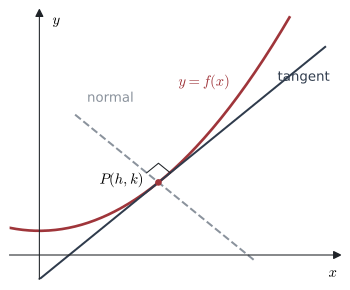
Equations of the tangent and the normal Not in the formula booklet
At the point \(P(h, k)\) on the curve \(y = f(x)\):
\[ \text{tangent:}\quad y - k = f'(h)\,(x - h) \qquad\qquad \text{normal:}\quad y - k = -\frac{1}{f'(h)}\,(x - h) \]
- \(h\): the \(x\)-coordinate of \(P\)
- \(k\): the \(y\)-coordinate of \(P\), \(k = f(h)\)
- \(f'(h)\): the gradient of the tangent at \(P\)
- \(-\dfrac{1}{f'(h)}\): the gradient of the normal at \(P\)
They come from \(y - y_1 = m(x - x_1)\), which is in the booklet.
Two special cases:
- if \(f'(h) = 0\), the tangent is horizontal (\(y = k\)) and the normal is vertical (\(x = h\));
- if the tangent is vertical, the normal is horizontal.
The method is always the same:
- find the \(y\)-coordinate of the point (if it is not given);
- find \(f'(x)\) and substitute \(x = h\) to get the gradient of the tangent;
- for the normal, take the negative reciprocal;
- use \(y - k = m(x - h)\).
Example 3 Find the equations of the tangent and the normal to the curve \(y = x^2 - 4x + 5\) at the point where \(x = 3\).
When \(x = 3\): \(y = 9 - 12 + 5 = 2\). The point is \((3, 2)\).
\(\frac{dy}{dx} = 2x - 4\), so the gradient of the tangent is \(2(3) - 4 = 2\).
Tangent: \(y - 2 = 2(x - 3)\), so \(y = 2x - 4\).
Normal: gradient \(-\frac{1}{2}\), so \(y - 2 = -\frac{1}{2}(x - 3)\), which gives \(y = -\frac{1}{2}x + \frac{7}{2}\), or \(x + 2y - 7 = 0\).
Example 4 The normal to the curve \(y = x^3 + ax\) at the point \(T(1, b)\) has gradient \(\frac{1}{2}\).
(a) Find the values of the constants \(a\) and \(b\).
(b) The tangent at \(T\) meets the \(x\)-axis at \(Q\). Find the coordinates of \(Q\).
(a) The normal has gradient \(\frac{1}{2}\), so the tangent has gradient \(-2\).
\(\frac{dy}{dx} = 3x^2 + a\). At \(x = 1\): \(3 + a = -2\), so \(a = -5\).
\(T\) is on the curve: \(b = 1^3 - 5(1) = -4\).
(b) Tangent at \(T(1, -4)\): \(y + 4 = -2(x - 1)\), so \(y = -2x - 2\).
On the \(x\)-axis \(y = 0\): \(-2x - 2 = 0\), so \(x = -1\). Hence \(Q(-1, 0)\).
A line \(y = mx + c\) is a tangent to a curve at \(x = h\) when two things are true: the line and the curve meet at \(x = h\), and they have the same gradient there. For a polynomial curve, the equation “curve \(=\) line” then has a repeated root at \(x = h\).
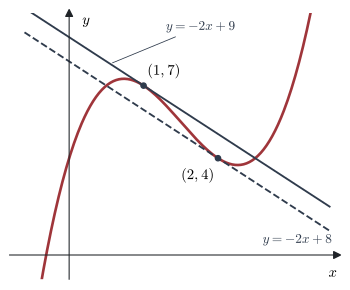
Example 5 Show that the line \(y = -2x + 9\) is a tangent to the curve \(y = 2x^3 - 9x^2 + 10x + 4\). Find the equation of the other tangent to the curve that is parallel to this line.
\(\frac{dy}{dx} = 6x^2 - 18x + 10\). The line has gradient \(-2\), so set
\[ 6x^2 - 18x + 10 = -2 \;\Rightarrow\; 6x^2 - 18x + 12 = 0 \;\Rightarrow\; x^2 - 3x + 2 = 0 \;\Rightarrow\; x = 1 \text{ or } x = 2 . \]
At \(x = 1\): \(y = 2 - 9 + 10 + 4 = 7\). The line gives \(y = -2(1) + 9 = 7\) too. So the line meets the curve at \((1, 7)\) with the same gradient: it is the tangent at \((1, 7)\).
(Check: \(2x^3 - 9x^2 + 10x + 4 = -2x + 9\) gives \(2x^3 - 9x^2 + 12x - 5 = (x - 1)^2(2x - 5) = 0\): a repeated root at \(x = 1\).)
At \(x = 2\): \(y = 16 - 36 + 20 + 4 = 4\). The other tangent with gradient \(-2\) is
\[ y - 4 = -2(x - 2) \quad\Rightarrow\quad y = -2x + 8 . \]
Gradient at a point (Calculator page): Menu → Calculus → Numerical Derivative at a Point. Enter the variable \(x\), the value (for example \(3\)) and the expression, for example \(x^2 - 4x + 5\). The result is \(2\).
Graphs page: draw \(f_1(x) = x^2 - 4x + 5\), then Menu → Analyze Graph → dy/dx, click on the curve and type the \(x\)-value. The gradient at that point is shown.
Use these to check an answer. On Paper 2 you still need to write the equation of the line yourself.
AHL 5.14 Tangents to curves given implicitly
For a curve such as \(x^2 + 2xy - y^2 = 7\) we cannot easily write \(y\) as a function of \(x\). We use implicit differentiation to find \(\frac{dy}{dx}\) in terms of both \(x\) and \(y\), then substitute the coordinates of the point.
Example 6 Find the equations of the tangents to the curve \(x^2 + 2xy - y^2 = 7\) at the points where \(y = 1\).
When \(y = 1\): \(x^2 + 2x - 1 = 7\), so \(x^2 + 2x - 8 = 0\), \((x + 4)(x - 2) = 0\). The points are \((2, 1)\) and \((-4, 1)\).
Differentiate:
\[ 2x + 2y + 2x\frac{dy}{dx} - 2y\frac{dy}{dx} = 0 \qquad\Rightarrow\qquad \frac{dy}{dx} = \frac{x + y}{y - x} . \]
At \((2, 1)\): \(\frac{dy}{dx} = \frac{3}{-1} = -3\). Tangent: \(y - 1 = -3(x - 2)\), so \(y = -3x + 7\).
At \((-4, 1)\): \(\frac{dy}{dx} = \frac{-3}{5} = -\frac{3}{5}\). Tangent: \(y - 1 = -\frac{3}{5}(x + 4)\), so \(3x + 5y + 7 = 0\).
For an implicit curve with \(\frac{dy}{dx} = \frac{N}{D}\):
- the tangent is horizontal (parallel to the \(x\)-axis) where \(N = 0\) (and \(D \neq 0\));
- the tangent is vertical (parallel to the \(y\)-axis) where \(D = 0\) (and \(N \neq 0\)).
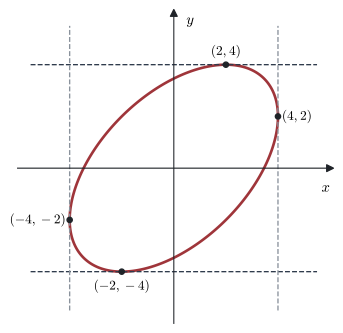
Example 7 For the curve \(x^2 - xy + y^2 = 12\), find \(\frac{dy}{dx}\) in terms of \(x\) and \(y\). Find the coordinates of each point on the curve at which the tangent is
(a) parallel to the \(x\)-axis, \(\qquad\) (b) parallel to the \(y\)-axis.
State the equations of these tangents.
\[ 2x - \left(y + x\frac{dy}{dx}\right) + 2y\frac{dy}{dx} = 0 \qquad\Rightarrow\qquad \frac{dy}{dx} = \frac{y - 2x}{2y - x} . \]
(a) Horizontal tangent: numerator \(= 0\), so \(y = 2x\). Substitute into the curve: \(x^2 - 2x^2 + 4x^2 = 3x^2 = 12\), so \(x = \pm 2\). The points are \((2, 4)\) and \((-2, -4)\). The tangents are \(y = 4\) and \(y = -4\).
(b) Vertical tangent: denominator \(= 0\), so \(x = 2y\). Substitute: \(4y^2 - 2y^2 + y^2 = 3y^2 = 12\), so \(y = \pm 2\). The points are \((4, 2)\) and \((-4, -2)\). The tangents are \(x = 4\) and \(x = -4\).
Common errors
| ✗ Wrong | ✓ Right | Why |
|---|---|---|
| Using \(f'(x)\) (with \(x\) in it) as the gradient of the tangent | Use the number \(f'(h)\) | The tangent is a straight line, so its gradient is a constant. |
| Normal gradient \(= \frac{1}{f'(h)}\) or \(-f'(h)\) | \(-\frac{1}{f'(h)}\) | The normal is perpendicular to the tangent: \(m_1 m_2 = -1\). |
| Using \(f(h)\) as the gradient | \(f(h)\) is the \(y\)-coordinate; \(f'(h)\) is the gradient | Do not mix up the point and the gradient. |
| Normal at a point where \(f'(h) = 0\) written as \(y = k\) | The normal is \(x = h\) | A horizontal tangent has a vertical normal. |
| Implicit curve: forgetting the \(\frac{dy}{dx}\) on terms with \(y\) | \(\frac{d}{dx}(y^3) = 3y^2\frac{dy}{dx}\) | This is the chain rule. |
Exercises
1 Find the gradient of the curve \(y = x^3 - 4x\) at the point where \(x = -1\).
\(\frac{dy}{dx} = 3x^2 - 4\). At \(x = -1\): \(3(1) - 4 = -1\).
2 Find the equations of the tangent and the normal to \(y = \sqrt{x}\) at the point where \(x = 4\).
Point: \((4, 2)\). \(\frac{dy}{dx} = \frac{1}{2\sqrt{x}}\), so the gradient at \(x = 4\) is \(\frac{1}{4}\).
Tangent: \(y - 2 = \frac{1}{4}(x - 4)\), so \(y = \frac{1}{4}x + 1\).
Normal: gradient \(-4\), so \(y - 2 = -4(x - 4)\), so \(y = -4x + 18\).
3 Find the coordinates of the point on the curve \(y = x^2 - 5x + 2\) at which the tangent is parallel to the line \(y = 3x - 1\).
Parallel means the same gradient: \(2x - 5 = 3\), so \(x = 4\). Then \(y = 16 - 20 + 2 = -2\). The point is \((4, -2)\).
4 (a) Show that the equation of the tangent to \(y = 3x^2 + 2\) at the point where \(x = a\) is \(y = 6ax - 3a^2 + 2\).
(b) Hence find the equations of the two tangents to the curve that pass through the point \((0, -1)\).
(a) The point is \((a, 3a^2 + 2)\) and the gradient is \(6a\). \(y - (3a^2 + 2) = 6a(x - a)\), so \(y = 6ax - 6a^2 + 3a^2 + 2 = 6ax - 3a^2 + 2\).
(b) Substitute \((0, -1)\): \(-1 = -3a^2 + 2\), so \(a^2 = 1\), \(a = \pm 1\).
\(a = 1\): \(y = 6x - 1\). \(\qquad\) \(a = -1\): \(y = -6x - 1\).
5 The normal to the curve \(y = x^2 - 2x\) at the point \(P(3, 3)\) meets the curve again at \(Q\). Find the coordinates of \(Q\).
\(\frac{dy}{dx} = 2x - 2 = 4\) at \(x = 3\), so the normal has gradient \(-\frac{1}{4}\):
\[ y - 3 = -\tfrac{1}{4}(x - 3) \quad\Rightarrow\quad y = -\tfrac{1}{4}x + \tfrac{15}{4} . \]
Solve with the curve: \(x^2 - 2x = -\frac{1}{4}x + \frac{15}{4}\), so \(4x^2 - 7x - 15 = 0\), \((x - 3)(4x + 5) = 0\).
\(x = 3\) is \(P\), so \(x = -\frac{5}{4}\) and \(y = \frac{25}{16} + \frac{5}{2} = \frac{65}{16}\). Hence \(Q\left(-\frac{5}{4}, \frac{65}{16}\right)\).
6 The curve \(y = ax^2 + bx\) passes through the point \((2, 2)\), and the gradient of the curve at this point is \(5\). Find \(a\) and \(b\).
Point: \(4a + 2b = 2\). Gradient: \(\frac{dy}{dx} = 2ax + b\), so \(4a + b = 5\).
Subtract: \(b = -3\), then \(4a = 8\), \(a = 2\).
7 The tangent and the normal to \(y = \mathrm{e}^{2x}\) at the point where \(x = 0\) meet the \(x\)-axis at \(A\) and \(B\). Find the area of the triangle formed by the tangent, the normal and the \(x\)-axis.
Point \((0, 1)\). \(\frac{dy}{dx} = 2\mathrm{e}^{2x} = 2\) at \(x = 0\).
Tangent: \(y = 2x + 1\), meets the \(x\)-axis at \(A\left(-\frac{1}{2}, 0\right)\). Normal: \(y = -\frac{1}{2}x + 1\), meets the \(x\)-axis at \(B(2, 0)\).
Base \(AB = \frac{5}{2}\), height \(1\) (the point \((0, 1)\)). Area \(= \frac{1}{2} \times \frac{5}{2} \times 1 = \frac{5}{4}\).
8 Show that the tangent to the curve \(y = \ln x\) at the point where \(x = \mathrm{e}\) passes through the origin.
Point \((\mathrm{e}, 1)\). \(\frac{dy}{dx} = \frac{1}{x} = \frac{1}{\mathrm{e}}\).
Tangent: \(y - 1 = \frac{1}{\mathrm{e}}(x - \mathrm{e})\), so \(y = \frac{x}{\mathrm{e}}\). When \(x = 0\), \(y = 0\), so the tangent passes through \(O\).
9 AHL The curve \(C\) has equation \(x^2y + xy^2 = -16\). Find the coordinates of the point on \(C\) at which the gradient is \(-1\), and show that there is only one such point.
\[ 2xy + x^2\frac{dy}{dx} + y^2 + 2xy\frac{dy}{dx} = 0 \qquad\Rightarrow\qquad \frac{dy}{dx} = -\frac{y(2x + y)}{x(x + 2y)} . \]
Set this equal to \(-1\): \(y(2x + y) = x(x + 2y)\), so \(2xy + y^2 = x^2 + 2xy\), so \(y^2 = x^2\), \(y = \pm x\).
- \(y = x\): \(x^3 + x^3 = -16\), so \(x^3 = -8\), \(x = -2\). Point \((-2, -2)\).
- \(y = -x\): \(-x^3 + x^3 = 0 \neq -16\). No point.
So \((-2, -2)\) is the only point (and there \(x(x + 2y) = 12 \neq 0\)).
10 AHL For the curve \(y^2 - 2xy + 3x^2 = 24\), find \(\frac{dy}{dx}\) in terms of \(x\) and \(y\). Hence find the coordinates of the points where the tangent is parallel to the \(x\)-axis, and the equations of these tangents.
\[ 2y\frac{dy}{dx} - 2y - 2x\frac{dy}{dx} + 6x = 0 \qquad\Rightarrow\qquad \frac{dy}{dx} = \frac{y - 3x}{y - x} . \]
Horizontal tangent: \(y = 3x\). Then \(9x^2 - 6x^2 + 3x^2 = 6x^2 = 24\), so \(x = \pm 2\).
Points \((2, 6)\) and \((-2, -6)\); tangents \(y = 6\) and \(y = -6\) (the denominator \(y - x = \pm 4 \neq 0\)).