23.1 Complex Numbers in Cartesian Form
AHL 1.12
- why we need a new number \(i\) with \(i^2 = -1\), and how to write square roots of negative numbers
- the Cartesian form \(z = x + iy\), and the real part and imaginary part of \(z\)
- how to add, subtract, multiply and divide complex numbers
- how to use the equality of complex numbers to find unknowns
- how to find the square roots of a complex number, and how to solve quadratic equations with complex roots
The number system
Every time mathematicians met a problem that their numbers could not solve, they invented new numbers. Negative numbers were needed to solve \(x + 5 = 2\). Fractions were needed to solve \(3x = 2\). Irrational numbers were needed to solve \(x^2 = 2\).
Now look at the equation
\[ x^2 = -1 . \]
For every real number \(x\) we have \(x^2 \geq 0\), so this equation has no real solution. To solve it we invent a new number, \(i\).
The imaginary unit Not in the formula booklet
\[ i^2 = -1, \qquad\text{so}\qquad i = \sqrt{-1} . \]
You must know it.
Now \(x^2 = -1\) has two solutions, \(x = \pm i\). We can write the square root of any negative number using \(i\). If \(a > 0\), then
\[ \sqrt{-a} = \sqrt{-1} \times \sqrt{a} = i\sqrt{a} . \]
For example, \(\sqrt{-25} = 5i\), \(\;\sqrt{-7} = i\sqrt{7}\) and \(\sqrt{-18} = i\sqrt{18} = 3\sqrt{2}\,i\).
The powers of \(i\) repeat in a cycle of four:
| \(i^1\) | \(i^2\) | \(i^3\) | \(i^4\) | \(i^5\) | \(i^6\) | \(i^7\) | \(i^8\) |
|---|---|---|---|---|---|---|---|
| \(i\) | \(-1\) | \(-i\) | \(1\) | \(i\) | \(-1\) | \(-i\) | \(1\) |
So to find \(i^n\), divide \(n\) by \(4\) and use the remainder. For example, \(i^{30} = i^{28} \times i^2 = 1 \times (-1) = -1\).
Cartesian form
A number like \(2 + \sqrt{-9} = 2 + 3i\) has a real part (\(2\)) and a part that is a real number times \(i\) (\(3i\)). These two parts can never be combined into one real number, so we keep them apart and write every such number as “real part \(+\) (real number)\(\times i\)”.
Cartesian form of a complex number In the HL formula booklet
\[ z = a + bi, \qquad a, b \in \mathbb{R} \]
In this book we usually write \(z = x + iy\) \((x, y \in \mathbb{R})\). \(x\) is the real part of \(z\), written \(\operatorname{Re}(z) = x\). \(y\) is the imaginary part of \(z\), written \(\operatorname{Im}(z) = y\).
- \(z\): a complex number
- \(a\): the real part of \(z\)
- \(b\): the imaginary part of \(z\)
- \(i\): the imaginary unit (\(i^2 = -1\))
The set of all complex numbers is \(\mathbb{C}\). Notice that the imaginary part is the real number \(y\), not \(iy\). For \(z = 4 - 9i\) we have \(\operatorname{Re}(z) = 4\) and \(\operatorname{Im}(z) = -9\).
- If \(y = 0\), then \(z = x\) is a real number, for example \(z = 6\) or \(z = -\frac{1}{2}\). So every real number is also a complex number: \(\mathbb{R} \subset \mathbb{C}\).
- If \(x = 0\) (and \(y \neq 0\)), then \(z = iy\) is a purely imaginary number, for example \(z = 3i\) or \(z = -8i\).
Addition and subtraction
Add or subtract the real parts and the imaginary parts separately, just like collecting like terms in algebra.
Addition and subtraction Not in the formula booklet
If \(z_1 = x_1 + iy_1\) and \(z_2 = x_2 + iy_2\), then
\[ z_1 + z_2 = (x_1 + x_2) + i(y_1 + y_2), \qquad z_1 - z_2 = (x_1 - x_2) + i(y_1 - y_2) . \]
- \(z_1, z_2\): two complex numbers
- \(x_1, x_2\): the real parts of \(z_1\) and \(z_2\)
- \(y_1, y_2\): the imaginary parts of \(z_1\) and \(z_2\)
- \(i\): the imaginary unit (\(i^2 = -1\))
Multiplying by a real number
If \(k \in \mathbb{R}\), then \(k(x + iy) = kx + iky\). For example, \(-3(2 - 5i) = -6 + 15i\).
Multiplication
Expand the brackets as usual, then replace \(i^2\) by \(-1\).
Multiplication Not in the formula booklet
\[ \begin{aligned} (x_1 + iy_1)(x_2 + iy_2) &= x_1x_2 + ix_1y_2 + ix_2y_1 + i^2y_1y_2 \\ &= (x_1x_2 - y_1y_2) + i(x_1y_2 + x_2y_1) \end{aligned} \]
- \(x_1, x_2\): the real parts of the two complex numbers
- \(i\): the imaginary unit (\(i^2 = -1\))
- \(y_1, y_2\): the imaginary parts of the two complex numbers
You do not need to learn this result. Just expand and use \(i^2 = -1\).
Division
To divide by \(x_2 + iy_2\), multiply the numerator and the denominator by \(x_2 - iy_2\). This number, with the sign of the imaginary part changed, is called the conjugate (see Section 23.2). It works because the denominator becomes real:
\[ (x_2 + iy_2)(x_2 - iy_2) = x_2^2 - i^2y_2^2 = x_2^2 + y_2^2 . \]
So
\[ \frac{x_1 + iy_1}{x_2 + iy_2} = \frac{(x_1 + iy_1)(x_2 - iy_2)}{(x_2 + iy_2)(x_2 - iy_2)} = \frac{x_1x_2 + y_1y_2}{x_2^2 + y_2^2} + i\,\frac{x_2y_1 - x_1y_2}{x_2^2 + y_2^2} . \]
When the denominator is purely imaginary (that is, \(x_2 = 0\)), it is quicker to multiply the top and bottom by \(i\):
\[ \frac{3 + 4i}{2i} = \frac{(3 + 4i) \times i}{2i \times i} = \frac{3i - 4}{-2} = 2 - \frac{3}{2}i . \]
Example 1 Write each complex number in the form \(x + iy\).
(a) \((4 - 2i) - (-3 + 5i)\)
(b) \((3 + 2i)(2 - 5i)\)
(c) \(\dfrac{7 + 4i}{2 - i}\)
(a) \((4 - 2i) - (-3 + 5i) = (4 + 3) + (-2 - 5)i = 7 - 7i\)
(b)
\[ (3 + 2i)(2 - 5i) = 6 - 15i + 4i - 10i^2 = 6 - 11i + 10 = 16 - 11i \]
(c) Multiply the top and bottom by \(2 + i\):
\[ \frac{7 + 4i}{2 - i} \times \frac{2 + i}{2 + i} = \frac{14 + 7i + 8i + 4i^2}{4 + 1} = \frac{10 + 15i}{5} = 2 + 3i \]
Equality of complex numbers
Equal complex numbers Not in the formula booklet
Two complex numbers are equal only if their real parts are equal and their imaginary parts are equal:
\[ x_1 + iy_1 = x_2 + iy_2 \quad\Longleftrightarrow\quad x_1 = x_2 \;\text{ and }\; y_1 = y_2 . \]
- \(x_1, x_2\): the real parts of the two complex numbers
- \(i\): the imaginary unit (\(i^2 = -1\))
- \(y_1, y_2\): the imaginary parts of the two complex numbers
So one equation between complex numbers gives two equations between real numbers. This is called equating real and imaginary parts. It only works when the letters stand for real numbers.
Example 2 Find the real numbers \(a\) and \(b\) such that
\[ \frac{a}{1 + i} + \frac{b}{1 - 2i} = 2 + i . \]
Make each denominator real:
\[ \frac{a}{1 + i} = \frac{a(1 - i)}{2} = \frac{a}{2} - \frac{a}{2}i, \qquad \frac{b}{1 - 2i} = \frac{b(1 + 2i)}{5} = \frac{b}{5} + \frac{2b}{5}i . \]
Equate real parts and imaginary parts:
\[ \text{Re: } \frac{a}{2} + \frac{b}{5} = 2 \qquad (1) \qquad\qquad \text{Im: } -\frac{a}{2} + \frac{2b}{5} = 1 \qquad (2) \]
\((1) + (2)\): \(\;\dfrac{3b}{5} = 3\), so \(b = 5\). Then \(\dfrac{a}{2} = 2 - 1 = 1\), so \(a = 2\).
Example 3 Solve the equation \(\dfrac{z}{z - 4} = 1 + 2i\), where \(z \neq 4\).
Multiply both sides by \(z - 4\) and collect the terms in \(z\):
\[ z = (1 + 2i)(z - 4) = (1 + 2i)z - 4 - 8i \;\Longrightarrow\; z - (1 + 2i)z = -4 - 8i \;\Longrightarrow\; -2i\,z = -4 - 8i . \]
The denominator is purely imaginary, so multiply the top and bottom by \(i\):
\[ z = \frac{-4 - 8i}{-2i} = \frac{2 + 4i}{i} = \frac{(2 + 4i)\,i}{i^2} = \frac{2i - 4}{-1} = 4 - 2i . \]
Check: \(z - 4 = -2i\) and \(\dfrac{4 - 2i}{-2i} = \dfrac{(4 - 2i)\,i}{2} = \dfrac{4i + 2}{2} = 1 + 2i\) ✓
Square roots of a complex number
To find the square roots of a complex number \(w\), let \(\sqrt{w} = a + ib\) with \(a, b \in \mathbb{R}\). Square it, and equate real and imaginary parts:
\[ (a + ib)^2 = (a^2 - b^2) + 2ab\,i . \]
Example 4 Find the square roots of \(-15 + 8i\).
Let \((a + ib)^2 = -15 + 8i\), where \(a, b \in \mathbb{R}\). Then
\[ a^2 - b^2 = -15 \qquad (1) \qquad\qquad 2ab = 8, \text{ so } b = \frac{4}{a} \qquad (2) \]
Substitute (2) into (1):
\[ a^2 - \frac{16}{a^2} = -15 \;\Longrightarrow\; a^4 + 15a^2 - 16 = 0 \;\Longrightarrow\; (a^2 + 16)(a^2 - 1) = 0 . \]
Since \(a\) is real, \(a^2 = 1\), so \(a = \pm 1\), and then \(b = \pm 4\) (same sign as \(a\)).
The square roots are \(1 + 4i\) and \(-1 - 4i\), that is \(\pm(1 + 4i)\).
Check: \((1 + 4i)^2 = 1 + 8i + 16i^2 = -15 + 8i\) ✓
A complex number \(w \neq 0\) always has two square roots, and one is the negative of the other.
Example 5 Find the complex numbers \(z\) and \(w\) that satisfy the simultaneous equations
\[ z + w = 5 + 4i, \qquad z - iw = 6 + i . \]
Subtract the second equation from the first to remove \(z\):
\[ w + iw = -1 + 3i \;\Longrightarrow\; w(1 + i) = -1 + 3i . \]
\[ w = \frac{-1 + 3i}{1 + i} \times \frac{1 - i}{1 - i} = \frac{-1 + i + 3i - 3i^2}{2} = \frac{2 + 4i}{2} = 1 + 2i \]
Then \(z = (5 + 4i) - (1 + 2i) = 4 + 2i\).
Quadratic equations with complex roots
When the discriminant \(\Delta = b^2 - 4ac\) is negative, the quadratic formula gives the square root of a negative number. Now we can write it with \(i\), so every quadratic equation has two roots in \(\mathbb{C}\).
Example 6 Without using a calculator, solve \(z^2 - 6z + 25 = 0\).
\(\Delta = 36 - 100 = -64 < 0\), so the roots are not real.
\[ z = \frac{6 \pm \sqrt{-64}}{2} = \frac{6 \pm 8i}{2} = 3 \pm 4i . \]
Or complete the square: \((z - 3)^2 + 16 = 0\), so \(z - 3 = \pm 4i\).
Notice that the two roots \(3 + 4i\) and \(3 - 4i\) differ only in the sign of the imaginary part. This is studied in Section 23.2.
On a Calculator page, type \(i\) from the π▸ key (choose \(i\) from the list). Do not type the letter i from the keyboard. Then enter the expression as usual, for example (7+4i)/(2-i), and the answer \(2 + 3i\) appears.
In Document Settings, Real or Complex is Real by default. In this setting a calculation such as \(\sqrt{-4}\) gives an error (non-real result). Change it to Rectangular to get answers in the form \(a + bi\) (here \(2i\)). The third choice, Polar, gives answers in polar form (see 23.3).
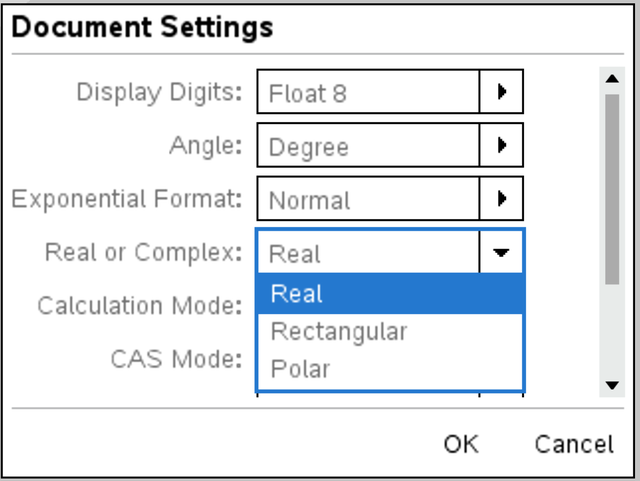
To solve \(z^2 - 6z + 25 = 0\): Menu → Algebra → Polynomial Tools → Find Roots of Polynomial, set Degree \(= 2\) and Roots \(=\) Complex, then enter the coefficients \(1, -6, 25\).
Common errors
| ✗ Wrong | ✓ Right | Why |
|---|---|---|
| \(\sqrt{-4} \times \sqrt{-9} = \sqrt{36} = 6\) | \(\sqrt{-4} \times \sqrt{-9} = 2i \times 3i = -6\) | \(\sqrt{a}\sqrt{b} = \sqrt{ab}\) is only true for \(a, b \geq 0\). Write each root with \(i\) first. |
| \(\operatorname{Im}(4 - 9i) = -9i\) | \(\operatorname{Im}(4 - 9i) = -9\) | The imaginary part is a real number. |
| \((3 + 2i)(2 - 5i) = 6 - 10i^2 = 16\) | \(16 - 11i\) | Multiply every term by every term. |
| \(\dfrac{7 + 4i}{2 - i} = \dfrac{7}{2} - 4i\) | Multiply top and bottom by \(2 + i\) | You cannot divide part by part. |
| \(i^2 = 1\) | \(i^2 = -1\) | This is the definition of \(i\). |
| Equating parts when \(a, b\) may be complex | Equate parts only for real unknowns | If \(z\) is unknown and complex, solve for \(z\) or put \(z = x + iy\) first. |
Exercises
1 Simplify
(a) \(\sqrt{-36}\)
(b) \(\sqrt{-20}\)
(c) \(i^7\)
(d) \(i^{22}\)
(a) \(6i\)
(b) \(i\sqrt{20} = 2\sqrt{5}\,i\)
(c) \(i^7 = i^4 \times i^3 = -i\)
(d) \(i^{22} = i^{20} \times i^2 = -1\)
2 Let \(z = 3 - 4i\) and \(w = -1 + 2i\). Find, in the form \(x + iy\),
(a) \(z + w\) \(\qquad\) (b) \(2z - 3w\) \(\qquad\) (c) \(zw\)
(a) \((3 - 1) + (-4 + 2)i = 2 - 2i\)
(b) \((6 - 8i) - (-3 + 6i) = 9 - 14i\)
(c) \((3 - 4i)(-1 + 2i) = -3 + 6i + 4i - 8i^2 = -3 + 10i + 8 = 5 + 10i\)
3 Expand and simplify
(a) \((2 + 5i)^2\) \(\qquad\) (b) \((1 - i)(1 + i)(2 + i)\)
(a) \(4 + 20i + 25i^2 = 4 + 20i - 25 = -21 + 20i\)
(b) \((1 - i)(1 + i) = 1 - i^2 = 2\), so the product is \(2(2 + i) = 4 + 2i\).
4 Write in the form \(x + iy\):
(a) \(\dfrac{3 + i}{1 - 2i}\) \(\qquad\) (b) \(\dfrac{4 - 6i}{2i}\)
(a) \(\dfrac{(3 + i)(1 + 2i)}{(1 - 2i)(1 + 2i)} = \dfrac{3 + 6i + i + 2i^2}{5} = \dfrac{1 + 7i}{5} = \dfrac{1}{5} + \dfrac{7}{5}i\)
(b) Multiply the top and bottom by \(i\): \(\dfrac{(4 - 6i)\,i}{2i^2} = \dfrac{4i + 6}{-2} = -3 - 2i\)
5 Find the real part and the imaginary part of \(\dfrac{1}{2 + 3i} + \dfrac{1}{2 - 3i}\).
Use a common denominator \((2 + 3i)(2 - 3i) = 4 + 9 = 13\):
\[ \frac{(2 - 3i) + (2 + 3i)}{13} = \frac{4}{13} . \]
The real part is \(\dfrac{4}{13}\) and the imaginary part is \(0\). (The sum is a real number.)
6 Find the real numbers \(x\) and \(y\) such that \((x + iy)(2 - i) = 8 + i\).
Expand: \((2x + y) + i(2y - x) = 8 + i\).
Equate parts: \(2x + y = 8\) and \(-x + 2y = 1\). From the second, \(x = 2y - 1\), so \(4y - 2 + y = 8\), \(y = 2\) and \(x = 3\).
(Or divide: \(x + iy = \dfrac{8 + i}{2 - i} = \dfrac{(8 + i)(2 + i)}{5} = \dfrac{15 + 10i}{5} = 3 + 2i\).)
7 Find the real numbers \(p\) and \(q\) such that \(\dfrac{p}{1 - i} + \dfrac{q}{2 + i} = 4 + i\).
\(\dfrac{p}{1 - i} = \dfrac{p(1 + i)}{2}\) and \(\dfrac{q}{2 + i} = \dfrac{q(2 - i)}{5}\).
\[ \text{Re: } \frac{p}{2} + \frac{2q}{5} = 4 \qquad\qquad \text{Im: } \frac{p}{2} - \frac{q}{5} = 1 \]
Subtract: \(\dfrac{3q}{5} = 3\), so \(q = 5\). Then \(\dfrac{p}{2} = 1 + 1 = 2\), so \(p = 4\).
8 Find the square roots of \(21 - 20i\).
Let \((a + ib)^2 = 21 - 20i\) with \(a, b \in \mathbb{R}\): \(\;a^2 - b^2 = 21\) and \(2ab = -20\), so \(b = -\dfrac{10}{a}\).
\[ a^2 - \frac{100}{a^2} = 21 \;\Longrightarrow\; a^4 - 21a^2 - 100 = 0 \;\Longrightarrow\; (a^2 - 25)(a^2 + 4) = 0 . \]
So \(a^2 = 25\), \(a = \pm 5\), \(b = \mp 2\). The square roots are \(\pm(5 - 2i)\).
Check: \((5 - 2i)^2 = 25 - 20i - 4 = 21 - 20i\) ✓
9 Solve, giving your answers in the form \(x + iy\):
(a) \(z^2 - 4z + 29 = 0\) \(\qquad\) (b) \(2z^2 + 2z + 5 = 0\)
(a) \(z = \dfrac{4 \pm \sqrt{16 - 116}}{2} = \dfrac{4 \pm \sqrt{-100}}{2} = \dfrac{4 \pm 10i}{2} = 2 \pm 5i\)
(b) \(z = \dfrac{-2 \pm \sqrt{4 - 40}}{4} = \dfrac{-2 \pm 6i}{4} = -\dfrac{1}{2} \pm \dfrac{3}{2}i\)
10 Solve the simultaneous equations \(2z + w = 7 + i\) and \(z - iw = 1 - 2i\).
From the first equation, \(w = 7 + i - 2z\). Substitute into the second:
\[ z - i(7 + i - 2z) = 1 - 2i \;\Longrightarrow\; z - 7i + 1 + 2iz = 1 - 2i \;\Longrightarrow\; z(1 + 2i) = 5i . \]
\[ z = \frac{5i}{1 + 2i} \times \frac{1 - 2i}{1 - 2i} = \frac{5i - 10i^2}{5} = 2 + i, \qquad w = 7 + i - 2(2 + i) = 3 - i . \]