14.12 Solving Trigonometric Equations
SL 3.8 AHL 3.11
- why a trigonometric equation usually has many solutions, and how a graph shows them
- the ASTC rule and a three-step method for \(\sin x = k\), \(\cos x = k\), \(\tan x = k\) in a given interval
- (AHL) the symmetry identities such as \(\sin(\pi - \theta) = \sin\theta\)
- how to solve equations with a multiple angle such as \(\sin 2x\), or a shifted angle
- how to solve equations that become quadratic in \(\sin x\), \(\cos x\) or \(\tan x\)
- how to solve harder equations graphically on the GDC
Many solutions
The trigonometric functions are periodic, so an equation like \(\cos x = \frac{1}{2}\) has infinitely many solutions. In IB questions the solutions are always asked for in a finite interval, for example \(0 \leq x \leq 2\pi\).
The solutions of \(\cos x = \frac{1}{2}\) are the \(x\)-coordinates of the points where the graph of \(y = \cos x\) meets the line \(y = \frac{1}{2}\). Figure 1 shows this for \(-2\pi \leq x \leq 3\pi\).
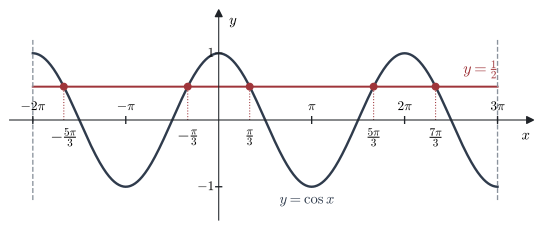
There are five points of intersection, so in this interval
\[ \cos\left(-\frac{5\pi}{3}\right) = \cos\left(-\frac{\pi}{3}\right) = \cos\frac{\pi}{3} = \cos\frac{5\pi}{3} = \cos\frac{7\pi}{3} = \frac{1}{2} . \]
The equation \(\cos x = \frac{1}{2}\) has five solutions for \(-2\pi \leq x \leq 3\pi\). The graph also shows the pattern: the solutions are \(\pm\frac{\pi}{3}\), and then we add or subtract \(2\pi\) (one period).
The ASTC rule
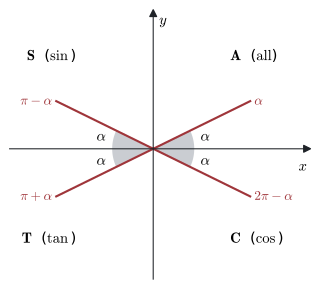
The signs of the trigonometric ratios in the four quadrants are summarised by the ASTC rule (“Add Sugar To Coffee”), which you met in Section 14.6:
- quadrant 1: All ratios are positive
- quadrant 2: only Sine is positive
- quadrant 3: only Tangent is positive
- quadrant 4: only Cosine is positive
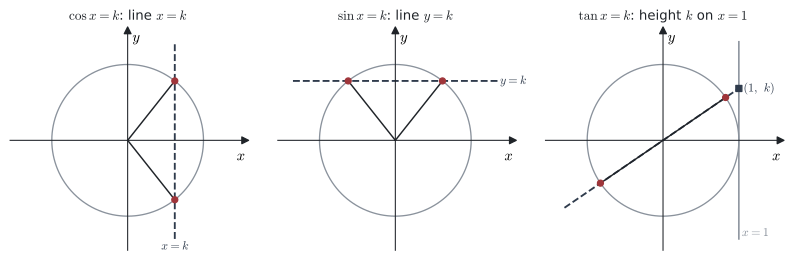
Recommended: draw the unit circle. Instead of only remembering ASTC, you can see the quadrants. On the unit circle, a point at angle \(x\) is \((\cos x, \sin x)\), and \(\tan x\) is the height where the radius, extended, meets the tangent line \(x = 1\) (Section 14.6).
- For \(\cos x = k\), draw the vertical line \(x = k\).
- For \(\sin x = k\), draw the horizontal line \(y = k\).
- For \(\tan x = k\), draw the tangent line \(x = 1\) and mark the point \((1, k)\) at height \(k\). Join it to the origin \(O\) and extend the line through \(O\).
The points where the line meets the circle show the quadrants of the solutions. Then find their angles from the reference angle \(\alpha\).
Solving \(\sin x = k\), \(\cos x = k\) or \(\tan x = k\) in an interval
Step 1. Find the reference angle \(\alpha\): the acute angle with \(\sin\alpha = |k|\) (or \(\cos\alpha = |k|\), \(\tan\alpha = |k|\)). \(\alpha\) does not depend on the quadrant.
Step 2. Draw the unit circle and the line \(x = k\), \(y = k\), or the line through \(O\) and \((1, k)\) (Figure 3), or use the sign of \(k\) and the ASTC rule, to decide which two quadrants \(x\) is in.
Step 3. Write the angles in those quadrants (Figure 2), then add or subtract \(2\pi\) (\(360^\circ\)) to find every solution in the given interval.
| Quadrant | 1 | 2 | 3 | 4 |
|---|---|---|---|---|
| Angle (radians) | \(\alpha\) | \(\pi - \alpha\) | \(\pi + \alpha\) | \(2\pi - \alpha\) |
| Angle (degrees) | \(\alpha\) | \(180^\circ - \alpha\) | \(180^\circ + \alpha\) | \(360^\circ - \alpha\) |
For example, for \(\sin x = k\) with \(0 \leq x \leq 2\pi\):
- if \(k > 0\), \(x\) is in quadrant 1 or 2: \(\;x = \alpha\) or \(x = \pi - \alpha\)
- if \(k < 0\), \(x\) is in quadrant 3 or 4: \(\;x = \pi + \alpha\) or \(x = 2\pi - \alpha\)
If \(k = 1\) or \(k = -1\), the line \(y = k\) only touches the curve, once in each cycle. If \(k = 0\), the solutions are where the curve crosses the \(x\)-axis. In these cases, read the solutions straight from the graph.
Symmetry identities
AHL The angles in the table give the symmetry properties of the graphs. They come from the unit circle: the point for \(\pi - \theta\) is the reflection of the point for \(\theta\) in the \(y\)-axis.
Symmetry identities Not in the formula booklet
| \(\sin\) | \(\cos\) | \(\tan\) | |
|---|---|---|---|
| \(\pi - \theta\) | \(\sin(\pi - \theta) = \sin\theta\) | \(\cos(\pi - \theta) = -\cos\theta\) | \(\tan(\pi - \theta) = -\tan\theta\) |
| \(\pi + \theta\) | \(\sin(\pi + \theta) = -\sin\theta\) | \(\cos(\pi + \theta) = -\cos\theta\) | \(\tan(\pi + \theta) = \tan\theta\) |
| \(-\theta\) | \(\sin(-\theta) = -\sin\theta\) | \(\cos(-\theta) = \cos\theta\) | \(\tan(-\theta) = -\tan\theta\) |
- \(\theta\): any angle (in radians; in degrees replace \(\pi\) by \(180^\circ\))
Example 1 AHL Given that \(\sin\dfrac{\pi}{5} = k\), write each expression in terms of \(k\).
(a) \(\sin\dfrac{4\pi}{5}\) \(\qquad\) (b) \(\sin\dfrac{6\pi}{5}\) \(\qquad\) (c) \(\sin\left(-\dfrac{\pi}{5}\right)\)
(d) \(\cos\dfrac{4\pi}{5}\) \(\qquad\) (e) \(\tan\dfrac{6\pi}{5}\)
(a) \(\sin\dfrac{4\pi}{5} = \sin\left(\pi - \dfrac{\pi}{5}\right) = \sin\dfrac{\pi}{5} = k\).
(b) \(\sin\dfrac{6\pi}{5} = \sin\left(\pi + \dfrac{\pi}{5}\right) = -\sin\dfrac{\pi}{5} = -k\).
(c) \(\sin\left(-\dfrac{\pi}{5}\right) = -\sin\dfrac{\pi}{5} = -k\).
(d) \(\dfrac{\pi}{5}\) is acute, so \(\cos\dfrac{\pi}{5} = +\sqrt{1 - k^2}\). Then \(\cos\dfrac{4\pi}{5} = -\cos\dfrac{\pi}{5} = -\sqrt{1 - k^2}\).
(e) \(\tan\dfrac{6\pi}{5} = \tan\dfrac{\pi}{5} = \dfrac{k}{\sqrt{1 - k^2}}\).
Solving equations analytically
Example 2 Solve each equation.
(a) \(\cos x = -0.5\), for \(0^\circ \leq x \leq 360^\circ\)
(b) \(\cos^2 x = \dfrac{3}{4}\), for \(0 \leq x \leq 2\pi\)
(c) \(\sqrt{3}\tan x = 1\), for \(-2\pi \leq x \leq \pi\)
(d) \(2\sin^2 x - \sin x - 1 = 0\), for \(0 \leq x \leq 2\pi\)
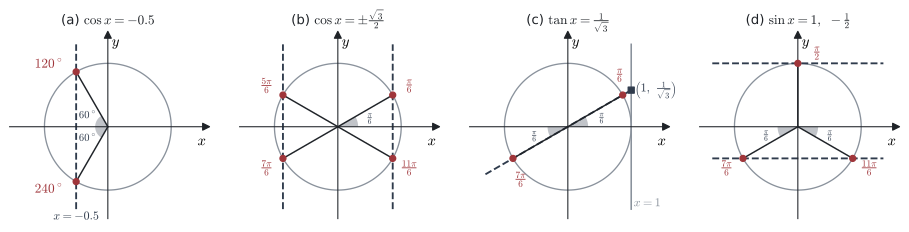
(a) Step 1: \(\cos\alpha = 0.5\), so \(\alpha = 60^\circ\). Step 2: the line \(x = -0.5\) meets the unit circle in quadrants 2 and 3. Step 3: \(x = 180^\circ - 60^\circ = 120^\circ\) or \(x = 180^\circ + 60^\circ = 240^\circ\).
(b) \(\cos x = \pm\dfrac{\sqrt{3}}{2}\), so \(\alpha = \dfrac{\pi}{6}\). The two lines \(x = \pm\dfrac{\sqrt{3}}{2}\) meet the unit circle in all four quadrants:
\[ x = \frac{\pi}{6}, \quad \frac{5\pi}{6}, \quad \frac{7\pi}{6}, \quad \frac{11\pi}{6} . \]
(c) \(\tan x = \dfrac{1}{\sqrt{3}}\), so \(\alpha = \dfrac{\pi}{6}\). The line through \(O\) and \(\left(1, \dfrac{1}{\sqrt{3}}\right)\) on the tangent line \(x = 1\) meets the unit circle in quadrants 1 and 3, so \(x = \dfrac{\pi}{6}\) or \(\dfrac{7\pi}{6}\) in \([0, 2\pi]\).
The interval is \(-2\pi \leq x \leq \pi\). Subtract \(2\pi\) to get the negative solutions:
\[ \frac{\pi}{6} - 2\pi = -\frac{11\pi}{6}, \qquad \frac{7\pi}{6} - 2\pi = -\frac{5\pi}{6} . \]
\(\dfrac{7\pi}{6} > \pi\) is outside the interval. So \(x = -\dfrac{11\pi}{6}, \; -\dfrac{5\pi}{6}, \; \dfrac{\pi}{6}\).
(d) This is a quadratic in \(\sin x\). Let \(s = \sin x\): \(\;2s^2 - s - 1 = 0\), so \((2s + 1)(s - 1) = 0\).
- \(\sin x = 1\): \(\;x = \dfrac{\pi}{2}\) (the line \(y = 1\) only touches the circle at the top).
- \(\sin x = -\dfrac{1}{2}\): \(\;\alpha = \dfrac{\pi}{6}\). The line \(y = -\dfrac{1}{2}\) meets the circle in quadrants 3 and 4: \(\;x = \dfrac{7\pi}{6}\) or \(\dfrac{11\pi}{6}\).
So \(x = \dfrac{\pi}{2}, \; \dfrac{7\pi}{6}, \; \dfrac{11\pi}{6}\).
Multiple and shifted angles
For an equation like \(\sin 2x = k\), first solve for the whole angle \(u = 2x\). If \(0 \leq x \leq 2\pi\), then \(0 \leq u \leq 4\pi\): the interval for \(u\) is twice as long, so there are twice as many solutions.
Equations of the form \(\sin\big(b(x - c)\big) = k\)
- Let \(u = b(x - c)\) and change the interval for \(x\) into an interval for \(u\).
- Find all the solutions for \(u\) in the new interval.
- Change each one back: \(x = \dfrac{u}{b} + c\).
Example 3 Solve
(a) \(2\sin 2x = \sqrt{3}\), for \(0 \leq x \leq 2\pi\)
(b) \(\sqrt{3}\tan\left(2\left(x - \dfrac{\pi}{6}\right)\right) = 3\), for \(0 \leq x \leq \pi\).
(a) Let \(u = 2x\), with \(0 \leq u \leq 4\pi\). \(\;\sin u = \dfrac{\sqrt{3}}{2}\), so \(\alpha = \dfrac{\pi}{3}\), quadrants 1 and 2:
\[ \begin{gathered} u = \frac{\pi}{3}, \qquad u = \frac{2\pi}{3}, \\ u = \frac{\pi}{3} + 2\pi = \frac{7\pi}{3}, \qquad u = \frac{2\pi}{3} + 2\pi = \frac{8\pi}{3} . \end{gathered} \]
Divide by \(2\): \(\;x = \dfrac{\pi}{6}, \; \dfrac{\pi}{3}, \; \dfrac{7\pi}{6}, \; \dfrac{4\pi}{3}\).
(b) \(\tan u = \dfrac{3}{\sqrt{3}} = \sqrt{3}\), where \(u = 2\left(x - \dfrac{\pi}{6}\right)\). For \(0 \leq x \leq \pi\): \(\;-\dfrac{\pi}{3} \leq u \leq \dfrac{5\pi}{3}\).
\(\alpha = \dfrac{\pi}{3}\) and \(\tan u > 0\) (quadrants 1 and 3): \(\;u = \dfrac{\pi}{3}\) or \(u = \dfrac{4\pi}{3}\). (\(u = \frac{\pi}{3} - \pi = -\frac{2\pi}{3}\) is outside the interval.)
Change back with \(x = \dfrac{u}{2} + \dfrac{\pi}{6}\): \(\;x = \dfrac{\pi}{3}\) or \(x = \dfrac{5\pi}{6}\).
Equations that need an identity
When an equation has two different ratios, use an identity to leave only one ratio:
- \(\sin x = k\cos x\): divide by \(\cos x\) to get \(\tan x = k\)
- \(\sin^2 x\) and \(\cos x\) together: replace \(\sin^2 x\) by \(1 - \cos^2 x\) (and the other way round)
- (AHL) \(\sec^2 x\) and \(\tan x\) together: replace \(\sec^2 x\) by \(1 + \tan^2 x\)
Never divide by \(\sin x\) or \(\cos x\) when it could be zero: factorise instead, or you lose solutions.
Example 4 Solve
(a) \(2\cos^2 x + 3\sin x - 3 = 0\), for \(0 \leq x \leq 2\pi\)
(b) \(\sin x = \sqrt{3}\cos x\), for \(0^\circ \leq x \leq 360^\circ\)
(c) \(2\sin x\cos x = \sin x\), for \(0 \leq x \leq 2\pi\)
(d) AHL Paper 2 \(\sec^2 x - 3\tan x + 1 = 0\), for \(0 \leq x \leq 2\pi\), giving answers to 3 significant figures
(a) Replace \(\cos^2 x\) by \(1 - \sin^2 x\):
\[ \begin{aligned} 2(1 - \sin^2 x) + 3\sin x - 3 &= 0 \\ 2\sin^2 x - 3\sin x + 1 &= 0 \\ (2\sin x - 1)(\sin x - 1) &= 0 . \end{aligned} \]
\(\sin x = \dfrac{1}{2}\): \(\;x = \dfrac{\pi}{6}\) or \(\dfrac{5\pi}{6}\). \(\quad\sin x = 1\): \(\;x = \dfrac{\pi}{2}\).
So \(x = \dfrac{\pi}{6}, \; \dfrac{\pi}{2}, \; \dfrac{5\pi}{6}\).
(b) If \(\cos x = 0\) then \(\sin x = \pm 1 \neq 0\), so \(\cos x \neq 0\) and we may divide by it: \(\;\tan x = \sqrt{3}\). \(\alpha = 60^\circ\), quadrants 1 and 3: \(\;x = 60^\circ\) or \(240^\circ\).
(c) Do not divide by \(\sin x\). Move everything to one side and factorise:
\[ 2\sin x\cos x - \sin x = 0 \;\Longrightarrow\; \sin x\,(2\cos x - 1) = 0 . \]
\(\sin x = 0\): \(\;x = 0, \pi, 2\pi\). \(\quad\cos x = \dfrac{1}{2}\): \(\;x = \dfrac{\pi}{3}, \dfrac{5\pi}{3}\).
So \(x = 0, \; \dfrac{\pi}{3}, \; \pi, \; \dfrac{5\pi}{3}, \; 2\pi\). (Dividing by \(\sin x\) would lose \(0\), \(\pi\) and \(2\pi\).)
(d) Replace \(\sec^2 x\) by \(1 + \tan^2 x\):
\[ \tan^2 x - 3\tan x + 2 = 0 \;\Longrightarrow\; (\tan x - 1)(\tan x - 2) = 0 . \]
\(\tan x = 1\): \(\;x = \dfrac{\pi}{4}\) or \(\dfrac{5\pi}{4}\). \(\quad\tan x = 2\): \(\;\alpha = \arctan 2 = 1.107\ldots\), quadrants 1 and 3: \(\;x = 1.107\) or \(\pi + 1.107 = 4.249\).
So \(x = 0.785, \; 1.11, \; 3.93, \; 4.25\).
Solving equations graphically
Some equations cannot be solved by algebra, for example when \(x\) appears both inside and outside a trigonometric function. Then we solve them graphically, on the GDC (Paper 2).
Example 5 Paper 2 Solve \(3\cos 2x = x - 1\) for \(0 \leq x \leq \pi\). Give your answers to 3 significant figures.
Graph \(y = 3\cos 2x\) and \(y = x - 1\) for \(0 \leq x \leq \pi\) and find the intersections (see the steps below). There are two: \(\;x = 0.816\) or \(x = 2.65\).
- Open a Graphs page. Check that RAD is shown at the top right (click on it to switch).
- Enter \(f_1(x) = 3\cos(2x)\) and \(f_2(x) = x - 1\).
- Menu → Window / Zoom → Window Settings: \(x\) from \(0\) to \(\pi\), \(y\) from \(-4\) to \(4\).
- Menu → Analyze Graph → Intersection.
- Click to the left of an intersection (lower bound), then to the right of it (upper bound). Read the \(x\)-coordinate.
- Repeat steps 4 and 5 for each intersection.
The window must show the whole interval and nothing more, so that you see every solution and no extra ones. You can also use this method to check your answers to an analytic question.
Common errors
| ✗ Wrong | ✓ Right | Why |
|---|---|---|
| Only one answer, \(x = \arcsin k\) | All the solutions in the interval | The calculator gives one angle; the ASTC rule and the period give the others. |
| \(\cos^2 x = \frac{3}{4} \Rightarrow \cos x = \frac{\sqrt{3}}{2}\) | \(\cos x = \pm\frac{\sqrt{3}}{2}\) | A square root has two signs: four solutions, not two. |
| \(\sin 2x = k\): solve for \(x\) in \([0, 2\pi]\), then halve | Solve for \(2x\) in \([0, 4\pi]\) | Change the interval first, or you lose half of the solutions. |
| Divide \(2\sin x\cos x = \sin x\) by \(\sin x\) | Factorise: \(\sin x(2\cos x - 1) = 0\) | Dividing loses the solutions of \(\sin x = 0\). |
| \(\sin x = 2\) gives \(x = \arcsin 2\) | No solution | \(-1 \leq \sin x \leq 1\) for every \(x\). |
| Degree answers for a radian interval | Match the interval | \(0 \leq x \leq 2\pi\) needs radians; \(0^\circ \leq x \leq 360^\circ\) needs degrees. |
Exercises
1 Solve
(a) \(2\sin x = -\sqrt{2}\), for \(0 \leq x \leq 2\pi\)
(b) \(\tan x = -1\), for \(0^\circ \leq x \leq 360^\circ\).
(a) \(\sin x = -\dfrac{\sqrt{2}}{2}\), \(\alpha = \dfrac{\pi}{4}\), quadrants 3 and 4: \(\;x = \dfrac{5\pi}{4}, \; \dfrac{7\pi}{4}\).
(b) \(\alpha = 45^\circ\), \(\tan x < 0\): quadrants 2 and 4: \(\;x = 135^\circ, \; 315^\circ\).
2 Solve \(\cos x = \dfrac{\sqrt{3}}{2}\) for \(-\pi \leq x \leq 3\pi\).
\(\alpha = \dfrac{\pi}{6}\), quadrants 1 and 4: \(\;\dfrac{\pi}{6}\) and \(\dfrac{11\pi}{6}\) in \([0, 2\pi]\). Add or subtract \(2\pi\): \(\;-\dfrac{\pi}{6}\) and \(\dfrac{13\pi}{6}\) are also in the interval.
\[ x = -\frac{\pi}{6}, \quad \frac{\pi}{6}, \quad \frac{11\pi}{6}, \quad \frac{13\pi}{6} . \]
3 Solve \(4\sin^2 x = 3\) for \(0 \leq x \leq 2\pi\).
\(\sin x = \pm\dfrac{\sqrt{3}}{2}\), \(\alpha = \dfrac{\pi}{3}\), all four quadrants: \(\;x = \dfrac{\pi}{3}, \; \dfrac{2\pi}{3}, \; \dfrac{4\pi}{3}, \; \dfrac{5\pi}{3}\).
4 Solve \(2\cos 2x = 1\) for \(0 \leq x \leq 2\pi\).
Let \(u = 2x\), \(0 \leq u \leq 4\pi\). \(\cos u = \dfrac{1}{2}\): \(\;u = \dfrac{\pi}{3}, \; \dfrac{5\pi}{3}, \; \dfrac{7\pi}{3}, \; \dfrac{11\pi}{3}\).
So \(x = \dfrac{\pi}{6}, \; \dfrac{5\pi}{6}, \; \dfrac{7\pi}{6}, \; \dfrac{11\pi}{6}\).
5 Solve \(\sin\left(x + \dfrac{\pi}{3}\right) = \dfrac{1}{2}\) for \(0 \leq x \leq 2\pi\).
Let \(u = x + \dfrac{\pi}{3}\), so \(\dfrac{\pi}{3} \leq u \leq \dfrac{7\pi}{3}\). \(\sin u = \dfrac{1}{2}\) gives \(u = \dfrac{\pi}{6}, \dfrac{5\pi}{6}, \dfrac{13\pi}{6}, \ldots\)
In the interval: \(u = \dfrac{5\pi}{6}\) or \(\dfrac{13\pi}{6}\). So \(x = u - \dfrac{\pi}{3} = \dfrac{\pi}{2}\) or \(\dfrac{11\pi}{6}\).
6 Solve \(2\cos^2 x - \cos x - 1 = 0\) for \(0 \leq x \leq 2\pi\).
\((2\cos x + 1)(\cos x - 1) = 0\).
\(\cos x = 1\): \(\;x = 0, \; 2\pi\). \(\quad\cos x = -\dfrac{1}{2}\): \(\;x = \dfrac{2\pi}{3}, \; \dfrac{4\pi}{3}\).
So \(x = 0, \; \dfrac{2\pi}{3}, \; \dfrac{4\pi}{3}, \; 2\pi\).
7 Solve \(2\sin^2 x = 3\cos x\) for \(0^\circ \leq x \leq 360^\circ\).
\(2(1 - \cos^2 x) = 3\cos x \Rightarrow 2\cos^2 x + 3\cos x - 2 = 0 \Rightarrow (2\cos x - 1)(\cos x + 2) = 0\).
\(\cos x = -2\) has no solution. \(\cos x = \dfrac{1}{2}\): \(\;x = 60^\circ, \; 300^\circ\).
8 Solve \(\sqrt{3}\sin x = \cos x\) for \(-\pi \leq x \leq \pi\).
\(\cos x = 0\) would give \(\sin x = 0\) too, which is impossible, so divide by \(\cos x\): \(\;\tan x = \dfrac{1}{\sqrt{3}}\).
\(\alpha = \dfrac{\pi}{6}\), quadrants 1 and 3: \(\;x = \dfrac{\pi}{6}\) or \(\dfrac{\pi}{6} - \pi = -\dfrac{5\pi}{6}\).
9 AHL Solve \(\operatorname{cosec}^2 x - 2\cot x = 0\) for \(0 < x < 2\pi\).
Replace \(\operatorname{cosec}^2 x\) by \(1 + \cot^2 x\):
\[ \cot^2 x - 2\cot x + 1 = 0 \;\Longrightarrow\; (\cot x - 1)^2 = 0 \;\Longrightarrow\; \cot x = 1 . \]
So \(\tan x = 1\): \(\;x = \dfrac{\pi}{4}, \; \dfrac{5\pi}{4}\).
10 Paper 2 Solve \(5\sin x = 2\) for \(0 \leq x \leq 3\pi\). Give your answers to 3 significant figures.
\(\sin x = 0.4\), so \(\alpha = \arcsin 0.4 = 0.4115\ldots\) Quadrants 1 and 2, then add \(2\pi\):
\[ \begin{gathered} x = 0.4115, \qquad \pi - 0.4115 = 2.730, \\ 2\pi + 0.4115 = 6.695, \qquad 3\pi - 0.4115 = 9.013 . \end{gathered} \]
(\(3\pi = 9.42\), so all four are in the interval.) \(\;x = 0.412, \; 2.73, \; 6.69, \; 9.01\).