11.5 Modulus Inequalities and Graphical Methods
AHL 2.15 AHL 2.16
- the basic rules for \(|x| < a\) and \(|x| > a\)
- how to use one solved inequality to solve related inequalities with \(|x|\) or a substitution
- how to solve \(|f(x)| \leq |g(x)|\) by squaring, including inequalities with a quotient such as \(\left|\dfrac{f(x)}{g(x)}\right| < k\)
- how to solve other modulus inequalities by cases
- how to solve \(g(x) \geq f(x)\) by sketching both graphs and finding where they cross
- how to use a GDC when the intersection points cannot be found by hand, and how to take care of the domain
Inequalities involving modulus functions
The modulus \(|x|\) is the distance of \(x\) from \(0\) on the number line (see Section 10.3). So \(|x| < 3\) means “\(x\) is less than \(3\) away from \(0\)”, that is \(-3 < x < 3\).
Modulus inequalities (for a constant \(a > 0\)) Not in the formula booklet
- \(|x| < a \iff -a < x < a\) \(\qquad\qquad\) \(|x| \leq a \iff -a \leq x \leq a\)
- \(|x| > a \iff x < -a \;\text{ or }\; x > a\) \(\qquad\) \(|x| \geq a \iff x \leq -a \;\text{ or }\; x \geq a\)
The same rules work with any expression in place of \(x\), for example \(|2x - 1| < 5 \iff -5 < 2x - 1 < 5\).
Sometimes one inequality has already been solved, and a second inequality is the same one with \(x\) replaced by \(|x|\) or by \(kx\). Then you do not need to start again.
Example 1 Solve the inequality \(x(x + 2)(x - 3) \geq 2x(x - 1)\). Hence deduce the solution of
(a) \(|x|\,(|x| + 2)(|x| - 3) \geq 2|x|\,(|x| - 1)\);
(b) \(x(x + 4)(x - 6) \geq 4x(x - 2)\).
Do not divide by \(x\). Move everything to one side and take out the common factor \(x\):
\[ x\big[(x + 2)(x - 3) - 2(x - 1)\big] \geq 0 \;\Longrightarrow\; x(x^2 - 3x - 4) \geq 0 \;\Longrightarrow\; x(x + 1)(x - 4) \geq 0 . \]
Critical values \(-1, 0, 4\). A positive cubic is \(\geq 0\) between the two smaller roots and after the largest root:
\[ -1 \leq x \leq 0 \quad\text{or}\quad x \geq 4 . \]
(a) This is the same inequality with \(x\) replaced by \(|x|\). So
\[ -1 \leq |x| \leq 0 \quad\text{or}\quad |x| \geq 4 . \]
\(|x|\) is never negative, so \(-1 \leq |x| \leq 0\) means \(|x| = 0\), that is \(x = 0\). And \(|x| \geq 4\) means \(x \leq -4\) or \(x \geq 4\). The solution is
\[ x \leq -4 \quad\text{or}\quad x = 0 \quad\text{or}\quad x \geq 4 . \]
(b) Put \(x = 2u\). Then
\[ \begin{aligned} x(x + 4)(x - 6) &= 2u \cdot 2(u + 2) \cdot 2(u - 3) = 8\,u(u + 2)(u - 3), \\ 4x(x - 2) &= 8u \cdot 2(u - 1) = 8 \cdot 2u(u - 1) . \end{aligned} \]
Dividing by \(8\) (positive) gives the original inequality in \(u\). So \(-1 \leq u \leq 0\) or \(u \geq 4\), and with \(u = \dfrac{x}{2}\):
\[ -2 \leq x \leq 0 \quad\text{or}\quad x \geq 8 . \]
When both sides are moduli, square them. Both sides are \(\geq 0\), so squaring keeps the inequality true.
Modulus on both sides Not in the formula booklet
\[ |f(x)| \leq |g(x)| \iff \big(f(x)\big)^2 \leq \big(g(x)\big)^2 \iff \big(f(x) - g(x)\big)\big(f(x) + g(x)\big) \leq 0 \]
The last step uses the difference of two squares, so you do not need to expand.
Example 2 Without using a calculator, solve \(|2x - 3| \leq |x + 1|\). Hence solve \(|2\ln x - 3| \leq |\ln x + 1|\).
Both sides are non-negative, so square:
\[ \begin{aligned} &(2x - 3)^2 - (x + 1)^2 \leq 0 \\ \Longrightarrow\;& \big[(2x - 3) - (x + 1)\big]\big[(2x - 3) + (x + 1)\big] \leq 0 \\ \Longrightarrow\;& (x - 4)(3x - 2) \leq 0 . \end{aligned} \]
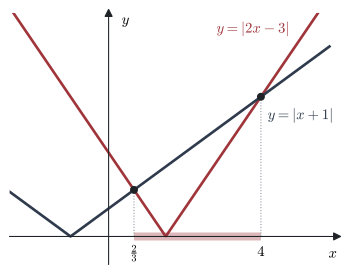
The critical values are \(\dfrac{2}{3}\) and \(4\), and the quadratic is \(\leq 0\) between them:
\[ \frac{2}{3} \leq x \leq 4 . \]
Figure 1 confirms this: the graph of \(y = |2x - 3|\) is on or below \(y = |x + 1|\) between the two crossing points.
Hence. Replace \(x\) by \(\ln x\): \(\;\dfrac{2}{3} \leq \ln x \leq 4\), so
\[ \mathrm{e}^{2/3} \leq x \leq \mathrm{e}^{4} . \]
A quotient inside a modulus can be split, because \(\left|\dfrac{f(x)}{g(x)}\right| = \dfrac{|f(x)|}{|g(x)|}\). Then multiply by the positive number \(|g(x)|\) and square.
Example 3 Solve \(\left|\dfrac{x + 1}{x - 2}\right| < \dfrac{1}{2}\).
\(x \neq 2\). Write the left side as \(\dfrac{|x + 1|}{|x - 2|}\) and multiply by \(2|x - 2| > 0\):
\[ 2|x + 1| < |x - 2| . \]
Both sides are non-negative, so square:
\[ \begin{aligned} 4(x + 1)^2 &< (x - 2)^2 \\ 4x^2 + 8x + 4 &< x^2 - 4x + 4 \\ 3x^2 + 12x &< 0 . \end{aligned} \]
So \(3x(x + 4) < 0\), which gives \(-4 < x < 0\). (This interval does not contain the excluded value \(x = 2\).)
If only one side is a modulus, you cannot simply square (the other side may be negative). Split into cases instead.
Example 4 Solve \(|x - 2| < 2x + 1\).
Case 1: \(x \geq 2\). Then \(|x - 2| = x - 2\): \(\;x - 2 < 2x + 1 \Rightarrow x > -3\). Together with \(x \geq 2\): \(\;x \geq 2\).
Case 2: \(x < 2\). Then \(|x - 2| = 2 - x\): \(\;2 - x < 2x + 1 \Rightarrow 3x > 1 \Rightarrow x > \dfrac{1}{3}\). Together with \(x < 2\): \(\;\dfrac{1}{3} < x < 2\).
Join the two cases:
\[ x > \frac{1}{3} . \]
(Check: \(x = 0\) gives \(2 < 1\), false ✓; \(x = 1\) gives \(1 < 3\), true ✓.)
Solving inequalities by sketching graphs
Some inequalities mix moduli, polynomials, exponentials or logarithms. These are often hard or impossible to solve by algebra alone. A graph helps.
Solving \(g(x) \geq f(x)\) graphically
- Sketch \(y = g(x)\) and \(y = f(x)\) on the same axes.
- Find the \(x\)-coordinates of the intersection points. These are the critical values. Find them by algebra if you can, otherwise with a GDC.
- The solution is where the graph of \(y = g(x)\) is on or above the graph of \(y = f(x)\).
- Exclude any \(x\) where a function is undefined (for example a vertical asymptote).
Methods for solving inequalities are not in the formula booklet.
Sometimes the inequality must first be rearranged (or multiplied by a constant) to match the given graphs.
Example 5 By considering the graphs of \(y = 3|x + 2|\) and \(y = \dfrac{1}{2}x^3 + \dfrac{3}{2}x^2 - 8x - 6\) on the same diagram, find the set of values of \(x\) that satisfies
\[ |x + 2| \leq \frac{1}{6}x^3 + \frac{1}{2}x^2 - \frac{8}{3}x - 2 . \]
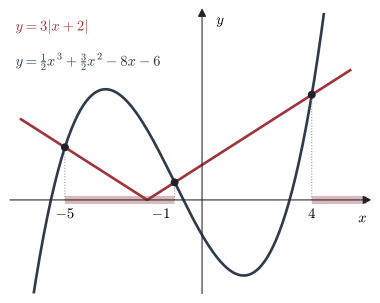
Multiply both sides by \(3\): the inequality is \(\;3|x + 2| \leq \dfrac{1}{2}x^3 + \dfrac{3}{2}x^2 - 8x - 6\). So we need the cubic to be on or above the V-shaped graph (Figure 2).
Find the intersections by algebra, one branch of the modulus at a time.
Right branch, \(x \geq -2\): \(\;\dfrac{1}{2}x^3 + \dfrac{3}{2}x^2 - 8x - 6 = 3x + 6\). Multiply by \(2\):
\[ x^3 + 3x^2 - 22x - 24 = 0 \;\Longrightarrow\; (x + 1)(x^2 + 2x - 24) = 0 \;\Longrightarrow\; (x + 1)(x - 4)(x + 6) = 0 . \]
Only \(x = -1\) and \(x = 4\) satisfy \(x \geq -2\).
Left branch, \(x < -2\): \(\;\dfrac{1}{2}x^3 + \dfrac{3}{2}x^2 - 8x - 6 = -3x - 6\). Multiply by \(2\):
\[ x^3 + 3x^2 - 10x = 0 \;\Longrightarrow\; x(x + 5)(x - 2) = 0 . \]
Only \(x = -5\) satisfies \(x < -2\).
From the graph, the cubic is on or above the V between \(x = -5\) and \(x = -1\), and again from \(x = 4\):
\[ -5 \leq x \leq -1 \quad\text{or}\quad x \geq 4 . \]
Example 6 (a) Sketch the graph of \(y = x + 1 - \dfrac{2}{x + 2}\). Show the axis intercepts and the equations of the asymptotes.
(b) By adding a suitable graph to your sketch, find the set of values of \(x\) that satisfies \(\;x + 2 - \mathrm{e}^x \geq \dfrac{2}{x + 2}\).
(c) Hence find the set of values of \(x\) for which \(\;|x| + 2 - \mathrm{e}^{|x|} \geq \dfrac{2}{|x| + 2}\).
(a) Vertical asymptote \(x = -2\). As \(x \to \pm\infty\), \(\dfrac{2}{x + 2} \to 0\), so the oblique asymptote is \(y = x + 1\) (see Section 10.2).
\(y\)-intercept: \(x = 0\) gives \(y = 1 - 1 = 0\). \(x\)-intercepts: \(x + 1 = \dfrac{2}{x + 2} \Rightarrow (x + 1)(x + 2) = 2 \Rightarrow x^2 + 3x = 0\), so \(x = 0\) or \(x = -3\). The graph passes through \((-3, 0)\) and \((0, 0)\).
(b) Rearrange so that the left side is the function from (a):
\[ x + 2 - \mathrm{e}^x \geq \frac{2}{x + 2} \iff x + 1 - \frac{2}{x + 2} \geq \mathrm{e}^x - 1 . \]
So add the graph of \(y = \mathrm{e}^x - 1\) (Figure 3). It passes through \((0, 0)\), so \(x = 0\) is one intersection. The GDC gives the other two: \(x \approx -3.40\) and \(x \approx 0.616\).
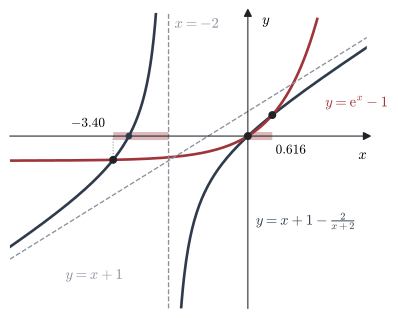
The rational graph is on or above the exponential graph for
\[ -3.40 \leq x < -2 \quad\text{or}\quad 0 \leq x \leq 0.616 \qquad (3 \text{ s.f.}). \]
\(x = -2\) is excluded because the function is not defined there.
(c) This is the inequality in (b) with \(x\) replaced by \(|x|\). Since \(|x| \geq 0\), only the interval \(0 \leq |x| \leq 0.616\) can be used:
\[ -0.616 \leq x \leq 0.616 . \]
Example 7 Use a GDC to solve \(\;6|x| - \mathrm{e}^{|x|} \geq \ln(x^2 - 1)\).
First the domain: \(\ln(x^2 - 1)\) needs \(x^2 - 1 > 0\), so \(|x| > 1\).
Move everything to one side and draw \(y = 6|x| - \mathrm{e}^{|x|} - \ln(x^2 - 1)\) (Figure 4). We need the parts of the graph on or above the \(x\)-axis. The function is even (it only depends on \(|x|\) and \(x^2\)), so the graph is symmetric about the \(y\)-axis.
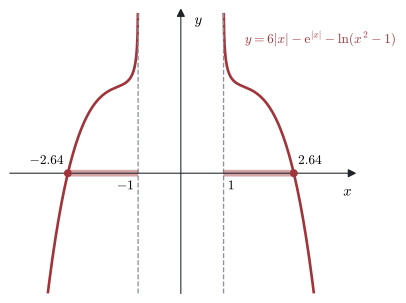
The GDC (Zero) gives \(x = \pm 2.64\) (3 s.f.). As \(x \to 1^+\), \(\ln(x^2 - 1) \to -\infty\), so the graph goes up near \(x = \pm 1\). The solution is
\[ -2.64 \leq x < -1 \quad\text{or}\quad 1 < x \leq 2.64 . \]
The GDC does not draw the graph where the function is undefined, but you must state the domain in your answer.
For Example 6, on a Graphs page:
- Enter \(f_1(x) = x + 1 - \dfrac{2}{x + 2}\).
- Enter \(f_2(x) = \mathrm{e}^x - 1\).
- Press Menu → Analyze Graph → Intersection.
- Select a lower bound and an upper bound around one crossing point.
- Repeat step 3 and step 4 for each crossing point. Some crossings are close together (here \(0\) and \(0.616\)), so zoom in to be sure you have found them all.
- Decide from the graph which intervals satisfy the inequality, and remove any vertical asymptotes.
Another way: on a Calculator page, type nSolve(f1(x)=f2(x),x,-4,-3) with a search interval.
When the inequality is written as (expression) \(\geq 0\), as in Example 7, graph the expression and use Menu → Analyze Graph → Zero instead.
Common errors
| ✗ Wrong | ✓ Right | Why |
|---|---|---|
| \(\lvert x\rvert > 3 \Rightarrow x > \pm 3\) | \(x < -3\) or \(x > 3\) | “\(x > \pm 3\)” has no clear meaning; write two inequalities. |
| \(\lvert 2x - 1\rvert \geq 5 \Rightarrow -5 \leq 2x - 1 \leq 5\) | \(2x - 1 \leq -5\) or \(2x - 1 \geq 5\) | “\(\geq\)” means outside the interval. |
| Squaring \(\lvert x - 2\rvert < 2x + 1\) | Use cases | \(2x + 1\) may be negative, and squaring is only safe when both sides are \(\geq 0\). |
| \(-1 \leq \lvert x\rvert \leq 0\) has no solution | It gives \(x = 0\) | \(\lvert x\rvert = 0\) is allowed, so \(x = 0\) is a solution. |
| Dividing \(x(x + 2)(x - 3) \geq 2x(x - 1)\) by \(x\) | Take \(x\) out as a common factor | \(x\) may be negative or zero. |
| Including \(x = -2\) in Example 6 | \(-3.40 \leq x < -2\) | The function is undefined on a vertical asymptote. |
| Forgetting the domain in Example 7 | State \(\lvert x\rvert > 1\) | The GDC hides undefined parts; you must say so. |
| Giving GDC answers to 1 or 2 s.f. | 3 s.f. (e.g. \(0.616\)) | IB answers must be exact or correct to 3 significant figures. |
Exercises
1 Solve \(|2x - 5| < 3\).
\(-3 < 2x - 5 < 3 \Rightarrow 2 < 2x < 8 \Rightarrow 1 < x < 4\).
2 Solve \(|3x + 1| \geq 5\).
\(3x + 1 \leq -5\) or \(3x + 1 \geq 5\), so
\[ x \leq -2 \quad\text{or}\quad x \geq \frac{4}{3} . \]
3 Solve \(|x - 4| \leq |x + 2|\).
Square: \((x - 4)^2 \leq (x + 2)^2 \Rightarrow x^2 - 8x + 16 \leq x^2 + 4x + 4 \Rightarrow 12 \leq 12x\), so \(x \geq 1\).
(Geometrically: \(x\) is at least as close to \(4\) as to \(-2\), and the midpoint is \(1\).)
4 Solve \(|2x + 1| > |x - 3|\).
\[ \begin{aligned} &(2x + 1)^2 - (x - 3)^2 > 0 \\ \Longrightarrow\;& \big[(2x + 1) - (x - 3)\big]\big[(2x + 1) + (x - 3)\big] > 0 \\ \Longrightarrow\;& (x + 4)(3x - 2) > 0 . \end{aligned} \]
\[ x < -4 \quad\text{or}\quad x > \frac{2}{3} . \]
5 Solve \(|x - 1| < 3x - 5\).
\(x \geq 1\): \(x - 1 < 3x - 5 \Rightarrow x > 2\). So \(x > 2\).
\(x < 1\): \(1 - x < 3x - 5 \Rightarrow x > \frac{3}{2}\). This contradicts \(x < 1\): no solution.
Answer: \(x > 2\).
6 Solve \(|x^2 - 5| < 4\).
\(-4 < x^2 - 5 < 4 \Rightarrow 1 < x^2 < 9\). So \(1 < |x| < 3\):
\[ -3 < x < -1 \quad\text{or}\quad 1 < x < 3 . \]
7 (a) Solve \(|3x - 2| \geq |x + 2|\).
(b) Hence solve \(|3\mathrm{e}^x - 2| \geq \mathrm{e}^x + 2\).
(a) \((3x - 2)^2 - (x + 2)^2 \geq 0 \Rightarrow (2x - 4)(4x) \geq 0 \Rightarrow 8x(x - 2) \geq 0\), so \(x \leq 0\) or \(x \geq 2\).
(b) \(\mathrm{e}^x + 2 > 0\), so \(\mathrm{e}^x + 2 = |\mathrm{e}^x + 2|\). This is (a) with \(x\) replaced by \(\mathrm{e}^x\): \(\mathrm{e}^x \leq 0\) (impossible) or \(\mathrm{e}^x \geq 2\). So \(x \geq \ln 2\).
8 (a) Solve \(x^3 + 3x^2 - 4x \leq 0\).
(b) Hence solve \(|x|^3 + 3x^2 - 4|x| \leq 0\).
(a) \(x(x^2 + 3x - 4) = x(x + 4)(x - 1) \leq 0\). Critical values \(-4, 0, 1\): \(\;x \leq -4\;\) or \(\;0 \leq x \leq 1\).
(b) Since \(x^2 = |x|^2\), this is (a) with \(x\) replaced by \(|x|\). \(|x| \leq -4\) is impossible; \(0 \leq |x| \leq 1\) gives \(\;-1 \leq x \leq 1\).
9 Use a GDC to solve \(\mathrm{e}^x > 4 - x^2\). Give the critical values to 3 significant figures.
Graph \(f_1(x) = \mathrm{e}^x\) and \(f_2(x) = 4 - x^2\). They intersect at \(x \approx -1.96\) and \(x \approx 1.06\).
The exponential curve is above the parabola outside these points (for example at \(x = 0\): \(1 < 4\), so the curve is below there):
\[ x < -1.96 \quad\text{or}\quad x > 1.06 . \]
10 By sketching \(y = |x^2 - 4|\) and \(y = x + 2\) on the same axes, solve \(|x^2 - 4| \leq x + 2\).
Intersections:
- where \(x^2 - 4 \geq 0\): \(\;x^2 - 4 = x + 2 \Rightarrow x^2 - x - 6 = 0 \Rightarrow x = 3\) or \(x = -2\);
- where \(x^2 - 4 < 0\): \(\;4 - x^2 = x + 2 \Rightarrow x^2 + x - 2 = 0 \Rightarrow x = 1\) (or \(x = -2\) again).
The line touches the modulus graph at \((-2, 0)\), then is below it until \(x = 1\), then above it until \(x = 3\). So
\[ x = -2 \quad\text{or}\quad 1 \leq x \leq 3 . \]
(Check \(x = 0\): \(4 \leq 2\) is false ✓.)
11 Solve \(|x + 4| \leq 3|x|\).
Both sides are non-negative, so square: \((x + 4)^2 \leq 9x^2\).
\[ \begin{aligned} x^2 + 8x + 16 &\leq 9x^2 \\ 0 &\leq 8x^2 - 8x - 16 \\ 0 &\leq (x - 2)(x + 1) . \end{aligned} \]
So \(x \leq -1\) or \(x \geq 2\).
12 Use your GDC to solve \(|\ln x| < 2 - x\).
The domain is \(x > 0\). Draw \(y = |\ln x|\) and \(y = 2 - x\). The graphs meet where \(-\ln x = 2 - x\) (for \(x < 1\)) and where \(\ln x = 2 - x\) (for \(x > 1\)): \(x = 0.159\) and \(x = 1.56\) (3 s.f.).
Between these points the line is above the modulus graph, so \(0.159 < x < 1.56\).