10.1 Reciprocal and Rational Functions
SL 2.8
- what a rational function is, and the difference between proper and improper rational functions
- the reciprocal function \(f(x) = \dfrac{1}{x}\): its graph, its asymptotes and why it is self-inverse
- how to find the equation of a reciprocal function \(y = \dfrac{k}{x}\) from its graph
- how to find the vertical and horizontal asymptotes of \(y = \dfrac{ax + b}{cx + d}\)
- how to use intercepts, asymptotes and a sign diagram to sketch \(y = \dfrac{ax + b}{cx + d}\)
Rational functions
Linear and quadratic functions belong to a larger family, the polynomials. Every polynomial can be written as
\[ y = a_0 + a_1 x + a_2 x^2 + a_3 x^3 + \cdots + a_n x^n . \]
A rational function is one polynomial divided by another:
\[ f(x) = \frac{P(x)}{Q(x)}, \qquad P(x) \text{ and } Q(x) \text{ polynomials}, \quad Q(x) \neq 0 . \]
We sort rational functions by comparing the degrees (highest powers) of the top and the bottom.
| Type | Degrees | Examples |
|---|---|---|
| Proper | degree of \(Q(x)\) > degree of \(P(x)\) | \(y = \dfrac{3}{x^2 + 4}\), \(\quad y = \dfrac{x - 1}{x^2 - 9}\) |
| Improper | degree of \(Q(x)\) ≤ degree of \(P(x)\) | \(y = \dfrac{2x + 5}{x - 1}\), \(\quad y = \dfrac{x^2 - 2}{x + 3}\) |
In this section the top and the bottom are both linear. In Section 10.2 one of them is quadratic.
Reciprocal functions
A reciprocal function has the form
\[ y = \frac{k}{x}, \qquad k \neq 0 . \]
Its graph is called a rectangular hyperbola. The simplest case is \(f(x) = \dfrac{1}{x}\) (Figure 1).
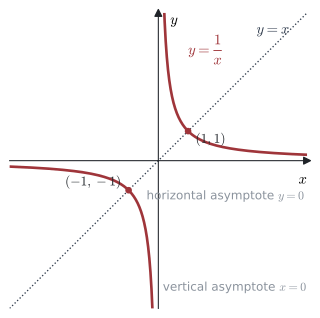
Notice these features.
- The graph has two branches, one in the first quadrant and one in the third quadrant.
- \(\dfrac{1}{x}\) is undefined when \(x = 0\). So the domain is \(\{x \mid x \neq 0\}\). On a sign diagram we mark \(x = 0\) with a dashed line, because the function does not exist there.
- The value \(y = 0\) is never reached, so the range is \(\{y \mid y \neq 0\}\).
- An asymptote is a line that the graph gets closer and closer to, but never reaches.
- \(x = 0\) (the \(y\)-axis) is a vertical asymptote.
- \(y = 0\) (the \(x\)-axis) is a horizontal asymptote.
| \(x\) | \(x < 0\) | \(0\) | \(x > 0\) |
|---|---|---|---|
| sign of \(\frac{1}{x}\) | \(-\) | undefined | \(+\) |
Behaviour near the asymptotes
We use arrows to describe what happens near an asymptote. \(x \to 0^+\) means “\(x\) approaches \(0\) from the right” (from values larger than \(0\)), and \(x \to 0^-\) means “from the left”.
\[ \text{As } x \to 0^+,\ \frac{1}{x} \to +\infty . \qquad \text{As } x \to 0^-,\ \frac{1}{x} \to -\infty . \qquad \text{As } x \to \pm\infty,\ \frac{1}{x} \to 0 . \]
The reciprocal function is self-inverse
To find the inverse of \(f(x) = \dfrac{1}{x}\), write \(y = \dfrac{1}{x}\) and make \(x\) the subject: \(x = \dfrac{1}{y}\). So \(f^{-1}(x) = \dfrac{1}{x}\), which is the same function.
The reciprocal function is self-inverse Not in the formula booklet
\[ f(x) = \frac{1}{x} \quad\Longrightarrow\quad f^{-1}(x) = \frac{1}{x}, \qquad (f \circ f)(x) = \frac{1}{\;\frac{1}{x}\;} = x \quad (x \neq 0). \]
Its graph is symmetric about the line \(y = x\).
This is true for every \(y = \dfrac{k}{x}\), \(k \neq 0\). (Self-inverse functions are studied in Section 9.5.)
The sign of \(k\)
- If \(k > 0\), the branches are in the first and third quadrants.
- If \(k < 0\), the branches are in the second and fourth quadrants.
To find \(k\) from a graph, substitute one known point: \(k = xy\).
Example 1 Each graph in Figure 2 has the form \(y = \dfrac{k}{x}\). Find the equation of each graph.
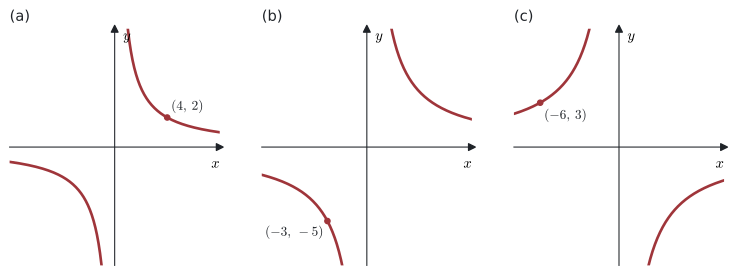
Since \(y = \dfrac{k}{x}\), we have \(k = xy\) for every point on the graph.
(a) \(k = 4 \times 2 = 8\), so \(y = \dfrac{8}{x}\).
(b) \(k = (-3) \times (-5) = 15\), so \(y = \dfrac{15}{x}\).
(c) \(k = (-6) \times 3 = -18\), so \(y = -\dfrac{18}{x}\). The branches are in the second and fourth quadrants, which agrees with \(k < 0\).
Rational functions of the form \(y = \frac{ax + b}{cx + d}\), \(c \neq 0\)
Now we divide one linear function by another linear function. These graphs are also rectangular hyperbolas. They have one vertical and one horizontal asymptote.
The easiest form to read is a translated reciprocal function.
Asymptotes of \(y = \dfrac{b}{cx + d} + a\) \(\quad(b \neq 0,\ c \neq 0)\) Not in the formula booklet
- vertical asymptote: \(x = -\dfrac{d}{c}\) \(\quad\) (where the denominator is zero)
- horizontal asymptote: \(y = a\) \(\quad\) (because \(\dfrac{b}{cx + d} \to 0\) as \(x \to \pm\infty\))
- \(b\): the constant in the numerator (\(b \neq 0\))
- \(c\): the coefficient of \(x\) in the denominator (\(c \neq 0\))
- \(d\): the constant term in the denominator
- \(a\): the constant added to the fraction
For the usual form, divide the top and the bottom by \(x\):
\[ y = \frac{ax + b}{cx + d} = \frac{a + \frac{b}{x}}{c + \frac{d}{x}} \;\to\; \frac{a}{c} \quad \text{as } x \to \pm\infty . \]
Asymptotes of \(y = \dfrac{ax + b}{cx + d}\) \(\quad(c \neq 0)\) Not in the formula booklet
- vertical asymptote: \(x = -\dfrac{d}{c}\)
- horizontal asymptote: \(y = \dfrac{a}{c}\) \(\quad\) (the ratio of the \(x\)-coefficients)
The domain is \(x \neq -\dfrac{d}{c}\) and the range is \(y \neq \dfrac{a}{c}\).
- \(a\): the coefficient of \(x\) in the numerator
- \(b\): the constant term in the numerator
- \(c\): the coefficient of \(x\) in the denominator (\(c \neq 0\))
- \(d\): the constant term in the denominator
How to sketch \(y = \frac{ax + b}{cx + d}\)
- Vertical asymptote: solve denominator \(= 0\).
- Intercepts: \(x\)-intercept from numerator \(= 0\); \(y\)-intercept from \(x = 0\), that is \(y = \dfrac{b}{d}\).
- Horizontal asymptote: rewrite as \(a' + \dfrac{b'}{cx + d}\), or use \(y = \dfrac{a}{c}\).
- Sign diagram: mark the zero of the numerator and the zero of the denominator (dashed).
- Behaviour near the asymptotes: use the signs to decide whether \(y \to +\infty\) or \(y \to -\infty\), and whether the graph approaches the horizontal asymptote from above or below.
- Sketch: draw the asymptotes as dashed lines first, then the two branches.
Example 2 For each function:
(i) find the vertical asymptote;
(ii) find the axis intercepts;
(iii) rearrange the function to find the horizontal asymptote;
(iv) draw a sign diagram;
(v) hence describe the behaviour of the function near its asymptotes;
(vi) sketch the graph.
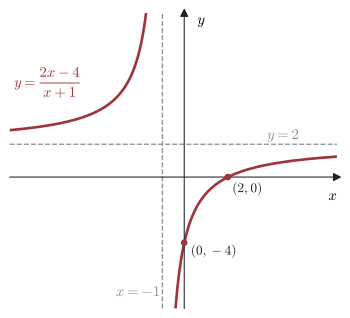
(a) \(f(x) = \dfrac{2x - 4}{x + 1}\)
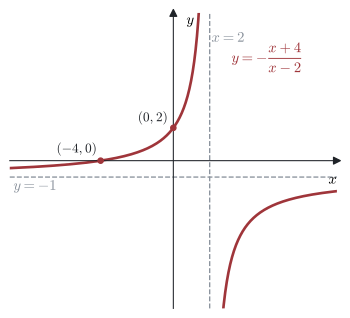
(b) \(f(x) = -\dfrac{x + 4}{x - 2}\)
(a)
(i) \(x + 1 = 0\), so the vertical asymptote is \(x = -1\).
(ii) \(x\)-intercept: \(2x - 4 = 0\), so \(x = 2\). \(\;y\)-intercept: \(f(0) = \dfrac{-4}{1} = -4\).
(iii) Write the numerator using the denominator: \(2x - 4 = 2(x + 1) - 6\). So
\[ f(x) = \frac{2(x + 1) - 6}{x + 1} = 2 - \frac{6}{x + 1} . \]
As \(x \to \pm\infty\), \(\dfrac{6}{x + 1} \to 0\), so the horizontal asymptote is \(y = 2\).
(iv) The critical values are \(x = -1\) (undefined) and \(x = 2\) (zero).
| \(x\) | \(x < -1\) | \(-1\) | \(-1 < x < 2\) | \(2\) | \(x > 2\) |
|---|---|---|---|---|---|
| sign of \(f(x)\) | \(+\) | undefined | \(-\) | \(0\) | \(+\) |
(v) As \(x \to -1^-\), \(f(x) \to +\infty\). \(\quad\) As \(x \to -1^+\), \(f(x) \to -\infty\).
As \(x \to +\infty\), \(\dfrac{6}{x + 1} > 0\), so \(f(x) = 2 - (\text{small positive}) \to 2^-\) (from below). As \(x \to -\infty\), \(\dfrac{6}{x + 1} < 0\), so \(f(x) \to 2^+\) (from above).
(vi) See Figure 3.
(b)
(i) \(x - 2 = 0\), so the vertical asymptote is \(x = 2\).
(ii) \(x\)-intercept: \(x + 4 = 0\), so \(x = -4\). \(\;y\)-intercept: \(f(0) = -\dfrac{4}{-2} = 2\).
(iii) \(x + 4 = (x - 2) + 6\), so
\[ f(x) = -\frac{(x - 2) + 6}{x - 2} = -1 - \frac{6}{x - 2} . \]
The horizontal asymptote is \(y = -1\).
(iv) Critical values \(x = -4\) (zero) and \(x = 2\) (undefined). Test, for example, \(x = -5\), \(x = 0\) and \(x = 3\): \(f(-5) = -\frac{1}{7} < 0\), \(f(0) = 2 > 0\), \(f(3) = -7 < 0\).
| \(x\) | \(x < -4\) | \(-4\) | \(-4 < x < 2\) | \(2\) | \(x > 2\) |
|---|---|---|---|---|---|
| sign of \(f(x)\) | \(-\) | \(0\) | \(+\) | undefined | \(-\) |
(v) As \(x \to 2^-\), \(f(x) \to +\infty\). \(\quad\) As \(x \to 2^+\), \(f(x) \to -\infty\).
As \(x \to +\infty\), \(\dfrac{6}{x - 2} > 0\), so \(f(x) \to -1^-\) (from below). As \(x \to -\infty\), \(\dfrac{6}{x - 2} < 0\), so \(f(x) \to -1^+\) (from above).
(vi) See Figure 4.
Graphs page: enter \(f_1(x) = \dfrac{2x - 4}{x + 1}\). Use Menu → Window / Zoom → Zoom – Standard. Enter \(f_2(x) = 2\) to draw the horizontal asymptote and check that the graph approaches it. Menu → Analyze Graph → Zero gives the \(x\)-intercept. Remember that the calculator may draw a near-vertical line at \(x = -1\): this is not part of the graph.
Common errors
| ✗ Wrong | ✓ Right | Why |
|---|---|---|
| Horizontal asymptote of \(\dfrac{2x - 4}{x + 1}\) is \(y = -4\) | \(y = \dfrac{2}{1} = 2\) | Use the ratio of the \(x\)-coefficients, not the constants. |
| Vertical asymptote of \(\dfrac{3x + 1}{2x - 5}\) is \(x = 5\) | \(x = \dfrac{5}{2}\) | Solve \(2x - 5 = 0\) fully. |
| The graph can never cross a horizontal asymptote | It can, for other rational functions | A horizontal asymptote describes \(x \to \pm\infty\) only (see 10.2). |
| \(y = -\dfrac{18}{x}\) has branches in quadrants 1 and 3 | Quadrants 2 and 4 | When \(k < 0\), \(x\) and \(y\) have opposite signs. |
| Drawing the vertical line from the GDC as part of the graph | Leave a gap; draw the asymptote dashed | The function is undefined there. |
Exercises
1 The graph of \(y = \dfrac{k}{x}\) passes through the point \((-4, 5)\). Find \(k\), and state which quadrants the graph lies in.
\(k = xy = (-4) \times 5 = -20\), so \(y = -\dfrac{20}{x}\). Since \(k < 0\), the graph lies in the second and fourth quadrants.
2 Let \(g(x) = \dfrac{6}{x}\), \(x \neq 0\).
(a) Find \((g \circ g)(x)\). \(\qquad\) (b) Hence write down \(g^{-1}(x)\).
(a) \((g \circ g)(x) = \dfrac{6}{\;\frac{6}{x}\;} = 6 \times \dfrac{x}{6} = x\).
(b) Since \(g(g(x)) = x\), \(g\) is self-inverse: \(g^{-1}(x) = \dfrac{6}{x}\), \(x \neq 0\).
3 Write down the equations of the asymptotes of
(a) \(y = \dfrac{5}{x - 3} + 2\)
(b) \(y = \dfrac{4x + 1}{2x - 6}\)
(c) \(y = \dfrac{7 - x}{3x + 2}\)
(a) \(x = 3\) and \(y = 2\).
(b) \(2x - 6 = 0 \Rightarrow x = 3\); \(\;y = \dfrac{4}{2} = 2\).
(c) \(3x + 2 = 0 \Rightarrow x = -\dfrac{2}{3}\); \(\;y = \dfrac{-1}{3} = -\dfrac{1}{3}\).
4 Let \(f(x) = \dfrac{3x + 6}{x - 4}\). Find the axis intercepts and the equations of the asymptotes.
\(x\)-intercept: \(3x + 6 = 0 \Rightarrow x = -2\). \(\;y\)-intercept: \(f(0) = \dfrac{6}{-4} = -\dfrac{3}{2}\).
Vertical asymptote \(x = 4\); horizontal asymptote \(y = 3\).
5 Write \(\dfrac{6x - 1}{2x + 1}\) in the form \(a + \dfrac{b}{2x + 1}\). Hence state the equations of the asymptotes of \(y = \dfrac{6x - 1}{2x + 1}\).
\(6x - 1 = 3(2x + 1) - 4\), so \(\dfrac{6x - 1}{2x + 1} = 3 - \dfrac{4}{2x + 1}\). \(\;a = 3\), \(b = -4\).
Asymptotes: \(x = -\dfrac{1}{2}\) and \(y = 3\).
6 Let \(f(x) = \dfrac{2 - x}{x + 3}\).
(a) Draw a sign diagram for \(f(x)\).
(b) State the domain and the range of \(f\).
(a) Zero at \(x = 2\); undefined at \(x = -3\). Test \(f(-4) = \frac{6}{-1} < 0\), \(f(0) = \frac{2}{3} > 0\), \(f(3) = -\frac{1}{6} < 0\).
| \(x\) | \(x < -3\) | \(-3\) | \(-3 < x < 2\) | \(2\) | \(x > 2\) |
|---|---|---|---|---|---|
| sign | \(-\) | undefined | \(+\) | \(0\) | \(-\) |
(b) Domain \(x \neq -3\). The horizontal asymptote is \(y = \dfrac{-1}{1} = -1\), so the range is \(y \neq -1\).
7 The graph of \(y = \dfrac{ax + b}{x + c}\) has asymptotes \(x = -2\) and \(y = 3\), and it passes through \((0, 1)\). Find \(a\), \(b\) and \(c\).
Vertical asymptote \(x = -c = -2\), so \(c = 2\). Horizontal asymptote \(y = \dfrac{a}{1} = 3\), so \(a = 3\).
Through \((0, 1)\): \(\dfrac{b}{2} = 1\), so \(b = 2\). The function is \(y = \dfrac{3x + 2}{x + 2}\).
8 Let \(f(x) = \dfrac{2x + 1}{x - 2}\), \(x \neq 2\). Find \(f^{-1}(x)\) and show that \(f\) is self-inverse.
Let \(y = \dfrac{2x + 1}{x - 2}\). Then \(y(x - 2) = 2x + 1\), so \(xy - 2x = 2y + 1\), \(x(y - 2) = 2y + 1\) and
\[ x = \frac{2y + 1}{y - 2} . \]
So \(f^{-1}(x) = \dfrac{2x + 1}{x - 2} = f(x)\): \(f\) is self-inverse. (Its graph is symmetric about \(y = x\).)
9 Find the coordinates of the points where the graph of \(y = \dfrac{x + 5}{x + 1}\) meets the line \(y = x\).
\(\dfrac{x + 5}{x + 1} = x \Rightarrow x + 5 = x^2 + x \Rightarrow x^2 = 5 \Rightarrow x = \pm\sqrt{5}\).
The points are \(\left(\sqrt{5}, \sqrt{5}\right)\) and \(\left(-\sqrt{5}, -\sqrt{5}\right)\). (Neither is \(x = -1\), so both are valid.)
10 Let \(f(x) = \dfrac{3 - 2x}{x - 1}\).
(a) Write \(f(x)\) in the form \(a + \dfrac{b}{x - 1}\).
(b) Find the asymptotes and the axis intercepts.
(c) Describe the behaviour of \(f\) near its asymptotes, and sketch the graph.
(a) \(3 - 2x = -2(x - 1) + 1\), so \(f(x) = -2 + \dfrac{1}{x - 1}\).
(b) Asymptotes \(x = 1\) and \(y = -2\). \(\;x\)-intercept: \(3 - 2x = 0 \Rightarrow x = \dfrac{3}{2}\). \(\;y\)-intercept: \(f(0) = \dfrac{3}{-1} = -3\).
(c) As \(x \to 1^+\), \(\dfrac{1}{x - 1} \to +\infty\), so \(f(x) \to +\infty\). As \(x \to 1^-\), \(f(x) \to -\infty\).
As \(x \to +\infty\), \(\dfrac{1}{x - 1} > 0\), so \(f(x) \to -2^+\) (from above). As \(x \to -\infty\), \(f(x) \to -2^-\) (from below).
The sketch is a hyperbola with one branch top-right of \((1, -2)\), through \(\left(\frac{3}{2}, 0\right)\), and one branch bottom-left of \((1, -2)\), through \((0, -3)\).