24.6 Implicit Differentiation
AHL 5.14
- the difference between explicit and implicit equations
- how to find \(\dfrac{\mathrm{d}y}{\mathrm{d}x}\) by implicit differentiation
- how to differentiate functions like \(x^{3x}\) by taking logarithms first
Explicit and implicit equations
An equation is explicit when \(y\) is given directly in terms of \(x\), for example
\[ y = 3x^2 - x, \qquad y = \frac{x + 1}{x - 4}, \qquad y = \ln(2x + 5) . \]
An equation is implicit when \(x\) and \(y\) are mixed together and \(y\) is not the subject. Often it is difficult, or impossible, to make \(y\) the subject:
\[ x^2 + xy + y^2 = 7, \qquad y^3 + 2y = x^4, \qquad \sin(xy) = x - y . \]
We can still find \(\dfrac{\mathrm{d}y}{\mathrm{d}x}\). We think of \(y\) as a function of \(x\) and differentiate every term with respect to \(x\).
Implicit differentiation
The key idea is the chain rule. To differentiate a term in \(y\) with respect to \(x\), differentiate with respect to \(y\), then multiply by \(\dfrac{\mathrm{d}y}{\mathrm{d}x}\):
Differentiating terms in \(y\) with respect to \(x\) Not in the formula booklet
\[ \frac{\mathrm{d}}{\mathrm{d}x}\big(g(y)\big) = g'(y)\,\frac{\mathrm{d}y}{\mathrm{d}x} \] for example \[ \frac{\mathrm{d}}{\mathrm{d}x}\left(y^3\right) = 3y^2\frac{\mathrm{d}y}{\mathrm{d}x}, \qquad \frac{\mathrm{d}}{\mathrm{d}x}(\sin y) = \cos y\,\frac{\mathrm{d}y}{\mathrm{d}x} \]
A term with both \(x\) and \(y\), such as \(xy\), needs the product rule: \(\;\dfrac{\mathrm{d}}{\mathrm{d}x}(xy) = x\dfrac{\mathrm{d}y}{\mathrm{d}x} + y\).
- \(y\): a function of \(x\) (we do not know it explicitly)
- \(g\): a function of \(y\)
- \(g'(y)\): the derivative of \(g\) with respect to \(y\)
The method:
- Differentiate both sides of the equation with respect to \(x\).
- Collect all the terms with \(\dfrac{\mathrm{d}y}{\mathrm{d}x}\) on one side.
- Factorise out \(\dfrac{\mathrm{d}y}{\mathrm{d}x}\) and divide.
The answer usually contains both \(x\) and \(y\).
Example 1 Find \(\dfrac{\mathrm{d}y}{\mathrm{d}x}\) for the curve \(2x^3 + y^2 - 5y = 4\).
Differentiate each term with respect to \(x\):
\[ 6x^2 + 2y\frac{\mathrm{d}y}{\mathrm{d}x} - 5\frac{\mathrm{d}y}{\mathrm{d}x} = 0 . \]
\[ (2y - 5)\frac{\mathrm{d}y}{\mathrm{d}x} = -6x^2 \qquad\Rightarrow\qquad \frac{\mathrm{d}y}{\mathrm{d}x} = \frac{6x^2}{5 - 2y} . \]
Example 2 Find an expression for \(\dfrac{\mathrm{d}y}{\mathrm{d}x}\) in terms of \(x\) and \(y\).
(a) \(x^3 + 2y^3 = 5xy\) \(\qquad\) (b) \(y\sin x = x^2 + y^2\)
(a) The right side needs the product rule:
\[ 3x^2 + 6y^2\frac{\mathrm{d}y}{\mathrm{d}x} = 5x\frac{\mathrm{d}y}{\mathrm{d}x} + 5y \qquad\Rightarrow\qquad (6y^2 - 5x)\frac{\mathrm{d}y}{\mathrm{d}x} = 5y - 3x^2 \qquad\Rightarrow\qquad \frac{\mathrm{d}y}{\mathrm{d}x} = \frac{5y - 3x^2}{6y^2 - 5x} . \]
(b) The left side is a product of \(y\) and \(\sin x\):
\[ \sin x\,\frac{\mathrm{d}y}{\mathrm{d}x} + y\cos x = 2x + 2y\frac{\mathrm{d}y}{\mathrm{d}x} \qquad\Rightarrow\qquad (\sin x - 2y)\frac{\mathrm{d}y}{\mathrm{d}x} = 2x - y\cos x \]
\[ \frac{\mathrm{d}y}{\mathrm{d}x} = \frac{2x - y\cos x}{\sin x - 2y} . \]
To find the gradient at a point, substitute both coordinates.
Example 3 The curve \(x^2 + xy + y^2 = 7\) is shown in Figure 1.
(a) Show that the point \((1,\,2)\) lies on the curve.
(b) Find the gradient of the curve at \((1,\,2)\).
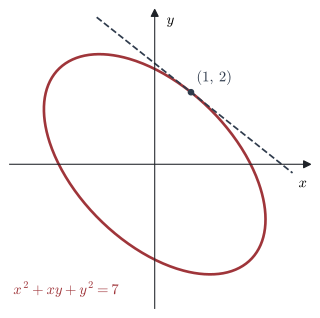
(a) \(1^2 + 1 \times 2 + 2^2 = 1 + 2 + 4 = 7\) ✓.
(b) \(\;2x + \left(x\dfrac{\mathrm{d}y}{\mathrm{d}x} + y\right) + 2y\dfrac{\mathrm{d}y}{\mathrm{d}x} = 0\), so
\[ \frac{\mathrm{d}y}{\mathrm{d}x} = -\frac{2x + y}{x + 2y} . \]
At \((1,\,2)\): \(\;\dfrac{\mathrm{d}y}{\mathrm{d}x} = -\dfrac{2 + 2}{1 + 4} = -\dfrac{4}{5}\).
Tangents and normals to implicit curves are in Unit 25.
Logarithmic differentiation
How do we differentiate \(y = x^{3x}\)? It is not \(x^n\) (the power is not constant) and not \(a^x\) (the base is not constant). Take the natural logarithm of both sides first, then use implicit differentiation.
Example 4 Differentiate with respect to \(x\):
(a) \(y = x^{3x}\), \(\;x > 0\)
(b) \(y = (\sin x)^x\), \(\;0 < x < \pi\)
(a) \(\ln y = \ln x^{3x} = 3x\ln x\). Differentiate both sides with respect to \(x\):
\[ \frac{1}{y}\frac{\mathrm{d}y}{\mathrm{d}x} = 3\ln x + 3x \cdot \frac{1}{x} = 3\ln x + 3 \qquad\Rightarrow\qquad \frac{\mathrm{d}y}{\mathrm{d}x} = 3x^{3x}(\ln x + 1) . \]
(b) \(\ln y = x\ln(\sin x)\). Differentiate:
\[ \frac{1}{y}\frac{\mathrm{d}y}{\mathrm{d}x} = \ln(\sin x) + x \cdot \frac{\cos x}{\sin x} = \ln(\sin x) + x\cot x \]
\[ \frac{\mathrm{d}y}{\mathrm{d}x} = (\sin x)^x\big(\ln(\sin x) + x\cot x\big) . \]
Common errors
| ✗ Wrong | ✓ Right | Why |
|---|---|---|
| \(\dfrac{\mathrm{d}}{\mathrm{d}x}\left(y^2\right) = 2y\) | \(2y\dfrac{\mathrm{d}y}{\mathrm{d}x}\) | \(y\) is a function of \(x\): use the chain rule. |
| \(\dfrac{\mathrm{d}}{\mathrm{d}x}(xy) = \dfrac{\mathrm{d}y}{\mathrm{d}x}\) | \(x\dfrac{\mathrm{d}y}{\mathrm{d}x} + y\) | \(xy\) is a product. |
| \(x^2 + y^2 = 25 \Rightarrow 2x + 2y\dfrac{\mathrm{d}y}{\mathrm{d}x} = 25\) | \(\ldots = 0\) | The constant \(25\) differentiates to \(0\). |
| \(\dfrac{\mathrm{d}}{\mathrm{d}x}\left(x^{3x}\right) = 3x \cdot x^{3x - 1}\) | \(3x^{3x}(\ln x + 1)\) | The power is not constant: take logs first. |
Exercises
1 For the circle \(x^2 + y^2 = 25\), find \(\dfrac{\mathrm{d}y}{\mathrm{d}x}\) in terms of \(x\) and \(y\), and the gradient at \((3,\,-4)\).
\(2x + 2y\dfrac{\mathrm{d}y}{\mathrm{d}x} = 0\), so \(\dfrac{\mathrm{d}y}{\mathrm{d}x} = -\dfrac{x}{y}\). At \((3,\,-4)\): \(\;-\dfrac{3}{-4} = \dfrac{3}{4}\).
2 Find \(\dfrac{\mathrm{d}y}{\mathrm{d}x}\) for \(x^2y + y^3 = 10\).
\(2xy + x^2\dfrac{\mathrm{d}y}{\mathrm{d}x} + 3y^2\dfrac{\mathrm{d}y}{\mathrm{d}x} = 0\), so \(\dfrac{\mathrm{d}y}{\mathrm{d}x} = -\dfrac{2xy}{x^2 + 3y^2}\).
3 Find \(\dfrac{\mathrm{d}y}{\mathrm{d}x}\) for \(\mathrm{e}^y = x^2 + y\).
\(\mathrm{e}^y\dfrac{\mathrm{d}y}{\mathrm{d}x} = 2x + \dfrac{\mathrm{d}y}{\mathrm{d}x}\), so \((\mathrm{e}^y - 1)\dfrac{\mathrm{d}y}{\mathrm{d}x} = 2x\) and \(\dfrac{\mathrm{d}y}{\mathrm{d}x} = \dfrac{2x}{\mathrm{e}^y - 1}\).
4 The curve \(x^3 + y^3 - 3xy = 3\) passes through a point with \(x = 1\) and \(y > 0\). Find the \(y\)-coordinate of this point and the gradient of the curve there.
\(x = 1\): \(\;1 + y^3 - 3y = 3 \Rightarrow y^3 - 3y - 2 = 0 \Rightarrow (y - 2)(y + 1)^2 = 0\). Since \(y > 0\), \(y = 2\).
\(3x^2 + 3y^2\dfrac{\mathrm{d}y}{\mathrm{d}x} - 3y - 3x\dfrac{\mathrm{d}y}{\mathrm{d}x} = 0 \Rightarrow \dfrac{\mathrm{d}y}{\mathrm{d}x} = \dfrac{y - x^2}{y^2 - x}\).
At \((1,\,2)\): \(\;\dfrac{2 - 1}{4 - 1} = \dfrac{1}{3}\).
5 Given \(\tan y = x^2 + y\), show that \(\dfrac{\mathrm{d}y}{\mathrm{d}x} = 2x\cot^2 y\).
\(\sec^2 y\,\dfrac{\mathrm{d}y}{\mathrm{d}x} = 2x + \dfrac{\mathrm{d}y}{\mathrm{d}x} \Rightarrow (\sec^2 y - 1)\dfrac{\mathrm{d}y}{\mathrm{d}x} = 2x\).
Since \(\sec^2 y - 1 = \tan^2 y\): \(\;\dfrac{\mathrm{d}y}{\mathrm{d}x} = \dfrac{2x}{\tan^2 y} = 2x\cot^2 y\).
6 Use logarithmic differentiation to find \(\dfrac{\mathrm{d}y}{\mathrm{d}x}\) for \(y = x^{\ln x}\), \(\;x > 0\).
\(\ln y = \ln x \cdot \ln x = (\ln x)^2\). Then \(\dfrac{1}{y}\dfrac{\mathrm{d}y}{\mathrm{d}x} = \dfrac{2\ln x}{x}\), so
\[ \frac{\mathrm{d}y}{\mathrm{d}x} = \frac{2\ln x}{x}\,x^{\ln x} . \]