28.1 Definite Integrals
SL 5.11
- how the area under a curve leads to the idea of a definite integral \(\displaystyle\int_a^b f(x)\,\mathrm{d}x\)
- the Fundamental Theorem of Calculus: \(\displaystyle\int_a^b f(x)\,\mathrm{d}x = F(b) - F(a)\)
- the properties of definite integrals
- how to evaluate definite integrals of polynomials, trigonometric and exponential functions
- how to change the limits when you use a substitution, and how to use integration by parts with limits (AHL)
- how to find a definite integral on the GDC
Area under a curve
In Unit 27 you found indefinite integrals: functions whose derivative is a given function. Now we use integration to find areas.
Look at the graph of \(y = x^2\) between \(x = a\) and \(x = b\). We want the area \(A\) of the region between the curve, the \(x\)-axis and the lines \(x = a\) and \(x = b\).
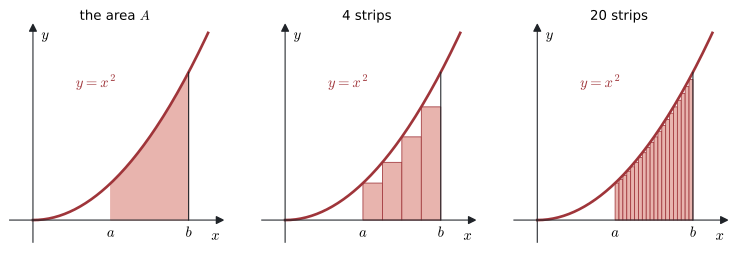
We can cut the region into thin vertical strips and treat each strip as a rectangle. The rectangles do not fit the curve exactly. But when the strips become thinner (and there are more of them), the total area of the rectangles gets closer and closer to \(A\) (Figure 1). You will see this idea in detail in Section 28.2.
The exact area found in this way is called the definite integral of \(f(x)\) from \(x = a\) to \(x = b\). We write
\[ \int_a^b f(x)\,\mathrm{d}x . \]
The numbers \(a\) and \(b\) are the lower limit and the upper limit of the integral.
Example 1 The region \(A\) is bounded by the line \(y = x + 2\), the \(x\)-axis, and the lines \(x = 2\) and \(x = 6\).
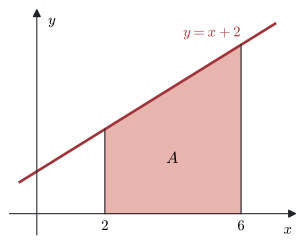
(a) Use the formula for the area of a trapezium to find the area of \(A\).
(b) Find \(F(x) = \displaystyle\int (x + 2)\,\mathrm{d}x\).
(c) Find \(F(6) - F(2)\).
(d) Compare your answers to (a) and (c). What does the value in (c) represent?
(a) The parallel sides are the heights at \(x = 2\) and \(x = 6\): \(\;2 + 2 = 4\) and \(6 + 2 = 8\). The width is \(4\).
\[ A = \frac{1}{2}(4 + 8) \times 4 = 24 . \]
(b) \(F(x) = \dfrac{x^2}{2} + 2x + c\).
(c) \(F(6) = 18 + 12 + c = 30 + c\) and \(F(2) = 2 + 4 + c = 6 + c\). So \(F(6) - F(2) = 24\). The constant \(c\) cancels.
(d) The answers are the same. \(F(6) - F(2)\) is the area under the line between \(x = 2\) and \(x = 6\).
The Fundamental Theorem of Calculus
Example 1 is an example of a general result. If \(F\) is any antiderivative of \(f\), then the area under \(y = f(x)\) from \(x = a\) to \(x = b\) is \(F(b) - F(a)\). We write \(F(b) - F(a)\) in a short form with square brackets:
\[ \Big[F(x)\Big]_a^b = F(b) - F(a). \]
The Fundamental Theorem of Calculus Not in the formula booklet
If \(f\) is continuous on \([a, b]\) and \(F\) is an antiderivative of \(f\) (so \(F'(x) = f(x)\)), then
\[ \int_a^b f(x)\,\mathrm{d}x = \Big[F(x)\Big]_a^b = F(b) - F(a). \]
- \(f\): a continuous function (the integrand)
- \(a\): the lower limit
- \(b\): the upper limit
- \(F\): an antiderivative of \(f\)
The syllabus writes it as \(\int_a^b g'(x)\,\mathrm{d}x = g(b) - g(a)\).
There is no need to write “\(+\,c\)” in a definite integral: it always cancels.
Properties of definite integrals Not in the formula booklet
- \(\displaystyle\int_a^a f(x)\,\mathrm{d}x = 0\)
- \(\displaystyle\int_b^a f(x)\,\mathrm{d}x = -\int_a^b f(x)\,\mathrm{d}x\) \(\quad\) (swapping the limits changes the sign)
- \(\displaystyle\int_a^b k\,\mathrm{d}x = k(b - a)\), \(\;k\) a constant
- \(\displaystyle\int_a^b k f(x)\,\mathrm{d}x = k\int_a^b f(x)\,\mathrm{d}x\)
- \(\displaystyle\int_a^b f(x)\,\mathrm{d}x + \int_b^c f(x)\,\mathrm{d}x = \int_a^c f(x)\,\mathrm{d}x\)
- \(\displaystyle\int_a^b \big[f(x) \pm g(x)\big]\,\mathrm{d}x = \int_a^b f(x)\,\mathrm{d}x \pm \int_a^b g(x)\,\mathrm{d}x\)
- \(a\): the lower limit
- \(b\): the upper limit
- \(k\): a constant
- \(c\): a third limit (the end of the second interval)
A definite integral \(\displaystyle\int_a^b f(x)\,\mathrm{d}x\) is a number. An indefinite integral \(\displaystyle\int f(x)\,\mathrm{d}x\) is a function (a family of functions, with a constant \(c\)).
Evaluating definite integrals
Find an antiderivative (use the rules from Unit 27), then substitute the upper limit and subtract the value at the lower limit. Put brackets around each substitution, because the signs are easy to get wrong.
Example 2 Evaluate
(a) \(\displaystyle\int_{-3}^{-1} (x^2 - 2x + 5)\,\mathrm{d}x\)
(b) \(\displaystyle\int_0^{\frac{\pi}{3}} (2 + 6\cos x)\,\mathrm{d}x\)
(c) \(\displaystyle\int_0^{\ln 2} \frac{6}{\mathrm{e}^{3x - 1}}\,\mathrm{d}x\)
(a) \[ \Big[\tfrac{x^3}{3} - x^2 + 5x\Big]_{-3}^{-1} = \left(-\tfrac{1}{3} - 1 - 5\right) - \left(-9 - 9 - 15\right) = -\tfrac{19}{3} + 33 = \tfrac{80}{3}. \]
(b) \[ \Big[2x + 6\sin x\Big]_0^{\frac{\pi}{3}} = \left(\tfrac{2\pi}{3} + 6 \times \tfrac{\sqrt{3}}{2}\right) - (0 + 0) = \tfrac{2\pi}{3} + 3\sqrt{3}. \]
(c) First write the integrand as \(6\mathrm{e}^{1 - 3x}\). Then \(\displaystyle\int 6\mathrm{e}^{1 - 3x}\,\mathrm{d}x = -2\mathrm{e}^{1 - 3x}\).
\[ \Big[-2\mathrm{e}^{1 - 3x}\Big]_0^{\ln 2} = -2\mathrm{e}^{1 - 3\ln 2} + 2\mathrm{e}^{1} = -2 \times \frac{\mathrm{e}}{8} + 2\mathrm{e} = \frac{7\mathrm{e}}{4}, \]
because \(\mathrm{e}^{1 - 3\ln 2} = \mathrm{e} \times \mathrm{e}^{-3\ln 2} = \mathrm{e} \times 2^{-3} = \dfrac{\mathrm{e}}{8}\).
Integration by parts with limits
AHL 5.16 For integration by parts (see Unit 27), the limits apply to both parts:
\[ \int_a^b u\,\frac{\mathrm{d}v}{\mathrm{d}x}\,\mathrm{d}x = \Big[uv\Big]_a^b - \int_a^b v\,\frac{\mathrm{d}u}{\mathrm{d}x}\,\mathrm{d}x . \]
Example 3 AHL 5.16 Find the exact value of
(a) \(\displaystyle\int_0^{1} x\mathrm{e}^{-x}\,\mathrm{d}x\)
(b) \(\displaystyle\int_0^{\frac{\pi}{3}} x\sec^2 x\,\mathrm{d}x\)
(a) Let \(u = x\), \(\dfrac{\mathrm{d}v}{\mathrm{d}x} = \mathrm{e}^{-x}\). Then \(\dfrac{\mathrm{d}u}{\mathrm{d}x} = 1\), \(v = -\mathrm{e}^{-x}\).
\[ \int_0^1 x\mathrm{e}^{-x}\,\mathrm{d}x = \Big[-x\mathrm{e}^{-x}\Big]_0^1 + \int_0^1 \mathrm{e}^{-x}\,\mathrm{d}x = -\mathrm{e}^{-1} + \Big[-\mathrm{e}^{-x}\Big]_0^1 = -\mathrm{e}^{-1} - \mathrm{e}^{-1} + 1 = 1 - \frac{2}{\mathrm{e}}. \]
(b) Let \(u = x\), \(\dfrac{\mathrm{d}v}{\mathrm{d}x} = \sec^2 x\). Then \(\dfrac{\mathrm{d}u}{\mathrm{d}x} = 1\), \(v = \tan x\).
\[ \int_0^{\frac{\pi}{3}} x\sec^2 x\,\mathrm{d}x = \Big[x\tan x\Big]_0^{\frac{\pi}{3}} - \int_0^{\frac{\pi}{3}} \tan x\,\mathrm{d}x = \frac{\pi}{3}\sqrt{3} + \Big[\ln(\cos x)\Big]_0^{\frac{\pi}{3}} \]
since \(\displaystyle\int \tan x\,\mathrm{d}x = -\ln|\cos x| + c\). Now \(\ln\left(\cos\frac{\pi}{3}\right) - \ln 1 = \ln \frac{1}{2} = -\ln 2\), so
\[ \int_0^{\frac{\pi}{3}} x\sec^2 x\,\mathrm{d}x = \frac{\pi\sqrt{3}}{3} - \ln 2 . \]
Substitution with limits
When you use a substitution in a definite integral, change the limits to values of the new variable. Then you do not need to go back to \(x\) at the end.
Example 4 AHL 5.16 Use the substitution \(u = \sqrt{3x - 2}\) to find \(\displaystyle\int_1^6 \frac{x}{\sqrt{3x - 2}}\,\mathrm{d}x\).
\(u = \sqrt{3x - 2}\), so \(u^2 = 3x - 2\), \(\;x = \dfrac{u^2 + 2}{3}\) and \(\dfrac{\mathrm{d}x}{\mathrm{d}u} = \dfrac{2u}{3}\), so \(\mathrm{d}x = \dfrac{2u}{3}\,\mathrm{d}u\).
New limits: \(x = 1 \Rightarrow u = \sqrt{1} = 1\); \(\quad x = 6 \Rightarrow u = \sqrt{16} = 4\).
\[ \int_1^6 \frac{x}{\sqrt{3x - 2}}\,\mathrm{d}x = \int_1^4 \frac{u^2 + 2}{3} \cdot \frac{1}{u} \cdot \frac{2u}{3}\,\mathrm{d}u = \frac{2}{9}\int_1^4 (u^2 + 2)\,\mathrm{d}u = \frac{2}{9}\Big[\tfrac{u^3}{3} + 2u\Big]_1^4 . \]
\[ = \frac{2}{9}\left[\left(\tfrac{64}{3} + 8\right) - \left(\tfrac{1}{3} + 2\right)\right] = \frac{2}{9}(21 + 6) = 6 . \]
Definite integrals on the GDC
Some definite integrals cannot be found exactly by hand, for example \(\displaystyle\int_0^1 \mathrm{e}^{-x^2}\,\mathrm{d}x\). On Paper 2 you can find the value with a GDC. Always write the integral first, then give the value.
Calculator page: Menu → Calculus → Numerical Integral. A template \(\displaystyle\int_{\square}^{\square} \square\,\mathrm{d}\square\) appears. Type the lower limit, the upper limit, the function and the variable, for example \(\displaystyle\int_0^1 \mathrm{e}^{-x^2}\,\mathrm{d}x\), then press enter. The answer is \(0.746824\ldots \approx 0.747\).
Graphs page: draw \(f_1(x)\), then Menu → Analyze Graph → Integral, and choose the lower and upper bounds. The region is shaded and the value is shown.
Use radian mode for trigonometric functions. Give answers to 3 significant figures unless the question says otherwise.
Common errors
| ✗ Wrong | ✓ Right | Why |
|---|---|---|
| \(\Big[x^3 - x\Big]_{-1}^{2} = (8 - 2) - (-1 - 1) = 8\) | \((8 - 2) - \big((-1)^3 - (-1)\big) = 6 - 0 = 6\) | Put brackets round each substitution; \(-(-1)\) is \(+1\). |
| \(F(a) - F(b)\) | \(F(b) - F(a)\) | Upper limit first. |
| Keeping \(x\)-limits after a substitution | Change the limits to \(u\)-values | The new integral is in \(u\). |
| Writing \(+\,c\) in a definite integral | No constant | It cancels. |
| \(\displaystyle\int_a^b f(x)g(x)\,\mathrm{d}x = \int_a^b f \times \int_a^b g\) | No product rule for integrals | Only sums and constant multiples split. |
| Degree mode for \(\displaystyle\int_0^{\frac{\pi}{3}}\cos x\,\mathrm{d}x\) on the GDC | Radian mode | Calculus with trigonometric functions uses radians. |
Exercises
1 Evaluate \(\displaystyle\int_1^3 (3x^2 - 4x + 1)\,\mathrm{d}x\).
\(\Big[x^3 - 2x^2 + x\Big]_1^3 = (27 - 18 + 3) - (1 - 2 + 1) = 12 - 0 = 12\).
2 Evaluate \(\displaystyle\int_1^4 \left(2\sqrt{x} - \frac{1}{x^2}\right)\mathrm{d}x\).
\(\displaystyle\int (2x^{1/2} - x^{-2})\,\mathrm{d}x = \frac{4}{3}x^{3/2} + \frac{1}{x}\).
\(\left(\dfrac{4}{3} \times 8 + \dfrac{1}{4}\right) - \left(\dfrac{4}{3} + 1\right) = \dfrac{32}{3} + \dfrac{1}{4} - \dfrac{7}{3} = \dfrac{25}{3} + \dfrac{1}{4} = \dfrac{103}{12}\).
3 Evaluate \(\displaystyle\int_0^{\frac{\pi}{6}} \cos 3x\,\mathrm{d}x\).
\(\Big[\tfrac{1}{3}\sin 3x\Big]_0^{\frac{\pi}{6}} = \tfrac{1}{3}\sin\tfrac{\pi}{2} - 0 = \dfrac{1}{3}\).
4 Find the exact value of \(\displaystyle\int_2^5 \frac{3}{x - 1}\,\mathrm{d}x\).
\(\Big[3\ln(x - 1)\Big]_2^5 = 3\ln 4 - 3\ln 1 = 3\ln 4 = 6\ln 2\).
5 You are given that \(\displaystyle\int_1^4 f(x)\,\mathrm{d}x = 7\) and \(\displaystyle\int_4^6 f(x)\,\mathrm{d}x = -2\). Find
(a) \(\displaystyle\int_1^6 f(x)\,\mathrm{d}x\)
(b) \(\displaystyle\int_6^1 2f(x)\,\mathrm{d}x\)
(c) \(\displaystyle\int_1^4 \big(f(x) + 3\big)\,\mathrm{d}x\)
(a) \(7 + (-2) = 5\).
(b) \(2 \times \left(-\displaystyle\int_1^6 f(x)\,\mathrm{d}x\right) = 2 \times (-5) = -10\).
(c) \(7 + 3 \times (4 - 1) = 7 + 9 = 16\).
6 Find the value of \(k\), where \(k > 0\), such that \(\displaystyle\int_0^k (2x + 1)\,\mathrm{d}x = 12\).
\(\Big[x^2 + x\Big]_0^k = k^2 + k = 12\), so \(k^2 + k - 12 = 0\), \((k + 4)(k - 3) = 0\). Since \(k > 0\), \(k = 3\).
7 Find \(\displaystyle\int_0^1 6x(x^2 + 1)^2\,\mathrm{d}x\).
\(6x\) is \(3\) times the derivative of \(x^2 + 1\), so \(\displaystyle\int 6x(x^2 + 1)^2\,\mathrm{d}x = (x^2 + 1)^3 + c\).
\(\Big[(x^2 + 1)^3\Big]_0^1 = 8 - 1 = 7\).
8 AHL 5.16 Find the exact value of \(\displaystyle\int_1^{\mathrm{e}} x\ln x\,\mathrm{d}x\).
\(u = \ln x\), \(\dfrac{\mathrm{d}v}{\mathrm{d}x} = x\): \(\;\dfrac{\mathrm{d}u}{\mathrm{d}x} = \dfrac{1}{x}\), \(v = \dfrac{x^2}{2}\).
\(\displaystyle\int_1^{\mathrm{e}} x\ln x\,\mathrm{d}x = \Big[\tfrac{x^2}{2}\ln x\Big]_1^{\mathrm{e}} - \int_1^{\mathrm{e}} \frac{x}{2}\,\mathrm{d}x = \frac{\mathrm{e}^2}{2} - \Big[\tfrac{x^2}{4}\Big]_1^{\mathrm{e}} = \frac{\mathrm{e}^2}{2} - \frac{\mathrm{e}^2}{4} + \frac{1}{4} = \frac{\mathrm{e}^2 + 1}{4}\).
9 AHL 5.16 Use the substitution \(u = x + 1\) to find \(\displaystyle\int_0^3 x\sqrt{x + 1}\,\mathrm{d}x\).
\(x = u - 1\), \(\mathrm{d}x = \mathrm{d}u\). Limits: \(x = 0 \Rightarrow u = 1\); \(x = 3 \Rightarrow u = 4\).
\(\displaystyle\int_1^4 (u - 1)u^{1/2}\,\mathrm{d}u = \int_1^4 (u^{3/2} - u^{1/2})\,\mathrm{d}u = \Big[\tfrac{2}{5}u^{5/2} - \tfrac{2}{3}u^{3/2}\Big]_1^4\)
\(= \left(\dfrac{64}{5} - \dfrac{16}{3}\right) - \left(\dfrac{2}{5} - \dfrac{2}{3}\right) = \dfrac{62}{5} - \dfrac{14}{3} = \dfrac{116}{15}\).
10 Paper 2 Use your GDC to find \(\displaystyle\int_0^2 \sqrt{1 + x^3}\,\mathrm{d}x\).
Numerical Integral: \(\displaystyle\int_0^2 \sqrt{1 + x^3}\,\mathrm{d}x = 3.2413\ldots \approx 3.24\).