11.3 Polynomial Equations; Sum and Product of Roots
AHL 2.12
- how to factorise a sum of cubes \(a^3 + b^3\) and a difference of cubes \(a^3 - b^3\)
- a step-by-step method to factorise a cubic using the factor theorem
- how to solve cubic equations, including answers in surd form
- the shape of the graph of a polynomial, and what happens at a repeated root
- the formulae for the sum and product of the roots, first for a quadratic and then for a polynomial equation of any degree
- how to find symmetric expressions such as \(\dfrac{1}{\alpha} + \dfrac{1}{\beta}\) or \(\alpha^2 + \beta^2\) without solving the equation
- how to form a new equation whose roots are related to \(\alpha\) and \(\beta\), and how to find an unknown coefficient
- how to use the equation itself to reduce powers of a root
Sum and difference of cubes
An expression of the form \(a^3 + b^3\) is a sum of cubes, and \(a^3 - b^3\) is a difference of cubes. You can check each of these identities by expanding the right-hand side.
Useful identities Not in the formula booklet
\[ a^3 + b^3 \equiv (a + b)(a^2 - ab + b^2) \]
\[ a^3 - b^3 \equiv (a - b)(a^2 + ab + b^2) \]
- \(a\), \(b\): any numbers or expressions
An easy way to remember the signs:
- the sign in the first bracket is the same as the sign in the question;
- the sign of the middle term \(ab\) is the opposite;
- the last term \(+b^2\) is always positive.
Example 1 Factorise
(a) \(x^3 + 27\), \(\qquad\) (b) \(8x^3 - 125y^3\).
(a) \(x^3 + 27 = x^3 + 3^3\), so \(a = x\) and \(b = 3\):
\[ x^3 + 27 = (x + 3)(x^2 - 3x + 9) . \]
(b) \(8x^3 - 125y^3 = (2x)^3 - (5y)^3\), so \(a = 2x\) and \(b = 5y\):
\[ 8x^3 - 125y^3 = (2x - 5y)(4x^2 + 10xy + 25y^2) . \]
Further generalisation
The difference of two squares, \(a^2 - b^2 = (a - b)(a + b)\), and the difference of two cubes are the first two cases of a general pattern. Expanding the right-hand side shows that, for every positive integer \(n\),
\[ a^n - b^n \equiv (a - b)\left(a^{n-1} + a^{n-2}b + a^{n-3}b^2 + \cdots + ab^{n-2} + b^{n-1}\right) = (a - b)\sum_{r=0}^{n-1} a^{n-1-r}\,b^{r} . \]
(When you multiply out, almost every term cancels; only \(a^n\) and \(-b^n\) are left.) An important special case is \(a = x\), \(b = 1\):
\[ x^n - 1 \equiv (x - 1)\left(x^{n-1} + x^{n-2} + \cdots + x + 1\right) . \]
For example, \(x^5 - 1 = (x - 1)(x^4 + x^3 + x^2 + x + 1)\). This also follows from the factor theorem, because \(x = 1\) makes \(x^n - 1\) equal to zero.
Factorising cubic polynomials
A cubic polynomial in \(x\) has degree 3. It can be written as \(ax^3 + bx^2 + cx + d\), where \(a \neq 0\).
Factorising a cubic \(f(x) = ax^3 + bx^2 + cx + d\)
- Find one factor with the factor theorem. Try \(x = \pm 1, \pm 2, \ldots\) — good values to try are factors of \(d\) divided by factors of \(a\). If \(f(k) = 0\), then \(x - k\) is a factor.
- Divide \(f(x)\) by \(x - k\) (long division, synthetic division, or comparing coefficients) to get a quadratic quotient.
- Factorise the quadratic, if possible.
Example 2 Factorise \(3x^3 - 4x^2 - 17x + 6\) completely.
Let \(f(x) = 3x^3 - 4x^2 - 17x + 6\).
Step 1. Try values:
\[ f(1) = 3 - 4 - 17 + 6 = -12, \qquad f(-1) = -3 - 4 + 17 + 6 = 16, \]
\[ f(2) = 24 - 16 - 34 + 6 = -20, \qquad f(-2) = -24 - 16 + 34 + 6 = 0 . \]
So \(x + 2\) is a factor.
Step 2. Divide by \(x + 2\) (synthetic division with \(k = -2\)):
\[ \begin{array}{r|rrrr} -2 & 3 & -4 & -17 & 6 \\ & & -6 & 20 & -6 \\ \hline & 3 & -10 & 3 & 0 \end{array} \]
The quotient is \(3x^2 - 10x + 3\) (and the remainder is \(0\), as expected).
Step 3. \(3x^2 - 10x + 3 = (3x - 1)(x - 3)\). So
\[ 3x^3 - 4x^2 - 17x + 6 = (x + 2)(3x - 1)(x - 3) . \]
Solving cubic equations
Once a cubic \(f(x)\) is factorised, the roots of \(f(x) = 0\) come from setting each factor equal to zero. If the quadratic factor does not factorise, use the quadratic formula.
Example 3 Find the real roots of the equation \(x^3 + 2x^2 - 13x + 10 = 0\).
Let \(f(x) = x^3 + 2x^2 - 13x + 10\). Then \(f(1) = 1 + 2 - 13 + 10 = 0\), so \(x - 1\) is a factor.
\[ \begin{array}{r|rrrr} 1 & 1 & 2 & -13 & 10 \\ & & 1 & 3 & -10 \\ \hline & 1 & 3 & -10 & 0 \end{array} \]
\[ x^3 + 2x^2 - 13x + 10 = (x - 1)(x^2 + 3x - 10) = (x - 1)(x + 5)(x - 2) = 0 . \]
The roots are \(x = 1\), \(x = 2\) and \(x = -5\).
Example 4 Solve the equation \(x^2(4 - x) = 3\). Give your answers in surd form where necessary.
First rearrange to the form \(f(x) = 0\):
\[ 4x^2 - x^3 = 3 \;\Longrightarrow\; x^3 - 4x^2 + 3 = 0 . \]
\(x = 1\) gives \(1 - 4 + 3 = 0\), so \(x - 1\) is a factor. Divide (remember the \(0x\) term):
\[ \begin{array}{r|rrrr} 1 & 1 & -4 & 0 & 3 \\ & & 1 & -3 & -3 \\ \hline & 1 & -3 & -3 & 0 \end{array} \]
So \((x - 1)(x^2 - 3x - 3) = 0\). The quadratic does not factorise, so use the formula:
\[ x = \frac{3 \pm \sqrt{9 + 12}}{2} = \frac{3 \pm \sqrt{21}}{2} . \]
The solutions are \(x = 1\) and \(x = \dfrac{3 \pm \sqrt{21}}{2}\).
When the roots are not “nice” numbers, a calculator is the quickest method (Paper 2 only).
On a Calculator page: Menu → Algebra → Polynomial Tools → Find Roots of Polynomial. Choose the degree, choose Real roots, and enter the coefficients. For \(x^3 - 3x^2 - 2x + 5 = 0\) this gives
\[ x \approx -1.33, \qquad x \approx 1.20, \qquad x \approx 3.13 . \]
You can also graph \(y = x^3 - 3x^2 - 2x + 5\) on a Graphs page and use Menu → Analyze Graph → Zero.
Graphs of polynomial functions
The graph of a polynomial is a smooth, unbroken curve. Its general shape depends on the degree \(n\) and the sign of the leading coefficient \(a\).
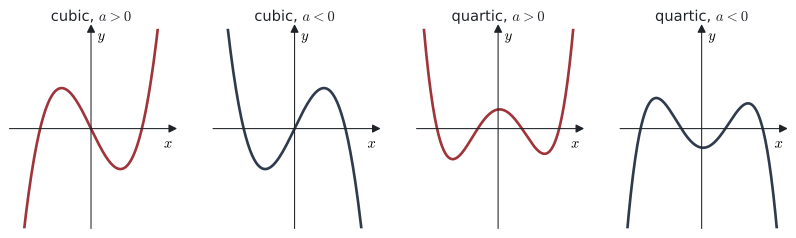
Features of the graph of a polynomial of degree \(n\) Not in the formula booklet
- The \(y\)-intercept is the constant term.
- There are at most \(n\) real zeros (\(x\)-intercepts) and at most \(n - 1\) turning points.
- Odd degree: the two ends go in opposite directions. If \(a > 0\), the graph rises to the right.
- Even degree: the two ends go in the same direction: both up if \(a > 0\), both down if \(a < 0\).
- \(n\): the degree of the polynomial
- \(a\): the leading coefficient (the coefficient of \(x^n\))
When a factor \((x - a)\) appears more than once, \(x = a\) is a repeated root. The graph behaves differently there.
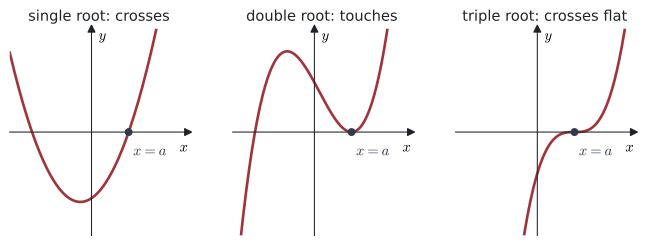
Repeated roots Not in the formula booklet
- \((x - a)\) — a single root: the graph crosses the \(x\)-axis at \(x = a\).
- \((x - a)^2\) — a double root: the graph touches the \(x\)-axis at \(x = a\) (a turning point on the axis) and turns back.
- \((x - a)^3\) — a triple root: the graph crosses the \(x\)-axis but is flat there (a point of inflection on the axis).
- \(a\): a root of the polynomial (a real number)
In general, an even power of \((x - a)\) means the graph touches; an odd power means it crosses.
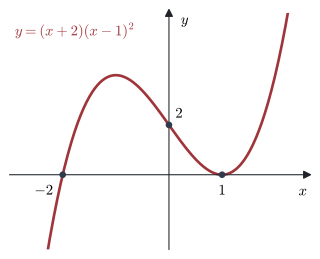
Example 5 Sketch the graph of \(y = (x + 2)(x - 1)^2\), showing the intercepts with the axes.
- Degree 3, and the leading coefficient is \(+1\): the graph comes up from the bottom left and rises to the top right.
- \(x\)-intercepts: \(x = -2\) (single root, crosses) and \(x = 1\) (double root, touches).
- \(y\)-intercept: \(x = 0\) gives \(y = (2)(-1)^2 = 2\).
Example 6 The graph of a cubic function is shown in Figure 3. It touches the \(x\)-axis at \(x = -1\), crosses it at \(x = 3\), and meets the \(y\)-axis at \((0, -6)\). Find the equation of the curve.
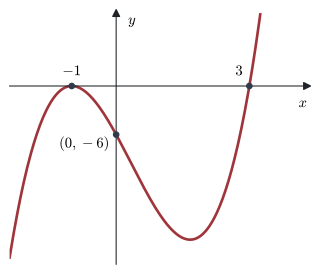
The graph touches at \(x = -1\) (double root) and crosses at \(x = 3\) (single root), so
\[ y = a(x + 1)^2(x - 3) . \]
The point \((0, -6)\) is on the curve: \(\;-6 = a(1)^2(-3) = -3a\), so \(a = 2\).
\[ y = 2(x + 1)^2(x - 3) \qquad \left(= 2x^3 - 2x^2 - 10x - 6\right) \]
Sum and product of roots
Quadratic equations
Let \(\alpha\) and \(\beta\) be the roots of \(ax^2 + bx + c = 0\). Divide the equation by \(a\):
\[ x^2 + \frac{b}{a}x + \frac{c}{a} = 0 . \qquad (1) \]
Because \(\alpha\) and \(\beta\) are the roots, the same equation can also be written as
\[ (x - \alpha)(x - \beta) = 0 \;\Longrightarrow\; x^2 - (\alpha + \beta)x + \alpha\beta = 0 . \qquad (2) \]
Equations (1) and (2) are the same, so their coefficients are equal.
Sum and product of the roots of \(ax^2 + bx + c = 0\) Not in the formula booklet
\[ \alpha + \beta = -\frac{b}{a}, \qquad\qquad \alpha\beta = \frac{c}{a} \]
So a quadratic equation can be written as
\[ x^2 - (\text{sum of roots})\,x + (\text{product of roots}) = 0 . \]
- \(\alpha\): one root of \(ax^2 + bx + c = 0\)
- \(\beta\): the other root
- \(a\): the coefficient of \(x^2\) (\(a \neq 0\))
- \(b\): the coefficient of \(x\)
- \(c\): the constant term
This quadratic form is not printed in the booklet, but it is the case \(n = 2\) of the general result below.
For example, \(2x^2 - 7x + 3 = 0\) has roots \(3\) and \(\frac{1}{2}\). Their sum is \(\frac{7}{2} = -\frac{-7}{2}\) ✓ and their product is \(\frac{3}{2}\) ✓.
Polynomial equations of degree \(n\)
The HL booklet gives the result for a polynomial equation of any degree \(n\). Such an equation looks like this:
\[ a_n x^n + a_{n-1} x^{n-1} + a_{n-2} x^{n-2} + \cdots + a_1 x + a_0 = 0 , \qquad a_n \neq 0 . \]
In sigma notation (2.6) this is written \(\displaystyle\sum_{r=0}^{n} a_r x^r = 0\).
Sum and product of the roots of a polynomial equation of degree \(n\) In the HL formula booklet
For polynomial equations of the form \(\displaystyle\sum_{r=0}^{n} a_r x^r = 0\),
\[ \text{Sum is } \frac{-a_{n-1}}{a_n} ; \qquad \text{product is } \frac{(-1)^n a_0}{a_n} . \]
- \(n\): the degree of the polynomial
- \(a_r\): the coefficient of \(x^r\)
- \(a_n\): the coefficient of \(x^n\) (the leading coefficient, \(a_n \neq 0\))
- \(a_{n-1}\): the coefficient of \(x^{n-1}\)
- \(a_0\): the constant term
For a quadratic, \(n = 2\), \(a_2 = a\), \(a_1 = b\) and \(a_0 = c\). The sum is \(\dfrac{-a_1}{a_2} = -\dfrac{b}{a}\) and the product is \(\dfrac{(-1)^2 a_0}{a_2} = \dfrac{c}{a}\), which agrees with the first box.
Expand and collect like terms:
\[ \begin{aligned} a(x - \alpha)(x - \beta) &= a x^2 - a(\alpha + \beta)x + a\alpha\beta \\[4pt] a(x - \alpha)(x - \beta)(x - \gamma) &= a x^3 - a(\alpha + \beta + \gamma)x^2 \\ &\quad + a(\alpha\beta + \beta\gamma + \gamma\alpha)x - a\alpha\beta\gamma \end{aligned} \]
Multiplying by one more factor \((x - \delta)\) gives \(a x^4 - a(\alpha + \beta + \gamma + \delta)x^3 + \cdots + a\alpha\beta\gamma\delta\).
- The coefficient of \(x^{n-1}\) is always \(-a \times (\text{sum of roots})\). So the sum of roots is \(\dfrac{-a_{n-1}}{a_n}\).
- The constant term is \(a\alpha\beta\), \(-a\alpha\beta\gamma\), \(a\alpha\beta\gamma\delta\): the sign alternates. It equals \((-1)^n \times a \times (\text{product of roots})\), so the product of roots is \(\dfrac{(-1)^n a_0}{a_n}\).
Notes:
- These results count all \(n\) roots, including complex roots and repeated roots counted as many times as they repeat. So they are true even when the roots are not real. Complex roots are studied in Unit 23.
- For even \(n\) the product is \(\dfrac{a_0}{a_n}\); for odd \(n\) it is \(-\dfrac{a_0}{a_n}\).
- If a power is missing, its coefficient is \(0\). For example, in \(x^3 + 2x - 5 = 0\) the sum of the roots is \(0\).
Example 7 Find the sum and the product of the roots of
(a) \(3x^3 + 5x^2 - 2x + 4 = 0\), \(\qquad\) (b) \(2x^4 - 3x^3 + x - 6 = 0\).
(a) \(n = 3\), \(a_3 = 3\), \(a_2 = 5\), \(a_0 = 4\).
\[ \text{sum} = \frac{-5}{3} = -\frac{5}{3}, \qquad \text{product} = \frac{(-1)^3 \times 4}{3} = -\frac{4}{3} . \]
(b) \(n = 4\), \(a_4 = 2\), \(a_3 = -3\), \(a_0 = -6\).
\[ \text{sum} = \frac{-(-3)}{2} = \frac{3}{2}, \qquad \text{product} = \frac{(-1)^4 \times (-6)}{2} = -3 . \]
Example 8 A cubic polynomial \(P(x)\) with real coefficients has zeros \(2 \pm \sqrt{3}\) and \(\dfrac{1}{2}\), and its leading coefficient is \(4\). Find
(a) the sum and the product of its zeros,
(b) the coefficient of \(x^2\),
(c) the constant term.
(a)
\[ \text{sum} = (2 + \sqrt{3}) + (2 - \sqrt{3}) + \frac{1}{2} = \frac{9}{2} \]
\[ \text{product} = (2 + \sqrt{3})(2 - \sqrt{3}) \times \frac{1}{2} = (4 - 3) \times \frac{1}{2} = \frac{1}{2} \]
(b) Write \(P(x) = 4x^3 + a_2 x^2 + a_1 x + a_0\). Sum of zeros \(= \dfrac{-a_2}{4} = \dfrac{9}{2}\), so \(a_2 = -18\).
(c) Product of zeros \(= \dfrac{(-1)^3 a_0}{4} = \dfrac{1}{2}\), so \(a_0 = -2\).
(Check: \(4\left(x^2 - 4x + 1\right)\left(x - \frac{1}{2}\right) = 4x^3 - 18x^2 + 12x - 2\) ✓.)
Symmetric expressions in the roots of a quadratic
An expression like \(\alpha^2 + \beta^2\) does not change if we swap \(\alpha\) and \(\beta\). It is called symmetric. Every symmetric expression can be written using only \(\alpha + \beta\) and \(\alpha\beta\), so you can find its value without solving the equation.
Useful identities Not in the formula booklet
\[ \begin{aligned} \frac{1}{\alpha} + \frac{1}{\beta} &= \frac{\alpha + \beta}{\alpha\beta} \\[4pt] \alpha^2 + \beta^2 &= (\alpha + \beta)^2 - 2\alpha\beta \\[4pt] (\alpha - \beta)^2 &= (\alpha + \beta)^2 - 4\alpha\beta \\[4pt] \alpha^3 + \beta^3 &= (\alpha + \beta)^3 - 3\alpha\beta(\alpha + \beta) \\[4pt] \alpha^3 - \beta^3 &= (\alpha - \beta)(\alpha^2 + \alpha\beta + \beta^2) \end{aligned} \]
- \(\alpha\): one root of a quadratic equation
- \(\beta\): the other root
You can check each identity by expanding. The last one is the difference of cubes from the start of this section.
Example 9 The roots of \(3x^2 - 6x - 2 = 0\) are \(\alpha\) and \(\beta\), where \(\alpha > \beta\). Find the exact value of
(a) \(\dfrac{1}{\alpha} + \dfrac{1}{\beta}\)
(b) \(\alpha^2 + \beta^2\)
(c) \(\alpha - \beta\)
(d) \(\alpha^3 - \beta^3\)
\(\alpha + \beta = -\dfrac{-6}{3} = 2\) and \(\alpha\beta = \dfrac{-2}{3} = -\dfrac{2}{3}\).
(a) \(\dfrac{1}{\alpha} + \dfrac{1}{\beta} = \dfrac{\alpha + \beta}{\alpha\beta} = \dfrac{2}{-\frac{2}{3}} = -3\).
(b) \(\alpha^2 + \beta^2 = 2^2 - 2\left(-\dfrac{2}{3}\right) = 4 + \dfrac{4}{3} = \dfrac{16}{3}\).
(c) \((\alpha - \beta)^2 = 2^2 - 4\left(-\dfrac{2}{3}\right) = 4 + \dfrac{8}{3} = \dfrac{20}{3}\).
Since \(\alpha > \beta\), \(\alpha - \beta > 0\), so we take the positive root:
\[ \alpha - \beta = \sqrt{\frac{20}{3}} = \frac{\sqrt{60}}{3} = \frac{2\sqrt{15}}{3} . \]
(d) \(\alpha^2 + \alpha\beta + \beta^2 = \dfrac{16}{3} - \dfrac{2}{3} = \dfrac{14}{3}\), so
\[ \alpha^3 - \beta^3 = \frac{2\sqrt{15}}{3} \times \frac{14}{3} = \frac{28\sqrt{15}}{9} . \]
Forming new equations
To write an equation with given roots, find their sum \(S\) and product \(P\). Then the equation is \(x^2 - Sx + P = 0\). Multiply through to clear any fractions.
Example 10 The roots of \(2x^2 - 3x = 4\) are \(\alpha\) and \(\beta\). Find a quadratic equation, with integer coefficients, whose roots are
(a) \(\alpha - 1\) and \(\beta - 1\)
(b) \(\dfrac{\alpha}{\beta}\) and \(\dfrac{\beta}{\alpha}\)
First write the equation as \(2x^2 - 3x - 4 = 0\). Then \(\alpha + \beta = \dfrac{3}{2}\) and \(\alpha\beta = -2\).
(a) Sum: \((\alpha - 1) + (\beta - 1) = \dfrac{3}{2} - 2 = -\dfrac{1}{2}\).
Product: \((\alpha - 1)(\beta - 1) = \alpha\beta - (\alpha + \beta) + 1 = -2 - \dfrac{3}{2} + 1 = -\dfrac{5}{2}\).
Equation: \(x^2 + \dfrac{1}{2}x - \dfrac{5}{2} = 0\), that is, \(2x^2 + x - 5 = 0\).
(b) Sum: \(\dfrac{\alpha}{\beta} + \dfrac{\beta}{\alpha} = \dfrac{\alpha^2 + \beta^2}{\alpha\beta}\). Here \(\alpha^2 + \beta^2 = \dfrac{9}{4} + 4 = \dfrac{25}{4}\), so the sum is \(\dfrac{\frac{25}{4}}{-2} = -\dfrac{25}{8}\).
Product: \(\dfrac{\alpha}{\beta} \times \dfrac{\beta}{\alpha} = 1\).
Equation: \(x^2 + \dfrac{25}{8}x + 1 = 0\), that is, \(8x^2 + 25x + 8 = 0\).
Finding an unknown coefficient
Example 11 The roots of \(2x^2 - kx + k - 1 = 0\) are \(\alpha\) and \(\beta\), and \(\alpha^2 + \beta^2 = 4\).
(a) Find the possible values of \(k\).
(b) Which of these values gives real roots?
(a) \(\alpha + \beta = \dfrac{k}{2}\) and \(\alpha\beta = \dfrac{k - 1}{2}\).
\[ \alpha^2 + \beta^2 = \frac{k^2}{4} - 2 \times \frac{k - 1}{2} = \frac{k^2}{4} - k + 1 = 4 . \]
Multiply by 4: \(\;k^2 - 4k + 4 = 16\), so \((k - 2)^2 = 16\) and \(k - 2 = \pm 4\).
\(k = 6\) or \(k = -2\).
(b) Check the discriminant in each case.
- \(k = 6\): \(\;2x^2 - 6x + 5 = 0\), \(\;\Delta = 36 - 40 = -4 < 0\). No real roots.
- \(k = -2\): \(\;2x^2 + 2x - 3 = 0\), \(\;\Delta = 4 + 24 = 28 > 0\). Real roots.
So only \(k = -2\) gives real roots. (When \(k = 6\) the roots are complex numbers, and \(\alpha^2 + \beta^2 = 4\) is still true.)
Using the equation to reduce powers
If \(\alpha\) is a root of an equation, then \(\alpha\) satisfies that equation. So we can replace \(\alpha^2\) by a linear expression in \(\alpha\), and then reduce higher powers step by step.
Example 12 Given that \(\alpha\) is a root of the equation \(x^2 = 2x - 4\), show that
(a) \(\alpha^3 + 8 = 0\), \(\qquad\) (b) \(\alpha^4 + 4\alpha^2 + 16 = 0\).
Since \(\alpha\) is a root, \(\alpha^2 = 2\alpha - 4\).
(a) Multiply by \(\alpha\):
\[ \alpha^3 = 2\alpha^2 - 4\alpha = 2(2\alpha - 4) - 4\alpha = 4\alpha - 8 - 4\alpha = -8 . \]
So \(\alpha^3 + 8 = 0\).
(b) From (a), \(\alpha^4 = \alpha \times \alpha^3 = -8\alpha\). Also \(4\alpha^2 = 8\alpha - 16\). So
\[ \alpha^4 + 4\alpha^2 + 16 = -8\alpha + (8\alpha - 16) + 16 = 0 . \]
Common errors
| ✗ Wrong | ✓ Right | Why |
|---|---|---|
| \(x^3 + 27 = (x + 3)(x^2 + 3x + 9)\) | \((x + 3)(x^2 - 3x + 9)\) | The middle sign is opposite to the sign in \(a^3 + b^3\). |
| Solving \(x^2(4 - x) = 3\) as \(x^2 = 3\) or \(4 - x = 3\) | Rearrange to \(\ldots = 0\) first | The “product \(= 0\)” rule only works with \(0\) on the right. |
| A double root drawn as a crossing | The graph touches the axis | \((x - a)^2 \geq 0\) does not change sign. |
| \(\alpha + \beta = \dfrac{b}{a}\) | \(\alpha + \beta = -\dfrac{b}{a}\) | The sum has a minus sign; the product does not. |
| Using \(2x^2 - 3x = 4\) with \(c = 4\) | Rearrange: \(c = -4\) | The equation must be \(= 0\) first. |
| \(\alpha^2 + \beta^2 = (\alpha + \beta)^2\) | \((\alpha + \beta)^2 - 2\alpha\beta\) | \((\alpha + \beta)^2 = \alpha^2 + 2\alpha\beta + \beta^2\). |
| New equation \(x^2 + Sx + P = 0\) | \(x^2 - Sx + P = 0\) | The sum appears with a minus sign. |
| Product of roots of \(3x^3 + \cdots + 4 = 0\) is \(\frac{4}{3}\) | \(-\frac{4}{3}\) | Include the factor \((-1)^n\); here \(n = 3\) is odd. |
| Sum of roots of \(x^3 + 2x - 5 = 0\) is \(-2\) | \(0\) | The \(x^2\) coefficient is \(0\); use \(a_{n-1}\), not \(a_1\). |
Exercises
1 Factorise \(27x^3 + 8y^3\).
\((3x)^3 + (2y)^3 = (3x + 2y)(9x^2 - 6xy + 4y^2)\).
2 Factorise \(2x^3 - x^2 - 13x - 6\) completely.
\(f(3) = 54 - 9 - 39 - 6 = 0\), so \(x - 3\) is a factor. Synthetic division by \(x - 3\) gives \(2, 5, 2\) with remainder \(0\):
\[ 2x^3 - x^2 - 13x - 6 = (x - 3)(2x^2 + 5x + 2) = (x - 3)(2x + 1)(x + 2) . \]
3 Solve \(x^3 + x^2 - 7x - 3 = 0\), giving your answers in exact form.
\(f(-3) = -27 + 9 + 21 - 3 = 0\), so \(x + 3\) is a factor.
\[ x^3 + x^2 - 7x - 3 = (x + 3)(x^2 - 2x - 1) \]
\(x^2 - 2x - 1 = 0\) gives \(x = \dfrac{2 \pm \sqrt{8}}{2} = 1 \pm \sqrt{2}\).
The roots are \(x = -3\) and \(x = 1 \pm \sqrt{2}\).
4 The graph of a cubic function touches the \(x\)-axis at \(x = 2\), crosses it at \(x = -3\), and passes through \((0, 6)\). Find its equation.
\(y = a(x - 2)^2(x + 3)\). At \((0, 6)\): \(\;6 = a(4)(3) = 12a\), so \(a = \dfrac{1}{2}\).
\[ y = \frac{1}{2}(x - 2)^2(x + 3) \]
5 Write down the sum and the product of the roots of
(a) \(x^2 + 7x - 5 = 0\)
(b) \(4x^2 - 3x + 9 = 0\)
(c) \(5x^2 = 2 - x\)
(a) Sum \(-7\), product \(-5\).
(b) Sum \(\dfrac{3}{4}\), product \(\dfrac{9}{4}\).
(c) \(5x^2 + x - 2 = 0\): sum \(-\dfrac{1}{5}\), product \(-\dfrac{2}{5}\).
6 The roots of \(2x^2 + 4x - 1 = 0\) are \(\alpha\) and \(\beta\). Find \(\alpha^3 + \beta^3\).
\(\alpha + \beta = -2\), \(\alpha\beta = -\dfrac{1}{2}\).
\(\alpha^3 + \beta^3 = (-2)^3 - 3\left(-\dfrac{1}{2}\right)(-2) = -8 - 3 = -11\).
7 The roots of \(3x^2 - x - 5 = 0\) are \(\alpha\) and \(\beta\). Find a quadratic equation, with integer coefficients, whose roots are \(\dfrac{1}{\alpha}\) and \(\dfrac{1}{\beta}\).
\(\alpha + \beta = \dfrac{1}{3}\), \(\alpha\beta = -\dfrac{5}{3}\).
Sum \(\dfrac{\alpha + \beta}{\alpha\beta} = \dfrac{\frac{1}{3}}{-\frac{5}{3}} = -\dfrac{1}{5}\); product \(\dfrac{1}{\alpha\beta} = -\dfrac{3}{5}\).
\(x^2 + \dfrac{1}{5}x - \dfrac{3}{5} = 0\), that is, \(5x^2 + x - 3 = 0\).
8 The roots of \(x^2 + px + 12 = 0\) differ by \(1\). Find the possible values of \(p\).
\((\alpha - \beta)^2 = (\alpha + \beta)^2 - 4\alpha\beta = p^2 - 48 = 1\), so \(p^2 = 49\) and \(p = \pm 7\).
(For \(p = -7\) the roots are \(3\) and \(4\); for \(p = 7\) they are \(-3\) and \(-4\).)
9 Given that \(\alpha\) is a root of \(x^2 = 3x - 1\), show that \(\alpha^3 = 8\alpha - 3\), and hence find \(\alpha^4\) in the form \(p\alpha + q\).
\(\alpha^2 = 3\alpha - 1\). Then \(\alpha^3 = 3\alpha^2 - \alpha = 3(3\alpha - 1) - \alpha = 8\alpha - 3\).
\(\alpha^4 = 8\alpha^2 - 3\alpha = 8(3\alpha - 1) - 3\alpha = 21\alpha - 8\).
10 Find the sum and the product of the roots of
(a) \(2x^4 + 5x^3 - x + 8 = 0\), \(\qquad\) (b) \(5x^3 - 2x + 3 = 0\).
(a) Sum \(= \dfrac{-5}{2}\). Product \(= \dfrac{(-1)^4 \times 8}{2} = 4\).
(b) There is no \(x^2\) term, so \(a_2 = 0\): sum \(= 0\). Product \(= \dfrac{(-1)^3 \times 3}{5} = -\dfrac{3}{5}\).
11 The equation \(2x^3 + px^2 + qx + 6 = 0\) has roots \(-1\), \(2\) and \(k\). Find \(k\), \(p\) and \(q\).
Product: \((-1)(2)k = \dfrac{(-1)^3 \times 6}{2} = -3\), so \(-2k = -3\) and \(k = \dfrac{3}{2}\).
Sum: \(-1 + 2 + \dfrac{3}{2} = \dfrac{5}{2} = \dfrac{-p}{2}\), so \(p = -5\).
\(x = -1\) is a root: \(-2 + p - q + 6 = 0 \Rightarrow -2 - 5 - q + 6 = 0 \Rightarrow q = -1\).
(Check: \(f(2) = 16 - 20 - 2 + 6 = 0\) ✓.)
12 A polynomial of degree 4 has leading coefficient \(1\). Its zeros are \(1 + \sqrt{2}\), \(1 - \sqrt{2}\), and \(3\) (a double zero). Find the coefficient of \(x^3\) and the constant term.
Count the double zero twice: the four zeros are \(1 + \sqrt{2}\), \(1 - \sqrt{2}\), \(3\), \(3\).
Sum \(= 2 + 6 = 8 = \dfrac{-a_3}{1}\), so the coefficient of \(x^3\) is \(-8\).
Product \(= (1 - 2) \times 9 = -9 = \dfrac{(-1)^4 a_0}{1}\), so the constant term is \(-9\).