22.2 The Cartesian Equation of a Plane
AHL 3.17
- the Cartesian equation of a plane, \(ax + by + cz = d\), and how to read off its normal
- how to convert between the vector, scalar-product and Cartesian forms
- where a plane meets the coordinate axes
- the equations of the coordinate planes and of planes parallel to them
The Cartesian equation
Write \(\boldsymbol{r} = \begin{pmatrix} x \\ y \\ z \end{pmatrix}\) and \(\boldsymbol{n} = \begin{pmatrix} a \\ b \\ c \end{pmatrix}\). Then \(\boldsymbol{r}\cdot\boldsymbol{n} = ax + by + cz\), so the scalar-product form becomes an ordinary equation.
Cartesian equation of a plane In the HL formula booklet
\[ ax + by + cz = d \]
- \(a, b, c\): the coefficients; they give a normal vector \(\boldsymbol{n} = \begin{pmatrix} a \\ b \\ c \end{pmatrix}\)
- \(x, y, z\): the coordinates of a general point on the plane
- \(d\): a constant; \(d = \boldsymbol{a}\cdot\boldsymbol{n}\), where \(\boldsymbol{a}\) is the position vector of any point \(A\) on the plane
For example, the plane \(\boldsymbol{r}\cdot\begin{pmatrix} 7 \\ 1 \\ 2 \end{pmatrix} = 12\) (Section 22.1) is \(\;7x + y + 2z = 12\).
Example 1 The plane \(\Pi\) has equation \(\boldsymbol{r}\cdot\begin{pmatrix} 4 \\ -7 \\ 2 \end{pmatrix} = -5\). Write down the Cartesian equation of \(\Pi\).
\[ 4x - 7y + 2z = -5 \]
Example 2 Write down a normal vector to each plane.
(a) \(3x - y + 5z = 8\) \(\qquad\) (b) \(2y - z = 0\)
(a) \(\begin{pmatrix} 3 \\ -1 \\ 5 \end{pmatrix}\)
(b) There is no \(x\)-term, so \(a = 0\): \(\;\begin{pmatrix} 0 \\ 2 \\ -1 \end{pmatrix}\).
Converting between the forms
Converting between forms
- Vector → Cartesian: find \(\boldsymbol{n} = \boldsymbol{b}\times\boldsymbol{c}\), then \(d = \boldsymbol{a}\cdot\boldsymbol{n}\).
- Cartesian → vector: let two of the variables be the parameters \(\lambda\) and \(\mu\), and solve for the third. (Or find three points on the plane that are not on one line.)
Example 3 Find the Cartesian equation of the plane \(\boldsymbol{r} = \begin{pmatrix} 1 \\ 0 \\ 3 \end{pmatrix} + \lambda\begin{pmatrix} 2 \\ 1 \\ 0 \end{pmatrix} + \mu\begin{pmatrix} 0 \\ 1 \\ -1 \end{pmatrix}\).
\[ \boldsymbol{n} = \begin{pmatrix} 2 \\ 1 \\ 0 \end{pmatrix}\times\begin{pmatrix} 0 \\ 1 \\ -1 \end{pmatrix} = \begin{pmatrix} (1)(-1) - (0)(1) \\ (0)(0) - (2)(-1) \\ (2)(1) - (1)(0) \end{pmatrix} = \begin{pmatrix} -1 \\ 2 \\ 2 \end{pmatrix}. \]
\(d = \boldsymbol{a}\cdot\boldsymbol{n} = -1 + 0 + 6 = 5\), so the plane is \(\;-x + 2y + 2z = 5\) (or \(x - 2y - 2z = -5\)).
Example 4 Find a vector equation of the plane \(2x - y + 3z = 6\).
Let \(x = \lambda\) and \(z = \mu\). Then \(y = 2x + 3z - 6 = 2\lambda + 3\mu - 6\). So
\[ \begin{pmatrix} x \\ y \\ z \end{pmatrix} = \begin{pmatrix} \lambda \\ -6 + 2\lambda + 3\mu \\ \mu \end{pmatrix} \quad\Longrightarrow\quad \boldsymbol{r} = \begin{pmatrix} 0 \\ -6 \\ 0 \end{pmatrix} + \lambda\begin{pmatrix} 1 \\ 2 \\ 0 \end{pmatrix} + \mu\begin{pmatrix} 0 \\ 3 \\ 1 \end{pmatrix}. \]
Check: both directions are perpendicular to \(\boldsymbol{n} = \begin{pmatrix} 2 \\ -1 \\ 3 \end{pmatrix}\): \(2 - 2 + 0 = 0\) ✓ and \(0 - 3 + 3 = 0\) ✓. (Many other answers are correct.)
Where a plane meets the axes
On the \(x\)-axis, \(y = 0\) and \(z = 0\). Put these into the equation to find the \(x\)-intercept. Do the same for the other two axes. The three intercepts help us to sketch the plane.
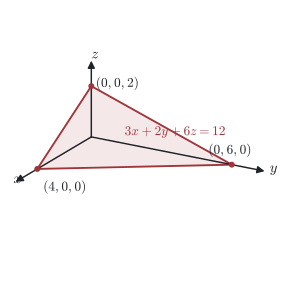
Example 5 Find the points where the plane \(3x + 2y + 6z = 12\) meets the coordinate axes.
\(y = z = 0\): \(\;3x = 12\), \(x = 4\). \(\quad x = z = 0\): \(\;2y = 12\), \(y = 6\). \(\quad x = y = 0\): \(\;6z = 12\), \(z = 2\).
The plane meets the axes at \((4, 0, 0)\), \((0, 6, 0)\) and \((0, 0, 2)\). The part of the plane between them is the triangle in Figure 1.
Special planes
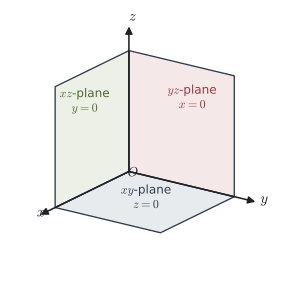
The three coordinate planes each contain two of the axes.
| Plane | Every point has | Normal | Vector form | Scalar-product form | Cartesian |
|---|---|---|---|---|---|
| \(xy\)-plane | \(z = 0\) | \(\boldsymbol{k}\) | \(\boldsymbol{r} = \lambda\boldsymbol{i} + \mu\boldsymbol{j}\) | \(\boldsymbol{r}\cdot\boldsymbol{k} = 0\) | \(z = 0\) |
| \(yz\)-plane | \(x = 0\) | \(\boldsymbol{i}\) | \(\boldsymbol{r} = \lambda\boldsymbol{j} + \mu\boldsymbol{k}\) | \(\boldsymbol{r}\cdot\boldsymbol{i} = 0\) | \(x = 0\) |
| \(xz\)-plane | \(y = 0\) | \(\boldsymbol{j}\) | \(\boldsymbol{r} = \lambda\boldsymbol{i} + \mu\boldsymbol{k}\) | \(\boldsymbol{r}\cdot\boldsymbol{j} = 0\) | \(y = 0\) |
Planes parallel to the axes Not in the formula booklet
- \(z = k\) is parallel to the \(xy\)-plane (normal \(\boldsymbol{k}\)). Similarly \(x = k\) and \(y = k\).
- If a variable is missing, the plane is parallel to that axis. For example, \(x + y = 3\) has normal \(\begin{pmatrix} 1 \\ 1 \\ 0 \end{pmatrix}\), which is perpendicular to \(\boldsymbol{k}\), so the plane is parallel to the \(z\)-axis.
- If also \(d = 0\), the plane contains that axis. For example, \(2x - y = 0\) contains the \(z\)-axis.
- \(k\): a constant
- \(\boldsymbol{k}\): the unit vector in the direction of the \(z\)-axis
- \(d\): the constant on the right-hand side of \(ax + by + cz = d\)
Example 6 The line \(L\) passes through \(A(2, -1, 4)\) and \(B(4, 2, -4)\). Find the coordinates of the point where \(L\) crosses
(a) the \(xy\)-plane, \(\qquad\) (b) the \(yz\)-plane.
\(\overrightarrow{AB} = \begin{pmatrix} 2 \\ 3 \\ -8 \end{pmatrix}\), so \(L: \boldsymbol{r} = \begin{pmatrix} 2 \\ -1 \\ 4 \end{pmatrix} + t\begin{pmatrix} 2 \\ 3 \\ -8 \end{pmatrix}\), that is \(x = 2 + 2t\), \(y = -1 + 3t\), \(z = 4 - 8t\).
(a) On the \(xy\)-plane \(z = 0\): \(\;4 - 8t = 0\), \(t = \dfrac{1}{2}\). The point is \(\left(3, \dfrac{1}{2}, 0\right)\).
(b) On the \(yz\)-plane \(x = 0\): \(\;2 + 2t = 0\), \(t = -1\). The point is \((0, -4, 12)\).
Common errors
| ✗ Wrong | ✓ Right | Why |
|---|---|---|
| Normal of \(2y - z = 0\) is \(\begin{pmatrix} 2 \\ -1 \\ 0 \end{pmatrix}\) | \(\begin{pmatrix} 0 \\ 2 \\ -1 \end{pmatrix}\) | A missing variable has coefficient \(0\) in its own place. |
| Direction of \(x = 3,\ \frac{y - 1}{2} = \frac{z + 4}{-1}\) is \(\begin{pmatrix} 3 \\ 2 \\ -1 \end{pmatrix}\) | \(\begin{pmatrix} 0 \\ 2 \\ -1 \end{pmatrix}\) | \(x\) is constant, so the line does not move in the \(x\)-direction. |
| The plane \(z = 2\) is “parallel to the \(z\)-axis” | It is parallel to the \(xy\)-plane | Its normal is \(\boldsymbol{k}\), so it is perpendicular to the \(z\)-axis. |
| Using \(\begin{pmatrix} a \\ b \\ c \end{pmatrix}\) of \(ax + by + cz = d\) as a direction in the plane | It is the normal | Directions in the plane are perpendicular to \(\begin{pmatrix} a \\ b \\ c \end{pmatrix}\). |
| \(x\)-intercept of \(3x + 2y + 6z = 12\) is \((12, 0, 0)\) | \((4, 0, 0)\) | Put \(y = z = 0\) and solve \(3x = 12\). |
Exercises
1 (a) Write down the Cartesian equation of the plane \(\boldsymbol{r}\cdot\begin{pmatrix} 5 \\ -2 \\ 1 \end{pmatrix} = 9\).
(b) Write down a normal vector to the plane \(4x + 7z = 3\).
(a) \(5x - 2y + z = 9\).
(b) \(\begin{pmatrix} 4 \\ 0 \\ 7 \end{pmatrix}\).
2 Find the Cartesian equation of the plane through \((3, -1, 2)\) with normal vector \(\begin{pmatrix} 2 \\ 4 \\ -1 \end{pmatrix}\). What do you notice about this plane?
\(d = 6 - 4 - 2 = 0\), so the plane is \(2x + 4y - z = 0\). Since \(d = 0\), the plane passes through the origin.
3 Find the Cartesian equation of the plane \(\boldsymbol{r} = \begin{pmatrix} 2 \\ 0 \\ -1 \end{pmatrix} + \lambda\begin{pmatrix} 1 \\ -1 \\ 2 \end{pmatrix} + \mu\begin{pmatrix} 3 \\ 0 \\ 1 \end{pmatrix}\).
\[ \boldsymbol{n} = \begin{pmatrix} 1 \\ -1 \\ 2 \end{pmatrix}\times\begin{pmatrix} 3 \\ 0 \\ 1 \end{pmatrix} = \begin{pmatrix} (-1)(1) - (2)(0) \\ (2)(3) - (1)(1) \\ (1)(0) - (-1)(3) \end{pmatrix} = \begin{pmatrix} -1 \\ 5 \\ 3 \end{pmatrix}. \]
\(d = -2 + 0 - 3 = -5\), so \(\;-x + 5y + 3z = -5\), or \(x - 5y - 3z = 5\).
4 Find a vector equation of the plane \(x + 2y - 4z = 8\).
Let \(y = \lambda\), \(z = \mu\). Then \(x = 8 - 2\lambda + 4\mu\):
\[ \boldsymbol{r} = \begin{pmatrix} 8 \\ 0 \\ 0 \end{pmatrix} + \lambda\begin{pmatrix} -2 \\ 1 \\ 0 \end{pmatrix} + \mu\begin{pmatrix} 4 \\ 0 \\ 1 \end{pmatrix}. \]
(Other answers are possible. Check: both directions are perpendicular to \(\begin{pmatrix} 1 \\ 2 \\ -4 \end{pmatrix}\).)
5 Find the coordinates of the points where the plane \(2x - 3y + 4z = 12\) meets the three axes.
\((6, 0, 0)\), \(\;(0, -4, 0)\), \(\;(0, 0, 3)\).
6 Write down the Cartesian equation of the plane that
(a) passes through \((2, -5, 7)\) and is parallel to the \(xz\)-plane;
(b) passes through \((1, 2, 3)\) and is parallel to the \(yz\)-plane;
(c) contains the \(z\)-axis and the point \((3, 4, 0)\).
(a) \(y = -5\). \(\qquad\) (b) \(x = 1\).
(c) The plane contains the \(z\)-axis, so it has the form \(ax + by = 0\). The point gives \(3a + 4b = 0\); take \(a = 4\), \(b = -3\): \(\;4x - 3y = 0\).
7 The line \(L\) passes through \(A(1, 3, -2)\) and \(B(4, -3, 4)\). Find where \(L\) crosses
(a) the \(xz\)-plane, \(\;\) (b) the \(xy\)-plane.
\(\overrightarrow{AB} = \begin{pmatrix} 3 \\ -6 \\ 6 \end{pmatrix}\): \(\;x = 1 + 3t\), \(y = 3 - 6t\), \(z = -2 + 6t\).
(a) \(y = 0\): \(t = \dfrac{1}{2}\), point \(\left(\dfrac{5}{2}, 0, 1\right)\).
(b) \(z = 0\): \(t = \dfrac{1}{3}\), point \((2, 1, 0)\).
8 Find the Cartesian equation of the plane that contains \(A(1, 0, 2)\) and \(B(2, -1, 1)\) and is parallel to the line \(\dfrac{x - 3}{2} = y = \dfrac{z + 1}{-3}\).
\(\overrightarrow{AB} = \begin{pmatrix} 1 \\ -1 \\ -1 \end{pmatrix}\) and the line’s direction is \(\begin{pmatrix} 2 \\ 1 \\ -3 \end{pmatrix}\).
\[ \boldsymbol{n} = \begin{pmatrix} 1 \\ -1 \\ -1 \end{pmatrix}\times\begin{pmatrix} 2 \\ 1 \\ -3 \end{pmatrix} = \begin{pmatrix} (-1)(-3) - (-1)(1) \\ (-1)(2) - (1)(-3) \\ (1)(1) - (-1)(2) \end{pmatrix} = \begin{pmatrix} 4 \\ 1 \\ 3 \end{pmatrix}. \]
\(d = 4 + 0 + 6 = 10\): \(\;4x + y + 3z = 10\). (Check with \(B\): \(8 - 1 + 3 = 10\) ✓.)
9 The point \((k, 2k, -1)\) lies on the plane \(3x - y + 2z = 6\). Find \(k\).
\(3k - 2k - 2 = 6\), so \(k = 8\).
10 The plane \(\Pi\) has equation \(6x + 3y + 2z = 18\). It meets the \(x\)-, \(y\)- and \(z\)-axes at \(A\), \(B\) and \(C\).
(a) Find the coordinates of \(A\), \(B\) and \(C\).
(b) Find the area of triangle \(ABC\).
(a) \(A(3, 0, 0)\), \(B(0, 6, 0)\), \(C(0, 0, 9)\).
(b) \(\overrightarrow{AB} = \begin{pmatrix} -3 \\ 6 \\ 0 \end{pmatrix}\), \(\overrightarrow{AC} = \begin{pmatrix} -3 \\ 0 \\ 9 \end{pmatrix}\).
\[ \overrightarrow{AB}\times\overrightarrow{AC} = \begin{pmatrix} (6)(9) - (0)(0) \\ (0)(-3) - (-3)(9) \\ (-3)(0) - (6)(-3) \end{pmatrix} = \begin{pmatrix} 54 \\ 27 \\ 18 \end{pmatrix} = 9\begin{pmatrix} 6 \\ 3 \\ 2 \end{pmatrix}. \]
Its length is \(9\sqrt{36 + 9 + 4} = 9 \times 7 = 63\), so the area is \(\dfrac{1}{2} \times 63 = \dfrac{63}{2}\).
(Notice that the vector product is a multiple of the normal \(\begin{pmatrix} 6 \\ 3 \\ 2 \end{pmatrix}\), as it should be.)