11.4 Polynomial and Rational Inequalities
AHL 2.15
- how to solve cubic inequalities by factorising and using a sketch or a sign diagram
- how to use a cubic inequality in a real-life model
- the rules for multiplying and dividing an inequality, and why you must never multiply by an expression whose sign you do not know
- how to solve rational inequalities such as \(\dfrac{f(x)}{g(x)} \geq 0\) using critical values
- how to use one answer to solve a related inequality with \(\ln x\), \(\mathrm{e}^x\) or \(|x|\)
An inequality contains one of the symbols \(<\), \(>\), \(\leq\) or \(\geq\). To solve an inequality in \(x\) means to find all the values of \(x\) that make it true. The answer is usually one or more intervals, not a few single numbers.
Inequalities involving cubic functions
Cubic inequalities are solved in the same way as quadratic inequalities (see Section 8.5). The idea is simple: a polynomial can only change sign where it is zero.
Solving a polynomial inequality
- Move every term to one side, so that the other side is \(0\): \(\;p(x) < 0\), \(p(x) \geq 0\), …
- Factorise \(p(x)\) (use the factor theorem to find a first factor).
- The zeros of \(p(x)\) are the critical values. Mark them on a number line or a sketch.
- Find the sign of \(p(x)\) in each interval. Use a sketch of \(y = p(x)\), or a sign diagram.
- Write the answer. Use \(\leq\) / \(\geq\) (closed ends) only if the inequality has \(\leq\) or \(\geq\).
A squared factor such as \((x - a)^2\) does not change sign at \(x = a\): the graph touches the axis there.
Methods for solving inequalities are not in the formula booklet.
For a cubic \(ax^3 + \cdots\) with \(a > 0\), the sketch goes from bottom left to top right. So with three different roots, the signs from right to left are \(+, -, +, -\).
Example 1 Find the set of values of \(x\) for which \(x^3 - 3x^2 - 6x + 8 < 0\).
Let \(p(x) = x^3 - 3x^2 - 6x + 8\). Try \(x = 1\): \(\;1 - 3 - 6 + 8 = 0\), so \((x - 1)\) is a factor (the factor theorem, Section 11.2).
\[ p(x) = (x - 1)(x^2 - 2x - 8) = (x - 1)(x - 4)(x + 2) \]
The critical values are \(x = -2\), \(1\) and \(4\). The coefficient of \(x^3\) is positive, so the graph goes from bottom left to top right (Figure 1).
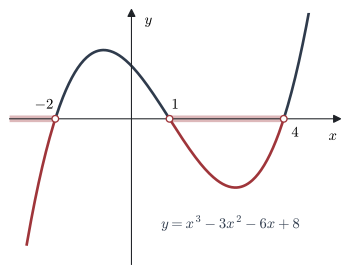
We need the graph below the \(x\)-axis:
\[ x < -2 \quad\text{or}\quad 1 < x < 4 . \]
The inequality is strict (\(<\)), so the critical values themselves are not included.
Many real-life models are cubic. On Paper 2 you may use a GDC to find the critical values, but you should still show a sketch with the important points.
Example 2 The number of fish in a lake during one year is modelled by
\[ P(t) = -t^3 + 21t^2 - 104t + 204, \qquad 0 \leq t \leq 12, \]
where \(P\) is in hundreds of fish and \(t\) is the time in months from the start of the year. Fishing is banned whenever the population is below \(12\,000\) fish. During which part of the year is fishing banned? Include a sketch of any graph you use.
\(12\,000\) fish means \(P = 120\). We need \(P(t) < 120\), that is
\[ -t^3 + 21t^2 - 104t + 84 < 0 . \]
By hand. \(t = 1\) gives \(-1 + 21 - 104 + 84 = 0\), so \((t - 1)\) is a factor. Factorising fully,
\[ -t^3 + 21t^2 - 104t + 84 = -(t - 1)(t - 6)(t - 14) . \]
Sketch. Draw \(y = P(t)\) and the line \(y = 120\) for \(0 \leq t \leq 12\) (Figure 2). The roots are \(t = 1\), \(6\) and \(14\), and \(14\) is outside the domain.
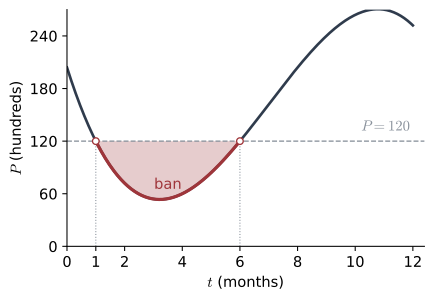
For \(1 < t < 6\): \(\;-(+)(-)(-) < 0\) ✓. For \(0 \leq t < 1\) or \(6 < t \leq 12\) the expression is positive.
So fishing is banned for \(1 < t < 6\): from the end of month 1 to the end of month 6 (that is, during months 2 to 6).
Graphs page: enter \(f_1(x) = -x^3 + 21x^2 - 104x + 204\) and \(f_2(x) = 120\). Set the window to the domain (Menu → Window / Zoom → Window Settings, \(x\) from \(0\) to \(12\)).
Menu → Analyze Graph → Intersection, then select the left and right bounds around each crossing. The calculator gives the points \((1, 120)\) and \((6, 120)\).
Read the answer from the graph: \(f_1 < f_2\) where the curve is below the line. Always copy a sketch with the intersection points into your answer.
Inequalities involving rational functions
Now we solve inequalities such as \(\dfrac{f(x)}{g(x)} > 0\), where \(f(x)\) and \(g(x)\) are polynomials. First, recall the basic rules.
Rules for inequalities Not in the formula booklet
- If \(a > b\) and \(c > 0\), then \(ac > bc\). \(\quad\) (multiplying by a positive number keeps the sign)
- If \(a > b\) and \(c < 0\), then \(ac < bc\). \(\quad\) (multiplying by a negative number reverses the sign)
- \(\dfrac{a}{b} > 0 \iff ab > 0\) \(\qquad\) and \(\qquad\) \(\dfrac{a}{b} < 0 \iff ab < 0\) \(\quad\) (\(b \neq 0\))
The same is true for dividing by a positive or a negative number.
- \(a\), \(b\): real numbers
- \(c\): the number you multiply both sides by
So the danger is multiplying by an expression like \((x - 3)\). It is positive for some \(x\) and negative for others, so we do not know whether to reverse the sign.
Solving a rational inequality
- Never multiply both sides by a denominator whose sign is unknown.
- Move everything to one side and write it as one fraction: \(\;\dfrac{N(x)}{D(x)} \geq 0\) (or \(>\), \(<\), \(\leq\)).
- Factorise the numerator and the denominator.
- Critical values: the zeros of the numerator and the zeros of the denominator.
- Use a sign diagram. Zeros of the denominator are never included (the fraction is undefined there).
Alternative for step 2: multiply both sides by \(D(x)^2\), which is positive (for \(D(x) \neq 0\)).
Methods for solving inequalities are not in the formula booklet.
In the first example the denominator is already a square, so it is positive. We may multiply by it safely.
Example 3 Without using a calculator, solve the inequality
\[ \frac{12}{(x + 2)^2} \geq \frac{x + 1}{x + 2} . \]
Hence solve \(\;\dfrac{12}{(\ln x + 2)^2} \geq \dfrac{\ln x + 1}{\ln x + 2}\).
The denominators are zero at \(x = -2\), so \(x \neq -2\). For \(x \neq -2\), \((x + 2)^2 > 0\). Multiply both sides by \((x + 2)^2\) (the sign stays the same):
\[ 12 \geq (x + 1)(x + 2) \;\Longrightarrow\; x^2 + 3x - 10 \leq 0 \;\Longrightarrow\; (x + 5)(x - 2) \leq 0 . \]
This quadratic is \(\leq 0\) between its roots: \(-5 \leq x \leq 2\). Now remove \(x = -2\):
\[ -5 \leq x < -2 \quad\text{or}\quad -2 < x \leq 2 . \]
Hence. The second inequality is the first one with \(x\) replaced by \(\ln x\). So
\[ -5 \leq \ln x < -2 \quad\text{or}\quad -2 < \ln x \leq 2 . \]
The function \(\mathrm{e}^x\) is increasing, so the inequality signs stay the same:
\[ \mathrm{e}^{-5} \leq x < \mathrm{e}^{-2} \quad\text{or}\quad \mathrm{e}^{-2} < x \leq \mathrm{e}^{2} . \]
A quadratic factor that is always positive can simply be divided out. It never changes the sign.
Example 4 (a) Show that \(2x^2 - 8x + 11\) is positive for all real values of \(x\).
(b) Hence, without using a calculator, solve the inequality \(\;\dfrac{x^2 - x - 6}{2x^3 - 8x^2 + 11x} > 0\).
(c) Use your answer to part (b) to solve the inequality \(\;\dfrac{x^2 - |x| - 6}{2|x|^3 - 8x^2 + 11|x|} > 0\).
(a) Complete the square:
\[ 2x^2 - 8x + 11 = 2(x^2 - 4x) + 11 = 2(x - 2)^2 - 8 + 11 = 2(x - 2)^2 + 3 . \]
Since \((x - 2)^2 \geq 0\), the expression is at least \(3\), so it is always positive. (Or: the discriminant is \(64 - 88 = -24 < 0\) and the leading coefficient is positive.)
(b) Factorise:
\[ \frac{x^2 - x - 6}{2x^3 - 8x^2 + 11x} = \frac{(x - 3)(x + 2)}{x\,(2x^2 - 8x + 11)} . \]
The factor \(2x^2 - 8x + 11\) is always positive, so the sign is the same as the sign of \(\dfrac{(x - 3)(x + 2)}{x}\). Critical values: \(-2\), \(0\) (denominator) and \(3\).
| \(x < -2\) | \(-2 < x < 0\) | \(0 < x < 3\) | \(x > 3\) | |
|---|---|---|---|---|
| \(x + 2\) | \(-\) | \(+\) | \(+\) | \(+\) |
| \(x\) | \(-\) | \(-\) | \(+\) | \(+\) |
| \(x - 3\) | \(-\) | \(-\) | \(-\) | \(+\) |
| fraction | \(-\) | \(+\) | \(-\) | \(+\) |
So \(\;-2 < x < 0\;\) or \(\;x > 3\).
(c) Since \(x^2 = |x|^2\), the new inequality is the inequality in (b) with \(x\) replaced by \(|x|\). So
\[ -2 < |x| < 0 \quad\text{or}\quad |x| > 3 . \]
\(|x| < 0\) is impossible, so only \(|x| > 3\) is left: \(\;x < -3\;\) or \(\;x > 3\).
When there are fractions on both sides, subtract to get one fraction, then use a sign diagram.
Example 5 Without using a calculator, solve the inequality \(\;\dfrac{x + 1}{x - 3} \geq \dfrac{x - 2}{x + 1}\).
Hence solve \(\;\dfrac{\mathrm{e}^x + 1}{\mathrm{e}^x - 3} \geq \dfrac{\mathrm{e}^x - 2}{\mathrm{e}^x + 1}\).
Do not cross-multiply: we do not know the signs of \(x - 3\) and \(x + 1\). Subtract instead:
\[ \frac{x + 1}{x - 3} - \frac{x - 2}{x + 1} \geq 0 \;\Longrightarrow\; \frac{(x + 1)^2 - (x - 2)(x - 3)}{(x - 3)(x + 1)} \geq 0 . \]
The numerator is \(x^2 + 2x + 1 - (x^2 - 5x + 6) = 7x - 5\). So we need
\[ \frac{7x - 5}{(x - 3)(x + 1)} \geq 0 . \]
Critical values: \(x = \dfrac{5}{7}\) (numerator, included) and \(x = -1\), \(x = 3\) (denominator, excluded). Test one value in each interval, for example \(x = 4\) gives \(\dfrac{23}{5 \times 5} > 0\). The signs then alternate, because every factor appears only once (Figure 3).
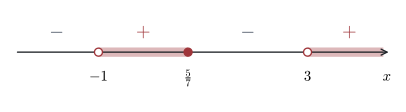
\[ -1 < x \leq \frac{5}{7} \quad\text{or}\quad x > 3 . \]
Hence. Replace \(x\) by \(\mathrm{e}^x\):
\[ -1 < \mathrm{e}^x \leq \frac{5}{7} \quad\text{or}\quad \mathrm{e}^x > 3 . \]
Since \(\mathrm{e}^x > 0\) for every \(x\), the condition \(-1 < \mathrm{e}^x\) is always true. Taking \(\ln\) (an increasing function):
\[ x \leq \ln \frac{5}{7} \quad\text{or}\quad x > \ln 3 . \]
Common errors
| ✗ Wrong | ✓ Right | Why |
|---|---|---|
| \(x^3 > 4x \Rightarrow x^2 > 4\) | \(x^3 - 4x > 0 \Rightarrow x(x - 2)(x + 2) > 0\) | Dividing by \(x\) is not allowed: \(x\) may be negative or zero. |
| \(\dfrac{x + 1}{x - 3} \geq \dfrac{x - 2}{x + 1} \Rightarrow (x + 1)^2 \geq (x - 2)(x - 3)\) | Subtract and use one fraction | Cross-multiplying assumes both denominators are positive. |
| \(-1 \leq x \leq \frac{5}{7}\) | \(-1 < x \leq \frac{5}{7}\) | A zero of the denominator is never part of the answer. |
| Signs always alternate | Check repeated factors | \((x - a)^2\) does not change sign at \(x = a\). |
| \(-1 < \mathrm{e}^x \leq \frac{5}{7} \Rightarrow \ln(-1) < x \leq \ln \frac{5}{7}\) | \(x \leq \ln \frac{5}{7}\) | \(\ln(-1)\) does not exist; \(\mathrm{e}^x > -1\) is true for all \(x\). |
| Giving only critical values, e.g. “\(x = -2, 1, 4\)” | Give intervals | The solution of an inequality is a set of intervals. |
Exercises
1 Solve \(x^3 - 7x + 6 \leq 0\).
\(x = 1\): \(1 - 7 + 6 = 0\), so \(x^3 - 7x + 6 = (x - 1)(x^2 + x - 6) = (x - 1)(x + 3)(x - 2)\).
Critical values \(-3, 1, 2\). A positive cubic is negative to the left of the smallest root and between the middle and largest roots:
\[ x \leq -3 \quad\text{or}\quad 1 \leq x \leq 2 . \]
2 Solve \(x^3 - 3x + 2 > 0\).
\(x = 1\) is a root: \(x^3 - 3x + 2 = (x - 1)(x^2 + x - 2) = (x - 1)^2(x + 2)\).
\((x - 1)^2 \geq 0\), and it is \(0\) only at \(x = 1\). So the expression is positive when \(x + 2 > 0\) and \(x \neq 1\):
\[ x > -2, \quad x \neq 1 \qquad (\text{that is, } -2 < x < 1 \text{ or } x > 1). \]
3 Solve \(x^3 > 4x\).
\(x^3 - 4x > 0 \Rightarrow x(x - 2)(x + 2) > 0\). Critical values \(-2, 0, 2\).
\[ -2 < x < 0 \quad\text{or}\quad x > 2 . \]
(Dividing by \(x\) would lose the interval \(-2 < x < 0\).)
4 Solve \(2x^3 + x^2 - 13x + 6 \geq 0\).
\(x = 2\): \(16 + 4 - 26 + 6 = 0\). So \(2x^3 + x^2 - 13x + 6 = (x - 2)(2x^2 + 5x - 3) = (x - 2)(2x - 1)(x + 3)\).
Critical values \(-3, \frac{1}{2}, 2\), leading coefficient positive:
\[ -3 \leq x \leq \frac{1}{2} \quad\text{or}\quad x \geq 2 . \]
5 Solve \(\dfrac{2x - 1}{x + 3} \leq 1\).
\[ \frac{2x - 1}{x + 3} - 1 \leq 0 \;\Longrightarrow\; \frac{2x - 1 - (x + 3)}{x + 3} \leq 0 \;\Longrightarrow\; \frac{x - 4}{x + 3} \leq 0 . \]
Critical values \(-3\) (excluded) and \(4\) (included). The fraction is negative between them:
\[ -3 < x \leq 4 . \]
6 Solve \(\dfrac{6}{x - 1} > x\).
\[ \frac{6 - x(x - 1)}{x - 1} > 0 \;\Longrightarrow\; \frac{-(x^2 - x - 6)}{x - 1} > 0 \;\Longrightarrow\; \frac{(x - 3)(x + 2)}{x - 1} < 0 . \]
Critical values \(-2, 1, 3\). Signs from the right: \(+, -, +, -\). We need the negative intervals:
\[ x < -2 \quad\text{or}\quad 1 < x < 3 . \]
7 Solve \(\dfrac{3}{x + 1} < \dfrac{2}{x - 1}\).
\[ \frac{3}{x + 1} - \frac{2}{x - 1} < 0 \;\Longrightarrow\; \frac{3(x - 1) - 2(x + 1)}{(x + 1)(x - 1)} < 0 \;\Longrightarrow\; \frac{x - 5}{(x + 1)(x - 1)} < 0 . \]
Critical values \(-1, 1, 5\); signs from the right \(+, -, +, -\):
\[ x < -1 \quad\text{or}\quad 1 < x < 5 . \]
8 (a) Show that \(x^2 + 2x + 5 > 0\) for all real \(x\).
(b) Hence solve \(\dfrac{x^2 - 9}{x^3 + 2x^2 + 5x} \leq 0\).
(a) \(x^2 + 2x + 5 = (x + 1)^2 + 4 \geq 4 > 0\).
(b) \(\dfrac{(x - 3)(x + 3)}{x(x^2 + 2x + 5)} \leq 0\) has the same sign as \(\dfrac{(x - 3)(x + 3)}{x}\). Critical values \(-3\), \(0\) (excluded), \(3\); signs from the right \(+, -, +, -\):
\[ x \leq -3 \quad\text{or}\quad 0 < x \leq 3 . \]
9 (a) Solve \(\dfrac{2x - 5}{x - 1} \geq 1\).
(b) Hence solve \(\dfrac{2\mathrm{e}^x - 5}{\mathrm{e}^x - 1} \geq 1\).
(a) \(\dfrac{2x - 5 - (x - 1)}{x - 1} \geq 0 \Rightarrow \dfrac{x - 4}{x - 1} \geq 0\). Critical values \(1\) (excluded) and \(4\) (included): \(\;x < 1\;\) or \(\;x \geq 4\).
(b) Replace \(x\) by \(\mathrm{e}^x\): \(\;\mathrm{e}^x < 1\;\) or \(\;\mathrm{e}^x \geq 4\), so
\[ x < 0 \quad\text{or}\quad x \geq \ln 4 . \]
10 A particle moves along a straight line. Its displacement from a point \(O\) at time \(t\) seconds is \(s(t) = t^3 - 9t^2 + 23t - 15\) metres, \(t \geq 0\). Find the times when the particle is on the positive side of \(O\).
\(s(1) = 1 - 9 + 23 - 15 = 0\), so \(s(t) = (t - 1)(t^2 - 8t + 15) = (t - 1)(t - 3)(t - 5)\).
We need \(s(t) > 0\). With \(t \geq 0\) and roots \(1, 3, 5\):
\[ 1 < t < 3 \quad\text{or}\quad t > 5 . \]
(At \(t = 0\), \(s = -15 < 0\), so the particle starts on the negative side.)