28.5 Volumes of Revolution
AHL 5.17
- what a solid of revolution is, and how a cylinder, a sphere and a cone are made by rotating simple regions
- why the volume of a solid of revolution about the \(x\)-axis is \(V = \displaystyle\int_a^b \pi y^2\,\mathrm{d}x\)
- the volume of revolution about the \(y\)-axis: \(V = \displaystyle\int_c^d \pi x^2\,\mathrm{d}y\)
- how to find the volume when the region lies between two curves, or is made of two parts
- how to solve a problem in context (a bowl)
Solids of revolution
When a region in a plane turns through a full turn (\(360°\), or \(2\pi\) radians) about a line in that plane, it sweeps out a solid of revolution. The line is the axis of revolution.
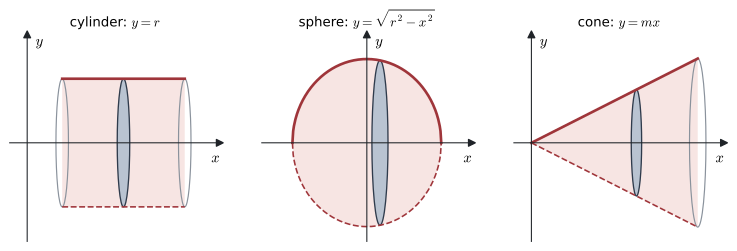
Three familiar solids are made in this way (about the \(x\)-axis):
- a cylinder: rotate the region under a horizontal line \(y = r\), from \(x = a\) to \(x = b\);
- a sphere: rotate the region under a semicircle \(y = \sqrt{r^2 - x^2}\), whose diameter lies on the \(x\)-axis;
- a cone: rotate the region under a line \(y = mx\) (\(m \neq 0\)), from \(x = 0\) to \(x = h\).
Volume of revolution about the \(x\)-axis
Let \(R\) be the region under \(y = f(x)\) (with \(f(x) \geq 0\)) from \(x = a\) to \(x = b\). Rotate \(R\) about the \(x\)-axis. Each cross-section of the solid at right angles to the \(x\)-axis is a circle with radius \(y\).
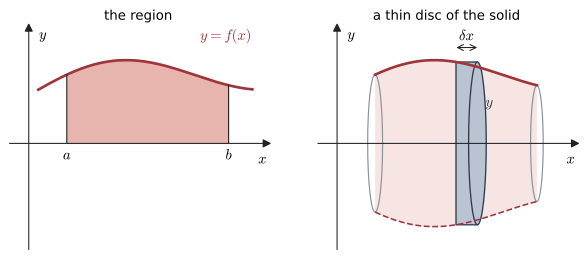
Cut the solid into thin slices of thickness \(\delta x\). Each slice is almost a disc (a short cylinder) of radius \(y\), so
\[ \delta V \approx \pi y^2\,\delta x . \]
Adding all the discs and letting \(\delta x \to 0\), as in Section 28.2:
\[ V = \lim_{\delta x \to 0}\sum_{x = a}^{b} \pi y^2\,\delta x = \int_a^b \pi y^2\,\mathrm{d}x . \]
Volume of revolution about the \(x\)-axis In the HL formula booklet
When the region under \(y = f(x)\) from \(x = a\) to \(x = b\) is rotated through \(2\pi\) about the \(x\)-axis,
\[ V = \int_a^b \pi y^2\,\mathrm{d}x = \pi\int_a^b \big[f(x)\big]^2\,\mathrm{d}x . \]
- \(V\): the volume of the solid of revolution
- \(a\): the lower limit
- \(b\): the upper limit
- \(y\): the curve, \(y = f(x)\) (the radius of each disc)
Check with a cone. Rotate \(y = \dfrac{r}{h}x\), \(0 \leq x \leq h\): \(\;V = \pi\displaystyle\int_0^h \frac{r^2}{h^2}x^2\,\mathrm{d}x = \pi\frac{r^2}{h^2} \cdot \frac{h^3}{3} = \frac{1}{3}\pi r^2 h\), the usual formula.
The formula uses \(y^2\), so it works even if part of the curve is below the \(x\)-axis.
Example 1 Find the exact volume of the solid formed when the region under \(y = 2 + x^2\) from \(x = 0\) to \(x = 1\) is rotated through \(360°\) about the \(x\)-axis.
\[ V = \pi\int_0^1 (2 + x^2)^2\,\mathrm{d}x = \pi\int_0^1 (4 + 4x^2 + x^4)\,\mathrm{d}x = \pi\Big[4x + \tfrac{4x^3}{3} + \tfrac{x^5}{5}\Big]_0^1 = \pi\left(4 + \tfrac{4}{3} + \tfrac{1}{5}\right) = \frac{83\pi}{15}. \]
Expand \((2 + x^2)^2\) first: you cannot square the antiderivative instead.
Volume of revolution about the \(y\)-axis
Now take the region between the curve \(x = g(y)\) and the \(y\)-axis, from \(y = a\) to \(y = b\), and rotate it about the \(y\)-axis. The slices are horizontal discs of radius \(x\) and thickness \(\delta y\).
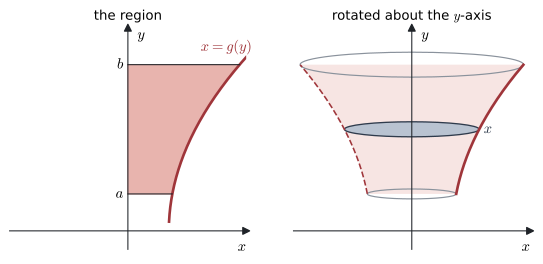
Volume of revolution about the \(y\)-axis In the HL formula booklet
When the region between \(x = g(y)\) and the \(y\)-axis, from \(y = a\) to \(y = b\), is rotated through \(2\pi\) about the \(y\)-axis,
\[ V = \int_a^b \pi x^2\,\mathrm{d}y = \pi\int_a^b \big[g(y)\big]^2\,\mathrm{d}y . \]
- \(V\): the volume of the solid of revolution
- \(a\): the lower limit
- \(b\): the upper limit
- \(x\): the curve, \(x = g(y)\) (the radius of each disc)
To use it, write \(x^2\) in terms of \(y\), and use \(y\)-values as the limits.
Example 2 Consider the curve \(y = 4 - x^2\), \(x \geq 0\).
(a) The region bounded by the curve and the \(x\)-axis (and the \(y\)-axis) is rotated through \(2\pi\) about the \(x\)-axis. Find the exact volume.
(b) The region bounded by the curve and the \(y\)-axis (and the \(x\)-axis) is rotated through \(2\pi\) about the \(y\)-axis. Find the volume, to 4 significant figures.
The curve meets the \(x\)-axis at \(x = 2\) and the \(y\)-axis at \(y = 4\).
(a) \[ V = \pi\int_0^2 (4 - x^2)^2\,\mathrm{d}x = \pi\int_0^2 (16 - 8x^2 + x^4)\,\mathrm{d}x = \pi\left(32 - \tfrac{64}{3} + \tfrac{32}{5}\right) = \frac{256\pi}{15}. \]
(b) \(x^2 = 4 - y\), and \(y\) goes from \(0\) to \(4\).
\[ V = \pi\int_0^4 (4 - y)\,\mathrm{d}y = \pi\Big[4y - \tfrac{y^2}{2}\Big]_0^4 = 8\pi \approx 25.13 . \]
The two solids are different: the same region gives different volumes about different axes.
Calculator page: Menu → Calculus → Numerical Integral, and type the whole expression, including \(\pi\) and the square. For example, rotating \(y = x\mathrm{e}^{-x}\), \(0 \leq x \leq 2\), about the \(x\)-axis: \(\displaystyle\int_0^2 \pi\left(x\mathrm{e}^{-x}\right)^2\mathrm{d}x = 0.59839\ldots \approx 0.598\).
About the \(y\)-axis, first write \(x\) in terms of \(y\), then integrate with respect to \(y\) (type y as the variable in the template).
Rotating regions between two curves
If the region between an upper curve \(y_1\) and a lower curve \(y_2\) (both \(\geq 0\)) is rotated about the \(x\)-axis, the solid has a hole in it. Each slice is a washer: a disc of radius \(y_1\) with a disc of radius \(y_2\) removed. So
\[ V = \pi\int_a^b \left(y_1^{\,2} - y_2^{\,2}\right)\mathrm{d}x . \]
Note: this is \(\pi\int (y_1^{\,2} - y_2^{\,2})\), not \(\pi\int (y_1 - y_2)^2\).
Example 3 (a) Find the area enclosed by the curve \(y = x^2\) and the line \(y = 3x\).
(b) The region enclosed by \(y = x^2\) and \(y = 3x\) is rotated through \(2\pi\) about the \(x\)-axis. Show that the volume of the solid is \(\dfrac{162\pi}{5}\).
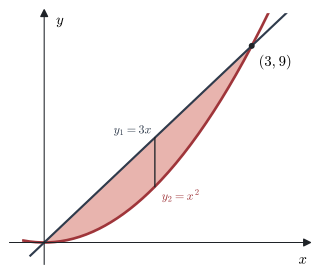
\(x^2 = 3x \Rightarrow x = 0\) or \(x = 3\). The line is above the curve between them.
(a) \[ A = \int_0^3 (3x - x^2)\,\mathrm{d}x = \Big[\tfrac{3x^2}{2} - \tfrac{x^3}{3}\Big]_0^3 = \tfrac{27}{2} - 9 = \tfrac{9}{2}. \]
(b) Outer radius \(3x\), inner radius \(x^2\):
\[ V = \pi\int_0^3 \left[(3x)^2 - (x^2)^2\right]\mathrm{d}x = \pi\int_0^3 (9x^2 - x^4)\,\mathrm{d}x = \pi\Big[3x^3 - \tfrac{x^5}{5}\Big]_0^3 = \pi\left(81 - \tfrac{243}{5}\right) = \frac{162\pi}{5}. \]
If the region is made of parts that lie under different curves, find the volume of each part and add.
Example 4 The finite region bounded by the curves \(y = (x - 1)^2\) and \(y = \dfrac{8}{x - 1}\), the line \(x = 5\) and the \(x\)-axis is rotated through \(2\pi\) about the \(x\)-axis. Find the exact volume of the solid formed.
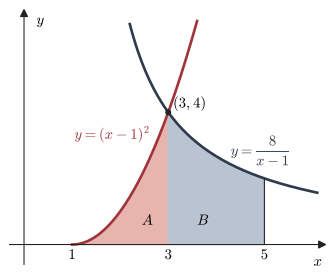
The curves meet where \((x - 1)^2 = \dfrac{8}{x - 1}\), so \((x - 1)^3 = 8\), \(x - 1 = 2\), \(x = 3\) (the point \((3, 4)\)). The curve \(y = (x - 1)^2\) meets the \(x\)-axis at \(x = 1\).
Part \(A\) (\(1 \leq x \leq 3\), under \(y = (x - 1)^2\)):
\[ V_A = \pi\int_1^3 (x - 1)^4\,\mathrm{d}x = \pi\Big[\tfrac{(x - 1)^5}{5}\Big]_1^3 = \frac{32\pi}{5}. \]
Part \(B\) (\(3 \leq x \leq 5\), under \(y = \frac{8}{x - 1}\)):
\[ V_B = \pi\int_3^5 \frac{64}{(x - 1)^2}\,\mathrm{d}x = \pi\Big[-\tfrac{64}{x - 1}\Big]_3^5 = \pi(-16 + 32) = 16\pi . \]
\[ V = \frac{32\pi}{5} + 16\pi = \frac{112\pi}{5}. \]
Example 5 Part of the curve \(y = ax^2\), where \(a\) is a positive constant, is rotated about the \(y\)-axis to form the curved surface of an open bowl. The bowl has a horizontal circular base of radius \(r\) and a horizontal circular rim of radius \(2r\).
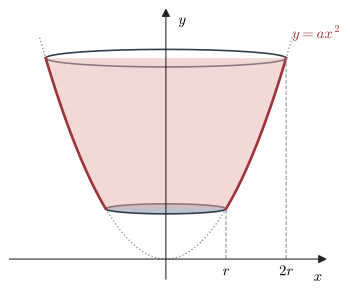
(a) Show that the depth of the bowl is \(3ar^2\).
(b) Find the volume of the bowl in terms of \(r\) and \(a\).
(c) Given that the volume of the bowl is \(\dfrac{30\pi}{a^3}\), find the depth of the bowl in terms of \(a\) only.
(a) The base is at \(x = r\), so \(y = ar^2\). The rim is at \(x = 2r\), so \(y = 4ar^2\). Depth \(= 4ar^2 - ar^2 = 3ar^2\).
(b) On the curve, \(x^2 = \dfrac{y}{a}\). Rotate about the \(y\)-axis from \(y = ar^2\) to \(y = 4ar^2\):
\[ V = \pi\int_{ar^2}^{4ar^2} \frac{y}{a}\,\mathrm{d}y = \frac{\pi}{a}\Big[\tfrac{y^2}{2}\Big]_{ar^2}^{4ar^2} = \frac{\pi}{2a}\left(16a^2r^4 - a^2r^4\right) = \frac{15\pi a r^4}{2}. \]
(c) \(\dfrac{15\pi a r^4}{2} = \dfrac{30\pi}{a^3} \Rightarrow r^4 = \dfrac{4}{a^4} \Rightarrow r^2 = \dfrac{2}{a^2}\) (since \(r^2 > 0\)).
Depth \(= 3ar^2 = 3a \times \dfrac{2}{a^2} = \dfrac{6}{a}\).
Common errors
| ✗ Wrong | ✓ Right | Why |
|---|---|---|
| \(V = \pi\displaystyle\int_a^b y\,\mathrm{d}x\) | \(V = \pi\displaystyle\int_a^b y^2\,\mathrm{d}x\) | The area of each disc is \(\pi y^2\). |
| Forgetting \(\pi\) | Keep \(\pi\) in front | Each slice is a circle. |
| \(\pi\displaystyle\int (y_1 - y_2)^2\,\mathrm{d}x\) for a washer | \(\pi\displaystyle\int (y_1^{\,2} - y_2^{\,2})\,\mathrm{d}x\) | Outer disc minus inner disc. |
| \(x\)-limits in \(\pi\displaystyle\int x^2\,\mathrm{d}y\) | \(y\)-limits | The variable is \(y\). |
| Squaring the antiderivative instead of the function | Expand \(\big[f(x)\big]^2\) first | \(\int f^2 \neq \left(\int f\right)^2\). |
| Using a revolution through \(\pi\) | A full turn is \(2\pi\) (\(360°\), “four right angles”) | The formula is for a complete turn. |
Exercises
1 The region under \(y = 2x\) from \(x = 0\) to \(x = 3\) is rotated through \(2\pi\) about the \(x\)-axis. Find the volume, and check your answer with the formula for a cone.
\(V = \pi\displaystyle\int_0^3 4x^2\,\mathrm{d}x = \pi\Big[\tfrac{4x^3}{3}\Big]_0^3 = 36\pi\).
Cone: \(r = 6\), \(h = 3\): \(\frac{1}{3}\pi \times 36 \times 3 = 36\pi\) ✓.
2 Find the volume when the region under \(y = \sqrt{x}\) from \(x = 0\) to \(x = 4\) is rotated through \(2\pi\) about the \(x\)-axis.
\(V = \pi\displaystyle\int_0^4 x\,\mathrm{d}x = \pi\Big[\tfrac{x^2}{2}\Big]_0^4 = 8\pi\).
3 Find the volume when the region under \(y = x^2 + 1\) from \(x = 0\) to \(x = 1\) is rotated through \(2\pi\) about the \(x\)-axis.
\(V = \pi\displaystyle\int_0^1 (x^4 + 2x^2 + 1)\,\mathrm{d}x = \pi\left(\tfrac{1}{5} + \tfrac{2}{3} + 1\right) = \dfrac{28\pi}{15}\).
4 Find the volume when the region under \(y = \dfrac{1}{x}\) from \(x = 1\) to \(x = 3\) is rotated through \(2\pi\) about the \(x\)-axis.
\(V = \pi\displaystyle\int_1^3 x^{-2}\,\mathrm{d}x = \pi\Big[-\tfrac{1}{x}\Big]_1^3 = \pi\left(1 - \tfrac{1}{3}\right) = \dfrac{2\pi}{3}\).
5 Find the exact volume when the region under \(y = \mathrm{e}^x\) from \(x = 0\) to \(x = \ln 2\) is rotated through \(2\pi\) about the \(x\)-axis.
\(V = \pi\displaystyle\int_0^{\ln 2} \mathrm{e}^{2x}\,\mathrm{d}x = \pi\Big[\tfrac{1}{2}\mathrm{e}^{2x}\Big]_0^{\ln 2} = \dfrac{\pi}{2}(4 - 1) = \dfrac{3\pi}{2}\).
6 Find the exact volume when the region under \(y = \sec x\) from \(x = 0\) to \(x = \dfrac{\pi}{4}\) is rotated through \(2\pi\) about the \(x\)-axis.
\(V = \pi\displaystyle\int_0^{\frac{\pi}{4}} \sec^2 x\,\mathrm{d}x = \pi\Big[\tan x\Big]_0^{\frac{\pi}{4}} = \pi\).
7 The region bounded by \(y = x^2\) (\(x \geq 0\)), the \(y\)-axis and the line \(y = 4\) is rotated through \(2\pi\) about the \(y\)-axis. Find the volume.
\(x^2 = y\). \(\;V = \pi\displaystyle\int_0^4 y\,\mathrm{d}y = \pi\Big[\tfrac{y^2}{2}\Big]_0^4 = 8\pi\).
8 The region bounded by \(y = \ln x\), the \(y\)-axis, and the lines \(y = 0\) and \(y = 1\) is rotated through \(2\pi\) about the \(y\)-axis. Find the exact volume.
\(x = \mathrm{e}^y\), so \(x^2 = \mathrm{e}^{2y}\). \(\;V = \pi\displaystyle\int_0^1 \mathrm{e}^{2y}\,\mathrm{d}y = \pi\Big[\tfrac{1}{2}\mathrm{e}^{2y}\Big]_0^1 = \dfrac{\pi(\mathrm{e}^2 - 1)}{2}\).
9 The region enclosed by \(y = x\) and \(y = x^2\) is rotated through \(2\pi\) about the \(x\)-axis. Find the volume.
They meet at \(x = 0, 1\); \(y = x\) is above. \(\;V = \pi\displaystyle\int_0^1 (x^2 - x^4)\,\mathrm{d}x = \pi\left(\tfrac{1}{3} - \tfrac{1}{5}\right) = \dfrac{2\pi}{15}\).
10 By rotating the region under \(y = \sqrt{r^2 - x^2}\), \(-r \leq x \leq r\), about the \(x\)-axis, show that the volume of a sphere of radius \(r\) is \(\dfrac{4}{3}\pi r^3\).
\(V = \pi\displaystyle\int_{-r}^{r} (r^2 - x^2)\,\mathrm{d}x = \pi\Big[r^2x - \tfrac{x^3}{3}\Big]_{-r}^{r} = \pi\left[\left(r^3 - \tfrac{r^3}{3}\right) - \left(-r^3 + \tfrac{r^3}{3}\right)\right] = \pi \times \tfrac{4r^3}{3} = \dfrac{4}{3}\pi r^3\).