29.2 Kinematics with Integration
SL 5.9
- how to go backwards: from acceleration to velocity, and from velocity to displacement, by integration
- how to use the initial conditions to find the constant of integration
- the difference between displacement \(\displaystyle\int_{t_1}^{t_2} v\,\mathrm{d}t\) and distance travelled \(\displaystyle\int_{t_1}^{t_2} |v|\,\mathrm{d}t\)
- how to find displacement and distance on the GDC in Paper 2
The integration rules are in Unit 27, and areas under curves are in Unit 28.
From acceleration to displacement
In Section 29.1 we differentiated: \(s \to v \to a\). Integration is the reverse process, so if we know \(a\) or \(v\) we can go back: \(a \to v \to s\).
Integration in kinematics Not in the formula booklet
\[ v = \int a\,\mathrm{d}t \qquad\qquad s = \int v\,\mathrm{d}t \]
Each integration gives a constant \(+\,c\). Find it from a known value, for example the velocity or the displacement when \(t = 0\) (the initial conditions).
- \(v\): the velocity
- \(a\): the acceleration
- \(t\): the time
- \(s\): the displacement from the fixed point \(O\)
The booklet gives only \(\int_{t_1}^{t_2} v(t)\,\mathrm{d}t\) for displacement (see below).
Words to look for: “starts from rest” means \(v = 0\) when \(t = 0\). “Passes through \(O\)” or “leaves \(O\)” means \(s = 0\) at that time.
Example 1 A particle moving in a straight line passes through a fixed point \(O\) with velocity \(8\ \mathrm{m\,s^{-1}}\). \(t\) seconds after passing \(O\), its acceleration is \(a = 6t - 14\ \mathrm{m\,s^{-2}}\).
(a) Find an expression for the velocity \(v\) in terms of \(t\).
(b) Find the displacement of the particle from \(O\) when \(t = 4\).
(c) Describe the motion of the particle when \(t = 4\). Justify your answer.
(a) \(v = \displaystyle\int (6t - 14)\,\mathrm{d}t = 3t^2 - 14t + c\). When \(t = 0\), \(v = 8\), so \(c = 8\): \[ v = 3t^2 - 14t + 8 . \]
(b) \(s = \displaystyle\int (3t^2 - 14t + 8)\,\mathrm{d}t = t^3 - 7t^2 + 8t + k\). When \(t = 0\), \(s = 0\), so \(k = 0\). \[ s(4) = 64 - 112 + 32 = -16 . \] The particle is \(16\) m from \(O\), on the negative side.
(c) \(v(4) = 48 - 56 + 8 = 0\) and \(a(4) = 24 - 14 = 10 > 0\). The particle is at instantaneous rest, and it is about to move in the positive direction. (Indeed \(v = (3t - 2)(t - 4)\) changes from negative to positive at \(t = 4\).)
Example 2 A particle moves in a straight line with velocity \(v = 30\mathrm{e}^{-\frac{t}{5}}\ \mathrm{m\,s^{-1}}\), where \(t\) is the time in seconds after it passes a fixed point \(O\). Find
(a) the initial acceleration of the particle,
(b) the displacement from \(O\) when \(t = 5\).
(a) \(a = \dfrac{\mathrm{d}v}{\mathrm{d}t} = 30 \cdot \left(-\dfrac{1}{5}\right)\mathrm{e}^{-\frac{t}{5}} = -6\mathrm{e}^{-\frac{t}{5}}\). When \(t = 0\): \(a = -6\ \mathrm{m\,s^{-2}}\).
(b) \(s = \displaystyle\int 30\mathrm{e}^{-\frac{t}{5}}\,\mathrm{d}t = -150\mathrm{e}^{-\frac{t}{5}} + c\). When \(t = 0\), \(s = 0\): \(\;0 = -150 + c\), so \(c = 150\). \[ s(5) = 150 - 150\mathrm{e}^{-1} = 150\left(1 - \frac{1}{\mathrm{e}}\right) \approx 94.8\ \text{m}. \]
Example 3 (a) A particle P moves along a horizontal straight line. Its displacement from a fixed point \(O\), \(t\) seconds after the motion begins, is \(s_P = t^3 + t^2 - 2t - 4\) metres. Find an expression for the velocity of P.
(b) A second particle Q starts at the same time and moves along the same line. Its acceleration is \(a_Q = 6t - 2\ \mathrm{m\,s^{-2}}\). Q has velocity \(3\ \mathrm{m\,s^{-1}}\) when \(t = 1\), and its initial displacement is \(2\) m. Find expressions for the velocity and the displacement of Q.
(c) Find the value of \(t\) when P and Q collide.
(d) Are P and Q moving in the same direction when they collide? Justify your answer.
(a) \(v_P = 3t^2 + 2t - 2\).
(b) \(v_Q = \displaystyle\int (6t - 2)\,\mathrm{d}t = 3t^2 - 2t + c\). \(\;v_Q(1) = 3\): \(\;3 - 2 + c = 3\), so \(c = 2\) and \(v_Q = 3t^2 - 2t + 2\).
\(s_Q = t^3 - t^2 + 2t + k\). \(\;s_Q(0) = 2\), so \(k = 2\) and \(s_Q = t^3 - t^2 + 2t + 2\).
(c) They collide when \(s_P = s_Q\): \[ t^3 + t^2 - 2t - 4 = t^3 - t^2 + 2t + 2 \;\Rightarrow\; 2t^2 - 4t - 6 = 0 \;\Rightarrow\; 2(t - 3)(t + 1) = 0 . \] Since \(t \ge 0\), they collide when \(t = 3\) s (both are at \(s = 26\) m).
(d) \(v_P(3) = 27 + 6 - 2 = 31 > 0\) and \(v_Q(3) = 27 - 6 + 2 = 23 > 0\). Both velocities are positive, so they move in the same direction (P catches Q from behind).
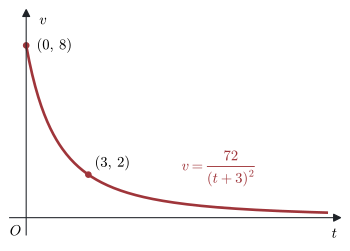
Example 4 A boat moves in a straight line. Its engine is turned off at time \(t = 0\). After that, its velocity is \[ v(t) = \frac{72}{(t + 3)^2}\ \mathrm{m\,s^{-1}} . \]
(a) Find the initial velocity, and the velocity after 3 seconds.
(b) Describe what happens to \(v(t)\) as \(t \to \infty\).
(c) Sketch the graph of \(v\) against \(t\).
(d) Find \(\displaystyle\int_0^3 v(t)\,\mathrm{d}t\) and interpret your answer.
(e) How long after the engine is turned off has the boat travelled \(16\) m?
(f) Will the boat ever travel \(30\) m? Explain.
(a) \(v(0) = \dfrac{72}{9} = 8\ \mathrm{m\,s^{-1}}\), \(\;v(3) = \dfrac{72}{36} = 2\ \mathrm{m\,s^{-1}}\).
(b) As \(t \to \infty\), \((t + 3)^2 \to \infty\), so \(v(t) \to 0\). The boat slows down and almost stops, but \(v\) never reaches \(0\).
(c)
(d) \[ \int_0^3 \frac{72}{(t + 3)^2}\,\mathrm{d}t = \left[-\frac{72}{t + 3}\right]_0^3 = -12 + 24 = 12 . \] In the first 3 seconds after the engine is turned off, the boat travels \(12\) m. (\(v > 0\), so displacement and distance are the same here.)
(e) Distance in the first \(T\) seconds: \[ \int_0^T \frac{72}{(t + 3)^2}\,\mathrm{d}t = 24 - \frac{72}{T + 3} = 16 \;\Rightarrow\; \frac{72}{T + 3} = 8 \;\Rightarrow\; T = 6 \text{ s}. \]
(f) No. The distance \(24 - \dfrac{72}{T + 3}\) is always less than \(24\) m, however large \(T\) is.
Distance and displacement
When \(v\) changes sign, the particle turns back. Then the displacement and the distance travelled are different.
Distance travelled and displacement from \(t_1\) to \(t_2\) In the formula booklet
\[ \text{distance} = \int_{t_1}^{t_2} \lvert v(t) \rvert\,\mathrm{d}t \qquad\qquad \text{displacement} = \int_{t_1}^{t_2} v(t)\,\mathrm{d}t \]
On a velocity–time graph, the distance is the total area between the graph and the \(t\)-axis. The displacement counts areas below the axis as negative.
- \(t_1\): the start time
- \(t_2\): the end time (\(t_2 > t_1\))
- \(v(t)\): the velocity at time \(t\)
- \(\lvert v(t) \rvert\): the speed at time \(t\)
Without a calculator (Paper 1): find where \(v = 0\), split the interval at those times, integrate on each part, and add the absolute values. With a GDC (Paper 2): integrate \(|v(t)|\) directly.
Example 5 A particle moves in a straight line with velocity \(v = t^2 - 6t + 8\ \mathrm{m\,s^{-1}}\), \(0 \le t \le 5\).
(a) Find the displacement of the particle from \(t = 0\) to \(t = 5\).
(b) Find the total distance travelled from \(t = 0\) to \(t = 5\).
Let \(F(t) = \dfrac{t^3}{3} - 3t^2 + 8t\), an antiderivative of \(v\).
(a) Displacement \(= F(5) - F(0) = \dfrac{125}{3} - 75 + 40 = \dfrac{20}{3}\) m.
(b) \(v = (t - 2)(t - 4)\), so \(v = 0\) at \(t = 2\) and \(t = 4\). \(v > 0\) on \((0, 2)\), \(v < 0\) on \((2, 4)\), \(v > 0\) on \((4, 5)\).
\(F(0) = 0\), \(\;F(2) = \dfrac{20}{3}\), \(\;F(4) = \dfrac{16}{3}\), \(\;F(5) = \dfrac{20}{3}\).
\[ \int_0^2 v\,\mathrm{d}t = \frac{20}{3}, \qquad \int_2^4 v\,\mathrm{d}t = \frac{16}{3} - \frac{20}{3} = -\frac{4}{3}, \qquad \int_4^5 v\,\mathrm{d}t = \frac{20}{3} - \frac{16}{3} = \frac{4}{3}. \]
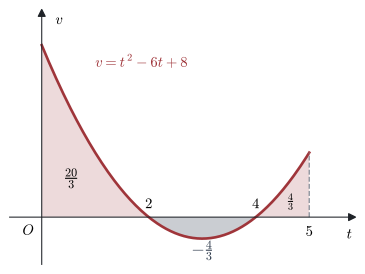
Distance \(= \dfrac{20}{3} + \dfrac{4}{3} + \dfrac{4}{3} = \dfrac{28}{3} \approx 9.33\) m.
Check: displacement \(= \dfrac{20}{3} - \dfrac{4}{3} + \dfrac{4}{3} = \dfrac{20}{3}\) ✓.
Example 6 Paper 2 A particle moves in a straight line with velocity \(v(t) = 6\cos t - t\ \mathrm{m\,s^{-1}}\), \(0 \le t \le 4\).
(a) Find the time when the particle changes direction.
(b) Find the displacement from \(t = 0\) to \(t = 4\).
(c) Find the total distance travelled from \(t = 0\) to \(t = 4\).
(a) Graph \(v\) and find its zero: \(t \approx 1.34\) s. (\(v\) changes from positive to negative there.)
(b) \(\displaystyle\int_0^4 (6\cos t - t)\,\mathrm{d}t \approx -12.5\) m. (Exactly, \(6\sin 4 - 8\).)
(c) \(\displaystyle\int_0^4 \lvert 6\cos t - t \rvert\,\mathrm{d}t \approx 22.4\) m.
- Calculator page → Menu → Calculus → Numerical Integral. Fill in the template: \(\displaystyle\int_0^4 (6\cos(x) - x)\,\mathrm{d}x\) gives the displacement, \(-12.5408\ldots\)
- For the distance, put the integrand inside an absolute value: type
abs(or use the \(|\square|\) template from the template palette. \(\displaystyle\int_0^4 \lvert 6\cos(x) - x \rvert\,\mathrm{d}x\) gives \(22.4271\ldots\) - To find when the particle changes direction: Graphs page, enter \(f1(x) = 6\cos(x) - x\), then Menu → Analyze Graph → Zero.
Use radian mode. Write your answers to 3 significant figures.
Common errors
| ✗ Wrong | ✓ Right | Why |
|---|---|---|
| Forgetting \(+\,c\) when integrating \(a\) or \(v\) | Add \(+\,c\) and use the initial conditions | The constant is usually not zero; see Example 1. |
| Distance \(= \displaystyle\int_{t_1}^{t_2} v\,\mathrm{d}t\) | Distance \(= \displaystyle\int_{t_1}^{t_2} \lvert v \rvert\,\mathrm{d}t\) | Parts where \(v < 0\) cancel the positive parts. |
| Taking the absolute value only at the end: \(\left\lvert \displaystyle\int v\,\mathrm{d}t \right\rvert\) | Split at the zeros of \(v\) first | \(\left\lvert \int v \right\rvert \ne \int \lvert v \rvert\) when \(v\) changes sign. |
| “From rest” means \(s = 0\) | “From rest” means \(v = 0\) | Rest is about velocity, not position. |
| Always taking \(s = 0\) when \(t = 0\) | Use the starting position given in the question | In Example 3, Q starts at \(s = 2\). |
Exercises
1 A particle starts at \(O\) with velocity \(3\ \mathrm{m\,s^{-1}}\). Its acceleration is \(a = 4t - 2\ \mathrm{m\,s^{-2}}\). Find \(v\) and \(s\) in terms of \(t\), and the displacement when \(t = 3\).
\(v = 2t^2 - 2t + 3\) (since \(v(0) = 3\)). \(\;s = \dfrac{2}{3}t^3 - t^2 + 3t\) (since \(s(0) = 0\)). \(s(3) = 18 - 9 + 9 = 18\) m.
2 A particle has velocity \(v = 3t^2 - 12t + 9\ \mathrm{m\,s^{-1}}\), \(0 \le t \le 4\). Find the displacement and the total distance travelled from \(t = 0\) to \(t = 4\).
\(F(t) = t^3 - 6t^2 + 9t\). Displacement \(= F(4) - F(0) = 64 - 96 + 36 = 4\) m.
\(v = 3(t - 1)(t - 3)\). \(F(0) = 0\), \(F(1) = 4\), \(F(3) = 0\), \(F(4) = 4\). Distance \(= 4 + 4 + 4 = 12\) m.
3 A particle has velocity \(v = 8 - 2t\ \mathrm{m\,s^{-1}}\), \(0 \le t \le 6\). Find the displacement and the distance travelled in this time.
Displacement \(= \displaystyle\int_0^6 (8 - 2t)\,\mathrm{d}t = 48 - 36 = 12\) m.
\(v = 0\) at \(t = 4\). \(\displaystyle\int_0^4 = 16\), \(\;\displaystyle\int_4^6 = 12 - 16 = -4\). Distance \(= 16 + 4 = 20\) m.
4 A particle leaves \(O\) with velocity \(v = 6\mathrm{e}^{-2t}\ \mathrm{m\,s^{-1}}\). Find its displacement \(s\) in terms of \(t\), and describe what happens to \(s\) as \(t \to \infty\).
\(s = -3\mathrm{e}^{-2t} + c\), \(\;s(0) = 0 \Rightarrow c = 3\), so \(s = 3\left(1 - \mathrm{e}^{-2t}\right)\). As \(t \to \infty\), \(s \to 3\): the particle gets closer and closer to the point \(3\) m from \(O\) but never reaches it.
5 A ball is thrown straight up from ground level with velocity \(15\ \mathrm{m\,s^{-1}}\). Its acceleration is \(-10\ \mathrm{m\,s^{-2}}\) (upwards is positive). Find
(a) \(v\) and \(s\) in terms of \(t\),
(b) the greatest height,
(c) the total distance travelled before it returns to the ground.
(a) \(v = 15 - 10t\), \(\;s = 15t - 5t^2\).
(b) \(v = 0\) at \(t = 1.5\): \(s = 22.5 - 11.25 = 11.25\) m.
(c) \(s = 0\) again at \(t = 3\). Distance \(= 11.25 + 11.25 = 22.5\) m.
6 A particle starts at \(O\) with velocity \(1\ \mathrm{m\,s^{-1}}\). Its acceleration is \(a = 6\cos 3t\ \mathrm{m\,s^{-2}}\). Find \(v\), \(s\), and the displacement when \(t = \dfrac{\pi}{3}\).
\(v = 2\sin 3t + c\), \(\;v(0) = 1 \Rightarrow c = 1\): \(\;v = 2\sin 3t + 1\).
\(s = -\dfrac{2}{3}\cos 3t + t + k\), \(\;s(0) = 0 \Rightarrow k = \dfrac{2}{3}\).
\(s\left(\dfrac{\pi}{3}\right) = -\dfrac{2}{3}\cos\pi + \dfrac{\pi}{3} + \dfrac{2}{3} = \dfrac{4}{3} + \dfrac{\pi}{3} = \dfrac{4 + \pi}{3}\) m.
7 A cyclist starts from rest. Her velocity increases steadily to \(6\ \mathrm{m\,s^{-1}}\) in 2 seconds, stays at \(6\ \mathrm{m\,s^{-1}}\) until \(t = 5\), then decreases steadily to \(0\) at \(t = 8\). Find the total distance travelled.
The distance is the area under the velocity–time graph (a trapezium): \(\dfrac{1}{2}(2)(6) + 3 \times 6 + \dfrac{1}{2}(3)(6) = 6 + 18 + 9 = 33\) m.
8 Particles A and B both start at \(O\) at \(t = 0\) and move along the same line, with velocities \(v_A = 2t + 1\) and \(v_B = 6 - t\ \mathrm{m\,s^{-1}}\).
(a) How far apart are they when \(t = 2\)?
(b) When do they meet again?
\(s_A = t^2 + t\), \(\;s_B = 6t - \dfrac{t^2}{2}\).
(a) \(s_A(2) = 6\), \(s_B(2) = 12 - 2 = 10\). They are \(4\) m apart.
(b) \(t^2 + t = 6t - \dfrac{t^2}{2} \Rightarrow \dfrac{3}{2}t^2 - 5t = 0 \Rightarrow t = \dfrac{10}{3}\) s.
9 A particle has velocity \(v = \dfrac{1}{t + 1}\ \mathrm{m\,s^{-1}}\), \(t \ge 0\). How long does it take to travel \(3\) m?
\(\displaystyle\int_0^T \frac{1}{t + 1}\,\mathrm{d}t = \ln(T + 1) = 3 \Rightarrow T = \mathrm{e}^3 - 1 \approx 19.1\) s.
10 Paper 2 A particle has velocity \(v = 4\sin t - 1\ \mathrm{m\,s^{-1}}\), \(0 \le t \le 4\). Find
(a) the times when it changes direction, \(\;\)
(b) the displacement, \(\;\)
(c) the total distance travelled, from \(t = 0\) to \(t = 4\).
(a) \(\sin t = \dfrac{1}{4}\): \(t \approx 0.253\) s and \(t \approx 2.89\) s.
(b) \(\displaystyle\int_0^4 (4\sin t - 1)\,\mathrm{d}t \approx 2.61\) m. (Exactly, \(-4\cos 4\).)
(c) \(\displaystyle\int_0^4 \lvert 4\sin t - 1 \rvert\,\mathrm{d}t \approx 7.60\) m.