2.5 Financial Applications
SL 1.4
- the difference between simple interest (arithmetic) and compound interest (geometric)
- the compound interest formula, including interest added several times a year
- how to model depreciation
- how to deal with regular deposits using a geometric series
- how to use the Finance Solver (TVM solver) on the TI-Nspire CX II
- how to use sequences and series in other real-life problems
Simple interest
With simple interest, the same amount of interest is added every year. It is always calculated on the original amount.
Simple interest Not in the formula booklet
\[ A = P(1 + rn) \]
- \(A\): the final amount
- \(P\): the original amount (the principal)
- \(r\): the interest rate per year, as a decimal
- \(n\): the number of years
The amounts \(P,\; P + Pr,\; P + 2Pr,\; \ldots\) form an arithmetic sequence with \(d = Pr\).
Example 1 Aiko invests €4000 in an account that pays 6% simple interest per year. How much does she have after 3 years?
The interest each year is \(0.06 \times 4000 = €240\).
\[ A = 4000(1 + 0.06 \times 3) = 4000 \times 1.18 = €4720 \]
Compound interest
With compound interest, the interest is added to the account, and next time interest is paid on the new total as well. Each year the amount is multiplied by the same number, so the amounts form a geometric sequence.
Interest is often added more than once a year: monthly (\(k = 12\)), quarterly (\(k = 4\)), half-yearly (\(k = 2\)). Then the rate for each period is \(\frac{r}{k}\%\), and there are \(kn\) periods.
Compound interest In the formula booklet
\[ FV = PV \times \left(1 + \frac{r}{100k}\right)^{kn} \]
- \(FV\): the future value
- \(PV\): the present value
- \(r\): the nominal annual interest rate, as a percentage (\(r\%\))
- \(k\): the number of compounding periods per year
- \(n\): the number of years
Example 2 An account pays 2.4% per year, compounded monthly. £1500 is deposited. Find the balance after 5 years, to the nearest penny.
\(PV = 1500\), \(r = 2.4\), \(k = 12\), \(n = 5\):
\[ FV = 1500 \times \left(1 + \frac{2.4}{100 \times 12}\right)^{12 \times 5} = 1500 \times 1.002^{60} = £1691.04 \]
Depreciation
Depreciation is a loss of value over time, for example of a car or a machine. If the value falls by \(r\%\) each year, then each year it is multiplied by \(1 - \frac{r}{100}\):
\[ \text{value after } n \text{ years} = PV \times \left(1 - \frac{r}{100}\right)^{n} . \]
Example 3 A machine costs $45 000. Its value falls by 12% each year. Find its value after 6 years, to the nearest dollar.
\[ 45\,000 \times 0.88^{6} = 20\,898.18\ldots \approx \$20\,898 \]
Regular deposits
If you deposit money every year, each deposit earns interest for a different number of years. The total is a geometric series.
Example 4 At the start of every year, Ms Tan deposits $1500 in an account paying 5% per year, compounded annually.
(a) Find the amount in the account at the end of the first year, and at the end of the second year.
(b) Show that the amount at the end of the \(n\)th year is \(\$31\,500\left(1.05^{n} - 1\right)\).
(c) At the end of which year does the amount first exceed $30 000?
(a) End of year 1: \(1500 \times 1.05 = \$1575\).
End of year 2: she adds $1500, then interest is paid: \((1575 + 1500) \times 1.05 = \$3228.75\).
(b) At the end of year \(n\), the last deposit has earned interest for 1 year, the one before for 2 years, …, and the first deposit for \(n\) years:
\[ 1500(1.05) + 1500(1.05)^2 + \cdots + 1500(1.05)^n . \]
This is a geometric series with \(u_1 = 1500 \times 1.05 = 1575\), \(r = 1.05\) and \(n\) terms:
\[ S_n = \frac{1575\left(1.05^{n} - 1\right)}{1.05 - 1} = \frac{1575}{0.05}\left(1.05^{n} - 1\right) = 31\,500\left(1.05^{n} - 1\right). \]
(c) Solve \(31\,500\left(1.05^{n} - 1\right) > 30\,000\):
\[ 1.05^{n} > 1 + \frac{30\,000}{31\,500} = 1.952\ldots \;\Longrightarrow\; n > \frac{\ln 1.952\ldots}{\ln 1.05} = 13.7\ldots \]
The amount first exceeds $30 000 at the end of the 14th year.
The Finance Solver (TVM solver)
On Paper 2, most compound interest questions are fastest with the Finance Solver. On a Calculator page: Menu → Finance → Finance Solver.
| Field | Meaning | Example: $5000 at 3% compounded monthly for 4 years |
|---|---|---|
| N | total number of compounding periods (\(kn\)) | \(12 \times 4 = 48\) |
| I(%) | nominal annual rate, as a percentage | \(3\) |
| PV | present value | \(-5000\) |
| Pmt | regular payment (0 for a single investment) | \(0\) |
| FV | future value | (unknown — press enter here) |
| PpY | payments per year | \(12\) |
| CpY | compounding periods per year | \(12\) |
Money that leaves you is negative; money that comes to you is positive. When you invest, PV is negative and FV is positive. When you borrow, PV is positive.
Move the cursor to the field you want to find and press [enter]. You can find any one of N, I(%), PV, Pmt or FV.
Example 5 Use the Finance Solver to answer each question.
(a) $12 000 is invested at 3.6% per year, compounded quarterly. Find the value after 6 years.
(b) How many years does it take for an investment to double at 4.2% per year, compounded monthly?
(c) What annual interest rate, compounded annually, makes $5000 grow to $7000 in 8 years?
(a) N \(= 24\), I \(= 3.6\), PV \(= -12\,000\), Pmt \(= 0\), PpY = CpY \(= 4\). Solve for FV: $14 878.85.
(b) I \(= 4.2\), PV \(= -1\), FV \(= 2\), Pmt \(= 0\), PpY = CpY \(= 12\). Solve for N: \(198.4\) months. So the money doubles after \(16.5\) years (it has doubled by the end of the 17th year).
(c) N \(= 8\), PV \(= -5000\), FV \(= 7000\), Pmt \(= 0\), PpY = CpY \(= 1\). Solve for I: 4.30% (3 s.f.).
You can check (c) by hand: \(\left(1 + \frac{r}{100}\right)^8 = 1.4\), so \(r = 100\left(1.4^{\frac{1}{8}} - 1\right) = 4.30\).
Other applications of sequences and series
Example 6 On its first swing, a pendulum moves through an angle of \(60^\circ\). On each later swing, the angle is \(\frac{5}{6}\) of the angle of the swing before.
(a) Find the angle of the 5th swing.
(b) Find the total angle covered in the first 5 swings.
(c) Find the total angle covered before the pendulum stops.
The angles form a geometric sequence with \(u_1 = 60\) and \(r = \frac{5}{6}\).
(a) \(u_5 = 60 \times \left(\frac{5}{6}\right)^4 = 28.9^\circ\) (3 s.f.).
(b) \(S_5 = \dfrac{60\left(1 - \left(\frac{5}{6}\right)^5\right)}{1 - \frac{5}{6}} = 215^\circ\) (3 s.f.).
(c) \(|r| < 1\), so \(S_\infty = \dfrac{60}{1 - \frac{5}{6}} = 360^\circ\).
Example 7 A square has sides of length 4 cm. A second square is drawn by joining the midpoints of the sides of the first square. This is repeated again and again.
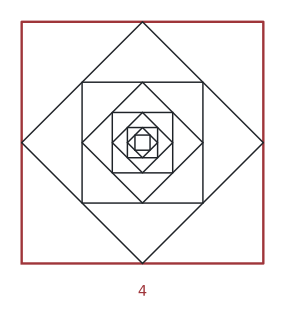
(a) Find the side lengths of the second, third and fourth squares.
(b) Find the total area of all the squares, if the process continues for ever.
(c) Show that the total perimeter of all the squares is \(32 + 16\sqrt{2}\) cm.
(a) Each new side joins two midpoints, so it is the hypotenuse of a right-angled triangle with both shorter sides equal to half the old side \(s\):
\[ \text{new side} = \sqrt{\left(\tfrac{s}{2}\right)^2 + \left(\tfrac{s}{2}\right)^2} = \frac{s}{\sqrt{2}} . \]
The sides are \(4,\; \dfrac{4}{\sqrt{2}} = 2\sqrt{2},\; 2,\; \sqrt{2}\) cm.
(b) The areas are \(16, 8, 4, 2, \ldots\), a geometric series with \(r = \frac{1}{2}\):
\[ S_\infty = \frac{16}{1 - \frac{1}{2}} = 32 \text{ cm}^2 . \]
(c) The perimeters are \(16,\; \dfrac{16}{\sqrt{2}},\; \ldots\), with \(r = \dfrac{1}{\sqrt{2}}\):
\[ S_\infty = \frac{16}{1 - \frac{1}{\sqrt{2}}} = \frac{16\sqrt{2}}{\sqrt{2} - 1} \times \frac{\sqrt{2} + 1}{\sqrt{2} + 1} = \frac{16(2 + \sqrt{2})}{2 - 1} = 32 + 16\sqrt{2} \text{ cm}. \]
Common errors
| ✗ Wrong | ✓ Right | Why |
|---|---|---|
| Using \(r = 5\) in \(1 + \frac{r}{100k}\) as \(1 + 5\) | \(1 + \frac{5}{100}\) | The formula needs the percentage divided by 100. |
| \(n = 5\) in the exponent for monthly interest | exponent \(kn = 60\) | The power is the number of periods, not years. |
| PV and FV both positive in the TVM solver | opposite signs | The solver gives an error or a wrong answer otherwise. |
| A 12% loss uses the factor \(1.12\) | \(0.88\) | Depreciation multiplies by \(1 - \frac{r}{100}\). |
| \(n = 13.7\), so “after 13 years” | the 14th year | The amount passes the target during the 14th year. |
Exercises
1 $2500 is invested at 4% simple interest per year. Find the total amount after 6 years.
\(2500(1 + 0.04 \times 6) = 2500 \times 1.24 = \$3100\).
2 $2500 is invested at 4% per year compounded annually. Find the amount after 6 years, and compare with Question 1.
\(2500 \times 1.04^{6} = \$3163.30\). This is $63.30 more than simple interest, because interest is also earned on earlier interest.
3 €8000 is invested at 3.2% per year compounded quarterly. Find the value after 10 years.
\(8000\left(1 + \dfrac{3.2}{400}\right)^{40} = 8000 \times 1.008^{40} = €11\,003.00\).
4 A car bought for $28 000 depreciates by 18% per year. Find its value after 5 years, and the year in which its value first falls below $8000.
After 5 years: \(28\,000 \times 0.82^{5} = \$10\,380.72\).
\(28\,000 \times 0.82^{n} < 8000 \Rightarrow 0.82^{n} < \dfrac{2}{7} \Rightarrow n > \dfrac{\ln \frac{2}{7}}{\ln 0.82} = 6.31\ldots\)
Its value first falls below $8000 during the 7th year.
5 How much must be invested now at 5% per year, compounded monthly, to have $20 000 in 8 years?
\(PV = \dfrac{20\,000}{\left(1 + \frac{5}{1200}\right)^{96}} = \$13\,417.55\) (or use the TVM solver for PV).
6 At what annual rate, compounded monthly, does $3000 grow to $4000 in 6 years?
TVM: N \(= 72\), PV \(= -3000\), FV \(= 4000\), PpY = CpY \(= 12\). I \(= 4.80\%\) (3 s.f.).
7 At the end of every year, Leo puts $1000 into an account paying 4% per year, compounded annually. Show that the amount just after his \(n\)th deposit is \(25\,000\left(1.04^{n} - 1\right)\), and find it when \(n = 10\).
The last deposit has earned no interest, the one before 1 year, …, the first \((n - 1)\) years:
\[ 1000 + 1000(1.04) + \cdots + 1000(1.04)^{n-1} = \frac{1000\left(1.04^{n} - 1\right)}{0.04} = 25\,000\left(1.04^{n} - 1\right). \]
For \(n = 10\): \(25\,000\left(1.04^{10} - 1\right) = \$12\,006.11\).
8 A ball is dropped and bounces. The first bounce is 2.4 m high, and each bounce is 80% of the height of the one before. Find the height of the 6th bounce and the total height of the first 6 bounces.
\(u_6 = 2.4 \times 0.8^{5} = 0.786\) m (3 s.f.).
\(S_6 = \dfrac{2.4\left(1 - 0.8^{6}\right)}{0.2} = 8.85\) m (3 s.f.).
9 A runner trains for a race. She runs 5 km in the first week and increases the distance by 10% each week. In which week does her weekly distance first exceed 20 km?
\(5 \times 1.1^{\,n-1} > 20 \Rightarrow 1.1^{\,n-1} > 4 \Rightarrow n - 1 > \dfrac{\ln 4}{\ln 1.1} = 14.5\ldots\)
So \(n - 1 = 15\), \(n = 16\): in the 16th week.
10 Kai and Noor each invest $10 000. Kai’s bank pays 4.5% compounded annually. Noor’s bank pays 4.4% compounded monthly. Who has more after 10 years, and by how much?
Kai: \(10\,000 \times 1.045^{10} = \$15\,529.69\).
Noor: \(10\,000\left(1 + \frac{4.4}{1200}\right)^{120} = \$15\,514.58\).
Kai has more, by $15.11. Monthly compounding helps Noor, but not enough to make up the lower rate.