7.3 Midpoints and Perpendicular Bisectors
SL 2.1
- how to find the midpoint of a line segment, and how to find an end point from the midpoint
- that the diagonals of a parallelogram bisect each other, and how to use this to find a missing vertex
- what a perpendicular bisector is, and how to find its equation
Midpoint of a line segment
The midpoint \(M\) of a line segment \(AB\) is the point on \(AB\) that divides it into two equal parts: \(AM = MB\).
The \(x\)-coordinate of \(M\) is halfway between \(x_1\) and \(x_2\), so it is their mean. The same is true for \(y\) (Figure 1).
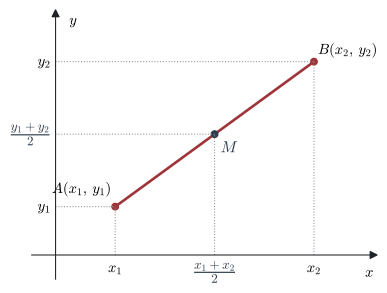
Coordinates of the midpoint of the segment with endpoints \(A(x_1, y_1)\) and \(B(x_2, y_2)\) In the formula booklet
\[ M = \left(\frac{x_1 + x_2}{2},\; \frac{y_1 + y_2}{2}\right) \]
- \(M\): the midpoint of \(AB\)
- \((x_1, y_1)\): the coordinates of \(A\)
- \((x_2, y_2)\): the coordinates of \(B\)
Example 1 A triangle \(PQR\) has vertices \(P(-6, 5)\), \(Q(4, -1)\) and \(R(2, 9)\). \(M\) and \(N\) are the midpoints of \(PR\) and \(QR\).
(a) Find the coordinates of \(M\) and of \(N\).
(b) Show that \(PQ = 2MN\).
(c) Is \(MN\) parallel to \(PQ\)? Explain.
(a) \(M = \left(\dfrac{-6 + 2}{2}, \dfrac{5 + 9}{2}\right) = (-2, 7)\) and \(N = \left(\dfrac{4 + 2}{2}, \dfrac{-1 + 9}{2}\right) = (3, 4)\).
(b) \(PQ = \sqrt{10^2 + (-6)^2} = \sqrt{136} = 2\sqrt{34}\) and \(MN = \sqrt{5^2 + (-3)^2} = \sqrt{34}\). So \(PQ = 2MN\).
(c) \(m_{MN} = \dfrac{4 - 7}{3 - (-2)} = -\dfrac{3}{5}\) and \(m_{PQ} = \dfrac{-1 - 5}{4 - (-6)} = -\dfrac{6}{10} = -\dfrac{3}{5}\).
The gradients are equal, so yes, \(MN \parallel PQ\). (This is the midpoint theorem: the segment joining the midpoints of two sides is parallel to the third side and half as long.)
Finding the other end
If you know one end \(A\) and the midpoint \(M\), you can find the other end \(B\). \(M\) is exactly halfway, so the step from \(M\) to \(B\) is the same as the step from \(A\) to \(M\) (Figure 2).
For example, \(A(1, 1)\) and \(M(4, 3)\):
- Step from \(A\) to \(M\): \(x\) goes up by \(4 - 1 = 3\), \(y\) goes up by \(3 - 1 = 2\).
- Take the same step again from \(M\): \(B = (4 + 3,\; 3 + 2) = (7, 5)\).
- Check: the midpoint of \(A(1, 1)\) and \(B(7, 5)\) is \(\left(\frac{1 + 7}{2}, \frac{1 + 5}{2}\right) = (4, 3)\) ✓
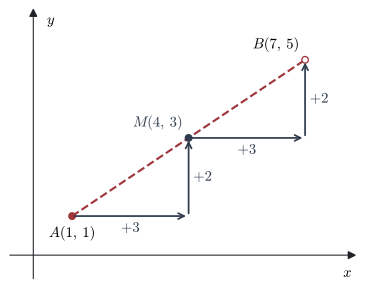
You can also put the unknown end \(B(x, y)\) into the midpoint formula and solve: \(\dfrac{1 + x}{2} = 4\) gives \(x = 7\), and \(\dfrac{1 + y}{2} = 3\) gives \(y = 5\).
Example 2 (a) The line \(y = x - 1\) meets the curve \(y^2 = x + 5\) at the points \(A\) and \(B\). Find the coordinates of \(M\), the midpoint of \(AB\).
(b) \(D(4, -1)\) is the midpoint of \(CM\). Find the coordinates of \(C\).
(a) Substitute \(y = x - 1\) into the curve:
\[ (x - 1)^2 = x + 5 \;\Longrightarrow\; x^2 - 3x - 4 = 0 \;\Longrightarrow\; (x - 4)(x + 1) = 0 . \]
\(x = 4\) gives \(y = 3\), and \(x = -1\) gives \(y = -2\). So \(A(4, 3)\) and \(B(-1, -2)\), and
\[ M = \left(\frac{4 + (-1)}{2}, \frac{3 + (-2)}{2}\right) = \left(\frac{3}{2}, \frac{1}{2}\right) . \]
(b) Let \(C = (p, q)\). Then \(\dfrac{p + \frac{3}{2}}{2} = 4\) and \(\dfrac{q + \frac{1}{2}}{2} = -1\).
So \(p = 8 - \dfrac{3}{2} = \dfrac{13}{2}\) and \(q = -2 - \dfrac{1}{2} = -\dfrac{5}{2}\). \(C\) is \(\left(\dfrac{13}{2}, -\dfrac{5}{2}\right)\).
The fourth vertex of a parallelogram
The diagonals of a parallelogram bisect each other (Figure 3). So the two diagonals have the same midpoint. This gives a quick way to find a missing vertex.
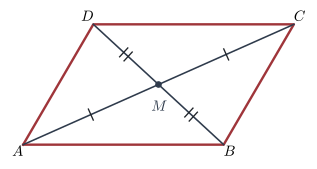
Diagonals of a parallelogram Not in the formula booklet
If \(ABCD\) is a parallelogram, then the midpoint of \(AC\) is the midpoint of \(BD\).
Take care with the order of the letters: in \(ABCD\) the vertices go round the shape, so \(A\) is opposite \(C\) and \(B\) is opposite \(D\).
Example 3 \(ABCD\) is a parallelogram with vertices \(A(5, -3)\), \(B(7, 5)\), \(C(-1, 3)\) and \(D(p, q)\).
(a) \(M\) is the midpoint of \(AC\). Find the coordinates of \(M\).
(b) Hence find the coordinates of \(D\).
(c) Show that \(ABCD\) is a rhombus.
(a) \(M = \left(\dfrac{5 + (-1)}{2}, \dfrac{-3 + 3}{2}\right) = (2, 0)\).
(b) \(M\) is also the midpoint of \(BD\):
\[ \frac{7 + p}{2} = 2 \;\Rightarrow\; p = -3, \qquad \frac{5 + q}{2} = 0 \;\Rightarrow\; q = -5 . \]
So \(D\) is \((-3, -5)\).
(c) A rhombus is a parallelogram with all four sides equal. For a parallelogram, it is enough to show that two adjacent sides are equal:
\[ AB = \sqrt{2^2 + 8^2} = \sqrt{68}, \qquad BC = \sqrt{(-8)^2 + (-2)^2} = \sqrt{68} . \]
\(AB = BC\), so \(ABCD\) is a rhombus.
(Another way: \(m_{AC} = \dfrac{3 - (-3)}{-1 - 5} = -1\) and \(m_{BD} = \dfrac{-5 - 5}{-3 - 7} = 1\). The diagonals are perpendicular, which also shows the parallelogram is a rhombus.)
Equations of perpendicular bisectors
The perpendicular bisector of a segment \(AB\) is the line that passes through the midpoint of \(AB\) and is perpendicular to \(AB\) (Figure 4).
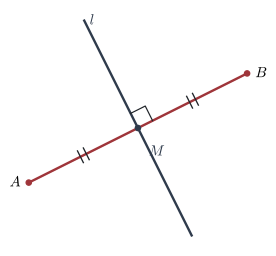
Every point on the perpendicular bisector is the same distance from \(A\) and from \(B\).
To find the perpendicular bisector of \(AB\)
- Find the midpoint \(M\) of \(AB\).
- Find the gradient \(m_{AB}\), then the perpendicular gradient \(-\dfrac{1}{m_{AB}}\).
- Use \(y - y_1 = m(x - x_1)\) with the point \(M\) and the perpendicular gradient.
If \(AB\) is horizontal, the perpendicular bisector is the vertical line \(x = x_M\). If \(AB\) is vertical, it is \(y = y_M\).
Example 4 The line \(3x + 4y = 24\) meets the \(x\)-axis at \(A\) and the \(y\)-axis at \(B\).
(a) Find the coordinates of \(A\) and of \(B\).
The perpendicular bisector of \(AB\) meets the line \(y = x\) at the point \(C\).
(b) Find the coordinates of \(C\).
(c) Find the area of triangle \(ACB\).
(a) \(y = 0\): \(3x = 24\), so \(A(8, 0)\). \(\quad x = 0\): \(4y = 24\), so \(B(0, 6)\).
(b) Midpoint \(M = (4, 3)\). \(\;m_{AB} = \dfrac{6 - 0}{0 - 8} = -\dfrac{3}{4}\), so the perpendicular gradient is \(\dfrac{4}{3}\).
\[ y - 3 = \frac{4}{3}(x - 4) \;\Longrightarrow\; 3y - 9 = 4x - 16 \;\Longrightarrow\; 4x - 3y - 7 = 0 . \]
Put \(y = x\): \(4x - 3x - 7 = 0\), so \(x = 7\). \(C\) is \((7, 7)\).
(c) \(CM\) is perpendicular to \(AB\), so take \(AB\) as the base and \(CM\) as the height:
\[ AB = \sqrt{8^2 + 6^2} = 10, \qquad CM = \sqrt{3^2 + 4^2} = 5, \qquad \text{Area} = \frac{1}{2} \times 10 \times 5 = 25 . \]
Common errors
| ✗ Wrong | ✓ Right | Why |
|---|---|---|
| Midpoint of \((2, 6)\) and \((8, 0)\) is \(\left(\dfrac{8 - 2}{2}, \dfrac{6 - 0}{2}\right)\) | \(\left(\dfrac{2 + 8}{2}, \dfrac{6 + 0}{2}\right) = (5, 3)\) | The midpoint uses the sum (the mean), not the difference. |
| \(M\) is the midpoint of \(AB\), so \(B = \left(\dfrac{x_A + x_M}{2}, \ldots\right)\) | \(B = (2x_M - x_A,\; 2y_M - y_A)\) | Solve \(\dfrac{x_A + x_B}{2} = x_M\) for \(x_B\). |
| Parallelogram \(ABCD\): midpoint of \(AB\) = midpoint of \(CD\) | midpoint of \(AC\) = midpoint of \(BD\) | It is the diagonals that bisect each other. |
| Perpendicular bisector through \(A\) with gradient \(-\dfrac{1}{m_{AB}}\) | Through the midpoint \(M\) | The line must cut \(AB\) into two equal parts. |
| Perpendicular bisector with gradient \(m_{AB}\) | gradient \(-\dfrac{1}{m_{AB}}\) | It must be perpendicular to \(AB\). |
Exercises
1 Find the midpoint of the segment joining \((-3, 8)\) and \((7, -2)\).
\(\left(\dfrac{-3 + 7}{2}, \dfrac{8 - 2}{2}\right) = (2, 3)\).
2 \(M(1, -2)\) is the midpoint of \(AB\), and \(A\) is \((-4, 3)\). Find the coordinates of \(B\).
\(B = (2 \times 1 - (-4),\; 2 \times (-2) - 3) = (6, -7)\).
3 The midpoint of the segment joining \((2a, 5)\) and \((4, a)\) is \((5, b)\). Find \(a\) and \(b\).
\(\dfrac{2a + 4}{2} = 5 \Rightarrow 2a + 4 = 10 \Rightarrow a = 3\). Then \(b = \dfrac{5 + 3}{2} = 4\).
4 Find the equation of the perpendicular bisector of \(A(1, 3)\) and \(B(5, -1)\).
\(M = (3, 1)\). \(\;m_{AB} = \dfrac{-1 - 3}{5 - 1} = -1\), so the perpendicular gradient is \(1\).
\(y - 1 = 1(x - 3)\), that is \(y = x - 2\).
5 Find the equation of the perpendicular bisector of \(P(-2, -1)\) and \(Q(4, 3)\), in the form \(ax + by + d = 0\).
\(M = (1, 1)\). \(\;m_{PQ} = \dfrac{4}{6} = \dfrac{2}{3}\), so the perpendicular gradient is \(-\dfrac{3}{2}\).
\(y - 1 = -\dfrac{3}{2}(x - 1) \Rightarrow 2y - 2 = -3x + 3 \Rightarrow 3x + 2y - 5 = 0\).
6 \(ABCD\) is a parallelogram with \(A(1, 1)\), \(B(6, 2)\) and \(C(8, 6)\). Find the coordinates of \(D\).
Midpoint of \(AC\) \(= \left(\dfrac{9}{2}, \dfrac{7}{2}\right)\). This is also the midpoint of \(BD\):
\(\dfrac{6 + x_D}{2} = \dfrac{9}{2} \Rightarrow x_D = 3\), \(\quad \dfrac{2 + y_D}{2} = \dfrac{7}{2} \Rightarrow y_D = 5\). So \(D\) is \((3, 5)\).
7 A triangle has vertices \(A(0, 0)\), \(B(8, 2)\) and \(C(2, 6)\). Find the length of the line from \(C\) to the midpoint of \(AB\).
Midpoint of \(AB\): \(M = (4, 1)\). \(\;CM = \sqrt{(4 - 2)^2 + (1 - 6)^2} = \sqrt{4 + 25} = \sqrt{29}\).
8 \(A\) is \((1, 2)\), \(B\) is \((8, 3)\) and \(P\) is \((5, -1)\). Show that \(P\) lies on the perpendicular bisector of \(AB\).
Method 1. \(PA = \sqrt{4^2 + 3^2} = 5\) and \(PB = \sqrt{3^2 + 4^2} = 5\). \(P\) is the same distance from \(A\) and \(B\), so it is on the perpendicular bisector.
Method 2. \(M = \left(\dfrac{9}{2}, \dfrac{5}{2}\right)\), \(m_{AB} = \dfrac{1}{7}\), so the bisector is \(y - \dfrac{5}{2} = -7\left(x - \dfrac{9}{2}\right)\). At \(x = 5\): \(y = \dfrac{5}{2} - \dfrac{7}{2} = -1\) ✓.
9 \(A\) is \((-2, 0)\), \(B\) is \((4, 0)\) and \(C\) is \((0, 4)\). By finding the perpendicular bisectors of \(AB\) and \(AC\), find the point that is the same distance from \(A\), \(B\) and \(C\).
\(AB\) is horizontal with midpoint \((1, 0)\), so its perpendicular bisector is \(x = 1\).
\(AC\): midpoint \((-1, 2)\), \(m_{AC} = \dfrac{4}{2} = 2\), perpendicular gradient \(-\dfrac{1}{2}\): \(\;y - 2 = -\dfrac{1}{2}(x + 1)\).
At \(x = 1\): \(y = 2 - 1 = 1\). The point is \((1, 1)\).
Check: its distance from each of \(A\), \(B\), \(C\) is \(\sqrt{10}\) ✓.
10 The line \(y = 2x - 3\) meets the curve \(y = x^2 - 4x + 2\) at \(A\) and \(B\). Find the midpoint of \(AB\) and the equation of the perpendicular bisector of \(AB\).
\(x^2 - 4x + 2 = 2x - 3 \Rightarrow x^2 - 6x + 5 = 0 \Rightarrow (x - 1)(x - 5) = 0\). So \(A(1, -1)\) and \(B(5, 7)\).
Midpoint \(M = (3, 3)\). \(m_{AB} = 2\), so the perpendicular gradient is \(-\dfrac{1}{2}\):
\(y - 3 = -\dfrac{1}{2}(x - 3) \Rightarrow x + 2y - 9 = 0\).