14.13 Compound and Double Angle Formulae
SL 3.6 AHL 3.10
- what a compound angle is, and why \(\sin(A + B) \neq \sin A + \sin B\)
- (HL) the addition formulae for \(\cos(A \pm B)\), \(\sin(A \pm B)\) and \(\tan(A \pm B)\), and where they come from
- (HL) how to use them to find exact values, such as \(\cos 75^\circ\)
- the double angle formulae for \(\sin 2A\) and \(\cos 2A\) (SL), and for \(\tan 2A\) (HL)
- how to use double angle formulae to find exact values, prove identities and solve equations
Compound angles
For any two angles \(A\) and \(B\), the angles \(A + B\) and \(A - B\) are called compound angles. In this section we write \(\sin(A + B)\), \(\cos(A - B)\), … in terms of the sines and cosines of \(A\) and \(B\) themselves.
First, a warning. The sine function does not “multiply out” over a bracket:
\[ \sin(30^\circ + 60^\circ) = \sin 90^\circ = 1, \qquad\text{but}\qquad \sin 30^\circ + \sin 60^\circ = \frac{1}{2} + \frac{\sqrt{3}}{2} \neq 1 . \]
So we need proper formulae.
Addition formulae for cosine
The compound angle (addition) formulae are HL only AHL 3.10. SL students may skip to Double angle formulae; the SL double angle formulae are given in the booklet.
We prove the formula for \(\cos(A - B)\) with the unit circle (see 14.6) and the distance formula.
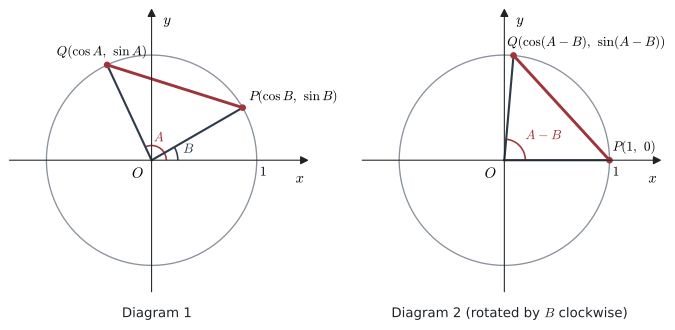
Example 1 In Figure 1, \(P\) and \(Q\) lie on the unit circle. The radius \(OP\) makes an angle \(B\) with the positive \(x\)-axis, and \(OQ\) makes an angle \(A\), where \(A > B\). In Diagram 2 the triangle \(OPQ\) has been rotated clockwise by \(B\) about \(O\), so that \(P\) moves to \((1, 0)\).
(a) Explain why
(i) \(P\) and \(Q\) in Diagram 1 have coordinates \((\cos B, \sin B)\) and \((\cos A, \sin A)\)
(ii) \(Q\) in Diagram 2 has coordinates \(\big(\cos(A - B), \sin(A - B)\big)\).
(b) Use the distance formula \(d = \sqrt{(x_1 - x_2)^2 + (y_1 - y_2)^2}\) to find \(PQ^2\) from each diagram.
(c) Hence show that \(\cos(A - B) = \cos A \cos B + \sin A \sin B\).
(d) By replacing \(B\) with \(-B\), show that \(\cos(A + B) = \cos A \cos B - \sin A \sin B\).
(a)
(i) A point on the unit circle at angle \(\theta\) from the positive \(x\)-axis has coordinates \((\cos\theta, \sin\theta)\). This is the definition of sine and cosine from 14.6.
(ii) After the rotation, \(OP\) lies along the positive \(x\)-axis. The angle \(\angle POQ = A - B\) does not change, so \(OQ\) now makes an angle \(A - B\) with the \(x\)-axis.
(b) Diagram 1:
\[ \begin{aligned} PQ^2 &= (\cos A - \cos B)^2 + (\sin A - \sin B)^2 \\ &= \cos^2 A + \sin^2 A + \cos^2 B + \sin^2 B \\ &\qquad - 2\cos A\cos B - 2\sin A\sin B \\ &= 2 - 2\cos A\cos B - 2\sin A\sin B . \end{aligned} \]
We used \(\cos^2\theta + \sin^2\theta = 1\) twice.
Diagram 2:
\[ \begin{aligned} PQ^2 &= \big(\cos(A - B) - 1\big)^2 + \sin^2(A - B) \\ &= \cos^2(A - B) + \sin^2(A - B) - 2\cos(A - B) + 1 \\ &= 2 - 2\cos(A - B) . \end{aligned} \]
(c) A rotation does not change lengths, so the two expressions are equal:
\[ 2 - 2\cos(A - B) = 2 - 2\cos A\cos B - 2\sin A\sin B , \]
which gives \(\cos(A - B) = \cos A\cos B + \sin A\sin B\).
(d) Replace \(B\) with \(-B\), and use \(\cos(-B) = \cos B\) and \(\sin(-B) = -\sin B\):
\[ \begin{aligned} \cos(A + B) &= \cos A\cos(-B) + \sin A\sin(-B) \\ &= \cos A\cos B - \sin A\sin B . \;\blacksquare \end{aligned} \]
Addition formulae for cosine In the HL formula booklet
\[ \cos(A \pm B) = \cos A\cos B \mp \sin A\sin B \]
- \(A\), \(B\): any two angles (in degrees or radians)
- \(\pm\), \(\mp\): take the top signs together, or the bottom signs together
Notice the sign changes: \(\cos(A + B)\) has a minus in the middle, and \(\cos(A - B)\) has a plus.
Addition formulae for sine
We change sine into cosine with \(\sin\theta = \cos\left(\frac{\pi}{2} - \theta\right)\):
\[ \begin{aligned} \sin(A + B) &= \cos\left(\left(\tfrac{\pi}{2} - A\right) - B\right) \\ &= \cos\left(\tfrac{\pi}{2} - A\right)\cos B + \sin\left(\tfrac{\pi}{2} - A\right)\sin B \\ &= \sin A\cos B + \cos A\sin B . \end{aligned} \]
Replacing \(B\) with \(-B\) again gives \(\sin(A - B)\).
Addition formulae for sine In the HL formula booklet
\[ \sin(A \pm B) = \sin A\cos B \pm \cos A\sin B \]
- \(A\), \(B\): any two angles
- \(\pm\): the sign is the same on both sides
Example 2 Given that \(\cos A = -\dfrac{8}{17}\) and \(\tan B = \dfrac{7}{24}\), where \(\dfrac{\pi}{2} < A < \pi\) and \(\pi < B < \dfrac{3\pi}{2}\), find the exact value of
(a) \(\cos(A - B)\) \(\qquad\) (b) \(\sin(A + B)\)
First find the missing ratios. Draw right-angled triangles, then choose the signs from the quadrant.
\(A\) is in the second quadrant, so \(\sin A > 0\): \(\;\sin A = \sqrt{1 - \dfrac{64}{289}} = \dfrac{15}{17}\).
\(B\) is in the third quadrant, so \(\sin B < 0\) and \(\cos B < 0\). A triangle with sides \(7\) and \(24\) has hypotenuse \(\sqrt{49 + 576} = 25\), so \(\sin B = -\dfrac{7}{25}\) and \(\cos B = -\dfrac{24}{25}\).
(a)
\[ \begin{aligned} \cos(A - B) &= \cos A\cos B + \sin A\sin B \\ &= \left(-\frac{8}{17}\right)\left(-\frac{24}{25}\right) + \frac{15}{17}\left(-\frac{7}{25}\right) \\ &= \frac{192 - 105}{425} \\ &= \frac{87}{425} . \end{aligned} \]
(b)
\[ \begin{aligned} \sin(A + B) &= \sin A\cos B + \cos A\sin B \\ &= \frac{15}{17}\left(-\frac{24}{25}\right) + \left(-\frac{8}{17}\right)\left(-\frac{7}{25}\right) \\ &= \frac{-360 + 56}{425} \\ &= -\frac{304}{425} . \end{aligned} \]
Write an angle as a sum or difference of \(30^\circ\), \(45^\circ\), \(60^\circ\) (or \(\frac{\pi}{6}\), \(\frac{\pi}{4}\), \(\frac{\pi}{3}\)) to find exact values of other angles.
Example 3 Without using a calculator, find the exact value of
(a) \(\cos 75^\circ\) \(\qquad\) (b) \(\sin\dfrac{\pi}{12}\)
(a) \(75^\circ = 45^\circ + 30^\circ\):
\[ \begin{aligned} \cos 75^\circ &= \cos 45^\circ\cos 30^\circ - \sin 45^\circ\sin 30^\circ \\ &= \frac{\sqrt{2}}{2}\cdot\frac{\sqrt{3}}{2} - \frac{\sqrt{2}}{2}\cdot\frac{1}{2} = \frac{\sqrt{6} - \sqrt{2}}{4} . \end{aligned} \]
(b) \(\dfrac{\pi}{12} = \dfrac{\pi}{3} - \dfrac{\pi}{4}\):
\[ \begin{aligned} \sin\frac{\pi}{12} &= \sin\frac{\pi}{3}\cos\frac{\pi}{4} - \cos\frac{\pi}{3}\sin\frac{\pi}{4} \\ &= \frac{\sqrt{3}}{2}\cdot\frac{\sqrt{2}}{2} - \frac{1}{2}\cdot\frac{\sqrt{2}}{2} = \frac{\sqrt{6} - \sqrt{2}}{4} . \end{aligned} \]
The answers are equal because \(\cos 75^\circ = \sin 15^\circ\) and \(\dfrac{\pi}{12} = 15^\circ\).
Addition formula for tangent
Example 4 (a) Use \(\tan(A + B) = \dfrac{\sin(A + B)}{\cos(A + B)}\) and the formulae above to show that
\[ \tan(A + B) = \frac{\tan A + \tan B}{1 - \tan A\tan B} . \]
(b) By replacing \(B\) with \(-B\), show that \(\tan(A - B) = \dfrac{\tan A - \tan B}{1 + \tan A\tan B}\).
(a) Divide the numerator and the denominator by \(\cos A\cos B\):
\[ \begin{aligned} \tan(A + B) &= \frac{\sin A\cos B + \cos A\sin B}{\cos A\cos B - \sin A\sin B} \\[4pt] &= \frac{\dfrac{\sin A\cos B}{\cos A\cos B} + \dfrac{\cos A\sin B}{\cos A\cos B}}{\dfrac{\cos A\cos B}{\cos A\cos B} - \dfrac{\sin A\sin B}{\cos A\cos B}} \\[4pt] &= \frac{\tan A + \tan B}{1 - \tan A\tan B} . \end{aligned} \]
(b) \(\tan(-B) = -\tan B\) (tangent is an odd function), so
\[ \tan(A - B) = \frac{\tan A + \tan(-B)}{1 - \tan A\tan(-B)} = \frac{\tan A - \tan B}{1 + \tan A\tan B} . \;\blacksquare \]
Addition formula for tangent In the HL formula booklet
\[ \tan(A \pm B) = \frac{\tan A \pm \tan B}{1 \mp \tan A\tan B} \]
- \(A\), \(B\): angles for which all the tangents are defined
- \(\pm\), \(\mp\): take the top signs together, or the bottom signs together
Example 5 The angles \(A\) and \(B\) are acute, with \(\tan A = 2\) and \(\tan B = 3\).
(a) Find the value of \(\tan(A + B)\).
(b) Hence show that \(A + B = \dfrac{3\pi}{4}\).
(a) \(\tan(A + B) = \dfrac{2 + 3}{1 - 2 \times 3} = \dfrac{5}{-5} = -1\).
(b) \(\tan A > 1\) and \(\tan B > 1\), so both angles are between \(\dfrac{\pi}{4}\) and \(\dfrac{\pi}{2}\). So \(\dfrac{\pi}{2} < A + B < \pi\). The only angle in this interval with tangent \(-1\) is \(\dfrac{3\pi}{4}\). \(\;\blacksquare\)
Double angle formulae
Put \(B = A\) in the addition formulae. For example, \(\sin(A + A) = \sin A\cos A + \cos A\sin A = 2\sin A\cos A\). In the same way, \(\cos 2A = \cos^2 A - \sin^2 A\). Using \(\sin^2 A + \cos^2 A = 1\) we can write \(\cos 2A\) in two more ways:
\[ \begin{aligned} \cos 2A &= \cos^2 A - (1 - \cos^2 A) = 2\cos^2 A - 1 \\ \cos 2A &= (1 - \sin^2 A) - \sin^2 A = 1 - 2\sin^2 A \end{aligned} \]
Double angle formulae for sine and cosine In the formula booklet
\[ \sin 2\theta = 2\sin\theta\cos\theta \]
\[ \begin{aligned} \cos 2\theta &= \cos^2\theta - \sin^2\theta \\ &= 2\cos^2\theta - 1 \\ &= 1 - 2\sin^2\theta \end{aligned} \]
- \(\theta\): any angle; \(2\theta\) is double the angle
Double angle formula for tangent In the HL formula booklet
\[ \tan 2\theta = \frac{2\tan\theta}{1 - \tan^2\theta} \]
- \(\theta\): an angle with \(\tan\theta \neq \pm 1\) and \(\tan\theta\) defined
SL students can still find \(\tan 2\theta\) as \(\dfrac{\sin 2\theta}{\cos 2\theta}\). Choose the form of \(\cos 2\theta\) that matches the question: use \(2\cos^2\theta - 1\) when you know \(\cos\theta\), and \(1 - 2\sin^2\theta\) when you know \(\sin\theta\).
Example 6 Given that \(\cos A = -\dfrac{12}{13}\) and \(\pi < A < \dfrac{3\pi}{2}\), find, without using a calculator, the exact value of
(a) \(\sin 2A\) \(\qquad\) (b) \(\cos 2A\) \(\qquad\) (c) \(\tan 2A\)
\(A\) is in the third quadrant, so \(\sin A < 0\): \(\;\sin A = -\sqrt{1 - \dfrac{144}{169}} = -\dfrac{5}{13}\).
(a) \(\sin 2A = 2\left(-\dfrac{5}{13}\right)\left(-\dfrac{12}{13}\right) = \dfrac{120}{169}\).
(b) \(\cos 2A = 2\left(-\dfrac{12}{13}\right)^2 - 1 = \dfrac{288}{169} - 1 = \dfrac{119}{169}\).
(c) \(\tan 2A = \dfrac{\sin 2A}{\cos 2A} = \dfrac{120}{119}\).
(HL check: \(\tan A = \dfrac{5}{12}\), so \(\tan 2A = \dfrac{2 \cdot \frac{5}{12}}{1 - \frac{25}{144}} = \dfrac{5}{6} \times \dfrac{144}{119} = \dfrac{120}{119}\).)
The formula \(\cos 2A = 1 - 2\sin^2 A\) can be rearranged to give \(\sin^2 A\) in terms of \(\cos 2A\). This lets us find exact values of half of a known angle.
Example 7 (a) Show that \(\sin^2 A = \dfrac{1 - \cos 2A}{2}\).
(b) Hence show that \(\sin 112.5^\circ = \dfrac{\sqrt{2 + \sqrt{2}}}{2}\).
(a) From \(\cos 2A = 1 - 2\sin^2 A\) we get \(2\sin^2 A = 1 - \cos 2A\), so \(\sin^2 A = \dfrac{1 - \cos 2A}{2}\).
(b) Put \(A = 112.5^\circ\), so \(2A = 225^\circ\) and \(\cos 225^\circ = -\dfrac{\sqrt{2}}{2}\):
\[ \sin^2 112.5^\circ = \frac{1 + \frac{\sqrt{2}}{2}}{2} = \frac{2 + \sqrt{2}}{4} . \]
\(112.5^\circ\) is in the second quadrant, where sine is positive, so take the positive root: \(\sin 112.5^\circ = \dfrac{\sqrt{2 + \sqrt{2}}}{2}\). \(\;\blacksquare\)
Solving equations with double angles
When an equation contains both \(2x\) and \(x\), use a double angle formula so that everything is in terms of one angle \(x\). Then factorise, as in 14.12.
- \(\sin 2x\) with \(\sin x\) or \(\cos x\): replace \(\sin 2x\) by \(2\sin x\cos x\) and factorise (never divide by \(\sin x\) or \(\cos x\), or you lose solutions).
- \(\cos 2x\) with \(\sin x\): use \(1 - 2\sin^2 x\) to get a quadratic in \(\sin x\).
- \(\cos 2x\) with \(\cos x\): use \(2\cos^2 x - 1\) to get a quadratic in \(\cos x\).
Example 8 Solve each equation for \(0^\circ \leq x \leq 360^\circ\).
(a) \(\sin 2x = \sin x\)
(b) \(\cos 2x - 3\sin x + 1 = 0\)
(c) AHL \(\tan 2x = 3\tan x\)
(a) \(2\sin x\cos x - \sin x = 0\), so \(\sin x\,(2\cos x - 1) = 0\).
- \(\sin x = 0\): \(\;x = 0^\circ, 180^\circ, 360^\circ\).
- \(\cos x = \dfrac{1}{2}\): \(\;x = 60^\circ, 300^\circ\).
So \(x = 0^\circ, 60^\circ, 180^\circ, 300^\circ, 360^\circ\).
(b) \((1 - 2\sin^2 x) - 3\sin x + 1 = 0\), so \(2\sin^2 x + 3\sin x - 2 = 0\), which factorises as
\[ (2\sin x - 1)(\sin x + 2) = 0 . \]
\(\sin x = -2\) has no solutions. \(\sin x = \dfrac{1}{2}\) gives \(x = 30^\circ, 150^\circ\).
(c) Let \(t = \tan x\). Then \(\dfrac{2t}{1 - t^2} = 3t\), so \(2t = 3t(1 - t^2)\) and
\[ t\,(3t^2 - 1) = 0 \;\Longrightarrow\; t = 0 \;\text{ or }\; t = \pm\frac{1}{\sqrt{3}} . \]
- \(\tan x = 0\): \(\;x = 0^\circ, 180^\circ, 360^\circ\).
- \(\tan x = \dfrac{1}{\sqrt{3}}\): \(\;x = 30^\circ, 210^\circ\).
- \(\tan x = -\dfrac{1}{\sqrt{3}}\): \(\;x = 150^\circ, 330^\circ\).
None of these makes \(\tan x\) or \(\tan 2x\) undefined. So \(x = 0^\circ, 30^\circ, 150^\circ, 180^\circ, 210^\circ, 330^\circ, 360^\circ\).
- Check that the angle mode is DEG (shown at the top right of the screen; click on it to change).
- Open a Graphs page.
- Enter \(f1(x) = \tan(2x)\) and \(f2(x) = 3\tan(x)\).
- Menu → Window / Zoom → Window Settings: set \(x\) from \(0\) to \(360\) and \(y\) from \(-10\) to \(10\).
- Menu → Analyze Graph → Intersection, then choose a lower and an upper bound around each crossing point.
The \(x\)-coordinates of the intersection points are the solutions. Count them: there should be seven, as in Example 8 (c).
Common errors
| ✗ Wrong | ✓ Right | Why |
|---|---|---|
| \(\sin(A + B) = \sin A + \sin B\) | \(\sin A\cos B + \cos A\sin B\) | Trigonometric functions do not “multiply out” over a bracket. |
| \(\cos(A + B) = \cos A\cos B + \sin A\sin B\) | \(\cos A\cos B - \sin A\sin B\) | For cosine the sign in the middle is the opposite sign. |
| \(\sin 2A = 2\sin A\) | \(\sin 2A = 2\sin A\cos A\) | Doubling the angle does not double the sine. |
| \(\cos 2A = 2\cos A - 1\) | \(\cos 2A = 2\cos^2 A - 1\) | The cosine is squared. |
| Dividing \(\sin x\cos x = \frac{1}{2}\sin x\) by \(\sin x\) | Factorise: \(\sin x\left(\cos x - \frac{1}{2}\right) = 0\) | Dividing loses the solutions of \(\sin x = 0\). |
| \(\sin A = +\frac{15}{17}\) for \(A\) in the third quadrant | Check the quadrant: \(\sin A < 0\) there | The square root gives the size; the quadrant gives the sign. |
Exercises
1 AHL Without using a calculator, find the exact value of
(a) \(\sin 105^\circ\)
(b) \(\tan 105^\circ\), giving your answer in the form \(a + b\sqrt{3}\).
(a) \(\sin(60^\circ + 45^\circ) = \dfrac{\sqrt{3}}{2}\cdot\dfrac{\sqrt{2}}{2} + \dfrac{1}{2}\cdot\dfrac{\sqrt{2}}{2} = \dfrac{\sqrt{6} + \sqrt{2}}{4}\).
(b) \(\tan(60^\circ + 45^\circ) = \dfrac{\sqrt{3} + 1}{1 - \sqrt{3}}\). Multiply the top and the bottom by \(1 + \sqrt{3}\):
\[ \frac{(\sqrt{3} + 1)(1 + \sqrt{3})}{(1 - \sqrt{3})(1 + \sqrt{3})} = \frac{4 + 2\sqrt{3}}{-2} = -2 - \sqrt{3} . \]
2 AHL Given that \(\sin A = \dfrac{3}{5}\) and \(\cos B = \dfrac{15}{17}\), where \(90^\circ < A < 180^\circ\) and \(0^\circ < B < 90^\circ\), find the exact value of
(a) \(\sin(A + B)\) \(\qquad\) (b) \(\cos(A - B)\)
\(\cos A = -\dfrac{4}{5}\) (second quadrant) and \(\sin B = \dfrac{8}{17}\) (first quadrant).
(a) \(\sin(A + B) = \dfrac{3}{5}\cdot\dfrac{15}{17} + \left(-\dfrac{4}{5}\right)\dfrac{8}{17} = \dfrac{45 - 32}{85} = \dfrac{13}{85}\).
(b) \(\cos(A - B) = \left(-\dfrac{4}{5}\right)\dfrac{15}{17} + \dfrac{3}{5}\cdot\dfrac{8}{17} = \dfrac{-60 + 24}{85} = -\dfrac{36}{85}\).
3 Write each expression as a single trigonometric ratio, and find its exact value where possible.
(a) \(2\sin 15^\circ\cos 15^\circ\)
(b) \(\cos^2\dfrac{\pi}{8} - \sin^2\dfrac{\pi}{8}\)
(c) AHL \(\sin 3x\cos x + \cos 3x\sin x\)
(a) \(\sin 30^\circ = \dfrac{1}{2}\).
(b) \(\cos\dfrac{\pi}{4} = \dfrac{\sqrt{2}}{2}\).
(c) This is \(\sin(3x + x) = \sin 4x\).
4 Given that \(\cos\theta = -\dfrac{1}{4}\) and \(\dfrac{\pi}{2} < \theta < \pi\), find the exact value of
(a) \(\sin\theta\)
(b) \(\sin 2\theta\)
(c) \(\cos 2\theta\)
(a) \(\sin\theta > 0\) in the second quadrant: \(\;\sin\theta = \sqrt{1 - \dfrac{1}{16}} = \dfrac{\sqrt{15}}{4}\).
(b) \(\sin 2\theta = 2 \cdot \dfrac{\sqrt{15}}{4} \cdot \left(-\dfrac{1}{4}\right) = -\dfrac{\sqrt{15}}{8}\).
(c) \(\cos 2\theta = 2\left(\dfrac{1}{16}\right) - 1 = -\dfrac{7}{8}\).
5 Show that \(\dfrac{1 - \cos 2\theta}{\sin 2\theta} = \tan\theta\).
Use \(1 - \cos 2\theta = 2\sin^2\theta\):
\[ \frac{1 - \cos 2\theta}{\sin 2\theta} = \frac{2\sin^2\theta}{2\sin\theta\cos\theta} = \frac{\sin\theta}{\cos\theta} = \tan\theta . \;\blacksquare \]
6 Solve \(\cos 2x = \cos x\) for \(0 \leq x \leq 2\pi\).
\(2\cos^2 x - 1 = \cos x\), so \(2\cos^2 x - \cos x - 1 = 0\), which factorises as \((2\cos x + 1)(\cos x - 1) = 0\).
- \(\cos x = 1\): \(\;x = 0, 2\pi\).
- \(\cos x = -\dfrac{1}{2}\): \(\;x = \dfrac{2\pi}{3}, \dfrac{4\pi}{3}\).
So \(x = 0, \dfrac{2\pi}{3}, \dfrac{4\pi}{3}, 2\pi\).
7 Solve \(2\sin 2x = 3\sin x\) for \(0^\circ \leq x \leq 360^\circ\). Give non-exact answers to 1 decimal place.
\(4\sin x\cos x - 3\sin x = 0\), so \(\sin x\,(4\cos x - 3) = 0\).
- \(\sin x = 0\): \(\;x = 0^\circ, 180^\circ, 360^\circ\).
- \(\cos x = \dfrac{3}{4}\): \(\;x = \cos^{-1}(0.75) = 41.4^\circ\) or \(x = 360^\circ - 41.4^\circ = 318.6^\circ\).
So \(x = 0^\circ, 41.4^\circ, 180^\circ, 318.6^\circ, 360^\circ\).
8 AHL
(a) Show that \(\tan(\theta + 45^\circ) = \dfrac{1 + \tan\theta}{1 - \tan\theta}\).
(b) Hence solve \(\tan(\theta + 45^\circ) = 6\tan\theta\) for \(0^\circ < \theta < 90^\circ\). Give your answers to 1 decimal place.
(a) \(\tan(\theta + 45^\circ) = \dfrac{\tan\theta + \tan 45^\circ}{1 - \tan\theta\tan 45^\circ} = \dfrac{1 + \tan\theta}{1 - \tan\theta}\), because \(\tan 45^\circ = 1\).
(b) Let \(t = \tan\theta\). Then \(1 + t = 6t(1 - t)\), so \(6t^2 - 5t + 1 = 0\), which factorises as \((2t - 1)(3t - 1) = 0\).
\(t = \dfrac{1}{2}\) gives \(\theta = 26.6^\circ\), and \(t = \dfrac{1}{3}\) gives \(\theta = 18.4^\circ\).
9 AHL The angle \(P\) is acute and \(\tan P = \dfrac{12}{5}\). Show that, for every angle \(Q\),
\[ 5\sin(Q + P) - 12\cos(Q + P) = 13\sin Q . \]
The triangle with sides \(5\) and \(12\) has hypotenuse \(13\), so \(\sin P = \dfrac{12}{13}\) and \(\cos P = \dfrac{5}{13}\).
\[ \begin{aligned} &5(\sin Q\cos P + \cos Q\sin P) - 12(\cos Q\cos P - \sin Q\sin P) \\ &= \frac{25}{13}\sin Q + \frac{60}{13}\cos Q - \frac{60}{13}\cos Q + \frac{144}{13}\sin Q \\ &= \frac{169}{13}\sin Q \\ &= 13\sin Q . \;\blacksquare \end{aligned} \]
10 Extension AHL
(a) Show that \(\sqrt{3}\cos x + \sin x = 2\cos(x - 30^\circ)\).
(b) Hence solve \(\sqrt{3}\cos x + \sin x = \sqrt{2}\) for \(0^\circ \leq x \leq 360^\circ\).
(a) \(2\cos(x - 30^\circ) = 2(\cos x\cos 30^\circ + \sin x\sin 30^\circ) = 2\left(\dfrac{\sqrt{3}}{2}\cos x + \dfrac{1}{2}\sin x\right) = \sqrt{3}\cos x + \sin x\).
(b) \(\cos(x - 30^\circ) = \dfrac{\sqrt{2}}{2}\), with \(-30^\circ \leq x - 30^\circ \leq 330^\circ\). So \(x - 30^\circ = 45^\circ\) or \(315^\circ\) (also \(-45^\circ\), but that is outside the interval).
\(x = 75^\circ\) or \(x = 345^\circ\).
(Writing \(a\cos x + b\sin x\) as one cosine, \(R\cos(x - \alpha)\), is not named in the syllabus, but it uses only the formulae on this page.)