22.6 Three Planes
AHL 3.18 AHL 1.16
- the five ways that three different planes can be arranged
- how to decide which arrangement you have, using the normals and the line of intersection
- how to solve a system of three linear equations in three unknowns by elimination and row reduction
- how to use the GDC to solve the system, and how to read the answer geometrically
Three planes \(\Pi_1: \boldsymbol{r}\cdot\boldsymbol{n}_1 = d_1\), \(\;\Pi_2: \boldsymbol{r}\cdot\boldsymbol{n}_2 = d_2\), \(\;\Pi_3: \boldsymbol{r}\cdot\boldsymbol{n}_3 = d_3\) give three linear equations in \(x\), \(y\), \(z\). A common point of the planes is a solution of the system. (Systems of equations are studied in Unit 32.)
Cases with parallel planes
First compare the normals.
Case 1: all three planes are parallel. All three normals are multiples of each other. There is no common point.
Case 2: exactly two planes are parallel. The third plane cuts each of them in a line, and these two lines are parallel. There is no common point.
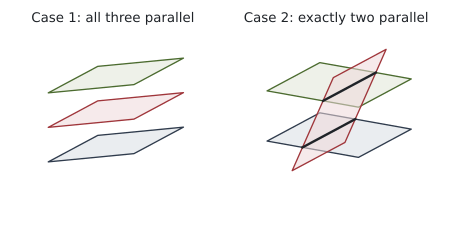
(If two of the equations describe the same plane, we really have only two planes; see Section 22.5.)
Cases with no parallel planes
If no two normals are parallel, find the line of intersection \(l\) of \(\Pi_1\) and \(\Pi_2\). The common points of all three planes are the points where \(l\) meets \(\Pi_3\) (see Section 22.3).
Case 3.1: exactly one common point. \(l\) meets \(\Pi_3\) at one point.
Case 3.2: one common line (a sheaf). \(l\) lies in \(\Pi_3\). All three planes pass through the same line.
Case 3.3: no common point (a triangular prism). \(l\) is parallel to \(\Pi_3\). Each pair of planes meets in a line, and the three lines are parallel.
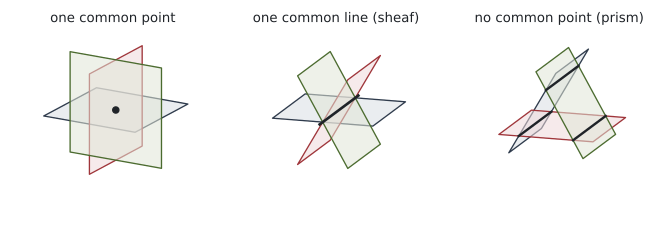
The direction of \(l\) is \(\boldsymbol{n}_1\times\boldsymbol{n}_2\), so we can test \(\Pi_3\) quickly:
Three planes, no two parallel Not in the formula booklet
- \((\boldsymbol{n}_1\times\boldsymbol{n}_2)\cdot\boldsymbol{n}_3 \neq 0\): exactly one common point (unique solution).
- \((\boldsymbol{n}_1\times\boldsymbol{n}_2)\cdot\boldsymbol{n}_3 = 0\): either a sheaf (infinitely many solutions, a line) or a triangular prism (no solution). Test one point of \(l\) in \(\Pi_3\) to decide.
| Geometry | Solutions of the system |
|---|---|
| one common point | unique solution |
| sheaf (common line) | infinitely many solutions, \(\boldsymbol{r} = \boldsymbol{a} + \lambda\boldsymbol{d}\) |
| prism, or any case with parallel planes | no solution (the system is inconsistent) |
- \(\boldsymbol{n}_1, \boldsymbol{n}_2, \boldsymbol{n}_3\): normal vectors of the planes \(\Pi_1, \Pi_2, \Pi_3\)
- \(l\): the line of intersection of \(\Pi_1\) and \(\Pi_2\)
- \(\Pi_3\): the third plane
- \(\boldsymbol{r}\): the position vector of a general point on the common line
- \(\boldsymbol{a}\): the position vector of a point on the common line
- \(\lambda\): the parameter (a real number)
- \(\boldsymbol{d}\): the direction vector of the common line
Solving by elimination
Eliminate one variable from two pairs of equations. This gives two equations in two unknowns.
Example 1 Show that the planes \(\Pi_1: x + y + z = 6\), \(\;\Pi_2: 2x - y + z = 3\) and \(\;\Pi_3: x + 2y - z = 2\) meet at exactly one point, and find this point.
Eliminate \(z\):
\[ \Pi_1 + \Pi_3: \; 2x + 3y = 8, \qquad\qquad \Pi_2 + \Pi_3: \; 3x + y = 5 . \]
From the second, \(y = 5 - 3x\). Then \(2x + 3(5 - 3x) = 8\), so \(-7x = -7\) and \(x = 1\). So \(y = 2\) and \(z = 6 - 1 - 2 = 3\).
The system has exactly one solution, so the planes meet at the single point \((1, 2, 3)\). (Check in \(\Pi_2\): \(2 - 2 + 3 = 3\) ✓.)
Calculator page: Menu → Algebra → Solve System of Equations → Solve System of Linear Equations. Enter Number of equations \(3\) and Variables \(x, y, z\), then type the equations. The command looks like
linSolve({x+y+z=6, 2x-y+z=3, x+2y-z=2}, {x,y,z}) \(\;\to\;\) {1, 2, 3}.
- One solution: one point.
- Infinitely many solutions: the answer contains a parameter such as
c1. This is a line (a sheaf). - No solution: “No solution found”. The planes have no common point; look at the normals to decide which case.
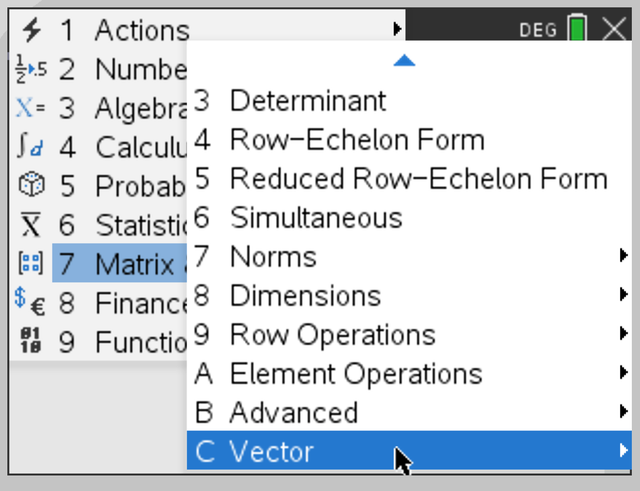
You can also use row reduction: enter the augmented matrix and use Menu → Matrix & Vector → Reduced Row-Echelon Form (rref), or Simultaneous (simult(A, b)) for a unique solution.
Example 2 Show that the planes \(\Pi_1: x + y + z = 4\), \(\;\Pi_2: x - y + 2z = 1\) and \(\;\Pi_3: 3x + y + 4z = 5\) have no common point and do not meet along a common line. Describe the arrangement.
No normal is a multiple of another, so no two planes are parallel.
Eliminate \(y\):
\[ \Pi_1 + \Pi_2: \; 2x + 3z = 5, \qquad\qquad \Pi_3 - \Pi_1: \; 2x + 3z = 1 . \]
These say \(5 = 1\), which is impossible. The system is inconsistent, so there is no common point.
Each pair of planes meets in a line, and the three lines are parallel: the planes form a triangular prism.
(Vector check: \(\boldsymbol{n}_1\times\boldsymbol{n}_2 = \begin{pmatrix} 3 \\ -1 \\ -2 \end{pmatrix}\) and \(\begin{pmatrix} 3 \\ -1 \\ -2 \end{pmatrix}\cdot\begin{pmatrix} 3 \\ 1 \\ 4 \end{pmatrix} = 9 - 1 - 8 = 0\), so the line \(\Pi_1 \cap \Pi_2\) is parallel to \(\Pi_3\).)
Row reduction
Write only the coefficients and the right-hand sides in an augmented matrix. Then use row operations (swap rows, multiply a row by a non-zero number, add a multiple of one row to another) to make zeros below the diagonal.
- A row \(\left[\,0\;\;0\;\;0 \mid k\,\right]\) with \(k \neq 0\) means no solution.
- A row \(\left[\,0\;\;0\;\;0 \mid 0\,\right]\) means one equation was not needed: infinitely many solutions.
Example 3 Determine the relationship between the planes \(\Pi_1: x - 2y + z = 1\), \(\;\Pi_2: 2x + y - z = 3\) and \(\;\Pi_3: x - 7y + 4z = 0\).
\[ \left(\begin{array}{ccc|c} 1 & -2 & 1 & 1 \\ 2 & 1 & -1 & 3 \\ 1 & -7 & 4 & 0 \end{array}\right) \xrightarrow[R_3 - R_1]{R_2 - 2R_1} \left(\begin{array}{ccc|c} 1 & -2 & 1 & 1 \\ 0 & 5 & -3 & 1 \\ 0 & -5 & 3 & -1 \end{array}\right) \xrightarrow{R_3 + R_2} \left(\begin{array}{ccc|c} 1 & -2 & 1 & 1 \\ 0 & 5 & -3 & 1 \\ 0 & 0 & 0 & 0 \end{array}\right) \]
The last row is all zeros, so there are infinitely many solutions. Let \(z = t\):
\[ 5y - 3t = 1 \Rightarrow y = \frac{1 + 3t}{5}, \qquad x = 1 + 2y - t = \frac{7 + t}{5} . \]
\[ \boldsymbol{r} = \begin{pmatrix} \frac{7}{5} \\ \frac{1}{5} \\ 0 \end{pmatrix} + t\begin{pmatrix} \frac{1}{5} \\ \frac{3}{5} \\ 1 \end{pmatrix} \]
Multiply the direction by \(5\) and choose the point with \(t = -2\): \(\;\boldsymbol{r} = \begin{pmatrix} 1 \\ -1 \\ -2 \end{pmatrix} + \lambda\begin{pmatrix} 1 \\ 3 \\ 5 \end{pmatrix}\).
No two normals are parallel, so the three planes form a sheaf: they all contain this line. (Notice that \(\Pi_3 = 3\Pi_1 - \Pi_2\).)
On the GDC, rref gives \(\left(\begin{array}{ccc|c} 1 & 0 & -\frac{1}{5} & \frac{7}{5} \\ 0 & 1 & -\frac{3}{5} & \frac{1}{5} \\ 0 & 0 & 0 & 0 \end{array}\right)\), which says the same thing: \(x - \frac{1}{5}z = \frac{7}{5}\) and \(y - \frac{3}{5}z = \frac{1}{5}\).
Planes with unknown coefficients
Example 4 The planes \(p_1\) and \(p_2\) have equations \(\boldsymbol{r}\cdot\begin{pmatrix} 1 \\ 1 \\ 2 \end{pmatrix} = 5\) and \(\boldsymbol{r}\cdot\begin{pmatrix} 2 \\ -1 \\ 1 \end{pmatrix} = 4\).
(a) Verify that the point \(A(2, 1, 1)\) lies on both planes.
(b) Hence find a vector equation of the line of intersection of \(p_1\) and \(p_2\).
(c) The plane \(p_3\) has equation \(ax + 2y + 3z = b\). Find the conditions on \(a\) and \(b\) for which
(i) the three planes have exactly one common point;
(ii) the three planes meet in a common line; \(\quad\) (iii) the three planes have no common point.
(a) \(p_1\): \(2 + 1 + 2 = 5\) ✓. \(\;p_2\): \(4 - 1 + 1 = 4\) ✓.
(b) Direction \(\begin{pmatrix} 1 \\ 1 \\ 2 \end{pmatrix}\times\begin{pmatrix} 2 \\ -1 \\ 1 \end{pmatrix} = \begin{pmatrix} (1)(1) - (2)(-1) \\ (2)(2) - (1)(1) \\ (1)(-1) - (1)(2) \end{pmatrix} = \begin{pmatrix} 3 \\ 3 \\ -3 \end{pmatrix} = 3\begin{pmatrix} 1 \\ 1 \\ -1 \end{pmatrix}\).
\[ l: \boldsymbol{r} = \begin{pmatrix} 2 \\ 1 \\ 1 \end{pmatrix} + t\begin{pmatrix} 1 \\ 1 \\ -1 \end{pmatrix} \]
(c) Substitute \((2 + t,\; 1 + t,\; 1 - t)\) into \(p_3\):
\[ a(2 + t) + 2(1 + t) + 3(1 - t) = b \;\Longrightarrow\; (a - 1)t = b - 2a - 5 . \]
(i) If \(a \neq 1\) there is exactly one value of \(t\): one common point (any \(b\)).
(ii) If \(a = 1\) the equation is \(0 = b - 7\). If \(b = 7\) it is true for every \(t\): \(l\) lies in \(p_3\), a common line.
(iii) If \(a = 1\) and \(b \neq 7\) there is no \(t\): no common point. (\(p_3\) is then \(x + 2y + 3z = b\), which is not parallel to \(p_1\) or \(p_2\), so the planes form a triangular prism.)
Common errors
| ✗ Wrong | ✓ Right | Why |
|---|---|---|
| “No solution, so all three planes are parallel” | Check the normals first | No solution can also be Case 2 or a triangular prism. |
| “Each pair meets in a line, so the three planes meet in a line” | Test whether the line of \(\Pi_1 \cap \Pi_2\) lies in \(\Pi_3\) | The three lines may be parallel (a prism). |
Reading c1 in a GDC answer as an error |
It is the parameter of a line | Infinitely many solutions form a line. |
| Stopping at \(0 = 0\) and saying “no solution” | \(0 = 0\) means infinitely many solutions | Only \(0 = k\) with \(k \neq 0\) means no solution. |
| Giving the point \((1, 2, 3)\) after checking it in only one plane | Check all three equations | A common point must satisfy every equation. |
Exercises
1 Show that the planes \(x + y + z = 2\), \(\;x - y + 2z = 9\) and \(\;2x + y - z = -3\) meet at exactly one point, and find it.
Eliminate \(z\): (1) + (3): \(3x + 2y = -1\). \(\;\) (2) + 2(3): \(5x + y = 3\).
\(y = 3 - 5x \Rightarrow 3x + 6 - 10x = -1 \Rightarrow x = 1\), \(y = -2\), \(z = 2 - 1 + 2 = 3\).
There is exactly one solution, so the planes meet at the single point \((1, -2, 3)\).
2 Describe the arrangement of the planes \(x + 2y - z = 1\), \(\;2x + 4y - 2z = 5\) and \(\;x - y + z = 3\).
The first two normals are parallel (\(\begin{pmatrix} 2 \\ 4 \\ -2 \end{pmatrix} = 2\begin{pmatrix} 1 \\ 2 \\ -1 \end{pmatrix}\)), and the planes are different (\(x + 2y - z = \frac{5}{2} \neq 1\)). The third normal is not parallel to them.
This is Case 2: the third plane cuts the two parallel planes in two parallel lines. There is no common point.
3 Describe the arrangement of the planes \(x - y + 2z = 1\), \(\;2x - 2y + 4z = 5\) and \(\;-x + y - 2z = 4\).
All normals are multiples of \(\begin{pmatrix} 1 \\ -1 \\ 2 \end{pmatrix}\). Written with this normal the planes are \(x - y + 2z = 1\), \(\;\frac{5}{2}\), \(\;-4\): three different parallel planes (Case 1). No common point.
4 Show that the planes \(x + y - z = 1\), \(\;2x - y + z = 3\) and \(\;4x + y - z = 6\) form a triangular prism.
No two normals are parallel. \(\;2 \times\) (1) \(+\) (2): \(4x + y - z = 5\). But (3) says \(4x + y - z = 6\). Since \(5 \neq 6\) there is no common point. With no parallel planes, the planes form a triangular prism.
5 Show that the planes \(x - y + z = 2\), \(\;2x + y - z = 1\) and \(\;x + 5y - 5z = -4\) meet in a line, and find a vector equation of the line.
- (2): \(3x = 3\), so \(x = 1\) and then \(y - z = -1\) (from both (1) and (2)).
Check (3) with \(x = 1\): \(5(y - z) = -5\), so \(1 + 5y - 5z = 1 - 5 = -4\) ✓ for every point with \(x = 1\), \(y - z = -1\).
Let \(z = \lambda\): \(y = \lambda - 1\). \[ \boldsymbol{r} = \begin{pmatrix} 1 \\ -1 \\ 0 \end{pmatrix} + \lambda\begin{pmatrix} 0 \\ 1 \\ 1 \end{pmatrix} \] (Equivalent: \(\boldsymbol{r} = \begin{pmatrix} 1 \\ 0 \\ 1 \end{pmatrix} + \lambda\begin{pmatrix} 0 \\ 1 \\ 1 \end{pmatrix}\).)
6 Paper 2 Use your GDC to find the common point of the planes
\[ 2x + 3y - z = 7.4, \qquad x - y + 4z = 3.1, \qquad 5x + 2y + 3z = 12 . \]
linSolve({2x+3y-z=7.4, x-y+4z=3.1, 5x+2y+3z=12}, {x,y,z}) gives
\(x = 0.75\), \(y = 2.36\), \(z = 1.18\) (3 s.f.). The common point is \((0.75, 2.36, 1.18)\).
7 The planes are \(x + y + z = 1\), \(\;2x - y + 3z = 4\) and \(\;x + ky + 2z = 3\).
(a) Find the value of \(k\) for which the planes do not meet at exactly one point.
(b) For this value of \(k\), show that the planes meet in a line, and find a vector equation of the line.
(a) \(\boldsymbol{n}_1\times\boldsymbol{n}_2 = \begin{pmatrix} (1)(3) - (1)(-1) \\ (1)(2) - (1)(3) \\ (1)(-1) - (1)(2) \end{pmatrix} = \begin{pmatrix} 4 \\ -1 \\ -3 \end{pmatrix}\).
\((\boldsymbol{n}_1\times\boldsymbol{n}_2)\cdot\boldsymbol{n}_3 = 4 - k - 6 = -2 - k = 0\), so \(k = -2\).
(b) Line of the first two planes: direction \(\begin{pmatrix} 4 \\ -1 \\ -3 \end{pmatrix}\); with \(y = 0\): \(x + z = 1\), \(2x + 3z = 4\), so \(z = 2\), \(x = -1\).
\[ l: \boldsymbol{r} = \begin{pmatrix} -1 \\ 0 \\ 2 \end{pmatrix} + \lambda\begin{pmatrix} 4 \\ -1 \\ -3 \end{pmatrix} \]
Substitute into \(x - 2y + 2z = 3\): \((-1 + 4\lambda) - 2(-\lambda) + 2(2 - 3\lambda) = 3 + 0\lambda = 3\) ✓ for every \(\lambda\). So \(l\) lies in the third plane: the planes meet in the line \(l\).
8 The planes are \(\Pi_1: x + y + z = 3\), \(\;\Pi_2: x + 2y - z = 2\) and \(\;\Pi_3: x + 3y + az = b\).
(a) Find a vector equation of the line of intersection of \(\Pi_1\) and \(\Pi_2\).
(b) Find the conditions on \(a\) and \(b\) for which the planes have
(i) exactly one common point,
(ii) a common line,
(iii) no common point.
(a) \(\boldsymbol{n}_1\times\boldsymbol{n}_2 = \begin{pmatrix} (1)(-1) - (1)(2) \\ (1)(1) - (1)(-1) \\ (1)(2) - (1)(1) \end{pmatrix} = \begin{pmatrix} -3 \\ 2 \\ 1 \end{pmatrix}\). With \(z = 0\): \(x + y = 3\), \(x + 2y = 2\), so \(y = -1\), \(x = 4\).
\[ \boldsymbol{r} = \begin{pmatrix} 4 \\ -1 \\ 0 \end{pmatrix} + t\begin{pmatrix} -3 \\ 2 \\ 1 \end{pmatrix} \]
(b) Substitute \((4 - 3t,\; -1 + 2t,\; t)\): \(\;4 - 3t - 3 + 6t + at = b\), so \((3 + a)t = b - 1\).
(i) \(a \neq -3\).
(ii) \(a = -3\) and \(b = 1\).
(iii) \(a = -3\) and \(b \neq 1\).
9 Solve, by elimination, the system \(\;2x - y + 4z = 7\), \(\;x + 3y - 2z = -2\), \(\;3x + y + 2z = 6\). Interpret your answer geometrically.
From the second equation, \(x = -2 - 3y + 2z\). Substitute into the other two:
\[ 2(-2 - 3y + 2z) - y + 4z = 7 \;\Rightarrow\; -7y + 8z = 11, \]
\[ 3(-2 - 3y + 2z) + y + 2z = 6 \;\Rightarrow\; -8y + 8z = 12 . \]
Subtract: \(y = -1\). Then \(8z = 12 - 8 = 4\), \(z = \dfrac{1}{2}\), and \(x = -2 + 3 + 1 = 2\).
The unique solution \(\left(2, -1, \dfrac{1}{2}\right)\) is the single common point of the three planes.
10 The planes are \(\Pi_1: x - 2y + 3z = 4\), \(\;\Pi_2: 2x + y - z = 3\) and \(\;\Pi_3: 4x - 3y + 5z = c\).
(a) Show that the planes do not meet at exactly one point, for any value of \(c\).
(b) Find the value of \(c\) for which the planes meet in a line, and find a vector equation of this line.
(c) Describe the arrangement of the planes for other values of \(c\).
(a) \(\boldsymbol{n}_1\times\boldsymbol{n}_2 = \begin{pmatrix} (-2)(-1) - (3)(1) \\ (3)(2) - (1)(-1) \\ (1)(1) - (-2)(2) \end{pmatrix} = \begin{pmatrix} -1 \\ 7 \\ 5 \end{pmatrix}\), and \(\begin{pmatrix} -1 \\ 7 \\ 5 \end{pmatrix}\cdot\begin{pmatrix} 4 \\ -3 \\ 5 \end{pmatrix} = -4 - 21 + 25 = 0\). So the line \(\Pi_1 \cap \Pi_2\) is parallel to \(\Pi_3\) (or lies in it): never exactly one point.
(b) \(2\Pi_1 + \Pi_2\) gives \(4x - 3y + 5z = 11\), so the planes share a line when \(c = 11\). Line: \(z = 0\) gives \(x - 2y = 4\), \(2x + y = 3\), so \(x = 2\), \(y = -1\).
\[ \boldsymbol{r} = \begin{pmatrix} 2 \\ -1 \\ 0 \end{pmatrix} + \lambda\begin{pmatrix} -1 \\ 7 \\ 5 \end{pmatrix} \]
(c) For \(c \neq 11\) there is no common point. No two normals are parallel, so the planes form a triangular prism.