8.5 Quadratic Inequalities
SL 2.7
- a reliable method for solving quadratic inequalities, using a sign diagram or a sketch
- how to combine a linear and a quadratic inequality
- how to use quadratic inequalities with the discriminant to find ranges of an unknown constant
Solving quadratic inequalities
A quadratic inequality looks like \(ax^2 + bx + c > 0\) (or \(<\), \(\geq\), \(\leq\)). Its solution is usually an interval of values, not just one or two numbers.
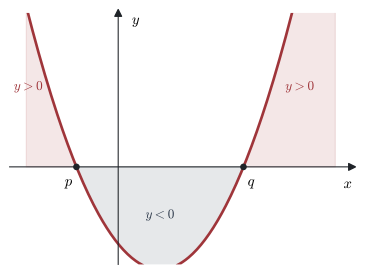
The graph tells us everything. Suppose \(y = a(x - p)(x - q)\) with \(a > 0\) and \(p < q\):
Solving a quadratic inequality Not in the formula booklet
- Move every term to the left, so that the right-hand side is zero.
- Factorise the left-hand side fully (or find its roots with the quadratic formula).
- Draw a sign diagram (or a quick sketch) of the left-hand side.
- Read off the values of \(x\) that you need.
For \(a > 0\) and roots \(p < q\):
- \((x - p)(x - q) > 0 \iff x < p\) or \(x > q\) (outside the roots);
- \((x - p)(x - q) < 0 \iff p < x < q\) (between the roots).
A sign diagram is a number line with the roots marked. Write \(+\) or \(-\) in each interval. For \(a(x - p)(x - q)\) with \(a > 0\) and \(p < q\):
| \(x\) | \(x < p\) | \(p\) | \(p < x < q\) | \(q\) | \(x > q\) |
|---|---|---|---|---|---|
| sign | \(+\) | \(0\) | \(-\) | \(0\) | \(+\) |
If \(a < 0\), every sign is reversed.
To check a sign, test one number from the interval. For example, \(x = 0\) is often easy.
Example 1 Solve for \(x\):
(a) \(3x^2 \geq 5x + 2\)
(b) \(2x^2 < 3(x + 3)\)
(c) \(x + 30 > x^2\)
(a) \(3x^2 - 5x - 2 \geq 0 \;\Longrightarrow\; (3x + 1)(x - 2) \geq 0\).
Roots: \(x = -\dfrac{1}{3}\) and \(x = 2\). The coefficient of \(x^2\) is positive, so the expression is \(\geq 0\) outside the roots:
\[ x \leq -\frac{1}{3} \quad\text{or}\quad x \geq 2 . \]
(b) \(2x^2 - 3x - 9 < 0 \;\Longrightarrow\; (2x + 3)(x - 3) < 0\).
Roots \(-\dfrac{3}{2}\) and \(3\). We need the part between the roots:
\[ -\frac{3}{2} < x < 3 . \]
(c) Move everything to the side of \(x^2\) so the \(x^2\) coefficient is positive: \(0 > x^2 - x - 30\), that is, \((x - 6)(x + 5) < 0\).
\[ -5 < x < 6 . \]
If the expression does not factorise, find the roots with the quadratic formula. The method is the same.
Pairs of inequalities
When \(x\) must satisfy two inequalities, solve each one, then find the values that satisfy both. A number line makes this clear.
Example 2 Find the set of values of \(x\) that satisfy both
\[ \frac{1}{3}x - 2 \leq 1 \qquad\text{and}\qquad 2 - 5x < 3x^2 . \]
First inequality: \(\dfrac{1}{3}x \leq 3\), so \(x \leq 9\).
Second inequality: \(3x^2 + 5x - 2 > 0 \;\Longrightarrow\; (3x - 1)(x + 2) > 0\), so \(x < -2\) or \(x > \dfrac{1}{3}\).
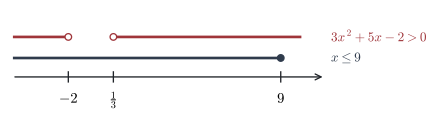
Both are true when
\[ x < -2 \quad\text{or}\quad \frac{1}{3} < x \leq 9 . \]
Inequalities from the discriminant
Questions about “two distinct real roots” or “no real roots” give an inequality for \(\Delta\). If \(\Delta\) is itself quadratic in the unknown constant, we must solve a quadratic inequality.
Example 3 Find the largest integer value of \(m\) for which the equation
\[ \frac{m + 2}{x^2} + \frac{4}{x} + m = 0 \]
has two distinct real roots.
Multiply by \(x^2\) (with \(x \neq 0\)): \(\;mx^2 + 4x + (m + 2) = 0\).
Two distinct real roots: \(\Delta > 0\).
\[ 16 - 4m(m + 2) > 0 \;\Longrightarrow\; 4 - m^2 - 2m > 0 \;\Longrightarrow\; m^2 + 2m - 4 < 0 . \]
The roots of \(m^2 + 2m - 4 = 0\) are \(m = \dfrac{-2 \pm \sqrt{4 + 16}}{2} = -1 \pm \sqrt{5}\). So
\[ -1 - \sqrt{5} < m < -1 + \sqrt{5}, \qquad\text{that is, about } -3.24 < m < 1.24 . \]
The largest integer is \(m = 1\).
Check: \(m = 1\) gives \(x^2 + 4x + 3 = 0\), with roots \(-1\) and \(-3\). Neither is \(0\), so both are allowed. ✓
Calculator page: solve(3x^2+5x-2>0, x) returns x<-2 or x>1/3. For roots that are not exact, the calculator may give decimals; use nSolve or the graph.
Graphs page: graph the left-hand side and use Menu → Analyze Graph → Zero. Then read from the graph where the curve is above (or below) the \(x\)-axis.
Common errors
| ✗ Wrong | ✓ Right | Why |
|---|---|---|
| \((x - 6)(x + 5) < 0 \Rightarrow x < 6\) and \(x < -5\) | \(-5 < x < 6\) | Do not treat it like an equation. Use a sign diagram. |
| \(x^2 > 16 \Rightarrow x > 4\) | \(x < -4\) or \(x > 4\) | There are two roots, \(\pm 4\). |
| \(x^2 < 9 \Rightarrow x < \pm 3\) | \(-3 < x < 3\) | “\(x < \pm 3\)” has no meaning. |
| Dividing \(x^2 > 3x\) by \(x\) | Write \(x(x - 3) > 0\) | \(x\) may be negative or zero, so dividing can lose solutions. |
| Writing “\(x < -2\) and \(x > \frac{1}{3}\)” | “or” | No number is both less than \(-2\) and greater than \(\frac{1}{3}\). |
Exercises
1 Solve \((x - 2)(x + 5) < 0\).
Between the roots: \(-5 < x < 2\).
2 Solve \(x^2 - 3x - 10 \geq 0\).
\((x - 5)(x + 2) \geq 0\): \(\;x \leq -2\) or \(x \geq 5\).
3 Solve \(x^2 > 7x\).
\(x^2 - 7x > 0 \Rightarrow x(x - 7) > 0\): \(\;x < 0\) or \(x > 7\).
4 Solve \(2x^2 + x \leq 6\).
\(2x^2 + x - 6 \leq 0 \Rightarrow (2x - 3)(x + 2) \leq 0\): \(\;-2 \leq x \leq \dfrac{3}{2}\).
5 Solve \(12 + x - x^2 > 0\).
Multiply by \(-1\) and reverse the sign: \(x^2 - x - 12 < 0 \Rightarrow (x - 4)(x + 3) < 0\): \(\;-3 < x < 4\).
6 Solve \(x^2 - 4x - 1 < 0\), giving exact answers.
Roots: \(x = \dfrac{4 \pm \sqrt{16 + 4}}{2} = 2 \pm \sqrt{5}\). So \(2 - \sqrt{5} < x < 2 + \sqrt{5}\).
7 Solve \((x + 1)^2 \leq 2x + 10\).
\(x^2 + 2x + 1 \leq 2x + 10 \Rightarrow x^2 \leq 9\): \(\;-3 \leq x \leq 3\).
8 Find the set of values of \(x\) for which \(2x - 1 < 9\) and \(x^2 - 2x - 8 > 0\).
First: \(x < 5\). Second: \((x - 4)(x + 2) > 0 \Rightarrow x < -2\) or \(x > 4\).
Both: \(x < -2\) or \(4 < x < 5\).
9 Find the range of values of \(k\) for which \(x^2 + kx + k + 3 = 0\) has no real roots.
\(\Delta = k^2 - 4(k + 3) < 0 \Rightarrow k^2 - 4k - 12 < 0 \Rightarrow (k - 6)(k + 2) < 0\): \(\;-2 < k < 6\).
10 Find the values of \(k\) for which the line \(y = kx - 1\) meets the curve \(y = x^2 + 3\) at two distinct points.
\(x^2 + 3 = kx - 1 \Rightarrow x^2 - kx + 4 = 0\). Two distinct points: \(\Delta = k^2 - 16 > 0\).
\(k < -4\) or \(k > 4\).