20.5 The Vector Product
AHL 3.16
- the definition of the vector product (cross product) \(\boldsymbol{a} \times \boldsymbol{b} = |\boldsymbol{a}||\boldsymbol{b}|\sin\theta\,\hat{\boldsymbol{n}}\)
- the properties of the vector product, including \(\boldsymbol{a} \times \boldsymbol{b} = -\boldsymbol{b} \times \boldsymbol{a}\)
- how to calculate \(\boldsymbol{a} \times \boldsymbol{b}\) from components, using a determinant
- how to find a vector perpendicular to two given vectors
- how to use \(|\boldsymbol{a} \times \boldsymbol{b}|\) to find the area of a parallelogram and of a triangle
- (Extension) the shortest distance from a point to a line
Definition
The vector product of \(\boldsymbol{v}\) and \(\boldsymbol{w}\) is a vector. (Compare: the scalar product is a number.)
Vector product (cross product) Partly in the HL formula booklet
\[ |\boldsymbol{v} \times \boldsymbol{w}| = |\boldsymbol{v}|\,|\boldsymbol{w}|\sin\theta, \quad \text{where } \theta \text{ is the angle between } \boldsymbol{v} \text{ and } \boldsymbol{w} \]
In the HL booklet
As a vector, \(\boldsymbol{v} \times \boldsymbol{w} = |\boldsymbol{v}|\,|\boldsymbol{w}|\sin\theta\;\hat{\boldsymbol{n}}\) \((0 \leq \theta \leq \pi)\), where \(\hat{\boldsymbol{n}}\) is the unit vector perpendicular to both \(\boldsymbol{v}\) and \(\boldsymbol{w}\), in the direction given by the right-hand rule.
- \(\boldsymbol{v}\), \(\boldsymbol{w}\): vectors
- \(|\boldsymbol{v}|\), \(|\boldsymbol{w}|\): the magnitudes of \(\boldsymbol{v}\) and \(\boldsymbol{w}\)
- \(\theta\): the angle between \(\boldsymbol{v}\) and \(\boldsymbol{w}\) (\(0 \leq \theta \leq \pi\))
- \(\hat{\boldsymbol{n}}\): the unit vector perpendicular to both \(\boldsymbol{v}\) and \(\boldsymbol{w}\) (right-hand rule)
We read \(\boldsymbol{v} \times \boldsymbol{w}\) as “\(\boldsymbol{v}\) cross \(\boldsymbol{w}\)”. Below, as in Figure 1, we call the two vectors \(\boldsymbol{a}\) and \(\boldsymbol{b}\).
Right-hand rule. Point the fingers of your right hand along \(\boldsymbol{a}\) and curl them towards \(\boldsymbol{b}\) (through the angle \(\theta\)). Your thumb points in the direction of \(\boldsymbol{a} \times \boldsymbol{b}\).
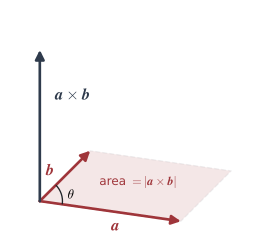
So the vector product has
- magnitude \(|\boldsymbol{a}||\boldsymbol{b}|\sin\theta\) (we will see that this is an area), and
- direction perpendicular to both \(\boldsymbol{a}\) and \(\boldsymbol{b}\).
Properties of the vector product
Properties of the vector product Not in the formula booklet
- \(\boldsymbol{a} \times \boldsymbol{b} = -\,\boldsymbol{b} \times \boldsymbol{a}\) (not commutative: the order matters)
- \(\boldsymbol{a} \times (\boldsymbol{b} + \boldsymbol{c}) = \boldsymbol{a} \times \boldsymbol{b} + \boldsymbol{a} \times \boldsymbol{c}\) (distributive)
- \((\lambda\boldsymbol{a}) \times (\mu\boldsymbol{b}) = \lambda\mu\,(\boldsymbol{a} \times \boldsymbol{b})\)
- \(\boldsymbol{a} \times \boldsymbol{0} = \boldsymbol{0} \times \boldsymbol{a} = \boldsymbol{0}\)
- \(\boldsymbol{a} \times \boldsymbol{a} = \boldsymbol{0}\) (because \(\sin 0 = 0\))
- If \(\boldsymbol{a} \perp \boldsymbol{b}\), then \(|\boldsymbol{a} \times \boldsymbol{b}| = |\boldsymbol{a}||\boldsymbol{b}|\) (because \(\sin 90^\circ = 1\))
- For non-zero vectors: \(\;\boldsymbol{a} \times \boldsymbol{b} = \boldsymbol{0} \iff \boldsymbol{a} \parallel \boldsymbol{b}\)
- \(\boldsymbol{a}\), \(\boldsymbol{b}\), \(\boldsymbol{c}\): vectors
- \(\lambda\), \(\mu\): scalars (real numbers)
- \(\boldsymbol{0}\): the zero vector
Property 1 follows from the right-hand rule: curling from \(\boldsymbol{b}\) to \(\boldsymbol{a}\) turns your thumb the other way. When you expand brackets with cross products, keep the order of each product. For example,
\[ (\boldsymbol{b} - \boldsymbol{a}) \times (\boldsymbol{c} - \boldsymbol{a}) = \boldsymbol{b} \times \boldsymbol{c} - \boldsymbol{b} \times \boldsymbol{a} - \boldsymbol{a} \times \boldsymbol{c} + \boldsymbol{a} \times \boldsymbol{a} = \boldsymbol{a} \times \boldsymbol{b} + \boldsymbol{b} \times \boldsymbol{c} + \boldsymbol{c} \times \boldsymbol{a} . \]
The vector product in components
Products of the base vectors
\(\boldsymbol{i}\), \(\boldsymbol{j}\), \(\boldsymbol{k}\) are perpendicular unit vectors, and they form a right-handed set. So
| \(\times\) | \(\boldsymbol{i}\) | \(\boldsymbol{j}\) | \(\boldsymbol{k}\) |
|---|---|---|---|
| \(\boldsymbol{i}\) | \(\boldsymbol{0}\) | \(\boldsymbol{k}\) | \(-\boldsymbol{j}\) |
| \(\boldsymbol{j}\) | \(-\boldsymbol{k}\) | \(\boldsymbol{0}\) | \(\boldsymbol{i}\) |
| \(\boldsymbol{k}\) | \(\boldsymbol{j}\) | \(-\boldsymbol{i}\) | \(\boldsymbol{0}\) |
(Read the table as “row \(\times\) column”, for example \(\boldsymbol{j} \times \boldsymbol{k} = \boldsymbol{i}\).) A memory aid: going forwards round the cycle \(\boldsymbol{i} \to \boldsymbol{j} \to \boldsymbol{k} \to \boldsymbol{i}\) gives a plus sign; going backwards gives a minus sign.
The component formula
Expand \((a_1\boldsymbol{i} + a_2\boldsymbol{j} + a_3\boldsymbol{k}) \times (b_1\boldsymbol{i} + b_2\boldsymbol{j} + b_3\boldsymbol{k})\) using the table and collect terms. The result is easiest to remember as a determinant.
Vector product in components Partly in the HL formula booklet
\[ \boldsymbol{v} \times \boldsymbol{w} = \begin{pmatrix} v_2 w_3 - v_3 w_2 \\ v_3 w_1 - v_1 w_3 \\ v_1 w_2 - v_2 w_1 \end{pmatrix}, \quad \text{where } \boldsymbol{v} = \begin{pmatrix} v_1 \\ v_2 \\ v_3 \end{pmatrix}, \; \boldsymbol{w} = \begin{pmatrix} w_1 \\ w_2 \\ w_3 \end{pmatrix} \]
In the HL booklet
As a determinant (easier to remember):
\[ \boldsymbol{v} \times \boldsymbol{w} = \begin{vmatrix} \boldsymbol{i} & \boldsymbol{j} & \boldsymbol{k} \\ v_1 & v_2 & v_3 \\ w_1 & w_2 & w_3 \end{vmatrix} = \begin{vmatrix} v_2 & v_3 \\ w_2 & w_3 \end{vmatrix}\boldsymbol{i} - \begin{vmatrix} v_1 & v_3 \\ w_1 & w_3 \end{vmatrix}\boldsymbol{j} + \begin{vmatrix} v_1 & v_2 \\ w_1 & w_2 \end{vmatrix}\boldsymbol{k} \]
- \(\boldsymbol{v}\), \(\boldsymbol{w}\): vectors
- \(v_1\), \(v_2\), \(v_3\): the components of \(\boldsymbol{v}\)
- \(w_1\), \(w_2\), \(w_3\): the components of \(\boldsymbol{w}\)
- \(\boldsymbol{i}\), \(\boldsymbol{j}\), \(\boldsymbol{k}\): the unit vectors in the directions of the \(x\)-, \(y\)- and \(z\)-axes
Each \(2 \times 2\) determinant is \(\begin{vmatrix} p & q \\ r & s \end{vmatrix} = ps - qr\). Do not forget the minus sign in front of the \(\boldsymbol{j}\) term.
Example 1 Given that \(\boldsymbol{a} = \begin{pmatrix} 1 \\ 0 \\ 2 \end{pmatrix}\) and \(\boldsymbol{b} = \begin{pmatrix} 2 \\ -1 \\ 3 \end{pmatrix}\), find
(a) \(\boldsymbol{a} \times \boldsymbol{b}\)
(b) \(\boldsymbol{b} \times \boldsymbol{a}\)
(a)
\[ \boldsymbol{a} \times \boldsymbol{b} = \begin{vmatrix} \boldsymbol{i} & \boldsymbol{j} & \boldsymbol{k} \\ 1 & 0 & 2 \\ 2 & -1 & 3 \end{vmatrix} = \big(0 \cdot 3 - 2 \cdot (-1)\big)\boldsymbol{i} - \big(1 \cdot 3 - 2 \cdot 2\big)\boldsymbol{j} + \big(1 \cdot (-1) - 0 \cdot 2\big)\boldsymbol{k} = \begin{pmatrix} 2 \\ 1 \\ -1 \end{pmatrix} . \]
(b) \(\boldsymbol{b} \times \boldsymbol{a} = -\,\boldsymbol{a} \times \boldsymbol{b} = \begin{pmatrix} -2 \\ -1 \\ 1 \end{pmatrix}\).
Example 2 Given that \(\boldsymbol{a} = 2\boldsymbol{i} + \boldsymbol{j} - \boldsymbol{k}\) and \(\boldsymbol{b} = \boldsymbol{i} + 3\boldsymbol{j} + 2\boldsymbol{k}\), find a vector perpendicular to both \(\boldsymbol{a}\) and \(\boldsymbol{b}\). Hence find a unit vector perpendicular to both.
\[ \boldsymbol{a} \times \boldsymbol{b} = \begin{vmatrix} \boldsymbol{i} & \boldsymbol{j} & \boldsymbol{k} \\ 2 & 1 & -1 \\ 1 & 3 & 2 \end{vmatrix} = (2 + 3)\boldsymbol{i} - (4 + 1)\boldsymbol{j} + (6 - 1)\boldsymbol{k} = 5\boldsymbol{i} - 5\boldsymbol{j} + 5\boldsymbol{k} . \]
Any non-zero multiple also works, so a simpler answer is \(\boldsymbol{i} - \boldsymbol{j} + \boldsymbol{k}\).
Its magnitude is \(\sqrt{3}\), so a unit vector perpendicular to both is \(\dfrac{1}{\sqrt{3}}(\boldsymbol{i} - \boldsymbol{j} + \boldsymbol{k})\) (or its negative).
Example 3 Given \(\boldsymbol{a} = \boldsymbol{i} - 2\boldsymbol{j} + 3\boldsymbol{k}\) and \(\boldsymbol{b} = 2\boldsymbol{i} + \boldsymbol{j} - \boldsymbol{k}\).
(a) Find \(\boldsymbol{a} \times \boldsymbol{b}\), and show that \((\boldsymbol{a} \times \boldsymbol{b}) \cdot \boldsymbol{b} = 0\).
(b) Explain briefly why \((\boldsymbol{a} \times \boldsymbol{b}) \cdot \boldsymbol{a} = 0\) without calculating it.
(a)
\[ \boldsymbol{a} \times \boldsymbol{b} = \begin{vmatrix} \boldsymbol{i} & \boldsymbol{j} & \boldsymbol{k} \\ 1 & -2 & 3 \\ 2 & 1 & -1 \end{vmatrix} = (2 - 3)\boldsymbol{i} - (-1 - 6)\boldsymbol{j} + (1 + 4)\boldsymbol{k} = -\boldsymbol{i} + 7\boldsymbol{j} + 5\boldsymbol{k} . \]
\((\boldsymbol{a} \times \boldsymbol{b}) \cdot \boldsymbol{b} = -2 + 7 - 5 = 0\).
(b) By definition, \(\boldsymbol{a} \times \boldsymbol{b}\) is perpendicular to \(\boldsymbol{a}\), and the scalar product of perpendicular vectors is \(0\).
On a Calculator page: Menu → Matrix & Vector → Vector → Cross Product, then type the two vectors in square brackets:
crossP([1,-2,3],[2,1,-1]) gives [-1 7 5].
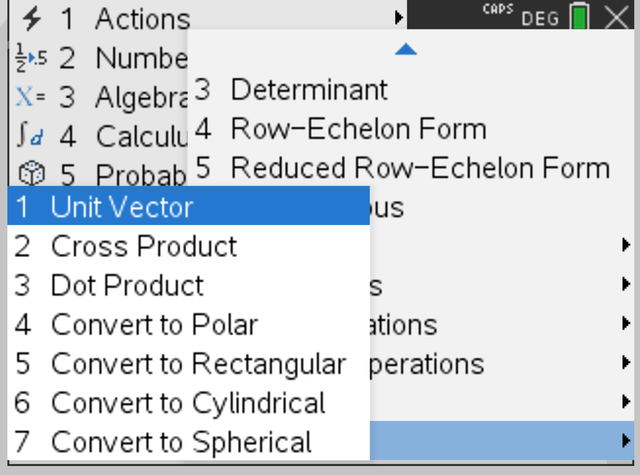
Combine it with Norm (Menu → Matrix & Vector → Norms → Norm) for areas, for example norm(crossP(u,v))/2. Check the order of the vectors: crossP(v,u) gives the negative.
Extension Sides of a right-angled triangle and the shortest distance to a line
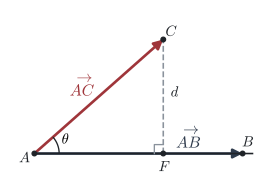
In the right-angled triangle \(AFC\) below, \(F\) is the foot of the perpendicular from \(C\) to the line \(AB\). The side \(AF\) is the length of projection of \(\overrightarrow{AC}\) onto \(\overrightarrow{AB}\) (see the Extension part of Section 20.4):
\[ AF = \frac{\big|\overrightarrow{AC} \cdot \overrightarrow{AB}\big|}{\big|\overrightarrow{AB}\big|} . \]
Then Pythagoras’ theorem gives the shortest distance \(d = CF\) from \(C\) to the line \(AB\): \(\;d^2 = AC^2 - AF^2\).
Example 4 The points \(A(2, -1, 3)\), \(B(4, 1, 2)\) and \(C(5, 3, 7)\) are given. Find the shortest distance from \(C\) to the line \(AB\).
\(\overrightarrow{AB} = \begin{pmatrix} 2 \\ 2 \\ -1 \end{pmatrix}\), \(\big|\overrightarrow{AB}\big| = 3\); \(\;\overrightarrow{AC} = \begin{pmatrix} 3 \\ 4 \\ 4 \end{pmatrix}\), \(AC^2 = 9 + 16 + 16 = 41\).
\(\overrightarrow{AC} \cdot \overrightarrow{AB} = 6 + 8 - 4 = 10\), so \(AF = \dfrac{10}{3}\).
\[ d^2 = 41 - \frac{100}{9} = \frac{269}{9} \quad\Longrightarrow\quad d = \frac{\sqrt{269}}{3} \approx 5.47 . \]
We will find the same answer with the vector product in Example 6.
Area of a parallelogram
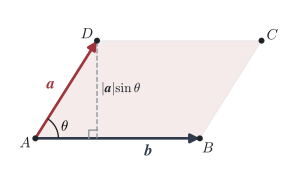
The parallelogram \(ABCD\) has sides \(\overrightarrow{AB} = \boldsymbol{b}\) and \(\overrightarrow{AD} = \boldsymbol{a}\), with angle \(\theta\) between them. Its base is \(|\boldsymbol{b}|\) and its perpendicular height is \(|\boldsymbol{a}|\sin\theta\). So
\[ \text{area} = |\boldsymbol{b}| \times |\boldsymbol{a}|\sin\theta = |\boldsymbol{a} \times \boldsymbol{b}| . \]
Area of a parallelogram In the HL formula booklet
If \(\boldsymbol{v}\) and \(\boldsymbol{w}\) form two adjacent sides of a parallelogram, then
\[ A = |\boldsymbol{v} \times \boldsymbol{w}| . \]
For the parallelogram \(ABCD\): \(\;A = \big|\overrightarrow{AB} \times \overrightarrow{AD}\big|\).
- \(\boldsymbol{v}\), \(\boldsymbol{w}\): two adjacent sides of the parallelogram
- \(A\): the area of the parallelogram
- \(\overrightarrow{AB}\), \(\overrightarrow{AD}\): two adjacent sides of the parallelogram \(ABCD\)
Area of a triangle
A diagonal cuts a parallelogram into two equal triangles, so a triangle has half the area.
Area of a triangle Not in the formula booklet
\[ \text{Area of triangle } ABC = \frac{1}{2}\big|\overrightarrow{AB} \times \overrightarrow{AC}\big| \]
- \(A\), \(B\), \(C\): the vertices of the triangle
- \(\overrightarrow{AB}\), \(\overrightarrow{AC}\): two sides of the triangle from \(A\)
Halve the parallelogram formula.
This is the vector version of \(\frac{1}{2}ab\sin C\). Both vectors must start at the same vertex.
Example 5 The points \(A(1, 2, 0)\), \(B(3, 1, 2)\) and \(C(0, 4, 1)\) are given, and \(O\) is the origin. Find
(a) the area of triangle \(ABC\),
(b) the area of the parallelogram \(OADC\).
(a) \(\overrightarrow{AB} = \begin{pmatrix} 2 \\ -1 \\ 2 \end{pmatrix}\) and \(\overrightarrow{AC} = \begin{pmatrix} -1 \\ 2 \\ 1 \end{pmatrix}\).
\[ \overrightarrow{AB} \times \overrightarrow{AC} = \begin{vmatrix} \boldsymbol{i} & \boldsymbol{j} & \boldsymbol{k} \\ 2 & -1 & 2 \\ -1 & 2 & 1 \end{vmatrix} = (-1 - 4)\boldsymbol{i} - (2 + 2)\boldsymbol{j} + (4 - 1)\boldsymbol{k} = \begin{pmatrix} -5 \\ -4 \\ 3 \end{pmatrix} . \]
Its magnitude is \(\sqrt{25 + 16 + 9} = \sqrt{50} = 5\sqrt{2}\). Area of triangle \(ABC = \dfrac{5\sqrt{2}}{2}\).
(b) In \(OADC\) the sides from \(O\) are \(\overrightarrow{OA} = \begin{pmatrix} 1 \\ 2 \\ 0 \end{pmatrix}\) and \(\overrightarrow{OC} = \begin{pmatrix} 0 \\ 4 \\ 1 \end{pmatrix}\).
\[ \overrightarrow{OA} \times \overrightarrow{OC} = \begin{vmatrix} \boldsymbol{i} & \boldsymbol{j} & \boldsymbol{k} \\ 1 & 2 & 0 \\ 0 & 4 & 1 \end{vmatrix} = (2 - 0)\boldsymbol{i} - (1 - 0)\boldsymbol{j} + (4 - 0)\boldsymbol{k} = \begin{pmatrix} 2 \\ -1 \\ 4 \end{pmatrix} . \]
Area of \(OADC = \sqrt{4 + 1 + 16} = \sqrt{21}\).
Distance from a point to a line, using areas
The area of triangle \(ABC\) is also \(\frac{1}{2} \times AB \times d\), where \(d\) is the height from \(C\) to the line \(AB\). So
\[ d = \frac{\big|\overrightarrow{AB} \times \overrightarrow{AC}\big|}{\big|\overrightarrow{AB}\big|} . \]
Example 6 Use the vector product to find the shortest distance from \(C(5, 3, 7)\) to the line through \(A(2, -1, 3)\) and \(B(4, 1, 2)\).
\[ \overrightarrow{AB} \times \overrightarrow{AC} = \begin{vmatrix} \boldsymbol{i} & \boldsymbol{j} & \boldsymbol{k} \\ 2 & 2 & -1 \\ 3 & 4 & 4 \end{vmatrix} = (8 + 4)\boldsymbol{i} - (8 + 3)\boldsymbol{j} + (8 - 6)\boldsymbol{k} = \begin{pmatrix} 12 \\ -11 \\ 2 \end{pmatrix} . \]
Its magnitude is \(\sqrt{144 + 121 + 4} = \sqrt{269}\), and \(\big|\overrightarrow{AB}\big| = 3\). So \(d = \dfrac{\sqrt{269}}{3} \approx 5.47\), the same as in Example 4.
Common errors
| ✗ Wrong | ✓ Right | Why |
|---|---|---|
| \(\boldsymbol{a} \times \boldsymbol{b} = \boldsymbol{b} \times \boldsymbol{a}\) | \(\boldsymbol{a} \times \boldsymbol{b} = -\,\boldsymbol{b} \times \boldsymbol{a}\) | The vector product is not commutative. |
| \(\boldsymbol{j}\)-component \(= a_1 b_3 - a_3 b_1\) | \(-(a_1 b_3 - a_3 b_1) = a_3 b_1 - a_1 b_3\) | The middle term of the determinant has a minus sign. |
| \(\boldsymbol{a} \times \boldsymbol{b}\) is a number | \(\boldsymbol{a} \times \boldsymbol{b}\) is a vector | Only its magnitude \(\vert\boldsymbol{a} \times \boldsymbol{b}\vert\) is a number. |
| Area of triangle \(= \vert\overrightarrow{AB} \times \overrightarrow{AC}\vert\) | \(\frac{1}{2}\vert\overrightarrow{AB} \times \overrightarrow{AC}\vert\) | The full magnitude is the area of the parallelogram. |
| The perpendicular vector must be exactly \(\boldsymbol{a} \times \boldsymbol{b}\) | Any non-zero multiple, e.g. \(\boldsymbol{i} - \boldsymbol{j} + \boldsymbol{k}\) instead of \(5\boldsymbol{i} - 5\boldsymbol{j} + 5\boldsymbol{k}\) | Every multiple has the same (or opposite) direction, so it is still perpendicular to both. |
| \(\sin\theta = \frac{1}{2} \Rightarrow \theta = 30^\circ\) only | \(\theta = 30^\circ\) or \(150^\circ\) | \(\vert\boldsymbol{a} \times \boldsymbol{b}\vert\) cannot tell acute from obtuse; use the dot product for angles. |
Exercises
1 Find \(\boldsymbol{a} \times \boldsymbol{b}\) for \(\boldsymbol{a} = \begin{pmatrix} 2 \\ 3 \\ -1 \end{pmatrix}\) and \(\boldsymbol{b} = \begin{pmatrix} 1 \\ -2 \\ 4 \end{pmatrix}\), and check your answer with a scalar product.
\[ \boldsymbol{a} \times \boldsymbol{b} = \begin{pmatrix} 3 \cdot 4 - (-1)(-2) \\ (-1) \cdot 1 - 2 \cdot 4 \\ 2 \cdot (-2) - 3 \cdot 1 \end{pmatrix} = \begin{pmatrix} 10 \\ -9 \\ -7 \end{pmatrix} . \]
Check: \((\boldsymbol{a} \times \boldsymbol{b}) \cdot \boldsymbol{a} = 20 - 27 + 7 = 0\) ✓ and \((\boldsymbol{a} \times \boldsymbol{b}) \cdot \boldsymbol{b} = 10 + 18 - 28 = 0\) ✓.
2 Use the table of base-vector products to simplify
(a) \((\boldsymbol{i} + 2\boldsymbol{j}) \times \boldsymbol{k}\)
(b) \((2\boldsymbol{i} - \boldsymbol{j}) \times (\boldsymbol{i} + 3\boldsymbol{j})\)
(a) \(\boldsymbol{i} \times \boldsymbol{k} + 2\,\boldsymbol{j} \times \boldsymbol{k} = -\boldsymbol{j} + 2\boldsymbol{i} = 2\boldsymbol{i} - \boldsymbol{j}\).
(b) \(2\,\boldsymbol{i} \times \boldsymbol{i} + 6\,\boldsymbol{i} \times \boldsymbol{j} - \boldsymbol{j} \times \boldsymbol{i} - 3\,\boldsymbol{j} \times \boldsymbol{j} = \boldsymbol{0} + 6\boldsymbol{k} + \boldsymbol{k} - \boldsymbol{0} = 7\boldsymbol{k}\).
3 Find a unit vector perpendicular to both \(\boldsymbol{i} + \boldsymbol{j}\) and \(\boldsymbol{j} + 2\boldsymbol{k}\).
\[ \begin{pmatrix} 1 \\ 1 \\ 0 \end{pmatrix} \times \begin{pmatrix} 0 \\ 1 \\ 2 \end{pmatrix} = \begin{pmatrix} 2 - 0 \\ 0 - 2 \\ 1 - 0 \end{pmatrix} = \begin{pmatrix} 2 \\ -2 \\ 1 \end{pmatrix}, \quad \text{magnitude } 3 . \]
A unit vector is \(\dfrac{1}{3}(2\boldsymbol{i} - 2\boldsymbol{j} + \boldsymbol{k})\) (or its negative).
4 \(|\boldsymbol{a}| = 4\), \(|\boldsymbol{b}| = 5\) and \(|\boldsymbol{a} \times \boldsymbol{b}| = 10\). Find the possible angles between \(\boldsymbol{a}\) and \(\boldsymbol{b}\), and the possible values of \(\boldsymbol{a} \cdot \boldsymbol{b}\).
\(20\sin\theta = 10\), so \(\sin\theta = \dfrac{1}{2}\) and \(\theta = 30^\circ\) or \(150^\circ\).
\(\boldsymbol{a} \cdot \boldsymbol{b} = 20\cos\theta = 20 \times \dfrac{\sqrt{3}}{2} = 10\sqrt{3}\), or \(-10\sqrt{3}\).
5 Show that \((\boldsymbol{a} + \boldsymbol{b}) \times (\boldsymbol{a} - \boldsymbol{b}) = -2\,\boldsymbol{a} \times \boldsymbol{b}\).
\[ \begin{aligned} (\boldsymbol{a} + \boldsymbol{b}) \times (\boldsymbol{a} - \boldsymbol{b}) &= \boldsymbol{a} \times \boldsymbol{a} - \boldsymbol{a} \times \boldsymbol{b} + \boldsymbol{b} \times \boldsymbol{a} - \boldsymbol{b} \times \boldsymbol{b} \\ &= \boldsymbol{0} - \boldsymbol{a} \times \boldsymbol{b} - \boldsymbol{a} \times \boldsymbol{b} - \boldsymbol{0} \\ &= -2\,\boldsymbol{a} \times \boldsymbol{b} . \end{aligned} \]
6 Find the area of the triangle with vertices \(P(1, 0, 1)\), \(Q(3, 2, 1)\) and \(R(2, 1, 4)\).
\(\overrightarrow{PQ} = \begin{pmatrix} 2 \\ 2 \\ 0 \end{pmatrix}\), \(\overrightarrow{PR} = \begin{pmatrix} 1 \\ 1 \\ 3 \end{pmatrix}\), \(\overrightarrow{PQ} \times \overrightarrow{PR} = \begin{pmatrix} 6 - 0 \\ 0 - 6 \\ 2 - 2 \end{pmatrix} = \begin{pmatrix} 6 \\ -6 \\ 0 \end{pmatrix}\).
Area \(= \dfrac{1}{2}\sqrt{36 + 36} = \dfrac{1}{2} \times 6\sqrt{2} = 3\sqrt{2}\).
7 Find the area of the parallelogram with adjacent sides \(\begin{pmatrix} 3 \\ 0 \\ 1 \end{pmatrix}\) and \(\begin{pmatrix} 1 \\ 2 \\ -1 \end{pmatrix}\).
\(\begin{pmatrix} 3 \\ 0 \\ 1 \end{pmatrix} \times \begin{pmatrix} 1 \\ 2 \\ -1 \end{pmatrix} = \begin{pmatrix} 0 - 2 \\ 1 + 3 \\ 6 - 0 \end{pmatrix} = \begin{pmatrix} -2 \\ 4 \\ 6 \end{pmatrix}\). Area \(= \sqrt{4 + 16 + 36} = \sqrt{56} = 2\sqrt{14}\).
8 Find \(k\) such that \(\begin{pmatrix} 1 \\ k \\ 2 \end{pmatrix} \times \begin{pmatrix} 2 \\ 4 \\ 4 \end{pmatrix} = \boldsymbol{0}\). What does this tell you about the two vectors?
\(\begin{pmatrix} 4k - 8 \\ 4 - 4 \\ 4 - 2k \end{pmatrix} = \begin{pmatrix} 0 \\ 0 \\ 0 \end{pmatrix}\) gives \(k = 2\). The vectors are then parallel: \(\begin{pmatrix} 2 \\ 4 \\ 4 \end{pmatrix} = 2\begin{pmatrix} 1 \\ 2 \\ 2 \end{pmatrix}\).
9 \(ABCD\) is a parallelogram with \(A(1, 1, 0)\), \(B(4, 2, 1)\) and \(D(2, 3, 2)\). Find the coordinates of \(C\) and the area of \(ABCD\).
\(\overrightarrow{DC} = \overrightarrow{AB}\), so \(\boldsymbol{c} = \boldsymbol{b} + \boldsymbol{d} - \boldsymbol{a} = \begin{pmatrix} 5 \\ 4 \\ 3 \end{pmatrix}\), and \(C\) is \((5, 4, 3)\).
\(\overrightarrow{AB} \times \overrightarrow{AD} = \begin{pmatrix} 3 \\ 1 \\ 1 \end{pmatrix} \times \begin{pmatrix} 1 \\ 2 \\ 2 \end{pmatrix} = \begin{pmatrix} 2 - 2 \\ 1 - 6 \\ 6 - 1 \end{pmatrix} = \begin{pmatrix} 0 \\ -5 \\ 5 \end{pmatrix}\). Area \(= \sqrt{50} = 5\sqrt{2}\).
10 The points \(A(1, 0, 2)\), \(B(3, 2, 1)\) and \(C(0, 4, 5)\) are given.
(a) Find the area of triangle \(ABC\).
(b) Hence find the shortest distance from \(C\) to the line \(AB\).
(a) \(\overrightarrow{AB} = \begin{pmatrix} 2 \\ 2 \\ -1 \end{pmatrix}\), \(\overrightarrow{AC} = \begin{pmatrix} -1 \\ 4 \\ 3 \end{pmatrix}\), \(\overrightarrow{AB} \times \overrightarrow{AC} = \begin{pmatrix} 6 + 4 \\ 1 - 6 \\ 8 + 2 \end{pmatrix} = \begin{pmatrix} 10 \\ -5 \\ 10 \end{pmatrix}\), with magnitude \(15\).
Area \(= \dfrac{15}{2}\).
(b) \(\dfrac{1}{2} \times \big|\overrightarrow{AB}\big| \times d = \dfrac{15}{2}\) with \(\big|\overrightarrow{AB}\big| = 3\), so \(d = 5\).