14.2 Right-Angled Trigonometry and Exact Values
SL 3.1 SL 3.2 SL 3.3 SL 3.5
- the sine, cosine and tangent ratios of an acute angle in a right-angled triangle
- how to use these ratios to find unknown sides and angles
- the exact values of the ratios for \(30^\circ\), \(45^\circ\) and \(60^\circ\), and how to work them out from two special triangles
- the rules for complementary angles, such as \(\sin(90^\circ - \theta) = \cos\theta\)
- angles of elevation and depression
- the angle between a line and a plane in a three-dimensional solid
Trigonometric ratios of acute angles
In this section all angles are in degrees. (Radians are introduced in Section 14.5.)
The triangle \(ABC\) below has a right angle at \(C\). We look at the acute angle \(\theta\) at \(A\) and name the three sides from the point of view of \(\theta\):
- the hypotenuse is the longest side, opposite the right angle (\(AB\));
- the opposite side is the side across from \(\theta\) (\(BC\));
- the adjacent side is the side next to \(\theta\) that is not the hypotenuse (\(AC\)).
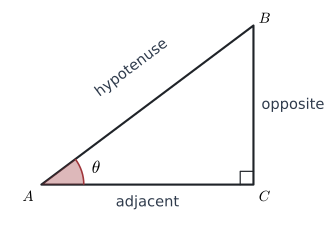
Trigonometric ratios in a right-angled triangle Not in the formula booklet
\[ \begin{aligned} \sin\theta &= \frac{\text{opposite}}{\text{hypotenuse}} = \frac{BC}{AB} \\[4pt] \cos\theta &= \frac{\text{adjacent}}{\text{hypotenuse}} = \frac{AC}{AB} \\[4pt] \tan\theta &= \frac{\text{opposite}}{\text{adjacent}} = \frac{BC}{AC} \end{aligned} \]
- \(\theta\): an acute angle of the right-angled triangle
- \(AB\): the hypotenuse; \(BC\): the side opposite \(\theta\); \(AC\): the side adjacent to \(\theta\)
Many students remember the three ratios with the word SOH CAH TOA (Sine = Opposite ÷ Hypotenuse, and so on).
If we divide \(\sin\theta\) by \(\cos\theta\), the hypotenuse cancels:
\[ \frac{\sin\theta}{\cos\theta} = \frac{BC}{AB} \div \frac{AC}{AB} = \frac{BC}{AC} = \tan\theta . \]
Identity for \(\tan\theta\) In the formula booklet
\[ \tan\theta = \frac{\sin\theta}{\cos\theta} \]
- \(\theta\): the angle (\(\cos\theta \neq 0\))
A calculator gives the ratios of any acute angle. To find an angle from a ratio, use the inverse functions \(\sin^{-1}\), \(\cos^{-1}\) and \(\tan^{-1}\) (also written \(\arcsin\), \(\arccos\), \(\arctan\)).
Example 1 (a) In a right-angled triangle, one angle is \(38^\circ\) and the hypotenuse is \(15\) cm. Find the length of the side opposite the \(38^\circ\) angle.
(b) The two shorter sides of a right-angled triangle are \(7\) cm and \(11\) cm. Find the smallest angle of the triangle.
(a) We know the hypotenuse and want the opposite side, so we use sine:
\[ \sin 38^\circ = \frac{x}{15} \;\Longrightarrow\; x = 15\sin 38^\circ = 9.23 \text{ cm } (3 \text{ s.f.}). \]
(b) The smallest angle is opposite the shortest side. For this angle, the opposite side is \(7\) and the adjacent side is \(11\):
\[ \tan\theta = \frac{7}{11} \;\Longrightarrow\; \theta = \tan^{-1}\!\left(\frac{7}{11}\right) = 32.5^\circ \;(3 \text{ s.f.}). \]
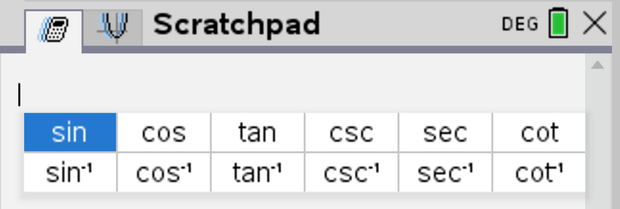
- Check the angle mode: DEG must show at the top right of the screen. If it shows RAD, click on it to switch.
- On a Calculator page, press the trig key and choose \(\sin\), then type
15·sin(38)and press enter: \(9.23492\ldots\) - For an angle, press trig and choose \(\tan^{-1}\), then type
tan⁻¹(7/11)and press enter: \(32.4712\ldots\)
Write down the equation (for example \(x = 15\sin 38^\circ\)) before you give the calculator value.
Exact values for 30°, 45° and 60°
For three special angles we do not need a calculator. Two simple triangles give exact values.
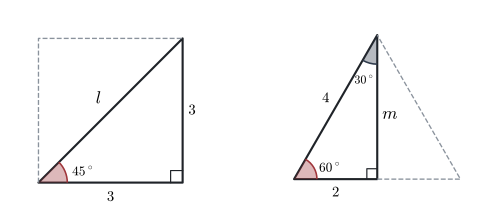
Example 2 (a) The left triangle in Figure 2 is half of a square of side \(3\). The right triangle is half of an equilateral triangle of side \(4\). Use Pythagoras’ theorem to find the exact values of \(l\) and \(m\).
(b) Hence find the exact values of \(\sin\theta\), \(\cos\theta\) and \(\tan\theta\) for \(\theta = 30^\circ\), \(45^\circ\) and \(60^\circ\).
(c) Compare these pairs of values. What do you notice?
(i) \(\sin 30^\circ\) and \(\cos 60^\circ\)
(ii) \(\cos 30^\circ\) and \(\sin 60^\circ\)
(iii) \(\sin 45^\circ\) and \(\cos 45^\circ\)
(iv) \(\tan 30^\circ\) and \(\tan 60^\circ\)
(a) \(l^2 = 3^2 + 3^2 = 18\), so \(l = \sqrt{18} = 3\sqrt{2}\).
The height of the equilateral triangle cuts the base in half, so the base of the right triangle is \(2\): \(m^2 = 4^2 - 2^2 = 12\), so \(m = \sqrt{12} = 2\sqrt{3}\).
(b) Left triangle (\(45^\circ\)): \(\;\sin 45^\circ = \dfrac{3}{3\sqrt{2}} = \dfrac{1}{\sqrt{2}} = \dfrac{\sqrt{2}}{2}\), \(\;\cos 45^\circ = \dfrac{\sqrt{2}}{2}\), \(\;\tan 45^\circ = \dfrac{3}{3} = 1\).
Right triangle (\(60^\circ\) at the bottom, \(30^\circ\) at the top):
\[ \sin 60^\circ = \frac{2\sqrt{3}}{4} = \frac{\sqrt{3}}{2}, \qquad \cos 60^\circ = \frac{2}{4} = \frac{1}{2}, \qquad \tan 60^\circ = \frac{2\sqrt{3}}{2} = \sqrt{3}, \]
\[ \sin 30^\circ = \frac{2}{4} = \frac{1}{2}, \qquad \cos 30^\circ = \frac{2\sqrt{3}}{4} = \frac{\sqrt{3}}{2}, \qquad \tan 30^\circ = \frac{2}{2\sqrt{3}} = \frac{\sqrt{3}}{3}. \]
The size of the triangle does not matter: the ratios are the same for any half-square or half-equilateral triangle.
(c)
(i) \(\sin 30^\circ = \cos 60^\circ = \dfrac{1}{2}\).
(ii) \(\cos 30^\circ = \sin 60^\circ = \dfrac{\sqrt{3}}{2}\).
(iii) \(\sin 45^\circ = \cos 45^\circ\).
(iv) \(\tan 60^\circ = \sqrt{3} = \dfrac{1}{\tan 30^\circ}\), so \(\tan 30^\circ \times \tan 60^\circ = 1\).
In each pair the two angles add up to \(90^\circ\). We explain this below.
Exact values of the special angles Not in the formula booklet
| \(\theta\) | \(30^\circ \left(\frac{\pi}{6}\right)\) | \(45^\circ \left(\frac{\pi}{4}\right)\) | \(60^\circ \left(\frac{\pi}{3}\right)\) |
|---|---|---|---|
| \(\sin\theta\) | \(\dfrac{1}{2}\) | \(\dfrac{\sqrt{2}}{2}\) | \(\dfrac{\sqrt{3}}{2}\) |
| \(\cos\theta\) | \(\dfrac{\sqrt{3}}{2}\) | \(\dfrac{\sqrt{2}}{2}\) | \(\dfrac{1}{2}\) |
| \(\tan\theta\) | \(\dfrac{\sqrt{3}}{3}\) | \(1\) | \(\sqrt{3}\) |
- \(\theta\): the angle, in degrees (radians in brackets — see Section 14.5)
You must know these values for Paper 1. If you forget one, sketch the two triangles again. Note that \(\dfrac{1}{\sqrt{2}} = \dfrac{\sqrt{2}}{2}\) and \(\dfrac{1}{\sqrt{3}} = \dfrac{\sqrt{3}}{3}\): both forms are correct.
Example 3 Without using a calculator, find the exact value of
(a) \(\dfrac{\sin 60^\circ}{\cos 30^\circ + \tan 45^\circ}\)
(b) \(\cos 30^\circ\left(\tan 60^\circ - \sin 45^\circ\right)\)
(a) Substitute the exact values, then rationalise the denominator:
\[ \begin{aligned} \frac{\frac{\sqrt{3}}{2}}{\frac{\sqrt{3}}{2} + 1} &= \frac{\sqrt{3}}{\sqrt{3} + 2} = \frac{\sqrt{3}\,(2 - \sqrt{3})}{(2 + \sqrt{3})(2 - \sqrt{3})} \\[4pt] &= \frac{2\sqrt{3} - 3}{4 - 3} \\ &= 2\sqrt{3} - 3 . \end{aligned} \]
(b)
\[ \frac{\sqrt{3}}{2}\left(\sqrt{3} - \frac{\sqrt{2}}{2}\right) = \frac{3}{2} - \frac{\sqrt{6}}{4} = \frac{6 - \sqrt{6}}{4} . \]
Example 4 In the triangle \(ABC\) below, angle \(C\) is a right angle. The point \(P\) lies on \(BC\) with \(BP = 2PC\). Angle \(APC = 30^\circ\) and \(AP = 12\) cm. Without using a calculator, find the integer \(k\) such that \(\angle ABC = \tan^{-1}\left(\dfrac{\sqrt{k}}{9}\right)\).
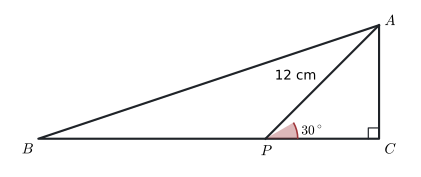
In the right-angled triangle \(APC\):
\[ \begin{aligned} AC &= 12\sin 30^\circ = 12 \times \frac{1}{2} = 6 \\[4pt] PC &= 12\cos 30^\circ = 12 \times \frac{\sqrt{3}}{2} = 6\sqrt{3} \end{aligned} \]
Then \(BP = 2PC = 12\sqrt{3}\), so \(BC = BP + PC = 18\sqrt{3}\).
In the right-angled triangle \(ABC\):
\[ \tan\angle ABC = \frac{AC}{BC} = \frac{6}{18\sqrt{3}} = \frac{1}{3\sqrt{3}} = \frac{\sqrt{3}}{9}. \]
So \(\angle ABC = \tan^{-1}\left(\dfrac{\sqrt{3}}{9}\right)\) and \(k = 3\).
Complementary angles
Two angles are complementary if they add up to \(90^\circ\). In a right-angled triangle the two acute angles are complementary: if one is \(\theta\), the other is \(90^\circ - \theta\).
Example 5 \(\theta\) is an acute angle with \(\cos\theta = \dfrac{8}{17}\). Find the exact value of
(a) \(\sin\theta\)
(b) \(\tan\theta\)
(c) \(\sin(90^\circ - \theta)\)
What is the connection between \(\sin(90^\circ - \theta)\) and \(\cos\theta\)?
Draw a right-angled triangle with angle \(\theta\), adjacent side \(8\) and hypotenuse \(17\). By Pythagoras’ theorem the opposite side is \(\sqrt{17^2 - 8^2} = \sqrt{225} = 15\).
(a) \(\sin\theta = \dfrac{15}{17}\).
(b) \(\tan\theta = \dfrac{15}{8}\).
(c) The third angle of the triangle is \(90^\circ - \theta\). For this angle the opposite side is \(8\) (the side that was adjacent to \(\theta\)), so
\[ \sin(90^\circ - \theta) = \frac{8}{17}. \]
This is the same as \(\cos\theta\): the side opposite one acute angle is the side adjacent to the other.
Complementary angles Not in the formula booklet
\[ \begin{gathered} \sin(90^\circ - \theta) = \cos\theta, \qquad \cos(90^\circ - \theta) = \sin\theta \\[4pt] \tan(90^\circ - \theta) = \frac{1}{\tan\theta} \end{gathered} \]
- \(\theta\): an angle; \(90^\circ - \theta\) is its complementary angle
The name cosine means “sine of the complementary angle”. In Section 14.6 we show that these rules are true for every angle, not only acute angles.
Angles of elevation and depression
When you look up at an object, the angle between your line of sight and the horizontal is the angle of elevation. When you look down, the angle between the horizontal and your line of sight is the angle of depression.
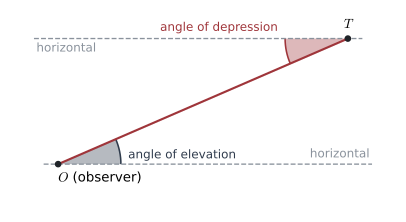
Angles of elevation and depression Not in the formula booklet
- Both angles are measured from the horizontal, never from the vertical.
- The two horizontal lines are parallel, so the angle of elevation of \(T\) from \(O\) equals the angle of depression of \(O\) from \(T\) (alternate angles).
Always start with a clear, labelled diagram. Mark the horizontal line, the right angle, and the angle you know.
Example 6 Mia stands at the top \(M\) of a building of height \(30\) m. A tower \(TF\) stands on the same level ground. From \(M\), the angle of elevation of the top \(T\) of the tower is \(45^\circ\) and the angle of depression of its base \(F\) is \(30^\circ\). Without using a calculator, find
(a) the horizontal distance \(d\) between the building and the tower
(b) the height of the tower, in the form \(a + b\sqrt{3}\).
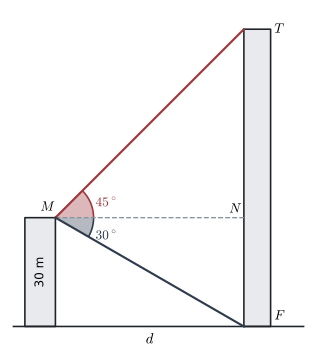
Let \(N\) be the point on the tower at the same height as \(M\). Then \(MN = d\) and \(NF = 30\) m.
(a) In triangle \(MNF\) the angle at \(M\) is \(30^\circ\):
\[ \tan 30^\circ = \frac{30}{d} \;\Longrightarrow\; d = \frac{30}{\tan 30^\circ} = \frac{30}{\frac{\sqrt{3}}{3}} = \frac{90}{\sqrt{3}} = 30\sqrt{3} \text{ m}. \]
(b) In triangle \(MNT\) the angle at \(M\) is \(45^\circ\), so \(TN = d\tan 45^\circ = 30\sqrt{3}\) m.
\[ \text{height of tower} = TN + NF = 30 + 30\sqrt{3} \text{ m} \;\;(\approx 82.0 \text{ m}). \]
Example 7 From the top of a cliff \(65\) m above sea level, the angles of depression of two boats are \(18^\circ\) and \(37^\circ\). The boats and the foot of the cliff are in a straight line, and both boats are on the same side of the cliff. Find the distance between the two boats.
The angle of depression equals the angle of elevation from each boat, so in each right-angled triangle the angle at the boat is known and the opposite side is \(65\) m.
\[ \begin{aligned} \text{far boat:} \quad & x_1 = \frac{65}{\tan 18^\circ} = 200.05\ldots \text{ m} \\ \text{near boat:} \quad & x_2 = \frac{65}{\tan 37^\circ} = 86.26\ldots \text{ m} \end{aligned} \]
The distance between the boats is \(x_1 - x_2 = 113.79\ldots \approx 114\) m (3 s.f.).
Keep the full calculator values until the last step, so that rounding errors do not build up.
The angle between a line and a plane
A line \(AP\) meets a plane at \(A\). Drop a perpendicular from \(P\) to the plane; its foot is \(N\). The line \(AN\) is the projection (the “shadow”) of \(AP\) on the plane.
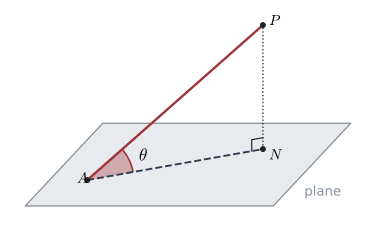
Angle between a line and a plane Not in the formula booklet
The angle between a line and a plane is the angle \(\theta\) between the line and its projection on the plane. The triangle \(APN\) has a right angle at \(N\), so
\[ \sin\theta = \frac{PN}{AP}, \qquad \tan\theta = \frac{PN}{AN}. \]
- \(A\): the point where the line meets the plane
- \(P\): another point on the line; \(N\): the foot of the perpendicular from \(P\) to the plane
- \(\theta\): the angle between the line and the plane (\(0^\circ \leq \theta \leq 90^\circ\))
In solids such as cuboids and pyramids, look for the right-angled triangle that contains the angle. In SL examinations, three-dimensional questions use only right-angled trigonometry.
Example 8 The cuboid \(ABCDEFGH\) has \(AB = 8\) cm, \(BC = 6\) cm and \(AE = 5\) cm. The base is \(ABCD\) and the edges \(AE\), \(BF\), \(CG\), \(DH\) are vertical.
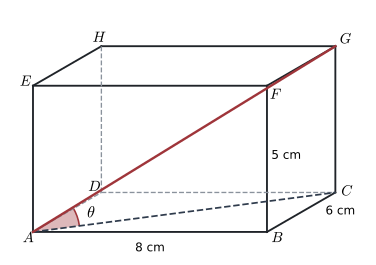
Find
(a) the length \(AC\)
(b) the length \(AG\)
(c) the angle between \(AG\) and the base \(ABCD\)
(d) the angle between \(AG\) and the face \(ABFE\).
(a) Triangle \(ABC\) has a right angle at \(B\): \(\;AC = \sqrt{8^2 + 6^2} = \sqrt{100} = 10\) cm.
(b) Triangle \(ACG\) has a right angle at \(C\): \(\;AG = \sqrt{10^2 + 5^2} = \sqrt{125} = 5\sqrt{5} \approx 11.2\) cm.
(c) \(G\) is directly above \(C\), so the projection of \(AG\) on the base is \(AC\). The angle is \(\theta = \angle GAC\):
\[ \tan\theta = \frac{GC}{AC} = \frac{5}{10} \;\Longrightarrow\; \theta = 26.6^\circ \;(3 \text{ s.f.}). \]
(d) The edge \(GF\) is perpendicular to the face \(ABFE\), so the projection of \(AG\) on this face is \(AF\). \(AF = \sqrt{8^2 + 5^2} = \sqrt{89}\) and \(GF = 6\):
\[ \tan\angle GAF = \frac{6}{\sqrt{89}} \;\Longrightarrow\; \angle GAF = 32.5^\circ \;(3 \text{ s.f.}). \]
Example 9 \(VABCD\) is a right pyramid with a square base \(ABCD\) of side \(6\) cm. The apex \(V\) is \(4\) cm vertically above the centre \(O\) of the base. \(M\) is the midpoint of \(BC\).
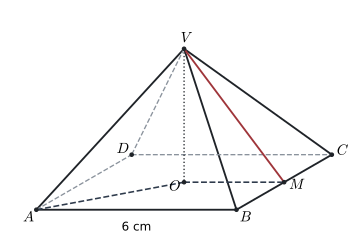
(a) Find the length of the edge \(VA\).
(b) Find the angle between \(VA\) and the base.
(c) Find the angle between \(VM\) and the base.
(a) \(OA\) is half of the diagonal \(AC = 6\sqrt{2}\), so \(OA = 3\sqrt{2}\). Triangle \(VOA\) has a right angle at \(O\):
\[ VA = \sqrt{\left(3\sqrt{2}\right)^2 + 4^2} = \sqrt{18 + 16} = \sqrt{34} \approx 5.83 \text{ cm}. \]
(b) The projection of \(VA\) on the base is \(OA\):
\[ \tan\angle VAO = \frac{4}{3\sqrt{2}} \;\Longrightarrow\; \angle VAO = 43.3^\circ \;(3 \text{ s.f.}). \]
(c) \(OM = 3\) (half the side), so \(\tan\angle VMO = \dfrac{4}{3}\) and \(\angle VMO = 53.1^\circ\) (3 s.f.).
Common errors
| ✗ Wrong | ✓ Right | Why |
|---|---|---|
| \(\sin\theta = \dfrac{\text{adjacent}}{\text{hypotenuse}}\) | \(\sin\theta = \dfrac{\text{opposite}}{\text{hypotenuse}}\) | Use SOH CAH TOA, and name the sides from the angle you are using. |
| Calculator in RAD mode for \(\sin 38^\circ\) | DEG mode | \(\sin 38\) in radians is \(0.296\ldots\), not \(0.616\ldots\) |
| \(\tan 30^\circ = \sqrt{3}\) | \(\tan 30^\circ = \dfrac{\sqrt{3}}{3}\) | \(\sqrt{3}\) is \(\tan 60^\circ\). Small angle, small tangent. |
| Angle of depression measured from the vertical | Measure from the horizontal | Both elevation and depression start at a horizontal line. |
| Angle between \(AG\) and the base \(= \angle GAB\) | \(\angle GAC\) | Use the projection of the line on the plane, which here is \(AC\). |
| Rounding \(x_1\) and \(x_2\) before subtracting | Keep full values | Early rounding can change the final answer. |
Exercises
1 Triangle \(ABC\) has a right angle at \(C\), \(AB = 20\) cm and \(\angle BAC = 52^\circ\). Find \(BC\) and \(AC\).
\(BC = 20\sin 52^\circ = 15.8\) cm and \(AC = 20\cos 52^\circ = 12.3\) cm (3 s.f.).
2 Triangle \(PQR\) has a right angle at \(Q\), \(PQ = 4\) cm and \(QR = 9\) cm. Find \(\angle QPR\).
For the angle at \(P\), \(QR\) is opposite and \(PQ\) is adjacent: \(\tan\angle QPR = \dfrac{9}{4}\), so \(\angle QPR = 66.0^\circ\) (3 s.f.).
3 Without a calculator, find the exact value of
(a) \(\tan 30^\circ \times \tan 60^\circ\)
(b) \(\dfrac{4\sin 30^\circ}{\tan 45^\circ + \cos 60^\circ}\)
(c) \((\sin 45^\circ)^2 + (\cos 60^\circ)^2\)
(a) \(\dfrac{\sqrt{3}}{3} \times \sqrt{3} = \dfrac{3}{3} = 1\).
(b) \(\dfrac{4 \times \frac{1}{2}}{1 + \frac{1}{2}} = \dfrac{2}{\frac{3}{2}} = \dfrac{4}{3}\).
(c) \(\left(\dfrac{\sqrt{2}}{2}\right)^2 + \left(\dfrac{1}{2}\right)^2 = \dfrac{2}{4} + \dfrac{1}{4} = \dfrac{3}{4}\).
4 Show that \(\dfrac{1 - \tan 30^\circ}{1 + \tan 30^\circ} = 2 - \sqrt{3}\).
Use \(\tan 30^\circ = \dfrac{1}{\sqrt{3}}\) and multiply the top and bottom by \(\sqrt{3}\):
\[ \frac{1 - \frac{1}{\sqrt{3}}}{1 + \frac{1}{\sqrt{3}}} = \frac{\sqrt{3} - 1}{\sqrt{3} + 1} = \frac{(\sqrt{3} - 1)^2}{(\sqrt{3} + 1)(\sqrt{3} - 1)} = \frac{4 - 2\sqrt{3}}{2} = 2 - \sqrt{3}. \]
5 \(\theta\) is acute and \(\sin\theta = \dfrac{20}{29}\). Find the exact values of
(a) \(\cos\theta\)
(b) \(\tan\theta\)
(c) \(\cos(90^\circ - \theta)\)
(d) \(\tan(90^\circ - \theta)\)
Opposite \(20\), hypotenuse \(29\), so adjacent \(= \sqrt{29^2 - 20^2} = \sqrt{441} = 21\).
(a) \(\cos\theta = \dfrac{21}{29}\)
(b) \(\tan\theta = \dfrac{20}{21}\)
(c) \(\cos(90^\circ - \theta) = \sin\theta = \dfrac{20}{29}\)
(d) \(\tan(90^\circ - \theta) = \dfrac{1}{\tan\theta} = \dfrac{21}{20}\)
6 Triangle \(ABC\) has a right angle at \(B\), \(\angle BAC = 60^\circ\) and \(AC = 10\) cm. Without a calculator, find the exact lengths of \(AB\) and \(BC\), and the exact area of the triangle.
\(AB = 10\cos 60^\circ = 5\) cm and \(BC = 10\sin 60^\circ = 5\sqrt{3}\) cm.
\[ \text{Area} = \frac{1}{2} \times 5 \times 5\sqrt{3} = \frac{25\sqrt{3}}{2} \text{ cm}^2 . \]
7 A kite string is \(45\) m long and makes an angle of \(58^\circ\) with the horizontal. Leo holds the string \(1.2\) m above the ground. Assuming the string is straight, find the height of the kite above the ground.
The vertical rise along the string is \(45\sin 58^\circ = 38.16\ldots\) m. Height \(= 1.2 + 38.16\ldots = 39.4\) m (3 s.f.).
8 A lighthouse is \(48\) m high. From its top, the angle of depression of a boat is \(12^\circ\). The boat sails straight towards the lighthouse until the angle of depression is \(25^\circ\). How far has the boat travelled?
\[ \begin{aligned} \text{start:} \quad & \frac{48}{\tan 12^\circ} = 225.82\ldots \text{ m} \\ \text{end:} \quad & \frac{48}{\tan 25^\circ} = 102.94\ldots \text{ m} \end{aligned} \]
Distance travelled \(= 225.82\ldots - 102.94\ldots = 123\) m (3 s.f.).
9 \(ABCDEFGH\) is a cube of side \(4\) cm, with base \(ABCD\) and \(G\) vertically above \(C\). Find the exact value of \(\tan\theta\), where \(\theta\) is the angle between the diagonal \(AG\) and the base. Hence find \(\theta\).
\(AC = \sqrt{4^2 + 4^2} = 4\sqrt{2}\) and \(GC = 4\), so
\[ \tan\theta = \frac{4}{4\sqrt{2}} = \frac{1}{\sqrt{2}} = \frac{\sqrt{2}}{2}, \qquad \theta = 35.3^\circ \;(3 \text{ s.f.}). \]
10 From a point \(A\) on level ground, the angle of elevation of the top of a tree is \(30^\circ\). From the point \(B\), \(20\) m closer to the tree, the angle of elevation is \(60^\circ\). Without a calculator, find the exact height of the tree.
Let the height be \(h\). The horizontal distances from the foot of the tree are
\[ \frac{h}{\tan 30^\circ} = \sqrt{3}\,h \quad\text{from } A, \qquad \frac{h}{\tan 60^\circ} = \frac{h}{\sqrt{3}} \quad\text{from } B. \]
Their difference is \(20\):
\[ \sqrt{3}\,h - \frac{h}{\sqrt{3}} = 20 \;\Longrightarrow\; \frac{3h - h}{\sqrt{3}} = 20 \;\Longrightarrow\; h = 10\sqrt{3} \text{ m} \;(\approx 17.3 \text{ m}). \]