25.3 Stationary Points and Points of Inflexion
SL 5.8
- what a stationary point is, and the difference between local and global maximum and minimum points
- the first derivative test (sign diagram of \(f'(x)\)) for the nature of a stationary point
- the second derivative test, and when it fails
- what a point of inflexion is, and the difference between stationary and non-stationary inflexion points
- how to put all of this together to sketch a curve
Stationary points
A stationary point of \(y = f(x)\) is a point where
\[ \frac{dy}{dx} = 0, \qquad \text{that is,} \qquad f'(x) = 0 . \]
At a stationary point the gradient is zero, so the tangent is horizontal.
Figure 1 shows \(y = x^3 - 3x^2 - 9x\) on the restricted domain \(-4 \le x \le 6\).
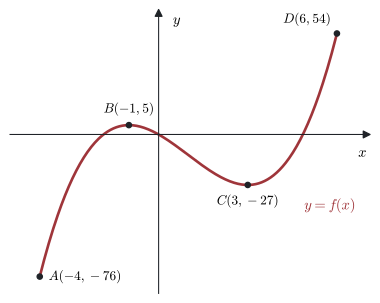
- \(A(-4, -76)\) is the global minimum: it has the smallest value of \(y\) on the whole domain. It is an end point, not a stationary point.
- \(B(-1, 5)\) is a local maximum: a turning point where \(f'(x) = 0\) and the gradient changes from positive to negative. The curve is concave down there.
- \(C(3, -27)\) is a local minimum: a turning point where \(f'(x) = 0\) and the gradient changes from negative to positive. The curve is concave up there.
- \(D(6, 54)\) is the global maximum: the largest value of \(y\) on the domain. It is also an end point.
For many functions a local maximum or minimum is also the global one. For example, \((0, 0)\) is the local minimum and the global minimum of \(y = x^2\). When the domain is restricted, always check the end points too.
The first derivative test
To decide the nature of a stationary point, look at the sign of \(f'(x)\) just to the left and just to the right of it. We show this on a sign diagram of \(f'(x)\).
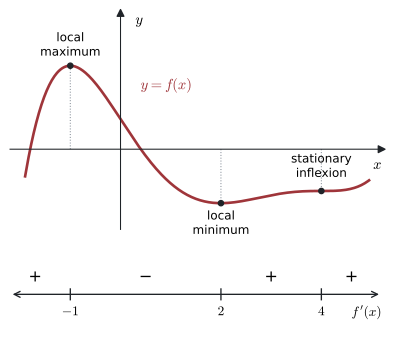
First derivative test Not in the formula booklet
Let \(f'(a) = 0\). Look at the sign of \(f'(x)\) as \(x\) passes through \(a\):
| \(f'(x)\) left of \(a\) | \(f'(x)\) right of \(a\) | Nature of the stationary point | Shape |
|---|---|---|---|
| \(+\) | \(-\) | local maximum | \(\nearrow\searrow\) |
| \(-\) | \(+\) | local minimum | \(\searrow\nearrow\) |
| \(+\) | \(+\) | stationary point of inflexion | \(\nearrow\to\nearrow\) |
| \(-\) | \(-\) | stationary point of inflexion | \(\searrow\to\searrow\) |
- \(a\): the \(x\)-coordinate of the stationary point
- \(f'(x)\): the first derivative (the gradient of the curve)
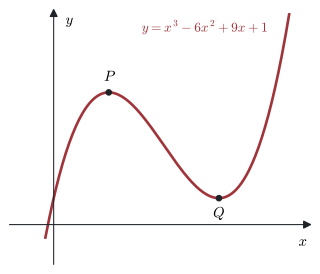
Example 1 The diagram shows part of the curve \(y = x^3 - 6x^2 + 9x + 1\) and its two stationary points \(P\) and \(Q\).
(a) Find \(\frac{dy}{dx}\).
(b) Find the coordinates of \(P\) and \(Q\).
(a) \(\frac{dy}{dx} = 3x^2 - 12x + 9\).
(b) \(3x^2 - 12x + 9 = 0 \Rightarrow 3(x - 1)(x - 3) = 0 \Rightarrow x = 1\) or \(x = 3\).
\(x = 1\): \(y = 1 - 6 + 9 + 1 = 5\). \(\quad\) \(x = 3\): \(y = 27 - 54 + 27 + 1 = 1\).
From the diagram \(P\) is the maximum, so \(P(1, 5)\) and \(Q(3, 1)\).
Example 2 Find and classify all the stationary points of \(f(x) = 2x^3 + 3x^2 - 12x + 1\).
\(f'(x) = 6x^2 + 6x - 12 = 6(x + 2)(x - 1)\), so \(f'(x) = 0\) when \(x = -2\) or \(x = 1\).
\(f(-2) = -16 + 12 + 24 + 1 = 21\) and \(f(1) = 2 + 3 - 12 + 1 = -6\).
Sign diagram of \(f'(x)\) (test \(x = -3\), \(0\), \(2\)):
| \(x\) | \(x < -2\) | \(-2\) | \(-2 < x < 1\) | \(1\) | \(x > 1\) |
|---|---|---|---|---|---|
| \(f'(x)\) | \(+\) | \(0\) | \(-\) | \(0\) | \(+\) |
\((-2, 21)\) is a local maximum and \((1, -6)\) is a local minimum.
The second derivative test
At a local minimum the gradient goes from negative, through zero, to positive: \(f'\) is increasing, so usually \(f''(a) > 0\). At a local maximum \(f'\) is decreasing, so usually \(f''(a) < 0\).
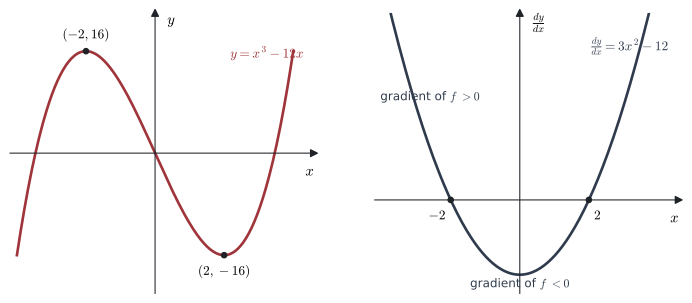
Figure 3 shows this for \(y = x^3 - 12x\). At \(x = 2\) the graph of \(\frac{dy}{dx} = 3x^2 - 12\) crosses the axis going up, so \(\frac{d^2y}{dx^2} = 6x = 12 > 0\), and \((2, -16)\) is a minimum. At \(x = -2\) it crosses going down, \(\frac{d^2y}{dx^2} = -12 < 0\), and \((-2, 16)\) is a maximum.
Second derivative test Not in the formula booklet
Let \(f'(a) = 0\).
- If \(f''(a) < 0\), the point is a local maximum.
- If \(f''(a) > 0\), the point is a local minimum.
- If \(f''(a) = 0\), the test fails: the point could be a maximum, a minimum or an inflexion. Use the first derivative test.
- \(a\): the \(x\)-coordinate of the stationary point
- \(f''(a)\): the second derivative at \(x = a\)
Example 3 The equation of a curve is \(y = x^3 + 3x^2 + 3x + 4\).
(a) Find the value of \(x\) for which the curve has a stationary point.
(b) Find the coordinates of the stationary point and determine its nature.
(a) \(\frac{dy}{dx} = 3x^2 + 6x + 3 = 3(x + 1)^2 = 0\), so \(x = -1\).
(b) \(y = -1 + 3 - 3 + 4 = 3\). The point is \((-1, 3)\).
\(\frac{d^2y}{dx^2} = 6x + 6 = 0\) at \(x = -1\), so the second derivative test fails.
First derivative test: \(\frac{dy}{dx} = 3(x + 1)^2 \ge 0\), so it is positive on both sides of \(x = -1\). The gradient does not change sign, so \((-1, 3)\) is a stationary point of inflexion.
(In fact \(y = (x + 1)^3 + 3\): the graph of \(y = x^3\) translated by the vector \(\begin{pmatrix} -1 \\ 3 \end{pmatrix}\).)
Points of inflexion
Not every stationary point is a maximum or a minimum. For \(f(x) = x^3\), \(f'(x) = 3x^2 = 0\) at \(x = 0\), but \((0, 0)\) is neither: the curve is concave down on the left and concave up on the right, and the horizontal tangent crosses the curve.
A point of inflexion is a point where the curve changes concavity (from concave up to concave down, or the other way).
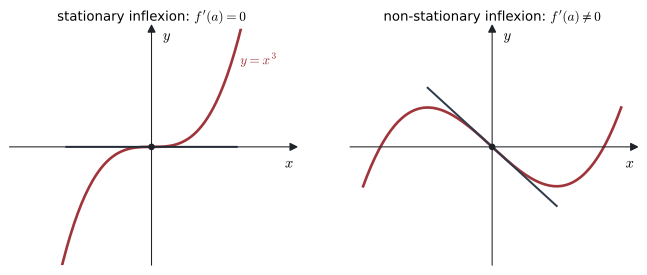
Points of inflexion Not in the formula booklet
There is a point of inflexion at \(x = a\) if \(f''(a) = 0\) and \(f''(x)\) changes sign at \(x = a\).
- If also \(f'(a) = 0\), it is a stationary point of inflexion (horizontal tangent).
- If \(f'(a) \neq 0\), it is a non-stationary point of inflexion.
- \(a\): the \(x\)-coordinate of the possible point of inflexion
- \(f''\): the second derivative
- \(f'\): the first derivative (the gradient)
\(f''(a) = 0\) alone is not enough. For \(y = x^4\), \(f''(x) = 12x^2\), so \(f''(0) = 0\). But \(f''(x) \ge 0\) on both sides, so there is no change of concavity: \((0, 0)\) is a minimum, not an inflexion.
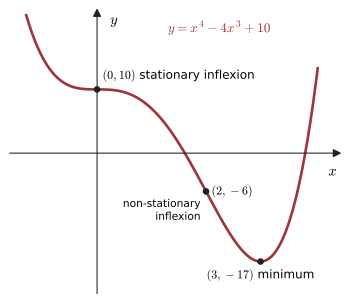
Example 4 Consider \(f(x) = x^4 - 4x^3 + 10\).
(a) Find and classify all points where \(f'(x) = 0\).
(b) Find and classify all points of inflexion.
(c) Find the intervals where \(f\) is increasing or decreasing.
(d) Find the intervals where \(f\) is concave up or concave down.
(e) Sketch the graph of \(y = f(x)\), showing these features.
(a) \(f'(x) = 4x^3 - 12x^2 = 4x^2(x - 3)\), so \(f'(x) = 0\) at \(x = 0\) and \(x = 3\).
| \(x\) | \(x < 0\) | \(0\) | \(0 < x < 3\) | \(3\) | \(x > 3\) |
|---|---|---|---|---|---|
| \(f'(x)\) | \(-\) | \(0\) | \(-\) | \(0\) | \(+\) |
\(f(0) = 10\): \((0, 10)\) is a stationary point of inflexion (\(-\) on both sides). \(f(3) = 81 - 108 + 10 = -17\): \((3, -17)\) is a local minimum.
(b) \(f''(x) = 12x^2 - 24x = 12x(x - 2)\), so \(f''(x) = 0\) at \(x = 0\) and \(x = 2\).
| \(x\) | \(x < 0\) | \(0\) | \(0 < x < 2\) | \(2\) | \(x > 2\) |
|---|---|---|---|---|---|
| \(f''(x)\) | \(+\) | \(0\) | \(-\) | \(0\) | \(+\) |
\(f''\) changes sign at both, so both are points of inflexion. At \(x = 0\), \(f'(0) = 0\): stationary inflexion \((0, 10)\). At \(x = 2\), \(f(2) = 16 - 32 + 10 = -6\) and \(f'(2) = 32 - 48 = -16 \neq 0\): non-stationary inflexion \((2, -6)\).
(c) Decreasing for \(x < 3\) (with \(f'(0) = 0\) at a single point); increasing for \(x > 3\).
(d) Concave up for \(x < 0\) or \(x > 2\); concave down for \(0 < x < 2\).
(e)
Graphs page: enter, for example, \(f_1(x) = x^4 - 3x^2 + x\) and choose a good window.
- Menu → Analyze Graph → Minimum (or Maximum): click to the left of the turning point (lower bound), then to the right (upper bound). You get the local minima \((-1.30, -3.51)\) and \((1.13, -1.07)\), and the local maximum \((0.170, 0.0841)\).
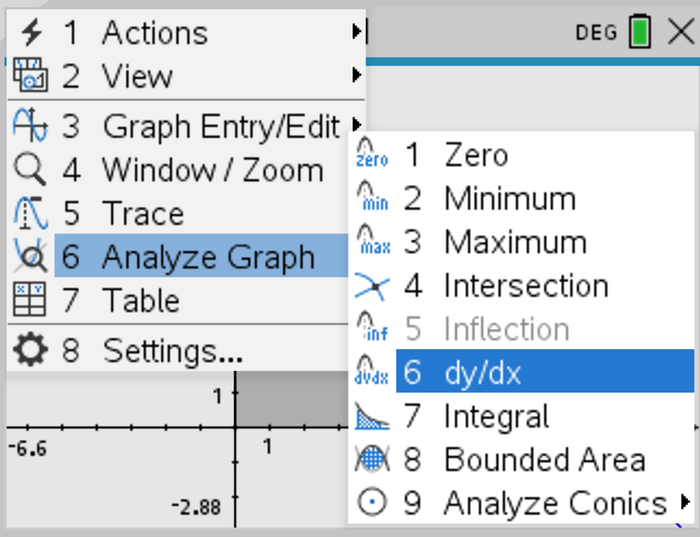
- Inflexion points: on the TI-Nspire CX II (non-CAS) Analyze Graph → Inflection is greyed out, so it cannot be used. Instead, graph the derivative: \(f_2(x) = \dfrac{\mathrm{d}}{\mathrm{d}x}\big(f_1(x)\big)\) (use the derivative template). The inflexion points of \(f\) are where \(f'\) has a maximum or a minimum, so use Minimum and Maximum on \(f_2\). You get \(x = -0.707\) and \(x = 0.707\); then the points on \(f\) are \((-0.707, -1.96)\) and \((0.707, -0.543)\).
Give answers to 3 significant figures unless the question says otherwise.
Common errors
| ✗ Wrong | ✓ Right | Why |
|---|---|---|
| “\(f''(a) = 0\), so it is a point of inflexion” | Check that \(f''\) changes sign | \(y = x^4\) has \(f''(0) = 0\) but a minimum at \(O\). |
| “\(f''(a) = 0\), so it is not a max or min” | The test fails; use the sign of \(f'\) | \(f''(a) = 0\) gives no information. |
| Giving only the \(x\)-coordinate of a stationary point | Give \((x, y)\) | “Find the stationary point” means both coordinates. |
| Calling an end point a “local maximum” | Call it the global maximum (if it is) | Stationary points need \(f'(x) = 0\); end points usually do not have it. |
| Testing the sign of \(f'\) far away from \(a\) | Test values between consecutive critical points | Another root in between can change the sign. |
Exercises
1 Find the coordinates of the stationary points of \(y = x^3 - 12x + 3\) and determine their nature.
\(\frac{dy}{dx} = 3x^2 - 12 = 0 \Rightarrow x = \pm 2\). \(\frac{d^2y}{dx^2} = 6x\).
\(x = -2\): \(y = -8 + 24 + 3 = 19\), \(\frac{d^2y}{dx^2} = -12 < 0\): \((-2, 19)\) is a local maximum.
\(x = 2\): \(y = 8 - 24 + 3 = -13\), \(\frac{d^2y}{dx^2} = 12 > 0\): \((2, -13)\) is a local minimum.
2 Find and classify the stationary points of \(y = 4x^3 - 3x^4\).
\(\frac{dy}{dx} = 12x^2 - 12x^3 = 12x^2(1 - x) = 0 \Rightarrow x = 0\) or \(x = 1\).
Sign of \(\frac{dy}{dx}\): \(x < 0\): \(+\); \(0 < x < 1\): \(+\); \(x > 1\): \(-\).
\((0, 0)\) is a stationary point of inflexion; \((1, 1)\) is a local maximum.
3 Find and classify the stationary points of \(y = x + \dfrac{4}{x}\), \(x \neq 0\).
\(\frac{dy}{dx} = 1 - \frac{4}{x^2} = 0 \Rightarrow x^2 = 4 \Rightarrow x = \pm 2\). \(\frac{d^2y}{dx^2} = \frac{8}{x^3}\).
\(x = 2\): \(y = 4\), \(\frac{d^2y}{dx^2} = 1 > 0\): \((2, 4)\) is a local minimum.
\(x = -2\): \(y = -4\), \(\frac{d^2y}{dx^2} = -1 < 0\): \((-2, -4)\) is a local maximum.
4 For \(y = x\mathrm{e}^{-x}\), find the coordinates of the stationary point and of the point of inflexion. Determine the nature of the stationary point.
\(\frac{dy}{dx} = \mathrm{e}^{-x} - x\mathrm{e}^{-x} = \mathrm{e}^{-x}(1 - x) = 0 \Rightarrow x = 1\), \(y = \mathrm{e}^{-1}\).
\(\frac{d^2y}{dx^2} = -\mathrm{e}^{-x}(1 - x) - \mathrm{e}^{-x} = \mathrm{e}^{-x}(x - 2)\).
At \(x = 1\): \(\frac{d^2y}{dx^2} = -\mathrm{e}^{-1} < 0\), so \(\left(1, \frac{1}{\mathrm{e}}\right)\) is a local maximum.
\(\frac{d^2y}{dx^2} = 0\) at \(x = 2\) and it changes sign there (since \(\mathrm{e}^{-x} > 0\)): point of inflexion \(\left(2, \frac{2}{\mathrm{e}^2}\right)\).
5 The curve \(y = x^3 + ax^2 + bx\) has a stationary point at \((1, -4)\). Find \(a\) and \(b\), and determine the nature of this stationary point.
On the curve: \(1 + a + b = -4\). Stationary: \(\frac{dy}{dx} = 3x^2 + 2ax + b\), so \(3 + 2a + b = 0\).
Subtract: \(2 + a = 4\), so \(a = 2\) and \(b = -7\).
\(\frac{d^2y}{dx^2} = 6x + 4 = 10 > 0\) at \(x = 1\): a local minimum.
6 Find the points of inflexion of \(y = x^4 - 6x^2 + 5\) and show that they are non-stationary.
\(\frac{dy}{dx} = 4x^3 - 12x\), \(\frac{d^2y}{dx^2} = 12x^2 - 12 = 12(x - 1)(x + 1)\).
\(\frac{d^2y}{dx^2} = 0\) at \(x = \pm 1\), and it changes sign at each (\(+, -, +\)). \(y = 1 - 6 + 5 = 0\).
Points of inflexion \((1, 0)\) and \((-1, 0)\). At \(x = 1\), \(\frac{dy}{dx} = -8 \neq 0\); at \(x = -1\), \(\frac{dy}{dx} = 8 \neq 0\). So both are non-stationary.
7 Let \(f(x) = x^4 + 2\). Show that \(f''(0) = 0\), but that \((0, 2)\) is not a point of inflexion. What kind of point is it?
\(f'(x) = 4x^3\), \(f''(x) = 12x^2\), so \(f''(0) = 0\).
But \(f''(x) = 12x^2 > 0\) on both sides of \(0\): the concavity does not change, so it is not an inflexion.
\(f'(x) < 0\) for \(x < 0\) and \(f'(x) > 0\) for \(x > 0\): \((0, 2)\) is a (local and global) minimum.
8 Let \(f(x) = x^3 - 3x\) for \(-2 \le x \le 3\). Find the global maximum and global minimum values of \(f\).
\(f'(x) = 3x^2 - 3 = 0 \Rightarrow x = \pm 1\). Values: \(f(-1) = 2\), \(f(1) = -2\).
End points: \(f(-2) = -8 + 6 = -2\), \(f(3) = 27 - 9 = 18\).
Global maximum \(18\) (at \(x = 3\)); global minimum \(-2\) (at \(x = -2\) and at \(x = 1\)).
9 Find the exact coordinates of the stationary point of \(y = x^2\ln x\), \(x > 0\), and determine its nature.
\(\frac{dy}{dx} = 2x\ln x + x = x(2\ln x + 1)\). Since \(x > 0\): \(\ln x = -\frac{1}{2}\), \(x = \mathrm{e}^{-\frac{1}{2}}\).
\(y = \mathrm{e}^{-1} \times \left(-\frac{1}{2}\right) = -\frac{1}{2\mathrm{e}}\).
\(\frac{d^2y}{dx^2} = 2\ln x + 3 = -1 + 3 = 2 > 0\): \(\left(\mathrm{e}^{-\frac{1}{2}}, -\frac{1}{2\mathrm{e}}\right)\) is a local minimum.
10 Let \(f(x) = x^3 - 4x^2 + x + 3\).
(a) Use your GDC to find the coordinates of the stationary points of \(f\).
(b) Find the exact coordinates of the point of inflexion.
(a) GDC (Analyze Graph → Maximum / Minimum): local maximum \((0.131, 3.06)\), local minimum \((2.54, -3.88)\).
(b) \(f''(x) = 6x - 8 = 0 \Rightarrow x = \frac{4}{3}\), and \(f''\) changes sign there. \(f\left(\frac{4}{3}\right) = \frac{64}{27} - \frac{64}{9} + \frac{4}{3} + 3 = -\frac{11}{27}\). The point is \(\left(\frac{4}{3}, -\frac{11}{27}\right)\).