25.2 Increasing and Decreasing Functions; Concavity
SL 5.2 SL 5.7
- what it means for a function to be increasing or decreasing on an interval
- how the sign of \(f'(x)\) tells you where \(f\) is increasing or decreasing
- the second derivative \(\frac{d^2y}{dx^2} = f''(x)\)
- what concave up and concave down mean, and how the sign of \(f''(x)\) tells you which one
Increasing and decreasing functions
A function \(f\) is increasing on an interval if \(y\) goes up as \(x\) increases (the graph rises from left to right). It is decreasing on an interval if \(y\) goes down as \(x\) increases (the graph falls from left to right).
More precisely, for any two values \(x_1 < x_2\) in the interval:
| Condition | |
|---|---|
| \(f\) is increasing | \(f(x_1) \le f(x_2)\) |
| \(f\) is strictly increasing | \(f(x_1) < f(x_2)\) |
| \(f\) is decreasing | \(f(x_1) \ge f(x_2)\) |
| \(f\) is strictly decreasing | \(f(x_1) > f(x_2)\) |
If no interval is given, “increasing” means increasing for all real \(x\) in the domain.
When we do not have the graph, we use the derivative. The derivative is the gradient of the tangent: a positive gradient means the curve is going up, and a negative gradient means it is going down.
The first derivative and increasing / decreasing Not in the formula booklet
For a function \(f\) that is differentiable on an interval:
- if \(f'(x) > 0\) on the interval, then \(f\) is (strictly) increasing there;
- if \(f'(x) < 0\) on the interval, then \(f\) is (strictly) decreasing there;
- if \(f'(x) = 0\), the tangent is horizontal (a stationary point, see 25.3).
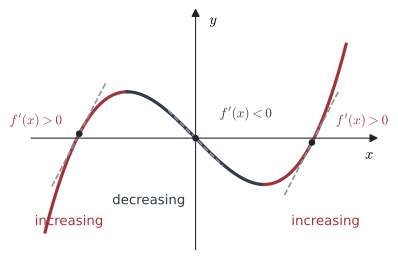
To find where a function is increasing or decreasing:
- find \(f'(x)\) and factorise it;
- solve \(f'(x) = 0\);
- draw a sign diagram of \(f'(x)\);
- read off the intervals.
Example 1 Find the set of values of \(x\) for which the function \(f(x) = x^3 - 6x^2 + 5\) is increasing.
\[ f'(x) = 3x^2 - 12x = 3x(x - 4) . \]
\(f'(x) = 0\) when \(x = 0\) or \(x = 4\). Sign diagram of \(f'(x)\) (test \(x = -1\), \(x = 1\), \(x = 5\)):
| \(x\) | \(x < 0\) | \(0\) | \(0 < x < 4\) | \(4\) | \(x > 4\) |
|---|---|---|---|---|---|
| \(f'(x)\) | \(+\) | \(0\) | \(-\) | \(0\) | \(+\) |
\(f\) is increasing for \(x < 0\) or \(x > 4\).
(Many mark schemes also accept \(x \le 0\) or \(x \ge 4\): at a single point where \(f'(x) = 0\) the function does not stop increasing.)
Example 2 (a) Without using a calculator, explain why \(f(x) = 5 - 2x - x^3\) is strictly decreasing for all \(x \in \mathbb{R}\).
(b) Prove that \(y = \dfrac{x^2}{x + 1}\) is strictly increasing for \(x > 0\).
(a) \(f'(x) = -2 - 3x^2\). Since \(x^2 \ge 0\), we have \(-3x^2 \le 0\), so \(f'(x) \le -2 < 0\) for every \(x\). Hence \(f\) is strictly decreasing for all \(x\).
(b) Quotient rule:
\[ \frac{dy}{dx} = \frac{2x(x + 1) - x^2 \cdot 1}{(x + 1)^2} = \frac{x^2 + 2x}{(x + 1)^2} = \frac{x(x + 2)}{(x + 1)^2} . \]
For \(x > 0\): \(x > 0\), \(x + 2 > 0\) and \((x + 1)^2 > 0\). So \(\frac{dy}{dx} > 0\), and \(y\) is strictly increasing for \(x > 0\).
The second derivative
If we differentiate \(f'(x)\) again, we get the second derivative:
\[ \frac{d^2y}{dx^2} = \frac{d}{dx}\left(\frac{dy}{dx}\right) = f''(x) . \]
You must know both notations. For example, if \(y = x^4 - 3x^2\), then \(\frac{dy}{dx} = 4x^3 - 6x\) and \(\frac{d^2y}{dx^2} = 12x^2 - 6\).
Just as \(f'(x)\) tells us how \(f(x)\) changes, \(f''(x)\) tells us how the gradient \(f'(x)\) changes.
Concavity
In Figure 2, tangents have been drawn at several points on four curves.
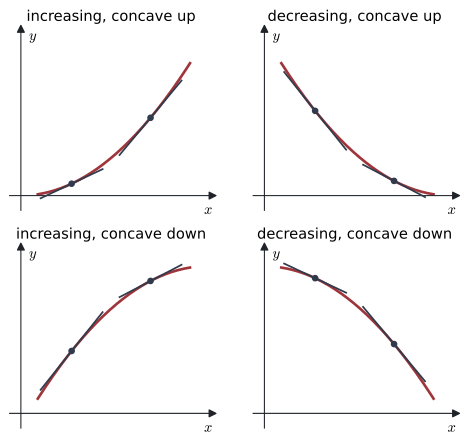
- Concave up: the curve lies above its tangents. It bends upwards, like a cup. Moving from left to right, the gradient increases (the tangents turn anticlockwise). So \(f'\) is increasing, and \(f''(x) > 0\).
- Concave down: the curve lies below its tangents. It bends downwards, like a cap. Moving from left to right, the gradient decreases. So \(f'\) is decreasing, and \(f''(x) < 0\).
Notice that concavity and increasing/decreasing are different ideas. An increasing function can be concave up or concave down.
Concavity Not in the formula booklet
On an interval \([a, b]\):
- if \(f''(x) > 0\) for all \(x\) in the interval, the curve is concave up;
- if \(f''(x) < 0\) for all \(x\) in the interval, the curve is concave down.
- \(a\), \(b\): the endpoints of the interval
- \(f''(x)\): the second derivative of \(f\)
Example 3 The equation of a curve is \(y = \dfrac{8}{x^2 + 12}\), \(x \in \mathbb{R}\). Find the values of \(x\) for which the curve is
(a) concave up, \(\qquad\) (b) concave down.
Write \(y = 8(x^2 + 12)^{-1}\). By the chain rule,
\[ \frac{dy}{dx} = -8(x^2 + 12)^{-2}(2x) = -\frac{16x}{(x^2 + 12)^2} . \]
Quotient rule for the second derivative:
\[ \frac{d^2y}{dx^2} = \frac{-16(x^2 + 12)^2 + 16x \cdot 2(x^2 + 12)(2x)}{(x^2 + 12)^4} = \frac{-16(x^2 + 12) + 64x^2}{(x^2 + 12)^3} = \frac{48(x^2 - 4)}{(x^2 + 12)^3} . \]
The denominator is always positive, so the sign of \(\frac{d^2y}{dx^2}\) is the sign of \(x^2 - 4 = (x - 2)(x + 2)\).
(a) Concave up when \(x^2 - 4 > 0\): \(x < -2\) or \(x > 2\).
(b) Concave down when \(x^2 - 4 < 0\): \(-2 < x < 2\).
Common errors
| ✗ Wrong | ✓ Right | Why |
|---|---|---|
| “\(f\) is increasing because \(f(x) > 0\)” | Look at \(f'(x) > 0\) | The sign of the function says nothing about whether it goes up. |
| Solving \(f'(x) > 0\) by dividing by a factor that can be negative | Use a sign diagram | Dividing an inequality by a negative number reverses it. |
| “Concave up means increasing” | Concave up means \(f''(x) > 0\) | A decreasing function can be concave up (see Figure 2). |
| Not simplifying \(f''(x)\) before finding its sign | Factorise \(f''(x)\) fully | The sign is easy to read only from a factorised form. |
Exercises
1 Find the intervals on which \(f(x) = x^2 - 6x + 1\) is increasing and decreasing.
\(f'(x) = 2x - 6\). Increasing for \(x > 3\), decreasing for \(x < 3\).
2 Find the intervals on which \(f(x) = 2x^3 + 3x^2 - 36x\) is increasing and decreasing.
\(f'(x) = 6x^2 + 6x - 36 = 6(x + 3)(x - 2)\).
Increasing for \(x < -3\) or \(x > 2\); decreasing for \(-3 < x < 2\).
3 The derivative of a function is \(f'(x) = x^2 - 4x + 7\). Show that \(f\) has no stationary points and is increasing for all \(x\).
Complete the square: \(f'(x) = (x - 2)^2 + 3 \ge 3 > 0\). So \(f'(x)\) is never \(0\) (no stationary points) and is always positive (\(f\) is increasing for all \(x\)).
4 The derivative of a function is \(f'(x) = (x + 2)(x - 1)(x - 4)\). Find the \(x\)-coordinates of the stationary points of \(f\), and the intervals on which \(f\) is strictly increasing and strictly decreasing.
Stationary points at \(x = -2\), \(1\), \(4\). Sign diagram of \(f'(x)\):
| \(x\) | \(x < -2\) | \(-2 < x < 1\) | \(1 < x < 4\) | \(x > 4\) |
|---|---|---|---|---|
| \(f'(x)\) | \(-\) | \(+\) | \(-\) | \(+\) |
Strictly increasing for \(-2 < x < 1\) or \(x > 4\); strictly decreasing for \(x < -2\) or \(1 < x < 4\).
5 Show that \(f(x) = x^3 + 3x - 2\) is increasing for all \(x\). Hence explain why the equation \(f(x) = 0\) has exactly one real root.
\(f'(x) = 3x^2 + 3 \ge 3 > 0\), so \(f\) is increasing for all \(x\).
An increasing function can cross the \(x\)-axis at most once. Since \(f(0) = -2 < 0\) and \(f(1) = 2 > 0\), it crosses exactly once.
6 Consider \(f(x) = 4 - \mathrm{e}^{-x}\).
(a) Find the \(x\)- and \(y\)-intercepts.
(b) Show that \(f\) is increasing for all \(x\).
(c) Find \(f''(x)\), and hence explain why the graph is concave down for all \(x\).
(d) Explain why \(y = 4\) is a horizontal asymptote.
(a) \(y\)-intercept: \(f(0) = 4 - 1 = 3\). \(x\)-intercept: \(\mathrm{e}^{-x} = 4\), so \(-x = \ln 4\), \(x = -\ln 4\).
(b) \(f'(x) = \mathrm{e}^{-x} > 0\) for all \(x\).
(c) \(f''(x) = -\mathrm{e}^{-x} < 0\) for all \(x\), so the graph is concave down everywhere.
(d) As \(x \to \infty\), \(\mathrm{e}^{-x} \to 0\), so \(f(x) \to 4\) (from below).
7 Find the intervals on which the graph of \(y = x^3 - 6x^2 + 2x\) is concave up and concave down.
\(\frac{dy}{dx} = 3x^2 - 12x + 2\), \(\frac{d^2y}{dx^2} = 6x - 12\).
Concave up for \(x > 2\); concave down for \(x < 2\).
8 Find the intervals on which the graph of \(f(x) = x^4 - 6x^2\) is concave up and concave down.
\(f'(x) = 4x^3 - 12x\), \(f''(x) = 12x^2 - 12 = 12(x - 1)(x + 1)\).
Concave up for \(x < -1\) or \(x > 1\); concave down for \(-1 < x < 1\).
9 Let \(f(x) = \dfrac{\ln x}{x}\), \(x > 0\). Find the interval on which \(f\) is increasing and the interval on which it is decreasing.
\[ f'(x) = \frac{\frac{1}{x} \cdot x - \ln x \cdot 1}{x^2} = \frac{1 - \ln x}{x^2} . \]
\(x^2 > 0\), so the sign is the sign of \(1 - \ln x\). This is positive when \(\ln x < 1\), i.e. \(x < \mathrm{e}\).
Increasing for \(0 < x < \mathrm{e}\); decreasing for \(x > \mathrm{e}\).
10 Find the set of values of \(k\) for which \(f(x) = x^3 + kx^2 + 12x\) is increasing for all \(x\).
\(f'(x) = 3x^2 + 2kx + 12\). We need \(f'(x) \ge 0\) for all \(x\), so this quadratic must have at most one real root:
\[ \Delta = (2k)^2 - 4(3)(12) = 4k^2 - 144 \le 0 \quad\Rightarrow\quad k^2 \le 36 \quad\Rightarrow\quad -6 \le k \le 6 . \]