23.4 Polar and Euler Forms
AHL 1.13
- the modulus–argument (polar) form \(z = r(\cos\theta + i\sin\theta) = r\operatorname{cis}\theta\)
- the Euler (exponential) form \(z = r\mathrm{e}^{i\theta}\)
- how to convert between Cartesian, polar and Euler forms
- the conjugate in polar and Euler form
- why, when we multiply, the moduli multiply and the arguments add (and when we divide, they divide and subtract)
- how to solve equations written in exponential form
Polar form
Let \(z = x + iy\) have modulus \(r = |z|\) and argument \(\theta = \arg z\). In Figure 1, the right-angled triangle gives
\[ \cos\theta = \frac{x}{r} \;\Rightarrow\; x = r\cos\theta, \qquad \sin\theta = \frac{y}{r} \;\Rightarrow\; y = r\sin\theta . \]
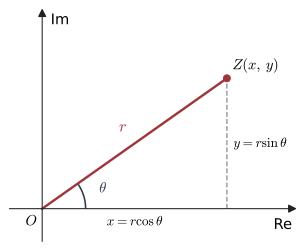
Put these into \(z = x + iy\):
\[ z = r\cos\theta + i\,r\sin\theta = r(\cos\theta + i\sin\theta) . \]
Modulus–argument (polar) form In the HL formula booklet
\[ z = r(\cos\theta + i\sin\theta) = r\operatorname{cis}\theta \]
- \(z\): a non-zero complex number
- \(r\): the modulus, \(r = |z| > 0\)
- \(\theta\): the argument, \(\theta = \arg z\), with \(-\pi < \theta \leq \pi\)
\(\operatorname{cis}\theta\) is short for \(\cos\theta + i\sin\theta\). To convert:
- Cartesian → polar: find \(r = \sqrt{x^2 + y^2}\) and \(\theta\) (sketch first, as in Section 23.3).
- Polar → Cartesian: work out \(x = r\cos\theta\) and \(y = r\sin\theta\).
Example 1 (a) Write \(z = -2\sqrt{3} + 2i\) in the form \(r\operatorname{cis}\theta\).
(b) Write \(w = 6\operatorname{cis}\left(-\dfrac{3\pi}{4}\right)\) in the form \(x + iy\).
(a) \(r = \sqrt{12 + 4} = 4\). The point is in the 2nd quadrant, and \(\alpha = \arctan\dfrac{2}{2\sqrt{3}} = \dfrac{\pi}{6}\), so \(\theta = \pi - \dfrac{\pi}{6} = \dfrac{5\pi}{6}\).
\[ z = 4\operatorname{cis}\frac{5\pi}{6} = 4\left(\cos\frac{5\pi}{6} + i\sin\frac{5\pi}{6}\right) \]
(b)
\[ w = 6\cos\left(-\frac{3\pi}{4}\right) + 6i\sin\left(-\frac{3\pi}{4}\right) = 6\left(-\frac{\sqrt{2}}{2}\right) + 6i\left(-\frac{\sqrt{2}}{2}\right) = -3\sqrt{2} - 3\sqrt{2}\,i \]
The conjugate in polar form
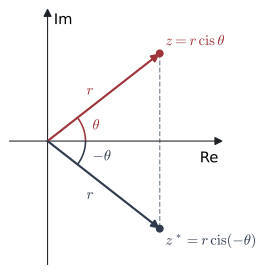
The conjugate \(z^*\) is the reflection of \(z\) in the real axis. It has the same modulus and the opposite argument:
\[ z = r\operatorname{cis}\theta \quad\Longrightarrow\quad z^* = r\big(\cos(-\theta) + i\sin(-\theta)\big) = r(\cos\theta - i\sin\theta) = r\operatorname{cis}(-\theta) . \]
(The only exception is a negative real number, where \(\theta = \pi\) and \(z^* = z\).)
Multiplication and division in polar form
Let \(z_1 = r_1\operatorname{cis}\theta_1\) and \(z_2 = r_2\operatorname{cis}\theta_2\). Then
\[ \begin{aligned} z_1z_2 &= r_1r_2(\cos\theta_1 + i\sin\theta_1)(\cos\theta_2 + i\sin\theta_2) \\ &= r_1r_2\big[(\cos\theta_1\cos\theta_2 - \sin\theta_1\sin\theta_2) + i(\sin\theta_1\cos\theta_2 + \cos\theta_1\sin\theta_2)\big] \\ &= r_1r_2\big[\cos(\theta_1 + \theta_2) + i\sin(\theta_1 + \theta_2)\big] . \end{aligned} \]
The last line uses the compound angle formulae (see Unit 14). In the same way, \(\dfrac{z_1}{z_2} = \dfrac{r_1}{r_2}\operatorname{cis}(\theta_1 - \theta_2)\).
Products and quotients in polar form Not in the formula booklet
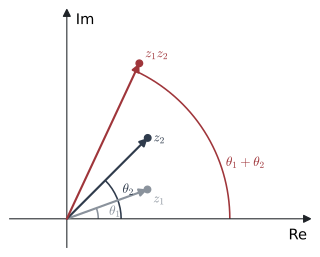
\[ z_1z_2 = r_1r_2\operatorname{cis}(\theta_1 + \theta_2), \qquad \frac{z_1}{z_2} = \frac{r_1}{r_2}\operatorname{cis}(\theta_1 - \theta_2) \]
Multiply the moduli and add the arguments. Divide the moduli and subtract the arguments.
- \(z_1, z_2\): two non-zero complex numbers
- \(r_1, r_2\): the moduli of \(z_1\) and \(z_2\)
- \(\theta_1, \theta_2\): the arguments of \(z_1\) and \(z_2\)
This gives eight rules (with \(z_2 \neq 0\) where needed):
| Modulus | Argument |
|---|---|
| \(\lvert z_1z_2\rvert = \lvert z_1\rvert\,\lvert z_2\rvert\) | \(\arg(z_1z_2) = \arg z_1 + \arg z_2\) |
| \(\left\lvert\dfrac{z_1}{z_2}\right\rvert = \dfrac{\lvert z_1\rvert}{\lvert z_2\rvert}\) | \(\arg\left(\dfrac{z_1}{z_2}\right) = \arg z_1 - \arg z_2\) |
| \(\lvert z^n\rvert = \lvert z\rvert^n\) | \(\arg(z^n) = n\arg z\) |
| \(\lvert z^*\rvert = \lvert z\rvert\) | \(\arg(z^*) = -\arg z\) |
Also \(\arg\left(\dfrac{1}{z}\right) = -\arg z = \arg(z^*)\).
The argument rules are true up to a multiple of \(2\pi\). If the answer is outside \(-\pi < \theta \leq \pi\), add or subtract \(2\pi\).
Example 2 Let \(z = 6\operatorname{cis}\dfrac{2\pi}{3}\) and \(w = 2\operatorname{cis}\dfrac{\pi}{4}\). Without a calculator, find the modulus and argument of \(zw\) and of \(\dfrac{z}{w}\).
\[ |zw| = 6 \times 2 = 12, \qquad \arg(zw) = \frac{2\pi}{3} + \frac{\pi}{4} = \frac{11\pi}{12} . \]
\[ \left|\frac{z}{w}\right| = \frac{6}{2} = 3, \qquad \arg\left(\frac{z}{w}\right) = \frac{2\pi}{3} - \frac{\pi}{4} = \frac{5\pi}{12} . \]
Both arguments are already between \(-\pi\) and \(\pi\).
Example 3 Let \(z = \sqrt{3} - i\). The complex number \(w\) satisfies \(\arg\left(\dfrac{z}{w}\right) = -\dfrac{\pi}{2}\) and \(|z^2w| = 12\). Write \(w\) in polar form and in Cartesian form.
\(|z| = \sqrt{3 + 1} = 2\) and \(\arg z = -\arctan\dfrac{1}{\sqrt{3}} = -\dfrac{\pi}{6}\) (4th quadrant).
Modulus: \(|z^2w| = |z|^2|w| = 4|w| = 12\), so \(|w| = 3\).
Argument: \(\arg z - \arg w = -\dfrac{\pi}{2}\), so \(\arg w = -\dfrac{\pi}{6} + \dfrac{\pi}{2} = \dfrac{\pi}{3}\).
\[ w = 3\operatorname{cis}\frac{\pi}{3} = 3\left(\frac{1}{2} + \frac{\sqrt{3}}{2}i\right) = \frac{3}{2} + \frac{3\sqrt{3}}{2}i . \]
Euler form
There is a third way to write a complex number. It makes multiplication and division even easier.
Euler (exponential) form In the HL formula booklet
\[ z = r(\cos\theta + i\sin\theta) = r\mathrm{e}^{i\theta} = r\operatorname{cis}\theta, \qquad r > 0, \;\; -\pi < \theta \leq \pi \]
- \(z\): a non-zero complex number
- \(r\): the modulus, \(r = |z|\)
- \(\theta\): the argument, \(\theta = \arg z\)
- \(\mathrm{e}\): Euler's number (\(\mathrm{e} \approx 2.718\))
- \(i\): the imaginary unit (\(i^2 = -1\))
So \(\mathrm{e}^{i\theta} = \cos\theta + i\sin\theta = \operatorname{cis}\theta\). This is called Euler’s formula. For example, \(2\mathrm{e}^{i\frac{\pi}{2}} = 2i\), \(\;\mathrm{e}^{i\pi} = -1\) and \(4\mathrm{e}^{-i\frac{\pi}{3}} = 2 - 2\sqrt{3}\,i\).
You will meet these series in Unit 30:
\[ \mathrm{e}^x = 1 + x + \frac{x^2}{2!} + \frac{x^3}{3!} + \frac{x^4}{4!} + \cdots \]
Replace \(x\) by \(i\theta\) and use \(i^2 = -1\), \(i^3 = -i\), \(i^4 = 1\), \(\ldots\):
\[ \mathrm{e}^{i\theta} = 1 + i\theta - \frac{\theta^2}{2!} - i\frac{\theta^3}{3!} + \frac{\theta^4}{4!} + \cdots = \left(1 - \frac{\theta^2}{2!} + \frac{\theta^4}{4!} - \cdots\right) + i\left(\theta - \frac{\theta^3}{3!} + \cdots\right) . \]
The two brackets are the series for \(\cos\theta\) and \(\sin\theta\). So \(\mathrm{e}^{i\theta} = \cos\theta + i\sin\theta\).
With \(\theta = \pi\) we get the famous identity \(\mathrm{e}^{i\pi} + 1 = 0\), which links \(\mathrm{e}\), \(i\), \(\pi\), \(1\) and \(0\).
The conjugate in Euler form
Since \(z^* = r\operatorname{cis}(-\theta)\),
\[ z = r\mathrm{e}^{i\theta} \quad\Longrightarrow\quad z^* = r\mathrm{e}^{-i\theta} . \]
Multiplication and division in Euler form
The usual laws of indices work for \(\mathrm{e}^{i\theta}\). If \(z_1 = r_1\mathrm{e}^{i\theta_1}\) and \(z_2 = r_2\mathrm{e}^{i\theta_2}\), then
Products and quotients in Euler form Not in the formula booklet
\[ z_1z_2 = r_1r_2\,\mathrm{e}^{i(\theta_1 + \theta_2)}, \qquad \frac{z_1}{z_2} = \frac{r_1}{r_2}\,\mathrm{e}^{i(\theta_1 - \theta_2)} \]
- \(z_1, z_2\): two non-zero complex numbers
- \(r_1, r_2\): the moduli of \(z_1\) and \(z_2\)
- \(\theta_1, \theta_2\): the arguments of \(z_1\) and \(z_2\)
These are the same rules as in polar form, but they are easier to remember.
Example 4 Without a calculator, write each number in Euler form.
(a) \((1 - i)(1 + \sqrt{3}\,i)\)
(b) \(\dfrac{1 - i}{1 + \sqrt{3}\,i}\)
First write each factor in Euler form:
\[ 1 - i = \sqrt{2}\,\mathrm{e}^{-i\frac{\pi}{4}}, \qquad 1 + \sqrt{3}\,i = 2\mathrm{e}^{i\frac{\pi}{3}} . \]
(a) \((1 - i)(1 + \sqrt{3}\,i) = 2\sqrt{2}\,\mathrm{e}^{i\left(-\frac{\pi}{4} + \frac{\pi}{3}\right)} = 2\sqrt{2}\,\mathrm{e}^{i\frac{\pi}{12}}\)
(b) \(\dfrac{1 - i}{1 + \sqrt{3}\,i} = \dfrac{\sqrt{2}}{2}\,\mathrm{e}^{i\left(-\frac{\pi}{4} - \frac{\pi}{3}\right)} = \dfrac{\sqrt{2}}{2}\,\mathrm{e}^{-i\frac{7\pi}{12}}\)
Example 5 Let \(z = 2\mathrm{e}^{i\frac{\pi}{3}}\) and \(w = \sqrt{2}\,\mathrm{e}^{i\frac{3\pi}{4}}\). Without a calculator, find the modulus and argument of \(zw\) and of \(\dfrac{z}{w}\). Hence write \(zw\) and \(\dfrac{z}{w}\) in polar form.
\(|zw| = 2\sqrt{2}\) and \(\dfrac{\pi}{3} + \dfrac{3\pi}{4} = \dfrac{13\pi}{12}\). This is more than \(\pi\), so subtract \(2\pi\):
\[ \arg(zw) = \frac{13\pi}{12} - 2\pi = -\frac{11\pi}{12}, \qquad zw = 2\sqrt{2}\operatorname{cis}\left(-\frac{11\pi}{12}\right) . \]
\(\left|\dfrac{z}{w}\right| = \dfrac{2}{\sqrt{2}} = \sqrt{2}\) and \(\arg\left(\dfrac{z}{w}\right) = \dfrac{\pi}{3} - \dfrac{3\pi}{4} = -\dfrac{5\pi}{12}\):
\[ \frac{z}{w} = \sqrt{2}\operatorname{cis}\left(-\frac{5\pi}{12}\right) . \]
Solving equations in exponential form
Since \(\mathrm{e}^{x + iy} = \mathrm{e}^x\,\mathrm{e}^{iy}\), the number \(\mathrm{e}^{x + iy}\) has modulus \(\mathrm{e}^x\) and argument \(y\) (up to a multiple of \(2\pi\)). Two complex numbers in Euler form are equal when their moduli are equal and their arguments differ by a multiple of \(2\pi\).
Example 6 Find the real numbers \(x\) and \(y\), with \(-\pi < y \leq \pi\), such that
\[ \mathrm{e}^{x + iy} = 3\left(\cos\frac{\pi}{6} - i\sin\frac{\pi}{6}\right) . \]
First write the right-hand side in Euler form. \(\cos\dfrac{\pi}{6} - i\sin\dfrac{\pi}{6} = \cos\left(-\dfrac{\pi}{6}\right) + i\sin\left(-\dfrac{\pi}{6}\right)\), so
\[ \mathrm{e}^x\,\mathrm{e}^{iy} = 3\mathrm{e}^{-i\frac{\pi}{6}} . \]
Moduli: \(\mathrm{e}^x = 3\), so \(x = \ln 3\). \(\quad\) Arguments: \(y = -\dfrac{\pi}{6}\).
(Without the condition on \(y\), \(y = -\dfrac{\pi}{6} + 2k\pi\), \(k \in \mathbb{Z}\).)
Use Radian mode. On a Calculator page:
- Menu → Number → Complex Number Tools → Convert to Polar turns
-2√(3)+2iinto4·e^(2.618·i)(in Radian mode), meaning modulus \(4\) and argument \(2.618\ldots = \dfrac{5\pi}{6}\). - To go the other way, type for example
6·e^(-3π/4·i)and press enter: the answer appears in Cartesian form.
The calculator gives decimals. In Paper 1 you must find exact values yourself.
Common errors
| ✗ Wrong | ✓ Right | Why |
|---|---|---|
| \(z_1z_2 = r_1r_2\operatorname{cis}(\theta_1\theta_2)\) | \(r_1r_2\operatorname{cis}(\theta_1 + \theta_2)\) | Arguments add; they do not multiply. |
| \(\arg(zw) = \dfrac{13\pi}{12}\) | \(-\dfrac{11\pi}{12}\) | Bring the argument back into \(-\pi < \theta \leq \pi\). |
| \(2(\cos\theta - i\sin\theta) = 2\operatorname{cis}\theta\) | \(2\operatorname{cis}(-\theta)\) | The polar form needs a plus sign between the terms. |
| \(-3\operatorname{cis}\dfrac{\pi}{4}\) has modulus \(-3\) | \(= 3\operatorname{cis}\left(-\dfrac{3\pi}{4}\right)\), modulus \(3\) | The modulus \(r\) is always positive. |
| \(\mathrm{e}^{x + iy} = 3\mathrm{e}^{-i\frac{\pi}{6}}\) gives \(x = 3\) | \(x = \ln 3\) | The modulus of \(\mathrm{e}^{x + iy}\) is \(\mathrm{e}^x\). |
Exercises
1 Write in exact polar form \(r\operatorname{cis}\theta\):
(a) \(3 + 3i\) \(\qquad\) (b) \(-4i\) \(\qquad\) (c) \(-1 + \sqrt{3}\,i\)
(a) \(3\sqrt{2}\operatorname{cis}\dfrac{\pi}{4}\)
(b) \(4\operatorname{cis}\left(-\dfrac{\pi}{2}\right)\) \(\qquad\)
(c) \(r = 2\), 2nd quadrant with \(\alpha = \dfrac{\pi}{3}\): \(\;2\operatorname{cis}\dfrac{2\pi}{3}\)
2 Write in the form \(x + iy\):
(a) \(4\operatorname{cis}\dfrac{\pi}{6}\)
(b) \(2\operatorname{cis}\left(-\dfrac{3\pi}{4}\right)\)
(c) \(5\operatorname{cis}\pi\)
(a) \(4\left(\dfrac{\sqrt{3}}{2} + \dfrac{1}{2}i\right) = 2\sqrt{3} + 2i\) \(\qquad\)
(b) \(2\left(-\dfrac{\sqrt{2}}{2} - \dfrac{\sqrt{2}}{2}i\right) = -\sqrt{2} - \sqrt{2}\,i\) \(\qquad\)
(c) \(-5\)
3 Write in exact Euler form \(r\mathrm{e}^{i\theta}\):
(a) \(-5\) \(\qquad\) (b) \(2 - 2i\) \(\qquad\) (c) \(-\sqrt{3} - i\)
(a) \(5\mathrm{e}^{i\pi}\)
(b) \(2\sqrt{2}\,\mathrm{e}^{-i\frac{\pi}{4}}\) \(\qquad\)
(c) \(r = 2\), 3rd quadrant with \(\alpha = \dfrac{\pi}{6}\): \(\;2\mathrm{e}^{-i\frac{5\pi}{6}}\)
4 Let \(z = 3\mathrm{e}^{i\frac{2\pi}{5}}\). Write \(z^*\) and \(-z\) in Euler form, with \(-\pi < \theta \leq \pi\).
\(z^* = 3\mathrm{e}^{-i\frac{2\pi}{5}}\).
\(-1 = \mathrm{e}^{i\pi}\), so \(-z = 3\mathrm{e}^{i\left(\frac{2\pi}{5} + \pi\right)} = 3\mathrm{e}^{i\frac{7\pi}{5}} = 3\mathrm{e}^{-i\frac{3\pi}{5}}\) (subtract \(2\pi\)).
5 Let \(z = 4\operatorname{cis}\dfrac{5\pi}{6}\) and \(w = 2\operatorname{cis}\dfrac{\pi}{3}\). Write \(zw\) and \(\dfrac{z}{w}\) in polar form, and \(\dfrac{z}{w}\) also in Cartesian form.
\(zw = 8\operatorname{cis}\dfrac{7\pi}{6} = 8\operatorname{cis}\left(-\dfrac{5\pi}{6}\right)\) (subtract \(2\pi\)).
\(\dfrac{z}{w} = 2\operatorname{cis}\left(\dfrac{5\pi}{6} - \dfrac{\pi}{3}\right) = 2\operatorname{cis}\dfrac{\pi}{2} = 2i\).
6 Let \(z = 2\mathrm{e}^{i\frac{\pi}{4}}\) and \(w = 3\mathrm{e}^{-i\frac{\pi}{6}}\). Write in Euler form:
(a) \(zw\) \(\qquad\) (b) \(\dfrac{z}{w}\) \(\qquad\) (c) \(\dfrac{w}{z}\)
(a) \(6\mathrm{e}^{i\left(\frac{\pi}{4} - \frac{\pi}{6}\right)} = 6\mathrm{e}^{i\frac{\pi}{12}}\) \(\qquad\)
(b) \(\dfrac{2}{3}\mathrm{e}^{i\left(\frac{\pi}{4} + \frac{\pi}{6}\right)} = \dfrac{2}{3}\mathrm{e}^{i\frac{5\pi}{12}}\) \(\qquad\)
(c) \(\dfrac{3}{2}\mathrm{e}^{-i\frac{5\pi}{12}}\)
7 (a) Write \(\sqrt{3} + i\) and \(1 + i\) in polar form, and hence find the modulus and argument of \((\sqrt{3} + i)(1 + i)\).
(b) Expand \((\sqrt{3} + i)(1 + i)\) in Cartesian form. Hence find the exact value of \(\cos\dfrac{5\pi}{12}\).
(a) \(\sqrt{3} + i = 2\operatorname{cis}\dfrac{\pi}{6}\) and \(1 + i = \sqrt{2}\operatorname{cis}\dfrac{\pi}{4}\). The product has modulus \(2\sqrt{2}\) and argument \(\dfrac{\pi}{6} + \dfrac{\pi}{4} = \dfrac{5\pi}{12}\).
(b) \((\sqrt{3} + i)(1 + i) = \sqrt{3} + \sqrt{3}\,i + i - 1 = (\sqrt{3} - 1) + (\sqrt{3} + 1)i\).
The real part is \(r\cos\theta\), so \(2\sqrt{2}\cos\dfrac{5\pi}{12} = \sqrt{3} - 1\) and
\[ \cos\frac{5\pi}{12} = \frac{\sqrt{3} - 1}{2\sqrt{2}} = \frac{\sqrt{6} - \sqrt{2}}{4} . \]
8 Let \(z = -1 + i\) and \(w = \sqrt{3} + i\). Write \(zw\) and \(\dfrac{z}{w}\) in exact Euler form.
\(z = \sqrt{2}\,\mathrm{e}^{i\frac{3\pi}{4}}\) and \(w = 2\mathrm{e}^{i\frac{\pi}{6}}\).
\(zw = 2\sqrt{2}\,\mathrm{e}^{i\left(\frac{3\pi}{4} + \frac{\pi}{6}\right)} = 2\sqrt{2}\,\mathrm{e}^{i\frac{11\pi}{12}}\) \(\qquad\) \(\dfrac{z}{w} = \dfrac{\sqrt{2}}{2}\,\mathrm{e}^{i\left(\frac{3\pi}{4} - \frac{\pi}{6}\right)} = \dfrac{\sqrt{2}}{2}\,\mathrm{e}^{i\frac{7\pi}{12}}\)
9 The complex number \(z\) has \(|z| = 2\) and \(\arg z = \theta\), where \(0 < \theta < \dfrac{\pi}{2}\). Find, in terms of \(\theta\), the modulus and argument of
(a) \(z^2\) \(\qquad\) (b) \(\dfrac{1}{z}\) \(\qquad\) (c) \(iz\)
(a) \(|z^2| = 4\), \(\;\arg(z^2) = 2\theta\) (this is between \(0\) and \(\pi\) ✓).
(b) \(\left|\dfrac{1}{z}\right| = \dfrac{1}{2}\), \(\;\arg\dfrac{1}{z} = -\theta\).
(c) \(i = \mathrm{e}^{i\frac{\pi}{2}}\), so \(|iz| = 2\) and \(\arg(iz) = \theta + \dfrac{\pi}{2}\) (between \(\dfrac{\pi}{2}\) and \(\pi\) ✓).
10 Find the real numbers \(x\) and \(y\), with \(-\pi < y \leq \pi\), such that \(\mathrm{e}^{x + iy} = -1 + i\).
\(-1 + i = \sqrt{2}\,\mathrm{e}^{i\frac{3\pi}{4}}\). So \(\mathrm{e}^x = \sqrt{2}\), giving \(x = \ln\sqrt{2} = \dfrac{1}{2}\ln 2\), and \(y = \dfrac{3\pi}{4}\).