23.3 The Argand Diagram, Modulus and Argument
AHL 1.12
- how to show complex numbers as points in the complex plane (the Argand diagram)
- the modulus \(|z|\), the distance from the origin
- the argument \(\arg z\), and the principal argument with \(-\pi < \arg z \leq \pi\)
- how to find the argument correctly in each of the four quadrants
The Argand diagram
Every point \((x, y)\) in a coordinate plane is different from every other point. A complex number \(z = x + iy\) is also fixed by two real numbers, \(x\) and \(y\). So we can show each complex number as a point.
The complex plane (Argand diagram) Not in the formula booklet
The complex number \(z = x + iy\) is shown by the point \(Z(x, y)\).
- The horizontal axis is the real axis (Re).
- The vertical axis is the imaginary axis (Im).
- \(z\): a complex number
- \(x\): the real part of \(z\)
- \(y\): the imaginary part of \(z\)
- \(Z\): the point in the complex plane that represents \(z\)
The real numbers lie on the real axis, and the purely imaginary numbers lie on the imaginary axis. Figure 1 shows \(z_1 = 3 + 2i\), \(z_2 = -2 + i\), \(z_3 = -1 - 3i\), \(z_4 = 2 - 2i\), the real number \(-3\) and the imaginary number \(3i\).
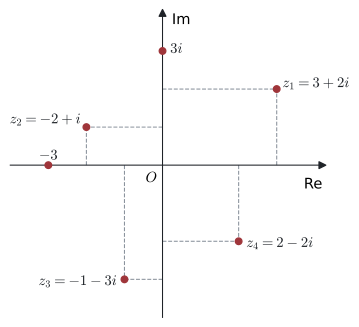
We can also think of \(z = x + iy\) as the position vector \(\begin{pmatrix} x \\ y \end{pmatrix}\) of the point \(Z\). This link with vectors is used in Section 23.7.
The modulus
Modulus Not in the formula booklet
The modulus of \(z = x + iy\) is the distance \(OZ\) from the origin to \(Z\):
\[ |z| = \sqrt{x^2 + y^2}, \qquad |z| \geq 0 . \]
- \(z\): a complex number
- \(x\): the real part of \(z\)
- \(y\): the imaginary part of \(z\)
- \(O\): the origin
- \(Z\): the point that represents \(z\)
It is Pythagoras’ theorem.
For example, \(|3 + 4i| = \sqrt{9 + 16} = 5\), \(\;|-6| = 6\) and \(|{-2i}| = 2\). For a real number, the modulus is the usual absolute value.
From Section 23.2, \(zz^* = x^2 + y^2\). So
\[ zz^* = |z|^2 . \]
The argument
The argument of \(z\), written \(\arg z\), is the angle between the positive real axis and the line \(OZ\). It is measured in radians, anticlockwise is positive and clockwise is negative.
The same point can be reached by many angles: \(\theta\), \(\theta + 2\pi\), \(\theta - 2\pi\), and so on. So we choose one value.
Principal argument Not in the formula booklet
The principal argument of \(z \neq 0\) is the angle \(\theta = \arg z\) with
\[ -\pi < \theta \leq \pi . \]
\(\arg 0\) is not defined.
In this course, “the argument” always means the principal argument.
The four quadrants
Always draw a sketch first and see which quadrant \(z\) is in. Then find the acute angle \(\alpha = \arctan\left|\dfrac{y}{x}\right|\) in the right-angled triangle, and use Figure 2.
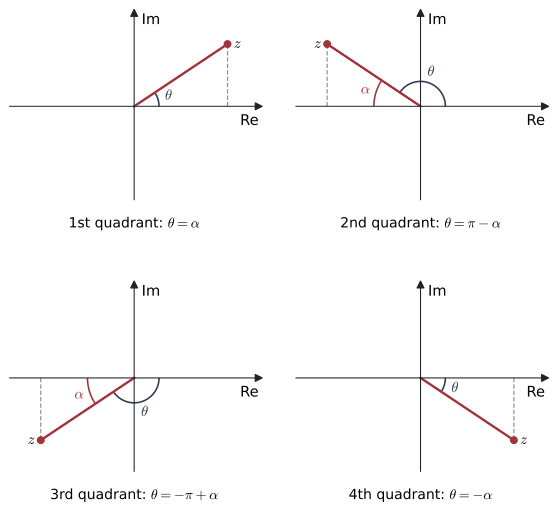
Finding \(\arg z\), with \(\alpha = \arctan\left|\dfrac{y}{x}\right|\) Not in the formula booklet
| Quadrant | Signs | \(\arg z\) | Range |
|---|---|---|---|
| 1st | \(x > 0\), \(y > 0\) | \(\alpha\) | \(0 < \theta < \dfrac{\pi}{2}\) |
| 2nd | \(x < 0\), \(y > 0\) | \(\pi - \alpha\) | \(\dfrac{\pi}{2} < \theta < \pi\) |
| 3rd | \(x < 0\), \(y < 0\) | \(-\pi + \alpha\) | \(-\pi < \theta < -\dfrac{\pi}{2}\) |
| 4th | \(x > 0\), \(y < 0\) | \(-\alpha\) | \(-\dfrac{\pi}{2} < \theta < 0\) |
- \(z\): a non-zero complex number
- \(x\): the real part of \(z\)
- \(y\): the imaginary part of \(z\)
- \(\theta\): the principal argument, \(\arg z\)
Points on the axes need no calculation:
| \(z\) | positive real, e.g. \(5\) | positive imaginary, e.g. \(2i\) | negative real, e.g. \(-3\) | negative imaginary, e.g. \(-4i\) |
|---|---|---|---|---|
| \(\arg z\) | \(0\) | \(\dfrac{\pi}{2}\) | \(\pi\) | \(-\dfrac{\pi}{2}\) |
Example 1 Find the modulus and the argument of each complex number.
(a) \(\sqrt{3} + i\)
(b) \(-2 + 2i\)
(c) \(-1 - \sqrt{3}\,i\)
(d) \(2 - 2\sqrt{3}\,i\)
(a) 1st quadrant. \(|z| = \sqrt{3 + 1} = 2\). \(\;\alpha = \arctan\dfrac{1}{\sqrt{3}} = \dfrac{\pi}{6}\), so \(\arg z = \dfrac{\pi}{6}\).
(b) 2nd quadrant. \(|z| = \sqrt{4 + 4} = 2\sqrt{2}\). \(\;\alpha = \arctan 1 = \dfrac{\pi}{4}\), so \(\arg z = \pi - \dfrac{\pi}{4} = \dfrac{3\pi}{4}\).
(c) 3rd quadrant. \(|z| = \sqrt{1 + 3} = 2\). \(\;\alpha = \arctan\sqrt{3} = \dfrac{\pi}{3}\), so \(\arg z = -\pi + \dfrac{\pi}{3} = -\dfrac{2\pi}{3}\).
(d) 4th quadrant. \(|z| = \sqrt{4 + 12} = 4\). \(\;\alpha = \arctan\sqrt{3} = \dfrac{\pi}{3}\), so \(\arg z = -\dfrac{\pi}{3}\).
When the angle is not a special angle, give the argument in radians to 3 significant figures.
Example 2 Find the modulus and argument of (a) \(z = -3 + 4i\) \(\qquad\) (b) \(w = -5 - 12i\).
(a) 2nd quadrant. \(|z| = \sqrt{9 + 16} = 5\). \(\;\arg z = \pi - \arctan\dfrac{4}{3} = \pi - 0.9273\ldots = 2.21\) (3 s.f.).
(b) 3rd quadrant. \(|w| = \sqrt{25 + 144} = 13\). \(\;\arg w = -\pi + \arctan\dfrac{12}{5} = -\pi + 1.1760\ldots = -1.97\) (3 s.f.).
A calculator that gives \(\arctan\dfrac{-12}{-5} = \arctan 2.4 = 1.18\) points into the 1st quadrant. This is wrong: always use the sketch.
Check that the document is in Radian mode (the top right of the screen must show RAD; click on DEG/RAD to switch).
You can also open Document Settings and change Angle to Radian.
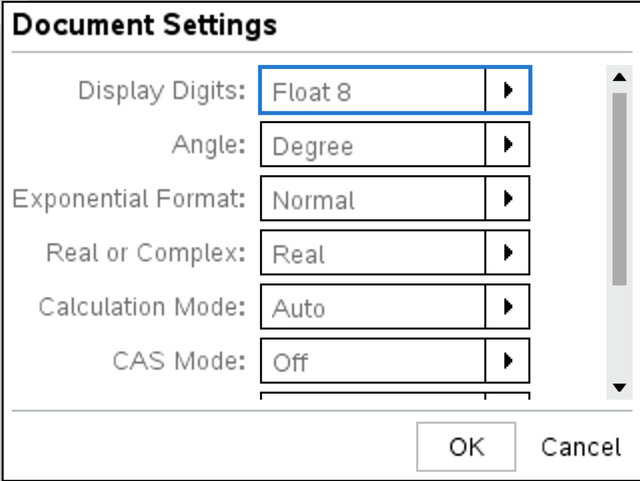
On a Calculator page: Menu → Number → Complex Number Tools, then
- Magnitude gives \(|z|\), for example
abs(-5-12i)returns \(13\); - Polar Angle gives \(\arg z\), for example
angle(-5-12i)returns \(-1.9656\ldots\)
The calculator always gives the principal argument, between \(-\pi\) and \(\pi\).
Common errors
| ✗ Wrong | ✓ Right | Why |
|---|---|---|
| \(\arg(-2 + 2i) = \arctan(-1) = -\dfrac{\pi}{4}\) | \(\dfrac{3\pi}{4}\) | \(-2 + 2i\) is in the 2nd quadrant. Sketch first. |
| \(\arg(-1 - \sqrt{3}i) = \dfrac{4\pi}{3}\) | \(-\dfrac{2\pi}{3}\) | The principal argument must be in \(-\pi < \theta \leq \pi\). |
| \(\arg z = 120°\) | \(\arg z = \dfrac{2\pi}{3}\) | Arguments are given in radians. |
| \(\lvert 3 - 4i\rvert = \sqrt{9 - 16}\) | \(\sqrt{3^2 + (-4)^2} = 5\) | Square the real numbers \(x\) and \(y\); do not include \(i\). |
| \(\arg(-3) = -\pi\) | \(\arg(-3) = \pi\) | The range includes \(\pi\) but not \(-\pi\). |
Exercises
1 The points \(A(2, -5)\), \(B(-3, 0)\) and \(C(0, 4)\) are drawn in an Argand diagram. Write down the complex numbers they represent.
\(A\): \(2 - 5i\). \(\quad B\): \(-3\). \(\quad C\): \(4i\).
2 Find the modulus of
(a) \(6 - 8i\)
(b) \(-5 + 12i\)
(c) \(1 + \sqrt{3}\,i\)
(d) \(-7i\)
(a) \(\sqrt{36 + 64} = 10\)
(b) \(\sqrt{25 + 144} = 13\)
(c) \(\sqrt{1 + 3} = 2\)
(d) \(7\)
3 Find the exact argument of
(a) \(5i\)
(b) \(-6\)
(c) \(-3 - 3i\)
(d) \(\sqrt{3} - 3i\)
(a) \(\dfrac{\pi}{2}\) \(\qquad\) (b) \(\pi\)
(c) 3rd quadrant, \(\alpha = \arctan 1 = \dfrac{\pi}{4}\): \(\;\arg z = -\pi + \dfrac{\pi}{4} = -\dfrac{3\pi}{4}\).
(d) 4th quadrant, \(\alpha = \arctan\dfrac{3}{\sqrt{3}} = \arctan\sqrt{3} = \dfrac{\pi}{3}\): \(\;\arg z = -\dfrac{\pi}{3}\).
4 Find the exact modulus and argument of
(a) \(-2\sqrt{3} + 2i\) \(\qquad\) (b) \(\dfrac{1}{2} - \dfrac{\sqrt{3}}{2}i\)
(a) \(|z| = \sqrt{12 + 4} = 4\). 2nd quadrant, \(\alpha = \arctan\dfrac{2}{2\sqrt{3}} = \dfrac{\pi}{6}\), so \(\arg z = \dfrac{5\pi}{6}\).
(b) \(|z| = \sqrt{\dfrac{1}{4} + \dfrac{3}{4}} = 1\). 4th quadrant, \(\alpha = \arctan\sqrt{3} = \dfrac{\pi}{3}\), so \(\arg z = -\dfrac{\pi}{3}\).
5 Find the modulus and argument of each number, to 3 significant figures.
(a) \(4 - 7i\) \(\qquad\) (b) \(-6 + i\)
(a) \(|z| = \sqrt{65} = 8.06\). 4th quadrant: \(\arg z = -\arctan\dfrac{7}{4} = -1.05\).
(b) \(|z| = \sqrt{37} = 6.08\). 2nd quadrant: \(\arg z = \pi - \arctan\dfrac{1}{6} = 2.98\).
6 The complex number \(z\) has \(|z| = 10\), \(\operatorname{Re}(z) = 6\) and \(\operatorname{Im}(z) < 0\). Find \(z\) and \(\arg z\).
\(36 + y^2 = 100\), so \(y = \pm 8\); \(y < 0\) gives \(z = 6 - 8i\).
\(\arg z = -\arctan\dfrac{8}{6} = -0.927\) (3 s.f.).
7 Let \(z = -1 + 2i\). Show that \(|z^*| = |z|\) and \(\arg z^* = -\arg z\).
\(z^* = -1 - 2i\). \(\;|z| = |z^*| = \sqrt{1 + 4} = \sqrt{5}\).
\(z\) is in the 2nd quadrant: \(\arg z = \pi - \arctan 2\). \(z^*\) is in the 3rd quadrant: \(\arg z^* = -\pi + \arctan 2 = -(\pi - \arctan 2) = -\arg z\).
(The conjugate is the reflection of \(z\) in the real axis.)
8 The complex number \(z = a + 3i\), where \(a \in \mathbb{R}\), has argument \(\dfrac{\pi}{6}\). Find \(a\) and \(|z|\).
\(z\) is in the 1st quadrant, so \(\tan\dfrac{\pi}{6} = \dfrac{3}{a}\), \(\;\dfrac{1}{\sqrt{3}} = \dfrac{3}{a}\), \(\;a = 3\sqrt{3}\).
\(|z| = \sqrt{27 + 9} = 6\).
9 Write \(z = \dfrac{1 + 7i}{3 - 4i}\) in the form \(x + iy\). Hence find the exact modulus and argument of \(z\).
\[ z = \frac{(1 + 7i)(3 + 4i)}{9 + 16} = \frac{3 + 4i + 21i - 28}{25} = \frac{-25 + 25i}{25} = -1 + i . \]
\(|z| = \sqrt{2}\). 2nd quadrant, so \(\arg z = \pi - \dfrac{\pi}{4} = \dfrac{3\pi}{4}\).
10 Find the complex number \(z\) such that \(|z| = 5\), \(z + z^* = -6\) and \(\operatorname{Im}(z) > 0\). Find \(\arg z\) to 3 significant figures.
\(z + z^* = 2\operatorname{Re}(z) = -6\), so \(x = -3\). Then \(9 + y^2 = 25\), \(y = 4\) (positive). So \(z = -3 + 4i\).
2nd quadrant: \(\arg z = \pi - \arctan\dfrac{4}{3} = 2.21\).