22.4 A Point and a Plane
AHL 3.18
- how to test whether a point lies on a plane
- how to find the foot of the perpendicular from a point to a plane
- how to find the shortest distance from a point to a plane, by two methods
- how to find the reflection (image) of a point in a plane
Does a point lie on a plane?
Substitute the coordinates of the point into the equation of the plane. The point lies on the plane only if the equation is true.
Example 1 The plane \(\Pi\) has equation \(\boldsymbol{r}\cdot(2\boldsymbol{i} - \boldsymbol{j} + 3\boldsymbol{k}) = 7\). Determine which of the points \(A(1, 4, 3)\) and \(B(3, 2, -1)\) lie on \(\Pi\).
\(A\): \(\;2(1) - 4 + 3(3) = 7\) ✓, so \(A\) lies on \(\Pi\).
\(B\): \(\;2(3) - 2 + 3(-1) = 1 \neq 7\), so \(B\) does not lie on \(\Pi\).
The foot of the perpendicular and the distance to a plane
Let \(P\) be a point that is not on the plane \(\Pi: \boldsymbol{r}\cdot\boldsymbol{n} = d\). Draw the line from \(P\) that is perpendicular to \(\Pi\). It meets \(\Pi\) at \(F\), the foot of the perpendicular.
- \(F\) is the point of \(\Pi\) that is closest to \(P\).
- The length \(PF\) is the (shortest, or perpendicular) distance from \(P\) to \(\Pi\).
The line \(PF\) is perpendicular to the plane, so its direction is the normal \(\boldsymbol{n}\).
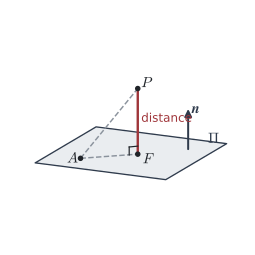
Foot of the perpendicular from \(P\) to \(\boldsymbol{r}\cdot\boldsymbol{n} = d\)
- Write the line through \(P\) with direction \(\boldsymbol{n}\): \(\;\boldsymbol{r} = \overrightarrow{OP} + \lambda\boldsymbol{n}\).
- Substitute it into the plane and solve for \(\lambda\). Then \(\overrightarrow{OF} = \overrightarrow{OP} + \lambda\boldsymbol{n}\).
- The distance is \(PF = |\lambda\boldsymbol{n}| = |\lambda|\,|\boldsymbol{n}|\).
Example 2 Find the position vector of the foot of the perpendicular from the point \(P\) with position vector \(5\boldsymbol{i} - \boldsymbol{j} + 6\boldsymbol{k}\) to the plane \(\Pi: \boldsymbol{r}\cdot(\boldsymbol{i} - \boldsymbol{j} + 2\boldsymbol{k}) = 6\). Hence find the distance from \(P\) to \(\Pi\).
The line through \(P\) along \(\boldsymbol{n}\): \(\;(5 + \lambda,\; -1 - \lambda,\; 6 + 2\lambda)\). Substitute:
\[ (5 + \lambda) - (-1 - \lambda) + 2(6 + 2\lambda) = 6 \;\Longrightarrow\; 18 + 6\lambda = 6 \;\Longrightarrow\; \lambda = -2 . \]
\[ \overrightarrow{OF} = \begin{pmatrix} 5 \\ -1 \\ 6 \end{pmatrix} - 2\begin{pmatrix} 1 \\ -1 \\ 2 \end{pmatrix} = \begin{pmatrix} 3 \\ 1 \\ 2 \end{pmatrix} = 3\boldsymbol{i} + \boldsymbol{j} + 2\boldsymbol{k}. \]
Distance: \(PF = |-2|\sqrt{1 + 1 + 4} = 2\sqrt{6}\).
Example 3 Find the perpendicular distance from \(P(4, -2, 1)\) to the plane \(\Pi: \boldsymbol{r}\cdot\begin{pmatrix} 2 \\ 1 \\ -2 \end{pmatrix} = 3\).
Line through \(P\) along \(\boldsymbol{n}\): \((4 + 2\lambda,\; -2 + \lambda,\; 1 - 2\lambda)\).
\[ 2(4 + 2\lambda) + (-2 + \lambda) - 2(1 - 2\lambda) = 3 \;\Longrightarrow\; 4 + 9\lambda = 3 \;\Longrightarrow\; \lambda = -\frac{1}{9} . \]
Distance \(= |\lambda|\,|\boldsymbol{n}| = \dfrac{1}{9} \times \sqrt{4 + 1 + 4} = \dfrac{1}{9} \times 3 = \dfrac{1}{3}\).
A second method: projection onto the normal
Let \(A\) be any point on the plane. The distance from \(P\) to the plane is the length of the projection of \(\overrightarrow{AP}\) onto the normal (see the scalar product in Unit 20).
Distance from a point \(P\) to the plane \(\boldsymbol{r}\cdot\boldsymbol{n} = d\) Not in the formula booklet
\[ \text{distance} = \frac{|\overrightarrow{AP}\cdot\boldsymbol{n}|}{|\boldsymbol{n}|} \qquad (A \text{ is any point on the plane}) \]
For the plane \(ax + by + cz = d\) and \(P(x_0, y_0, z_0)\) this becomes
\[ \text{distance} = \frac{|a x_0 + b y_0 + c z_0 - d|}{\sqrt{a^2 + b^2 + c^2}} . \]
- \(P\): the point
- \(\boldsymbol{n}\): a normal vector of the plane
- \(d\): the constant on the right-hand side of the plane equation
- \(a, b, c\): the coefficients in the Cartesian equation (the components of \(\boldsymbol{n}\))
- \((x_0, y_0, z_0)\): the coordinates of \(P\)
Be ready to show the method (foot of the perpendicular or projection).
Example 4 The plane \(\Pi\) has equation \(\boldsymbol{r}\cdot(3\boldsymbol{i} - 2\boldsymbol{j} + 6\boldsymbol{k}) = 14\). Find the perpendicular distance from the origin to \(\Pi\).
A point on \(\Pi\): try \(A\left(0, 0, \dfrac{7}{3}\right)\), since \(6 \times \dfrac{7}{3} = 14\) ✓. Then \(\overrightarrow{AO} = \begin{pmatrix} 0 \\ 0 \\ -\frac{7}{3} \end{pmatrix}\) and \(|\boldsymbol{n}| = \sqrt{9 + 4 + 36} = 7\).
\[ \text{distance} = \frac{\left|0 + 0 + 6 \times \left(-\frac{7}{3}\right)\right|}{7} = \frac{14}{7} = 2 . \]
(With the Cartesian formula: \(\dfrac{|0 - 14|}{7} = 2\).)
In general, the distance from the origin to \(\boldsymbol{r}\cdot\boldsymbol{n} = d\) is \(\dfrac{|d|}{|\boldsymbol{n}|}\).
The reflection of a point in a plane
The image \(P'\) of \(P\) in the plane is on the other side, at the same distance. The foot \(F\) is the midpoint of \(PP'\):
Image of \(P\) in a plane Not in the formula booklet
\[ \overrightarrow{OP'} = 2\overrightarrow{OF} - \overrightarrow{OP} \]
Equivalently, if \(\overrightarrow{OF} = \overrightarrow{OP} + \lambda\boldsymbol{n}\), then \(\overrightarrow{OP'} = \overrightarrow{OP} + 2\lambda\boldsymbol{n}\).
- \(O\): the origin
- \(P'\): the image of \(P\) (the reflection of \(P\) in the plane)
- \(F\): the foot of the perpendicular from \(P\) to the plane
- \(P\): the point that we reflect
- \(\lambda\): the value of the parameter that gives \(F\) on the line through \(P\) with direction \(\boldsymbol{n}\)
- \(\boldsymbol{n}\): a normal vector of the plane
Example 5 Find the image of \(P(5, -1, 6)\) in the plane \(\boldsymbol{r}\cdot(\boldsymbol{i} - \boldsymbol{j} + 2\boldsymbol{k}) = 6\) (the plane of Example 2).
From Example 2, \(\lambda = -2\) and \(F = (3, 1, 2)\).
\[ \overrightarrow{OP'} = 2\begin{pmatrix} 3 \\ 1 \\ 2 \end{pmatrix} - \begin{pmatrix} 5 \\ -1 \\ 6 \end{pmatrix} = \begin{pmatrix} 1 \\ 3 \\ -2 \end{pmatrix}. \]
The image is \(P'(1, 3, -2)\). (Check: \(P'\) gives \(1 - 3 - 4 = -6\). The plane value \(6\) is halfway between \(18\) for \(P\) and \(-6\) for \(P'\) ✓.)
Common errors
| ✗ Wrong | ✓ Right | Why |
|---|---|---|
| Distance \(= \lvert\lambda\rvert\) | Distance \(= \lvert\lambda\rvert\,\lvert\boldsymbol{n}\rvert\) | \(\lambda\) counts steps of length \(\lvert\boldsymbol{n}\rvert\), not steps of length \(1\). |
| Distance \(= \dfrac{\lvert ax_0 + by_0 + cz_0\rvert}{\sqrt{a^2 + b^2 + c^2}}\) | Subtract \(d\) first: \(\lvert ax_0 + by_0 + cz_0 - d\rvert\) | Without \(-d\) you find the distance to a different, parallel plane through \(O\). |
| Using a direction in the plane for the line \(PF\) | Use the normal \(\boldsymbol{n}\) | \(PF\) is perpendicular to the plane. |
| Image \(= \overrightarrow{OF} + \overrightarrow{OP}\) | \(2\overrightarrow{OF} - \overrightarrow{OP}\) | \(F\) is the midpoint of \(PP'\). |
| Giving a negative distance | Take the modulus | Distance is never negative. |
Exercises
1 Determine which of the points \((2, 1, 0)\), \((0, 2, 1)\) and \((3, 1, 1)\) lie on the plane \(\boldsymbol{r}\cdot\begin{pmatrix} 1 \\ 4 \\ -2 \end{pmatrix} = 6\).
\((2, 1, 0)\): \(2 + 4 - 0 = 6\) ✓. \(\;(0, 2, 1)\): \(0 + 8 - 2 = 6\) ✓. \(\;(3, 1, 1)\): \(3 + 4 - 2 = 5 \neq 6\) ✗.
The first two points lie on the plane.
2 Find the foot of the perpendicular from \(P(3, 4, -1)\) to the plane \(x + y + z = 3\), and the distance from \(P\) to the plane.
\((3 + \lambda) + (4 + \lambda) + (-1 + \lambda) = 3 \Rightarrow 6 + 3\lambda = 3 \Rightarrow \lambda = -1\).
Foot \(F(2, 3, -2)\); distance \(= 1 \times \sqrt{3} = \sqrt{3}\).
3 Find the distance from \((1, -2, 3)\) to the plane \(2x - y + 2z = 1\).
\(\dfrac{|2 + 2 + 6 - 1|}{\sqrt{4 + 1 + 4}} = \dfrac{9}{3} = 3\).
4 Find the distance from the origin to the plane \(4x - 4y + 7z = 18\).
\(|\boldsymbol{n}| = \sqrt{16 + 16 + 49} = 9\), so the distance is \(\dfrac{18}{9} = 2\).
5 Find the image of \(P(6, 1, 3)\) in the plane \(x - y + z = 2\).
\((6 + \lambda) - (1 - \lambda) + (3 + \lambda) = 2 \Rightarrow 8 + 3\lambda = 2 \Rightarrow \lambda = -2\). Foot \(F(4, 3, 1)\).
\(\overrightarrow{OP'} = 2\begin{pmatrix} 4 \\ 3 \\ 1 \end{pmatrix} - \begin{pmatrix} 6 \\ 1 \\ 3 \end{pmatrix} = \begin{pmatrix} 2 \\ 5 \\ -1 \end{pmatrix}\), so \(P'(2, 5, -1)\).
6 The point \((1, k, 2)\) is at a distance of \(2\) from the plane \(2x + y - 2z = 3\). Find the possible values of \(k\).
\(\dfrac{|2 + k - 4 - 3|}{3} = 2 \Rightarrow |k - 5| = 6 \Rightarrow k = 11\) or \(k = -1\).
7 For the plane \(x + y - z = 1\), the value of \(x + y - z - 1\) is positive on one side and negative on the other. Use this to decide whether \(A(1, 2, 3)\) and \(B(-1, 0, 4)\) are on the same side of the plane.
\(A\): \(1 + 2 - 3 - 1 = -1\). \(\;B\): \(-1 + 0 - 4 - 1 = -6\). Both are negative, so \(A\) and \(B\) are on the same side.
8 Find the foot of the perpendicular from the origin to the plane \(\boldsymbol{r}\cdot\begin{pmatrix} 2 \\ -3 \\ 6 \end{pmatrix} = 49\), and the distance from the origin to the plane.
Line \(\boldsymbol{r} = \lambda\begin{pmatrix} 2 \\ -3 \\ 6 \end{pmatrix}\): \(\;\lambda(4 + 9 + 36) = 49 \Rightarrow \lambda = 1\).
Foot \((2, -3, 6)\); distance \(= \sqrt{4 + 9 + 36} = 7\).
9 The point \(P\) is \((2, 0, 5)\) and the plane \(\Pi\) is \(3x - 4z = 11\).
(a) Find the point of \(\Pi\) that is closest to \(P\).
(b) Find the distance from \(P\) to \(\Pi\).
(c) Find the image of \(P\) in \(\Pi\).
\(\boldsymbol{n} = \begin{pmatrix} 3 \\ 0 \\ -4 \end{pmatrix}\). Line: \((2 + 3\lambda,\; 0,\; 5 - 4\lambda)\).
(a) \(3(2 + 3\lambda) - 4(5 - 4\lambda) = 11 \Rightarrow -14 + 25\lambda = 11 \Rightarrow \lambda = 1\). The closest point is \(F(5, 0, 1)\).
(b) \(1 \times \sqrt{9 + 16} = 5\).
(c) \(\overrightarrow{OP'} = \overrightarrow{OP} + 2\boldsymbol{n} = \begin{pmatrix} 8 \\ 0 \\ -3 \end{pmatrix}\), so \(P'(8, 0, -3)\).
10 The line \(l\) is \(\boldsymbol{r} = \begin{pmatrix} 1 \\ 0 \\ 0 \end{pmatrix} + t\begin{pmatrix} 2 \\ -2 \\ 1 \end{pmatrix}\) and the plane \(\Pi\) is \(x + 2y + 2z = 10\).
(a) Show that \(l\) is parallel to \(\Pi\).
(b) Find the distance between \(l\) and \(\Pi\).
(a) \(\boldsymbol{d}\cdot\boldsymbol{n} = 2 - 4 + 2 = 0\), and \((1, 0, 0)\) gives \(1 \neq 10\), so \(l\) is parallel to \(\Pi\) (not in it).
(b) Every point of \(l\) is the same distance from \(\Pi\). Use \((1, 0, 0)\): \(\;\dfrac{|1 - 10|}{\sqrt{1 + 4 + 4}} = \dfrac{9}{3} = 3\).