22.3 A Line and a Plane
AHL 3.18
- the three ways a line and a plane can be related: meeting at one point, parallel, or lying in the plane
- how to find the point of intersection of a line and a plane
- how to find the angle between a line and a plane
- how to find the length of the projection of a line segment onto a plane
- how to find the reflection of a line in a plane
How a line and a plane can be related
Let the line be \(\boldsymbol{r} = \boldsymbol{a} + \lambda\boldsymbol{d}\) and the plane be \(\boldsymbol{r}\cdot\boldsymbol{n} = D\).
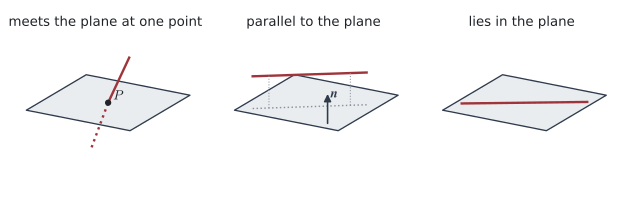
The key question is whether the direction \(\boldsymbol{d}\) is perpendicular to the normal \(\boldsymbol{n}\).
A line and a plane Not in the formula booklet
- \(\boldsymbol{d}\cdot\boldsymbol{n} \neq 0\): the line meets the plane at exactly one point.
- \(\boldsymbol{d}\cdot\boldsymbol{n} = 0\) and the point \(A\) is not on the plane: the line is parallel to the plane (no common point).
- \(\boldsymbol{d}\cdot\boldsymbol{n} = 0\) and the point \(A\) is on the plane: the line lies in the plane.
- \(\boldsymbol{d}\): the direction vector of the line \(\boldsymbol{r} = \boldsymbol{a} + \lambda\boldsymbol{d}\)
- \(\boldsymbol{n}\): a normal vector of the plane
- \(A\): the fixed point on the line (position vector \(\boldsymbol{a}\))
Example 1 (a) The plane \(P\) has equation \(x + 3y - z = 5\). Show that the line \(\boldsymbol{r} = \begin{pmatrix} 2 \\ 1 \\ 0 \end{pmatrix} + \lambda\begin{pmatrix} 1 \\ 0 \\ 1 \end{pmatrix}\) lies in \(P\).
(b) Show that the line \(\boldsymbol{r} = \boldsymbol{i} + \boldsymbol{j} + \boldsymbol{k} + t(2\boldsymbol{i} - \boldsymbol{j} - \boldsymbol{k})\) is parallel to the plane \(\boldsymbol{r}\cdot(\boldsymbol{i} + \boldsymbol{j} + \boldsymbol{k}) = 6\), and does not lie in it.
(a) \(\boldsymbol{d}\cdot\boldsymbol{n} = (1)(1) + (0)(3) + (1)(-1) = 0\), so the line is parallel to \(P\) or lies in it. The point \((2, 1, 0)\) gives \(2 + 3 - 0 = 5\) ✓, so it is on \(P\). Hence the line lies in \(P\).
(Another way: substitute the general point \((2 + \lambda, 1, \lambda)\): \(\;(2 + \lambda) + 3 - \lambda = 5\) for every \(\lambda\).)
(b) \(\boldsymbol{d}\cdot\boldsymbol{n} = 2 - 1 - 1 = 0\), so the line is parallel to the plane or lies in it. The point \((1, 1, 1)\) gives \(1 + 1 + 1 = 3 \neq 6\), so it is not on the plane. Hence the line is parallel to the plane and does not lie in it.
The point of intersection
If the line meets the plane, exactly one value of \(\lambda\) makes \((\boldsymbol{a} + \lambda\boldsymbol{d})\cdot\boldsymbol{n} = D\) true.
Point of intersection of a line and a plane
- Write the general point of the line, \(\boldsymbol{r} = \boldsymbol{a} + \lambda\boldsymbol{d}\), in coordinates.
- Substitute it into the equation of the plane and solve for \(\lambda\).
- Put this \(\lambda\) back into the equation of the line.
If step 2 gives a false statement such as \(3 = 6\), the line is parallel to the plane. If it gives a true statement such as \(5 = 5\) for all \(\lambda\), the line lies in the plane.
Example 2 The plane \(\Pi\) has equation \(2x - y + 3z = 10\) and the line \(l\) has equation \(\boldsymbol{r} = \begin{pmatrix} 1 \\ 4 \\ -2 \end{pmatrix} + \lambda\begin{pmatrix} 1 \\ -1 \\ 2 \end{pmatrix}\). Find the coordinates of the point where \(l\) meets \(\Pi\).
The general point of \(l\) is \((1 + \lambda,\; 4 - \lambda,\; -2 + 2\lambda)\). Substitute:
\[ 2(1 + \lambda) - (4 - \lambda) + 3(-2 + 2\lambda) = 10 \;\Longrightarrow\; -8 + 9\lambda = 10 \;\Longrightarrow\; \lambda = 2 . \]
The point is \((3, 2, 2)\). (Check: \(6 - 2 + 6 = 10\) ✓.)
The angle between a line and a plane
The angle between a line and a plane is the angle \(\theta\) between the line and its shadow (projection) on the plane. It is never more than \(90^\circ\).
The normal \(\boldsymbol{n}\) makes an angle of \(90^\circ - \theta\) with the line. From the scalar product,
\[ \cos(90^\circ - \theta) = \frac{|\boldsymbol{d}\cdot\boldsymbol{n}|}{|\boldsymbol{d}|\,|\boldsymbol{n}|} \qquad\text{and}\qquad \cos(90^\circ - \theta) = \sin\theta . \]
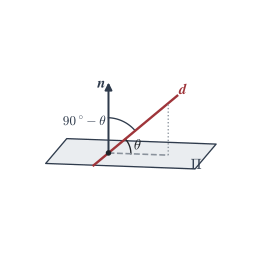
Angle between a line and a plane Not in the formula booklet
\[ \sin\theta = \frac{|\boldsymbol{d}\cdot\boldsymbol{n}|}{|\boldsymbol{d}|\,|\boldsymbol{n}|} \]
- \(\theta\): the acute angle between the line and the plane (the modulus makes \(\theta\) acute)
- \(\boldsymbol{d}\): the direction vector of the line
- \(\boldsymbol{n}\): a normal vector of the plane
The HL booklet gives only \(\cos\theta = \frac{\boldsymbol{v}\cdot\boldsymbol{w}}{|\boldsymbol{v}||\boldsymbol{w}|}\) for two vectors, so learn to use sin here.
Example 3 The plane \(\Pi\) has equation \(\boldsymbol{r}\cdot(2\boldsymbol{i} - \boldsymbol{j} + 2\boldsymbol{k}) = 4\). A line passes through \((1, 0, 3)\) and is parallel to \(\boldsymbol{i} + \boldsymbol{j} + 4\boldsymbol{k}\). Find the acute angle between the line and \(\Pi\).
\(\boldsymbol{d}\cdot\boldsymbol{n} = 2 - 1 + 8 = 9\), \(\;|\boldsymbol{d}| = \sqrt{1 + 1 + 16} = 3\sqrt{2}\), \(\;|\boldsymbol{n}| = \sqrt{4 + 1 + 4} = 3\).
\[ \sin\theta = \frac{9}{3\sqrt{2} \times 3} = \frac{1}{\sqrt{2}} \quad\Longrightarrow\quad \theta = 45^\circ . \]
(The point \((1, 0, 3)\) is not needed for the angle.)
The length of the projection of a line segment onto a plane
Let \(PQ\) be a line segment and let \(F\) be the foot of the perpendicular from \(Q\) to the plane. If \(P\) is on the plane, the projection of \(\overrightarrow{PQ}\) onto the plane is \(PF\) (Figure 3).
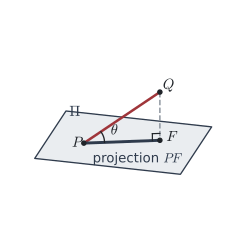
Then
\[ PF = |\overrightarrow{PQ}|\cos\theta = |\overrightarrow{PQ}|\sin(90^\circ - \theta), \]
where \(90^\circ - \theta\) is the angle between \(\overrightarrow{PQ}\) and \(\boldsymbol{n}\). Using \(|\boldsymbol{v}\times\boldsymbol{w}| = |\boldsymbol{v}|\,|\boldsymbol{w}|\sin\alpha\) gives a short formula. The length is the same for any segment parallel to \(PQ\), so \(P\) does not need to be on the plane.
Length of the projection of \(\overrightarrow{PQ}\) onto a plane with normal \(\boldsymbol{n}\) Not in the formula booklet
\[ \text{length} = \frac{|\overrightarrow{PQ}\times\boldsymbol{n}|}{|\boldsymbol{n}|} \qquad\text{or}\qquad \text{length} = \sqrt{|\overrightarrow{PQ}|^2 - \left(\frac{\overrightarrow{PQ}\cdot\boldsymbol{n}}{|\boldsymbol{n}|}\right)^2} \]
- \(P, Q\): the two ends of the line segment
- \(\boldsymbol{n}\): a normal vector of the plane
Example 4 The plane \(\Pi\) has equation \(\boldsymbol{r}\cdot(\boldsymbol{i} + 2\boldsymbol{j} + 2\boldsymbol{k}) = 4\). The points \(P\) and \(Q\) have position vectors \(3\boldsymbol{j} + \boldsymbol{k}\) and \(4\boldsymbol{i} - \boldsymbol{k}\). Find the length of the projection of \(\overrightarrow{PQ}\) onto \(\Pi\).
\(\overrightarrow{PQ} = \begin{pmatrix} 4 \\ -3 \\ -2 \end{pmatrix}\) and \(\boldsymbol{n} = \begin{pmatrix} 1 \\ 2 \\ 2 \end{pmatrix}\), \(|\boldsymbol{n}| = 3\).
\[ \overrightarrow{PQ}\times\boldsymbol{n} = \begin{pmatrix} (-3)(2) - (-2)(2) \\ (-2)(1) - (4)(2) \\ (4)(2) - (-3)(1) \end{pmatrix} = \begin{pmatrix} -2 \\ -10 \\ 11 \end{pmatrix}, \qquad |\overrightarrow{PQ}\times\boldsymbol{n}| = \sqrt{4 + 100 + 121} = 15 . \]
\[ \text{length} = \frac{15}{3} = 5 . \]
Check with the second formula: \(|\overrightarrow{PQ}|^2 = 29\) and \(\dfrac{\overrightarrow{PQ}\cdot\boldsymbol{n}}{|\boldsymbol{n}|} = \dfrac{4 - 6 - 4}{3} = -2\), so the length is \(\sqrt{29 - 4} = 5\) ✓.
The reflection of a line in a plane
Let the line \(l\) meet the plane at \(P\), and let \(Q\) be another point on \(l\). The reflected line \(l'\) also passes through \(P\). It passes through \(Q'\), the image of \(Q\). The foot of the perpendicular \(N\) from \(Q\) to the plane is the midpoint of \(QQ'\).
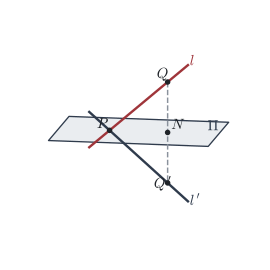
Reflecting a line in a plane
- Find \(P\), the point where \(l\) meets the plane.
- Choose a point \(Q\) on \(l\) and find \(N\), the foot of the perpendicular from \(Q\) to the plane (the line through \(Q\) with direction \(\boldsymbol{n}\) meets the plane at \(N\)).
- \(N\) is the midpoint of \(QQ'\), so \(\overrightarrow{OQ'} = 2\overrightarrow{ON} - \overrightarrow{OQ}\).
- \(l'\) is the line through \(P\) and \(Q'\).
The foot of the perpendicular is studied again in Section 22.4.
Example 5 The line \(l\) has Cartesian equations \(x - 2 = z - 5\), \(y = 3\). The plane \(\Pi\) has equation \(\boldsymbol{r}\cdot\begin{pmatrix} 1 \\ 2 \\ 2 \end{pmatrix} = 9\). Find a vector equation of the reflection of \(l\) in \(\Pi\).
\(l\) passes through \(Q(2, 3, 5)\) with direction \(\begin{pmatrix} 1 \\ 0 \\ 1 \end{pmatrix}\) (\(y\) does not change): \(\;(2 + t,\; 3,\; 5 + t)\).
Step 1. \((2 + t) + 2(3) + 2(5 + t) = 9 \Rightarrow 18 + 3t = 9 \Rightarrow t = -3\). So \(P = (-1, 3, 2)\).
Step 2. The line through \(Q\) along \(\boldsymbol{n}\) is \((2 + s,\; 3 + 2s,\; 5 + 2s)\):
\[ (2 + s) + 2(3 + 2s) + 2(5 + 2s) = 9 \;\Longrightarrow\; 18 + 9s = 9 \;\Longrightarrow\; s = -1 , \]
so \(N = (1, 1, 3)\).
Step 3. \(\overrightarrow{OQ'} = 2\begin{pmatrix} 1 \\ 1 \\ 3 \end{pmatrix} - \begin{pmatrix} 2 \\ 3 \\ 5 \end{pmatrix} = \begin{pmatrix} 0 \\ -1 \\ 1 \end{pmatrix}\).
Step 4. \(\overrightarrow{PQ'} = \begin{pmatrix} 0 - (-1) \\ -1 - 3 \\ 1 - 2 \end{pmatrix} = \begin{pmatrix} 1 \\ -4 \\ -1 \end{pmatrix}\), so
\[ l': \boldsymbol{r} = \begin{pmatrix} -1 \\ 3 \\ 2 \end{pmatrix} + \mu\begin{pmatrix} 1 \\ -4 \\ -1 \end{pmatrix}. \]
Common errors
| ✗ Wrong | ✓ Right | Why |
|---|---|---|
| \(\cos\theta = \dfrac{\lvert\boldsymbol{d}\cdot\boldsymbol{n}\rvert}{\lvert\boldsymbol{d}\rvert\lvert\boldsymbol{n}\rvert}\) for the line–plane angle | \(\sin\theta = \dfrac{\lvert\boldsymbol{d}\cdot\boldsymbol{n}\rvert}{\lvert\boldsymbol{d}\rvert\lvert\boldsymbol{n}\rvert}\) | \(\boldsymbol{n}\) is perpendicular to the plane; the cosine gives the angle with the normal, \(90^\circ - \theta\). |
| \(\boldsymbol{d}\cdot\boldsymbol{n} = 0\), so “the line is parallel to the plane” | Also test one point of the line | The line may lie in the plane. |
| Using a point on the line (not \(\boldsymbol{d}\)) in \(\boldsymbol{d}\cdot\boldsymbol{n}\) | Use the direction vector | Position does not change the angle. |
| Giving \(\lambda = 2\) as the answer | Substitute back: the point \((3, 2, 2)\) | The question asks for the point. |
| Reflecting by using \(Q' = 2Q - P\) | \(\overrightarrow{OQ'} = 2\overrightarrow{ON} - \overrightarrow{OQ}\) | The mirror point is through \(N\), the foot of the perpendicular, not through \(P\). |
Exercises
1 Determine whether the line \(\boldsymbol{r} = \begin{pmatrix} 1 \\ 2 \\ 3 \end{pmatrix} + t\begin{pmatrix} 2 \\ -1 \\ 1 \end{pmatrix}\) meets, is parallel to, or lies in the plane \(x + 3y + z = 10\).
\(\boldsymbol{d}\cdot\boldsymbol{n} = 2 - 3 + 1 = 0\). The point \((1, 2, 3)\): \(1 + 6 + 3 = 10\) ✓. The line lies in the plane.
2 Show that the line \(\boldsymbol{r} = \begin{pmatrix} 0 \\ 1 \\ -1 \end{pmatrix} + t\begin{pmatrix} 1 \\ 1 \\ 2 \end{pmatrix}\) is parallel to the plane \(3x - y - z = 4\) and does not lie in it.
\(\boldsymbol{d}\cdot\boldsymbol{n} = 3 - 1 - 2 = 0\), so the line is parallel to the plane or in it. The point \((0, 1, -1)\): \(0 - 1 + 1 = 0 \neq 4\), so it is not on the plane. The line is parallel and does not lie in it.
3 Find the point where the line \(\boldsymbol{r} = \begin{pmatrix} 2 \\ -1 \\ 3 \end{pmatrix} + t\begin{pmatrix} 1 \\ 2 \\ -1 \end{pmatrix}\) meets the plane \(x + y + z = 10\).
\((2 + t) + (-1 + 2t) + (3 - t) = 10 \Rightarrow 4 + 2t = 10 \Rightarrow t = 3\). The point is \((5, 5, 0)\).
4 Find the point where the line \(\dfrac{x - 1}{2} = \dfrac{y + 1}{3} = \dfrac{z}{-1}\) meets the plane \(x + y + z = 6\).
General point \((1 + 2t,\; -1 + 3t,\; -t)\): \(\;(1 + 2t) + (-1 + 3t) - t = 6 \Rightarrow 4t = 6 \Rightarrow t = \dfrac{3}{2}\).
The point is \(\left(4, \dfrac{7}{2}, -\dfrac{3}{2}\right)\).
5 Find the acute angle between the line \(\boldsymbol{r} = \begin{pmatrix} 1 \\ 0 \\ 2 \end{pmatrix} + t\begin{pmatrix} 1 \\ 2 \\ 2 \end{pmatrix}\) and the plane \(\boldsymbol{r}\cdot\begin{pmatrix} 2 \\ -1 \\ 2 \end{pmatrix} = 3\).
\(\boldsymbol{d}\cdot\boldsymbol{n} = 2 - 2 + 4 = 4\), \(|\boldsymbol{d}| = 3\), \(|\boldsymbol{n}| = 3\). \(\;\sin\theta = \dfrac{4}{9}\), so \(\theta = 26.4^\circ\) (3 s.f.).
6 Find the acute angle between the line \(\dfrac{x - 2}{1} = \dfrac{y + 1}{-1} = \dfrac{z}{4}\) and the \(xy\)-plane.
\(\boldsymbol{d} = \begin{pmatrix} 1 \\ -1 \\ 4 \end{pmatrix}\), \(\boldsymbol{n} = \boldsymbol{k}\). \(\;\sin\theta = \dfrac{4}{\sqrt{18} \times 1} = \dfrac{4}{3\sqrt{2}} = \dfrac{2\sqrt{2}}{3}\), so \(\theta = 70.5^\circ\) (3 s.f.).
7 The line \(\boldsymbol{r} = \begin{pmatrix} 1 \\ 1 \\ 1 \end{pmatrix} + t\begin{pmatrix} k \\ 2 \\ -1 \end{pmatrix}\) is parallel to the plane \(3x - y + 2z = 5\). Find \(k\), and show that the line does not lie in the plane.
\(\boldsymbol{d}\cdot\boldsymbol{n} = 3k - 2 - 2 = 0\), so \(k = \dfrac{4}{3}\). The point \((1, 1, 1)\) gives \(3 - 1 + 2 = 4 \neq 5\), so the line is not in the plane.
8 The points \(A(4, 1, -2)\) and \(B(2, 3, 0)\) are given. Show that the plane \(x + 2y + 3z = 4\) cuts the line segment \(AB\) at its midpoint.
\(\overrightarrow{AB} = \begin{pmatrix} -2 \\ 2 \\ 2 \end{pmatrix}\), so a general point of line \(AB\) is \((4 - 2t,\; 1 + 2t,\; -2 + 2t)\).
\((4 - 2t) + 2(1 + 2t) + 3(-2 + 2t) = 4 \Rightarrow 8t = 4 \Rightarrow t = \dfrac{1}{2}\).
The point is \((3, 2, -1)\). The midpoint of \(AB\) is \(\left(\dfrac{4 + 2}{2}, \dfrac{1 + 3}{2}, \dfrac{-2 + 0}{2}\right) = (3, 2, -1)\) ✓.
9 The plane \(\Pi\) has equation \(2x - y + 2z = 5\). The points are \(A(1, 2, 0)\) and \(B(4, 6, 2)\).
(a) Find the acute angle between the line \(AB\) and \(\Pi\).
(b) Find the length of the projection of \(\overrightarrow{AB}\) onto \(\Pi\).
\(\overrightarrow{AB} = \begin{pmatrix} 3 \\ 4 \\ 2 \end{pmatrix}\), \(|\overrightarrow{AB}| = \sqrt{29}\), \(\boldsymbol{n} = \begin{pmatrix} 2 \\ -1 \\ 2 \end{pmatrix}\), \(|\boldsymbol{n}| = 3\), \(\overrightarrow{AB}\cdot\boldsymbol{n} = 6 - 4 + 4 = 6\).
(a) \(\sin\theta = \dfrac{6}{3\sqrt{29}} = \dfrac{2}{\sqrt{29}}\), so \(\theta = 21.8^\circ\) (3 s.f.).
(b) \(\text{length} = \sqrt{29 - \left(\dfrac{6}{3}\right)^2} = \sqrt{25} = 5\). (Or \(|\overrightarrow{AB}|\cos\theta = \sqrt{29} \times \dfrac{5}{\sqrt{29}} = 5\).)
10 The line \(l\) has equation \(\boldsymbol{r} = \begin{pmatrix} 1 \\ 4 \\ -2 \end{pmatrix} + t\begin{pmatrix} 0 \\ 1 \\ -1 \end{pmatrix}\) and the plane \(\Pi\) has equation \(2x + y - 2z = 1\).
(a) Find the point \(P\) where \(l\) meets \(\Pi\).
(b) Find the foot of the perpendicular from \(Q(1, 4, -2)\) to \(\Pi\), and the image \(Q'\) of \(Q\) in \(\Pi\).
(c) Hence find a vector equation of the reflection of \(l\) in \(\Pi\).
(a) \(2(1) + (4 + t) - 2(-2 - t) = 1 \Rightarrow 10 + 3t = 1 \Rightarrow t = -3\). \(\;P = (1, 1, 1)\).
(b) Line through \(Q\) along \(\boldsymbol{n}\): \((1 + 2s,\; 4 + s,\; -2 - 2s)\). \(\;2(1 + 2s) + (4 + s) - 2(-2 - 2s) = 1 \Rightarrow 10 + 9s = 1 \Rightarrow s = -1\).
Foot \(N = (-1, 3, 0)\). Image: \(\overrightarrow{OQ'} = 2\begin{pmatrix} -1 \\ 3 \\ 0 \end{pmatrix} - \begin{pmatrix} 1 \\ 4 \\ -2 \end{pmatrix} = \begin{pmatrix} -3 \\ 2 \\ 2 \end{pmatrix}\).
(c) \(\overrightarrow{PQ'} = \begin{pmatrix} -4 \\ 1 \\ 1 \end{pmatrix}\), so \(\;l': \boldsymbol{r} = \begin{pmatrix} 1 \\ 1 \\ 1 \end{pmatrix} + \mu\begin{pmatrix} -4 \\ 1 \\ 1 \end{pmatrix}\).