22.1 Vector Equations of a Plane
AHL 3.17
- how a point and two non-parallel direction vectors fix a plane
- the vector (parametric) equation of a plane, \(\boldsymbol{r} = \boldsymbol{a} + \lambda\boldsymbol{b} + \mu\boldsymbol{c}\)
- how to find this equation from three points, from two lines, or from a line and a point
- what a normal vector is, and the scalar-product form \(\boldsymbol{r}\cdot\boldsymbol{n} = \boldsymbol{a}\cdot\boldsymbol{n}\)
- how to find a normal vector with the vector product, also for a plane through two points and parallel to a line
This unit uses lines in 3D from Unit 21 and the scalar and vector products from Unit 20.
The vector equation of a plane
A line is fixed by one point and one direction. A plane needs one point and two directions.
Let \(\Pi\) (capital Greek letter pi, read “pie”) be a plane. Suppose that
- \(A\) is a point on \(\Pi\), with position vector \(\boldsymbol{a}\), and
- \(\boldsymbol{b}\) and \(\boldsymbol{c}\) are two vectors parallel to \(\Pi\) that are not parallel to each other.
Let \(R\) be any point on the plane, with position vector \(\boldsymbol{r}\). The vector \(\overrightarrow{AR}\) lies in the plane, so we can reach \(R\) from \(A\) by moving some amount along \(\boldsymbol{b}\) and some amount along \(\boldsymbol{c}\):
\[ \overrightarrow{AR} = \lambda\boldsymbol{b} + \mu\boldsymbol{c} \qquad\text{for some numbers } \lambda, \mu . \]
Since \(\overrightarrow{AR} = \boldsymbol{r} - \boldsymbol{a}\), we get \(\boldsymbol{r} = \boldsymbol{a} + \lambda\boldsymbol{b} + \mu\boldsymbol{c}\).
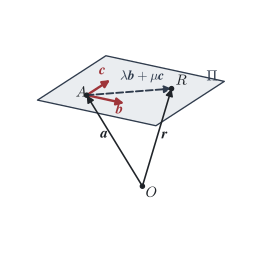
Vector equation of a plane In the HL formula booklet
\[ \boldsymbol{r} = \boldsymbol{a} + \lambda\boldsymbol{b} + \mu\boldsymbol{c}, \qquad \lambda, \mu \in \mathbb{R} \]
- \(\boldsymbol{r}\): the position vector of a general point on the plane
- \(\boldsymbol{a}\): the position vector of one point on the plane
- \(\lambda, \mu\): the parameters (real numbers); each pair of values \((\lambda, \mu)\) gives one point of the plane
- \(\boldsymbol{b}\), \(\boldsymbol{c}\): non-zero, non-parallel vectors parallel to the plane (direction vectors)
A plane has many vector equations: any point on the plane and any two non-parallel directions in it will do.
Example 1 Find a vector equation of the plane that passes through the point \(A(2, -1, 3)\) and is parallel to the vectors \(\boldsymbol{i} + 2\boldsymbol{k}\) and \(-\boldsymbol{i} + 3\boldsymbol{j} + \boldsymbol{k}\).
The two vectors are not parallel (one is not a multiple of the other), so
\[ \boldsymbol{r} = \begin{pmatrix} 2 \\ -1 \\ 3 \end{pmatrix} + \lambda \begin{pmatrix} 1 \\ 0 \\ 2 \end{pmatrix} + \mu \begin{pmatrix} -1 \\ 3 \\ 1 \end{pmatrix}, \qquad \lambda, \mu \in \mathbb{R}. \]
Three points that are not on one line fix a plane. Use one point as \(\boldsymbol{a}\), and two vectors between the points as directions.
Example 2 Find a vector equation of the plane through \(A(2, 1, -1)\), \(B(4, 0, 1)\) and \(C(1, 3, 2)\).
\[ \overrightarrow{AB} = \begin{pmatrix} 4 - 2 \\ 0 - 1 \\ 1 - (-1) \end{pmatrix} = \begin{pmatrix} 2 \\ -1 \\ 2 \end{pmatrix}, \qquad \overrightarrow{AC} = \begin{pmatrix} 1 - 2 \\ 3 - 1 \\ 2 - (-1) \end{pmatrix} = \begin{pmatrix} -1 \\ 2 \\ 3 \end{pmatrix}. \]
These are not parallel, so \(A\), \(B\), \(C\) are not on one line. A vector equation is
\[ \boldsymbol{r} = \begin{pmatrix} 2 \\ 1 \\ -1 \end{pmatrix} + \lambda \begin{pmatrix} 2 \\ -1 \\ 2 \end{pmatrix} + \mu \begin{pmatrix} -1 \\ 2 \\ 3 \end{pmatrix}. \]
(Check: \(\lambda = 1, \mu = 0\) gives \(B\), and \(\lambda = 0, \mu = 1\) gives \(C\).)
Two lines lie in one plane only if they intersect or are parallel. Skew lines do not lie in any plane.
Example 3 The lines \[ l_1: \boldsymbol{r} = \begin{pmatrix} 1 \\ 0 \\ 2 \end{pmatrix} + \lambda \begin{pmatrix} 1 \\ 1 \\ -1 \end{pmatrix} \qquad\text{and}\qquad l_2: \boldsymbol{r} = \begin{pmatrix} 3 \\ 4 \\ -3 \end{pmatrix} + \mu \begin{pmatrix} 1 \\ -1 \\ 2 \end{pmatrix} \] intersect. Find their point of intersection, and a vector equation of the plane that contains both lines.
Make the coordinates equal:
\[ 1 + \lambda = 3 + \mu, \qquad \lambda = 4 - \mu, \qquad 2 - \lambda = -3 + 2\mu . \]
From the first two: \(\lambda - \mu = 2\) and \(\lambda + \mu = 4\), so \(\lambda = 3\), \(\mu = 1\). Third equation: \(2 - 3 = -1\) and \(-3 + 2 = -1\) ✓. The point of intersection is \((4, 3, -1)\).
The plane contains a point of \(l_1\) and both directions:
\[ \boldsymbol{r} = \begin{pmatrix} 1 \\ 0 \\ 2 \end{pmatrix} + \lambda \begin{pmatrix} 1 \\ 1 \\ -1 \end{pmatrix} + \mu \begin{pmatrix} 1 \\ -1 \\ 2 \end{pmatrix}. \]
Example 4 Find a vector equation of the plane that contains the line \(\boldsymbol{r} = \begin{pmatrix} 2 \\ 1 \\ 0 \end{pmatrix} + t \begin{pmatrix} 1 \\ -2 \\ 3 \end{pmatrix}\) and the point \(P(4, 0, 5)\).
The line gives one point, \(A(2, 1, 0)\), and one direction, \(\begin{pmatrix} 1 \\ -2 \\ 3 \end{pmatrix}\). A second direction is
\[ \overrightarrow{AP} = \begin{pmatrix} 4 - 2 \\ 0 - 1 \\ 5 - 0 \end{pmatrix} = \begin{pmatrix} 2 \\ -1 \\ 5 \end{pmatrix}, \]
which is not parallel to \(\begin{pmatrix} 1 \\ -2 \\ 3 \end{pmatrix}\). So
\[ \boldsymbol{r} = \begin{pmatrix} 2 \\ 1 \\ 0 \end{pmatrix} + \lambda \begin{pmatrix} 1 \\ -2 \\ 3 \end{pmatrix} + \mu \begin{pmatrix} 2 \\ -1 \\ 5 \end{pmatrix}. \]
The normal vector and the scalar-product form
A normal vector to a plane is a non-zero vector that is perpendicular to every line in the plane. We usually call it \(\boldsymbol{n}\).
Let \(A\) (position vector \(\boldsymbol{a}\)) be a point on the plane, and let \(R\) (position vector \(\boldsymbol{r}\)) be any point on the plane. The vector \(\overrightarrow{AR} = \boldsymbol{r} - \boldsymbol{a}\) lies in the plane, so it is perpendicular to \(\boldsymbol{n}\):
\[ (\boldsymbol{r} - \boldsymbol{a})\cdot\boldsymbol{n} = 0 \quad\Longrightarrow\quad \boldsymbol{r}\cdot\boldsymbol{n} = \boldsymbol{a}\cdot\boldsymbol{n} . \]
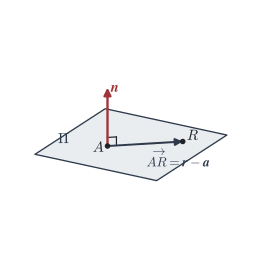
Scalar-product (normal) form of a plane In the HL formula booklet
\[ \boldsymbol{r}\cdot\boldsymbol{n} = \boldsymbol{a}\cdot\boldsymbol{n} \]
The right-hand side is just a number, so we often write \(\boldsymbol{r}\cdot\boldsymbol{n} = d\).
- \(\boldsymbol{r}\): the position vector of a general point on the plane
- \(\boldsymbol{n}\): a normal vector (perpendicular to the plane)
- \(\boldsymbol{a}\): the position vector of a point on the plane
- \(d\): the number \(\boldsymbol{a}\cdot\boldsymbol{n}\)
Any non-zero multiple of \(\boldsymbol{n}\) is also a normal. For example, \(\boldsymbol{r}\cdot\begin{pmatrix} 2 \\ -4 \\ 6 \end{pmatrix} = 10\) and \(\boldsymbol{r}\cdot\begin{pmatrix} 1 \\ -2 \\ 3 \end{pmatrix} = 5\) are the same plane.
Example 5 Find, in scalar-product form, the equation of the plane through the point with position vector \(2\boldsymbol{i} - \boldsymbol{j} + 4\boldsymbol{k}\) that is perpendicular to the vector \(3\boldsymbol{i} + \boldsymbol{j} - 2\boldsymbol{k}\).
\(\boldsymbol{n} = \begin{pmatrix} 3 \\ 1 \\ -2 \end{pmatrix}\) and \(\boldsymbol{a}\cdot\boldsymbol{n} = 2(3) + (-1)(1) + 4(-2) = 6 - 1 - 8 = -3\).
\[ \boldsymbol{r}\cdot\begin{pmatrix} 3 \\ 1 \\ -2 \end{pmatrix} = -3 \]
Finding a normal with the vector product
If \(\boldsymbol{b}\) and \(\boldsymbol{c}\) are two non-parallel vectors in the plane, then \(\boldsymbol{b}\times\boldsymbol{c}\) is perpendicular to both of them, so it is perpendicular to the plane.
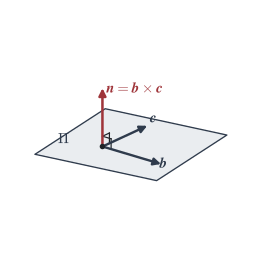
A normal vector from two directions Not in the formula booklet
\[ \boldsymbol{n} = \boldsymbol{b}\times\boldsymbol{c} \]
Check your answer: \(\boldsymbol{n}\cdot\boldsymbol{b} = 0\) and \(\boldsymbol{n}\cdot\boldsymbol{c} = 0\).
- \(\boldsymbol{n}\): a normal vector to the plane
- \(\boldsymbol{b}\), \(\boldsymbol{c}\): non-parallel vectors parallel to the plane
The vector product formula is in the HL formula booklet (3.16).
Example 6 Find, in scalar-product form, the equation of the plane containing \(A(1, 2, 0)\), \(B(3, 1, 2)\) and \(C(0, 4, 1)\).
\[ \overrightarrow{AB} = \begin{pmatrix} 2 \\ -1 \\ 2 \end{pmatrix}, \qquad \overrightarrow{AC} = \begin{pmatrix} -1 \\ 2 \\ 1 \end{pmatrix}. \]
\[ \overrightarrow{AB}\times\overrightarrow{AC} = \begin{pmatrix} (-1)(1) - (2)(2) \\ (2)(-1) - (2)(1) \\ (2)(2) - (-1)(-1) \end{pmatrix} = \begin{pmatrix} -5 \\ -4 \\ 3 \end{pmatrix}. \]
Use \(\boldsymbol{n} = \begin{pmatrix} 5 \\ 4 \\ -3 \end{pmatrix}\) (multiplying by \(-1\) is allowed). Then \(\boldsymbol{a}\cdot\boldsymbol{n} = 5 + 8 + 0 = 13\), so
\[ \boldsymbol{r}\cdot\begin{pmatrix} 5 \\ 4 \\ -3 \end{pmatrix} = 13 . \]
Check with \(B\): \(15 + 4 - 6 = 13\) ✓. Check with \(C\): \(0 + 16 - 3 = 13\) ✓.
If a plane is perpendicular to a line, the direction of the line is a normal to the plane.
Example 7 Find the equation, in scalar-product form, of the plane through \((2, -3, 1)\) that is perpendicular to the line \(\boldsymbol{r} = \begin{pmatrix} 0 \\ 1 \\ 4 \end{pmatrix} + \lambda\begin{pmatrix} 4 \\ -1 \\ 2 \end{pmatrix}\).
The normal is the direction of the line: \(\boldsymbol{n} = \begin{pmatrix} 4 \\ -1 \\ 2 \end{pmatrix}\).
\(\boldsymbol{a}\cdot\boldsymbol{n} = 8 + 3 + 2 = 13\), so \(\;\boldsymbol{r}\cdot\begin{pmatrix} 4 \\ -1 \\ 2 \end{pmatrix} = 13\).
Parallel planes have parallel normals, so we can use the same \(\boldsymbol{n}\).
Example 8 Find the equation, in scalar-product form, of the plane through \(A(3, 0, -2)\) that is parallel to the plane \(\boldsymbol{r}\cdot\begin{pmatrix} 2 \\ -5 \\ 1 \end{pmatrix} = 7\).
Use the same normal \(\boldsymbol{n} = \begin{pmatrix} 2 \\ -5 \\ 1 \end{pmatrix}\). \(\;\boldsymbol{a}\cdot\boldsymbol{n} = 6 + 0 - 2 = 4\), so the plane is
\[ \boldsymbol{r}\cdot\begin{pmatrix} 2 \\ -5 \\ 1 \end{pmatrix} = 4 . \]
Example 9 Find the equation, in scalar-product form, of the plane that contains the lines \(l_1\) and \(l_2\) of Example 3.
The directions are \(\begin{pmatrix} 1 \\ 1 \\ -1 \end{pmatrix}\) and \(\begin{pmatrix} 1 \\ -1 \\ 2 \end{pmatrix}\).
\[ \boldsymbol{n} = \begin{pmatrix} 1 \\ 1 \\ -1 \end{pmatrix} \times \begin{pmatrix} 1 \\ -1 \\ 2 \end{pmatrix} = \begin{pmatrix} (1)(2) - (-1)(-1) \\ (-1)(1) - (1)(2) \\ (1)(-1) - (1)(1) \end{pmatrix} = \begin{pmatrix} 1 \\ -3 \\ -2 \end{pmatrix}. \]
With the point \((1, 0, 2)\): \(\;\boldsymbol{a}\cdot\boldsymbol{n} = 1 + 0 - 4 = -3\).
\[ \boldsymbol{r}\cdot\begin{pmatrix} 1 \\ -3 \\ -2 \end{pmatrix} = -3 \]
Check with the intersection point \((4, 3, -1)\): \(4 - 9 + 2 = -3\) ✓.
A plane from two points and a line
The direction of a line is easy to read from its Cartesian equations (see Unit 21). For example,
\[ x = 3, \qquad \frac{y - 1}{2} = \frac{z + 4}{-1} \]
has direction \(\begin{pmatrix} 0 \\ 2 \\ -1 \end{pmatrix}\): \(x\) does not change, so the \(x\)-component is \(0\).
Example 10 Find, in scalar-product form, the equation of the plane that contains \(A(2, 0, -1)\) and \(B(1, 3, 1)\) and is parallel to the line \(\;x = 3,\; \dfrac{y - 1}{2} = \dfrac{z + 4}{-1}\).
Two directions in the plane: \(\overrightarrow{AB} = \begin{pmatrix} -1 \\ 3 \\ 2 \end{pmatrix}\) and the line’s direction \(\begin{pmatrix} 0 \\ 2 \\ -1 \end{pmatrix}\).
\[ \boldsymbol{n} = \begin{pmatrix} -1 \\ 3 \\ 2 \end{pmatrix}\times\begin{pmatrix} 0 \\ 2 \\ -1 \end{pmatrix} = \begin{pmatrix} (3)(-1) - (2)(2) \\ (2)(0) - (-1)(-1) \\ (-1)(2) - (3)(0) \end{pmatrix} = \begin{pmatrix} -7 \\ -1 \\ -2 \end{pmatrix}. \]
Use \(\boldsymbol{n} = \begin{pmatrix} 7 \\ 1 \\ 2 \end{pmatrix}\). With \(A\): \(\;14 + 0 - 2 = 12\).
\[ \boldsymbol{r}\cdot\begin{pmatrix} 7 \\ 1 \\ 2 \end{pmatrix} = 12 \]
(Check with \(B\): \(7 + 3 + 2 = 12\) ✓.)
Common errors
| ✗ Wrong | ✓ Right | Why |
|---|---|---|
| Using two parallel vectors as \(\boldsymbol{b}\) and \(\boldsymbol{c}\) | Check that one is not a multiple of the other | Parallel vectors give only a line, not a plane. |
| Using position vectors \(\boldsymbol{a}\), \(\boldsymbol{b}\), \(\boldsymbol{c}\) of three points as the directions | Use \(\overrightarrow{AB}\) and \(\overrightarrow{AC}\) | Directions must lie in the plane; position vectors start at \(O\). |
| Using the direction of a line in the plane as \(\boldsymbol{n}\) | \(\boldsymbol{n}\) is perpendicular to the plane | A normal is perpendicular to every direction in the plane. |
| \(\boldsymbol{r}\cdot\boldsymbol{n} = \boldsymbol{n}\) or \(\boldsymbol{r}\cdot\boldsymbol{n} = \boldsymbol{a}\) | \(\boldsymbol{r}\cdot\boldsymbol{n} = \boldsymbol{a}\cdot\boldsymbol{n}\), a number | A scalar product is a number, so the right-hand side must be a number too. |
| Not checking the normal | Test \(\boldsymbol{n}\cdot\boldsymbol{b} = 0\), or substitute the other points | One sign slip in a vector product gives a wrong plane. |
Exercises
1 Write down a vector equation of the plane through \((3, -1, 2)\) parallel to the vectors \(\begin{pmatrix} 1 \\ 2 \\ 0 \end{pmatrix}\) and \(\begin{pmatrix} 0 \\ 1 \\ -3 \end{pmatrix}\). Hence write down the coordinates of two other points on the plane.
\[ \boldsymbol{r} = \begin{pmatrix} 3 \\ -1 \\ 2 \end{pmatrix} + \lambda \begin{pmatrix} 1 \\ 2 \\ 0 \end{pmatrix} + \mu \begin{pmatrix} 0 \\ 1 \\ -3 \end{pmatrix} \]
\(\lambda = 1, \mu = 0\) gives \((4, 1, 2)\); \(\;\lambda = 0, \mu = 1\) gives \((3, 0, -1)\). (Other answers are possible.)
2 Find a vector equation of the plane through \(A(1, 0, 2)\), \(B(3, 1, 0)\) and \(C(-1, 2, 5)\).
\(\overrightarrow{AB} = \begin{pmatrix} 2 \\ 1 \\ -2 \end{pmatrix}\), \(\;\overrightarrow{AC} = \begin{pmatrix} -2 \\ 2 \\ 3 \end{pmatrix}\) (not parallel).
\[ \boldsymbol{r} = \begin{pmatrix} 1 \\ 0 \\ 2 \end{pmatrix} + \lambda \begin{pmatrix} 2 \\ 1 \\ -2 \end{pmatrix} + \mu \begin{pmatrix} -2 \\ 2 \\ 3 \end{pmatrix} \]
3 For the plane in Question 2, determine whether each point lies on the plane.
(a) \((5, -1, -3)\) \(\qquad\) (b) \((4, 1, 1)\)
Solve \(\;1 + 2\lambda - 2\mu = x\), \(\;\lambda + 2\mu = y\) using the first two coordinates, then test the third.
(a) \(2\lambda - 2\mu = 4\) and \(\lambda + 2\mu = -1\). Adding: \(3\lambda = 3\), so \(\lambda = 1\), \(\mu = -1\). Third coordinate: \(2 - 2(1) + 3(-1) = -3\) ✓. Yes, it lies on the plane.
(b) \(2\lambda - 2\mu = 3\) and \(\lambda + 2\mu = 1\). Adding: \(3\lambda = 4\), so \(\lambda = \dfrac{4}{3}\), \(\mu = -\dfrac{1}{6}\). Third coordinate: \(2 - \dfrac{8}{3} - \dfrac{1}{2} = -\dfrac{7}{6} \neq 1\). No.
4 Find, in scalar-product form, the equation of the plane through \((2, 5, -1)\) that is perpendicular to \(3\boldsymbol{i} - 2\boldsymbol{j} + 4\boldsymbol{k}\).
\(\boldsymbol{a}\cdot\boldsymbol{n} = 6 - 10 - 4 = -8\), so \(\;\boldsymbol{r}\cdot\begin{pmatrix} 3 \\ -2 \\ 4 \end{pmatrix} = -8\).
5 Find, in scalar-product form, the equation of the plane through \(A(2, 1, 0)\), \(B(0, 3, 1)\) and \(C(1, 1, 3)\).
\(\overrightarrow{AB} = \begin{pmatrix} -2 \\ 2 \\ 1 \end{pmatrix}\), \(\;\overrightarrow{AC} = \begin{pmatrix} -1 \\ 0 \\ 3 \end{pmatrix}\).
\[ \boldsymbol{n} = \overrightarrow{AB}\times\overrightarrow{AC} = \begin{pmatrix} (2)(3) - (1)(0) \\ (1)(-1) - (-2)(3) \\ (-2)(0) - (2)(-1) \end{pmatrix} = \begin{pmatrix} 6 \\ 5 \\ 2 \end{pmatrix}. \]
\(\boldsymbol{a}\cdot\boldsymbol{n} = 12 + 5 + 0 = 17\), so \(\;\boldsymbol{r}\cdot\begin{pmatrix} 6 \\ 5 \\ 2 \end{pmatrix} = 17\). (Check: \(B\) gives \(0 + 15 + 2 = 17\) ✓, \(C\) gives \(6 + 5 + 6 = 17\) ✓.)
6 Find the equation of the plane through \((1, -4, 2)\) that is perpendicular to the line \(\boldsymbol{r} = \begin{pmatrix} 3 \\ 0 \\ 1 \end{pmatrix} + t\begin{pmatrix} 2 \\ 1 \\ -5 \end{pmatrix}\). Give your answer in scalar-product form.
\(\boldsymbol{n} = \begin{pmatrix} 2 \\ 1 \\ -5 \end{pmatrix}\), \(\;\boldsymbol{a}\cdot\boldsymbol{n} = 2 - 4 - 10 = -12\).
\[ \boldsymbol{r}\cdot\begin{pmatrix} 2 \\ 1 \\ -5 \end{pmatrix} = -12 \]
7 Find the equation of the plane through the origin that is parallel to \(\boldsymbol{r}\cdot\begin{pmatrix} 4 \\ -1 \\ 3 \end{pmatrix} = 10\).
Same normal; the origin gives \(\boldsymbol{a}\cdot\boldsymbol{n} = 0\). So \(\;\boldsymbol{r}\cdot\begin{pmatrix} 4 \\ -1 \\ 3 \end{pmatrix} = 0\).
8 The lines \(l_1: \boldsymbol{r} = \begin{pmatrix} 1 \\ 2 \\ -1 \end{pmatrix} + \lambda\begin{pmatrix} 1 \\ 0 \\ 2 \end{pmatrix}\) and \(l_2: \boldsymbol{r} = \begin{pmatrix} 2 \\ 2 \\ 1 \end{pmatrix} + \mu\begin{pmatrix} 0 \\ 1 \\ 1 \end{pmatrix}\) are given.
(a) Show that \(l_1\) and \(l_2\) intersect.
(b) Find, in scalar-product form, the equation of the plane that contains \(l_1\) and \(l_2\).
(a) \(1 + \lambda = 2\), \(\;2 = 2 + \mu\), \(\;-1 + 2\lambda = 1 + \mu\). The first two give \(\lambda = 1\), \(\mu = 0\); then \(-1 + 2 = 1 = 1 + 0\) ✓. They meet at \((2, 2, 1)\).
(b)
\[ \boldsymbol{n} = \begin{pmatrix} 1 \\ 0 \\ 2 \end{pmatrix}\times\begin{pmatrix} 0 \\ 1 \\ 1 \end{pmatrix} = \begin{pmatrix} (0)(1) - (2)(1) \\ (2)(0) - (1)(1) \\ (1)(1) - (0)(0) \end{pmatrix} = \begin{pmatrix} -2 \\ -1 \\ 1 \end{pmatrix}. \]
Use \(\boldsymbol{n} = \begin{pmatrix} 2 \\ 1 \\ -1 \end{pmatrix}\) and the point \((1, 2, -1)\): \(\;2 + 2 + 1 = 5\).
\[ \boldsymbol{r}\cdot\begin{pmatrix} 2 \\ 1 \\ -1 \end{pmatrix} = 5 \]
(Check with \((2, 2, 1)\): \(4 + 2 - 1 = 5\) ✓.)
9 Find, in scalar-product form, the equation of the plane that contains the line \(\boldsymbol{r} = \begin{pmatrix} 1 \\ -1 \\ 0 \end{pmatrix} + t\begin{pmatrix} 2 \\ 1 \\ 1 \end{pmatrix}\) and the point \(P(3, 2, -1)\).
With \(A(1, -1, 0)\): \(\;\overrightarrow{AP} = \begin{pmatrix} 2 \\ 3 \\ -1 \end{pmatrix}\).
\[ \boldsymbol{n} = \begin{pmatrix} 2 \\ 1 \\ 1 \end{pmatrix}\times\begin{pmatrix} 2 \\ 3 \\ -1 \end{pmatrix} = \begin{pmatrix} (1)(-1) - (1)(3) \\ (1)(2) - (2)(-1) \\ (2)(3) - (1)(2) \end{pmatrix} = \begin{pmatrix} -4 \\ 4 \\ 4 \end{pmatrix} = -4\begin{pmatrix} 1 \\ -1 \\ -1 \end{pmatrix}. \]
Use \(\boldsymbol{n} = \begin{pmatrix} 1 \\ -1 \\ -1 \end{pmatrix}\): \(\;\boldsymbol{a}\cdot\boldsymbol{n} = 1 + 1 - 0 = 2\).
\[ \boldsymbol{r}\cdot\begin{pmatrix} 1 \\ -1 \\ -1 \end{pmatrix} = 2 \]
(Check with \(P\): \(3 - 2 + 1 = 2\) ✓.)
10 The lines \(l_1: \boldsymbol{r} = \begin{pmatrix} 1 \\ 0 \\ 1 \end{pmatrix} + \lambda\begin{pmatrix} 1 \\ 2 \\ -1 \end{pmatrix}\) and \(l_2: \boldsymbol{r} = \begin{pmatrix} 2 \\ 1 \\ 4 \end{pmatrix} + \mu\begin{pmatrix} -2 \\ -4 \\ 2 \end{pmatrix}\) are parallel.
(a) Explain why you cannot use the two direction vectors as \(\boldsymbol{b}\) and \(\boldsymbol{c}\).
(b) Find a vector equation and the scalar-product equation of the plane containing both lines.
(a) \(\begin{pmatrix} -2 \\ -4 \\ 2 \end{pmatrix} = -2\begin{pmatrix} 1 \\ 2 \\ -1 \end{pmatrix}\): the directions are parallel, so together they describe only one direction.
(b) A second direction joins a point of \(l_1\) to a point of \(l_2\): \(\begin{pmatrix} 2 \\ 1 \\ 4 \end{pmatrix} - \begin{pmatrix} 1 \\ 0 \\ 1 \end{pmatrix} = \begin{pmatrix} 1 \\ 1 \\ 3 \end{pmatrix}\).
\[ \boldsymbol{r} = \begin{pmatrix} 1 \\ 0 \\ 1 \end{pmatrix} + \lambda \begin{pmatrix} 1 \\ 2 \\ -1 \end{pmatrix} + \mu \begin{pmatrix} 1 \\ 1 \\ 3 \end{pmatrix} \]
\[ \boldsymbol{n} = \begin{pmatrix} 1 \\ 2 \\ -1 \end{pmatrix}\times\begin{pmatrix} 1 \\ 1 \\ 3 \end{pmatrix} = \begin{pmatrix} (2)(3) - (-1)(1) \\ (-1)(1) - (1)(3) \\ (1)(1) - (2)(1) \end{pmatrix} = \begin{pmatrix} 7 \\ -4 \\ -1 \end{pmatrix}, \qquad \boldsymbol{a}\cdot\boldsymbol{n} = 7 - 0 - 1 = 6 . \]
\[ \boldsymbol{r}\cdot\begin{pmatrix} 7 \\ -4 \\ -1 \end{pmatrix} = 6 \]
(Check with \((2, 1, 4)\): \(14 - 4 - 4 = 6\) ✓.)