21.3 Two Lines
AHL 3.14 AHL 3.15
- how to show that two lines are perpendicular or parallel
- how to tell whether parallel lines are coincident (the same line)
- how to show that two lines intersect, and find the point of intersection
- what skew lines are, and how to decide which of the four cases you have
- how to find the acute angle between two lines, and the length of projection of a vector onto a line
- how to use \(\boldsymbol{r} = \boldsymbol{a} + t\boldsymbol{v}\) in kinematics: velocity, speed, collision and closest approach
In this section the two lines are
\[ l_1: \boldsymbol{r} = \boldsymbol{a}_1 + \lambda\boldsymbol{b}_1, \qquad l_2: \boldsymbol{r} = \boldsymbol{a}_2 + \mu\boldsymbol{b}_2 . \]
Always use different letters for the two parameters (\(\lambda\) and \(\mu\)): the two lines usually reach a common point at different parameter values.
Perpendicular lines
Two lines are perpendicular when their direction vectors are perpendicular. The scalar product (Unit 20) tests this.
Perpendicular lines Not in the formula booklet
\[ l_1 \perp l_2 \iff \boldsymbol{b}_1 \cdot \boldsymbol{b}_2 = 0 \]
- \(l_1, l_2\): the two lines
- \(\boldsymbol{b}_1, \boldsymbol{b}_2\): the direction vectors of \(l_1\) and \(l_2\)
The scalar product is in the HL formula booklet (3.13).
Example 1 (a) Show that the lines \(l_1: \boldsymbol{r} = 2\boldsymbol{i} - \boldsymbol{j} + 3\boldsymbol{k} + \lambda(4\boldsymbol{i} + \boldsymbol{j} - 2\boldsymbol{k})\) and \(l_2: \boldsymbol{r} = \boldsymbol{i} + 5\boldsymbol{k} + \mu(3\boldsymbol{i} - 2\boldsymbol{j} + 5\boldsymbol{k})\) are perpendicular.
(b) The line \(l_3\) has direction \(2\boldsymbol{i} + p\boldsymbol{j} + 3\boldsymbol{k}\) and is perpendicular to \(l_1\). Find \(p\).
(a) \(\;\boldsymbol{b}_1 \cdot \boldsymbol{b}_2 = 4 \times 3 + 1 \times (-2) + (-2) \times 5 = 12 - 2 - 10 = 0\), so \(l_1 \perp l_2\).
(b) \(\;4 \times 2 + 1 \times p + (-2) \times 3 = 0 \Rightarrow 2 + p = 0 \Rightarrow p = -2\).
Perpendicular lines in three dimensions do not have to meet. “Perpendicular” here is only about the directions.
Parallel and coincident lines
Two lines are parallel when one direction vector is a multiple of the other.
Parallel lines Not in the formula booklet
\[ l_1 \parallel l_2 \iff \boldsymbol{b}_1 = k\,\boldsymbol{b}_2 \text{ for some number } k \]
Parallel lines are either coincident (the same line) or distinct (they never meet). To decide, take one point of \(l_2\) and test whether it lies on \(l_1\) (see Section 21.2). If it does, the lines are coincident; if not, they are parallel and distinct.
- \(l_1, l_2\): the two lines
- \(\boldsymbol{b}_1, \boldsymbol{b}_2\): the direction vectors of \(l_1\) and \(l_2\)
- \(k\): a non-zero number (scalar)
Example 2 Show that the lines \(\;\dfrac{x - 2}{4} = \dfrac{1 - y}{2} = \dfrac{z + 3}{6}\;\) and \(\;\dfrac{5 - x}{2} = y + 2 = \dfrac{3 - z}{3}\;\) are parallel, and that they are not coincident.
First make every numerator have the form \(x - x_0\), \(y - y_0\), \(z - z_0\):
\[ l_1: \frac{x - 2}{4} = \frac{y - 1}{-2} = \frac{z + 3}{6}, \qquad l_2: \frac{x - 5}{-2} = \frac{y + 2}{1} = \frac{z - 3}{-3} . \]
So \(\boldsymbol{b}_1 = \begin{pmatrix} 4 \\ -2 \\ 6 \end{pmatrix}\) and \(\boldsymbol{b}_2 = \begin{pmatrix} -2 \\ 1 \\ -3 \end{pmatrix}\). Since \(\boldsymbol{b}_1 = -2\,\boldsymbol{b}_2\), the lines are parallel.
The point \((2, 1, -3)\) is on \(l_1\). Put it into \(l_2\): \(\;\dfrac{2 - 5}{-2} = \dfrac{3}{2}\), but \(\;\dfrac{1 + 2}{1} = 3\). These are not equal, so \((2, 1, -3)\) is not on \(l_2\). The lines are parallel and not coincident.
Example 3 Show that \(l_1: \boldsymbol{r} = \begin{pmatrix} 1 \\ 0 \\ 3 \end{pmatrix} + \lambda \begin{pmatrix} 2 \\ -1 \\ 1 \end{pmatrix}\) and \(l_2: \boldsymbol{r} = \begin{pmatrix} 5 \\ -2 \\ 5 \end{pmatrix} + \mu \begin{pmatrix} -4 \\ 2 \\ -2 \end{pmatrix}\) are coincident.
\(\begin{pmatrix} -4 \\ 2 \\ -2 \end{pmatrix} = -2\begin{pmatrix} 2 \\ -1 \\ 1 \end{pmatrix}\), so the lines are parallel.
Test the point \((5, -2, 5)\) of \(l_2\) on \(l_1\): \(\;1 + 2\lambda = 5 \Rightarrow \lambda = 2\); then \(y = -2\) ✓ and \(z = 3 + 2 = 5\) ✓. A point of \(l_2\) lies on \(l_1\) and the lines are parallel, so they are the same line.
Intersecting lines
If \(l_1\) and \(l_2\) meet, there are values of \(\lambda\) and \(\mu\) that give the same point: \(\boldsymbol{a}_1 + \lambda\boldsymbol{b}_1 = \boldsymbol{a}_2 + \mu\boldsymbol{b}_2\). This vector equation is three equations in only two unknowns.
To decide whether two non-parallel lines intersect
- Set \(\boldsymbol{a}_1 + \lambda\boldsymbol{b}_1 = \boldsymbol{a}_2 + \mu\boldsymbol{b}_2\) and write the three component equations.
- Solve two of them simultaneously for \(\lambda\) and \(\mu\).
- Substitute \(\lambda\) and \(\mu\) into the third equation. If it is true, the lines intersect. If it is false, they do not.
- For the point of intersection, put \(\lambda\) into \(l_1\) (or \(\mu\) into \(l_2\) — this is a useful check).
Not in the formula booklet.
Example 4 Show that the lines \(l_1: \boldsymbol{r} = \begin{pmatrix} 1 \\ 2 \\ -1 \end{pmatrix} + \lambda \begin{pmatrix} 1 \\ -1 \\ 2 \end{pmatrix}\) and \(l_2: \boldsymbol{r} = \begin{pmatrix} 4 \\ 2 \\ 4 \end{pmatrix} + \mu \begin{pmatrix} 1 \\ 2 \\ 1 \end{pmatrix}\) intersect, and find the position vector of the point of intersection.
\[ \begin{aligned} 1 + \lambda &= 4 + \mu && (1) \\ 2 - \lambda &= 2 + 2\mu && (2) \\ -1 + 2\lambda &= 4 + \mu && (3) \end{aligned} \]
\((1)\): \(\lambda = 3 + \mu\). Substitute into \((2)\): \(\;2 - 3 - \mu = 2 + 2\mu \Rightarrow -3 = 3\mu \Rightarrow \mu = -1\), so \(\lambda = 2\).
Check in \((3)\): LHS \(= -1 + 4 = 3\), RHS \(= 4 - 1 = 3\) ✓. The lines intersect.
\[ \boldsymbol{r} = \begin{pmatrix} 1 + 2 \\ 2 - 2 \\ -1 + 4 \end{pmatrix} = \begin{pmatrix} 3 \\ 0 \\ 3 \end{pmatrix} . \]
Check with \(l_2\), \(\mu = -1\): \(\begin{pmatrix} 4 - 1 \\ 2 - 2 \\ 4 - 1 \end{pmatrix} = \begin{pmatrix} 3 \\ 0 \\ 3 \end{pmatrix}\) ✓.
Calculator page: Menu → Algebra → Solve System of Equations → Solve System of Linear Equations. Choose 2 equations, variables l, m (use any letters), and enter, for Example 4, 1+l=4+m and 2-l=2+2m. The result is \(l = 2\), \(m = -1\). You must still check the third equation yourself.
Skew lines
In two dimensions, two lines that are not parallel always meet. In three dimensions this is not true. Two lines that are not parallel and do not intersect are called skew.
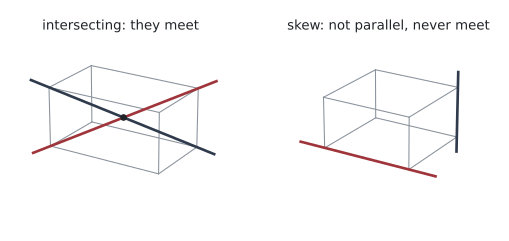
To show that lines are skew, show two things: they are not parallel, and the three equations have no common solution (the third equation fails).
Example 5 Show that \(l_1: \boldsymbol{r} = \begin{pmatrix} 1 \\ -1 \\ 2 \end{pmatrix} + \lambda \begin{pmatrix} 2 \\ 1 \\ -1 \end{pmatrix}\) and \(l_2: \boldsymbol{r} = \begin{pmatrix} 2 \\ 2 \\ 5 \end{pmatrix} + \mu \begin{pmatrix} 1 \\ -2 \\ 3 \end{pmatrix}\) are skew.
Not parallel: \(\begin{pmatrix} 2 \\ 1 \\ -1 \end{pmatrix} = k\begin{pmatrix} 1 \\ -2 \\ 3 \end{pmatrix}\) would need \(k = 2\) (first component) and \(k = -\frac{1}{2}\) (second). Impossible.
Do not intersect:
\[ \begin{aligned} 1 + 2\lambda &= 2 + \mu && (1) \\ -1 + \lambda &= 2 - 2\mu && (2) \\ 2 - \lambda &= 5 + 3\mu && (3) \end{aligned} \]
From \((2)\): \(\lambda = 3 - 2\mu\). Into \((1)\): \(\;1 + 6 - 4\mu = 2 + \mu \Rightarrow 5 = 5\mu \Rightarrow \mu = 1\), so \(\lambda = 1\).
Check \((3)\): LHS \(= 2 - 1 = 1\), RHS \(= 5 + 3 = 8\). \(\;1 \ne 8\), so there is no common point.
The lines are not parallel and do not intersect, so they are skew.
Deciding the relationship between two lines
- Are \(\boldsymbol{b}_1\) and \(\boldsymbol{b}_2\) multiples of each other?
- Yes: test a point of one line on the other → coincident (point is on it) or parallel (point is not).
- No: solve \(\boldsymbol{a}_1 + \lambda\boldsymbol{b}_1 = \boldsymbol{a}_2 + \mu\boldsymbol{b}_2\) → intersecting (third equation true) or skew (third equation false).
The angle between two lines
The angle between two lines is the angle between their direction vectors. Two crossing lines make two angles, \(\theta\) and \(180^\circ - \theta\). We normally give the acute one.
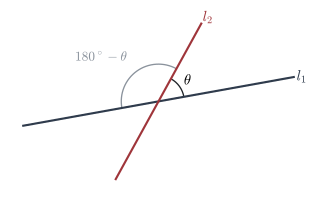
The formula \(\cos\theta = \dfrac{\boldsymbol{b}_1 \cdot \boldsymbol{b}_2}{|\boldsymbol{b}_1|\,|\boldsymbol{b}_2|}\) gives an obtuse angle when \(\boldsymbol{b}_1 \cdot \boldsymbol{b}_2 < 0\). Taking the modulus of the scalar product always gives the acute angle.
Acute angle \(\theta\) between two lines Not in the formula booklet
\[ \cos\theta = \frac{|\boldsymbol{b}_1 \cdot \boldsymbol{b}_2|}{|\boldsymbol{b}_1|\,|\boldsymbol{b}_2|} \]
If \(\boldsymbol{b}_1 \cdot \boldsymbol{b}_2 = 0\) the lines are perpendicular (\(\theta = 90^\circ\)). The lines do not have to meet: for skew lines this is still the angle between their directions.
- \(\theta\): the acute angle between the two lines
- \(\boldsymbol{b}_1, \boldsymbol{b}_2\): the direction vectors of the two lines
The HL booklet gives the angle between two vectors (3.13), \(\cos\theta = \dfrac{v_1w_1 + v_2w_2 + v_3w_3}{|\boldsymbol{v}|\,|\boldsymbol{w}|}\), without the modulus. Use it with the direction vectors.
Example 6 Find the acute angle between the lines \(\boldsymbol{r} = \boldsymbol{i} - 2\boldsymbol{j} + 3\boldsymbol{k} + \lambda(2\boldsymbol{i} - \boldsymbol{j} + 2\boldsymbol{k})\) and \(\boldsymbol{r} = 3\boldsymbol{i} + \boldsymbol{j} + \mu(\boldsymbol{j} - \boldsymbol{k})\).
\(\boldsymbol{b}_1 = \begin{pmatrix} 2 \\ -1 \\ 2 \end{pmatrix}\), \(\;\boldsymbol{b}_2 = \begin{pmatrix} 0 \\ 1 \\ -1 \end{pmatrix}\).
\(\boldsymbol{b}_1 \cdot \boldsymbol{b}_2 = 0 - 1 - 2 = -3\), \(\;|\boldsymbol{b}_1| = \sqrt{4 + 1 + 4} = 3\), \(\;|\boldsymbol{b}_2| = \sqrt{2}\).
\[ \cos\theta = \frac{|-3|}{3\sqrt{2}} = \frac{1}{\sqrt{2}} \quad\Longrightarrow\quad \theta = 45^\circ . \]
(Without the modulus you would get \(\cos\theta = -\frac{1}{\sqrt{2}}\), that is \(135^\circ\), the obtuse angle.)
To find the angle between a line and a coordinate axis, use \(\boldsymbol{i}\), \(\boldsymbol{j}\) or \(\boldsymbol{k}\) as the second direction vector.
Example 7 Find the acute angle between the line \(l: \boldsymbol{r} = \begin{pmatrix} 1 \\ 0 \\ 5 \end{pmatrix} + s \begin{pmatrix} 1 \\ 2 \\ -2 \end{pmatrix}, \; s \in \mathbb{R}\), and the \(z\)-axis.
The \(z\)-axis has direction \(\boldsymbol{k} = \begin{pmatrix} 0 \\ 0 \\ 1 \end{pmatrix}\).
\[ \cos\theta = \frac{\left|\begin{pmatrix} 1 \\ 2 \\ -2 \end{pmatrix} \cdot \begin{pmatrix} 0 \\ 0 \\ 1 \end{pmatrix}\right|}{\sqrt{1 + 4 + 4} \times 1} = \frac{|-2|}{3} = \frac{2}{3} \quad\Longrightarrow\quad \theta = \arccos\frac{2}{3} \approx 48.2^\circ . \]
Length of projection of a vector onto a line
Let \(\overrightarrow{PQ}\) be a vector and \(l\) a line with direction \(\boldsymbol{b}\). Drop perpendiculars from \(P\) and \(Q\) to \(l\), meeting it at \(P'\) and \(Q'\). The length \(P'Q'\) is the length of projection of \(\overrightarrow{PQ}\) onto \(l\): the “shadow” of \(PQ\) on the line.
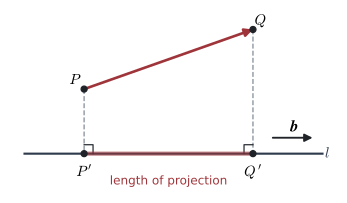
If \(\theta\) is the angle between \(\overrightarrow{PQ}\) and \(\boldsymbol{b}\), then \(P'Q' = |\overrightarrow{PQ}|\,|\cos\theta|\). Using \(\overrightarrow{PQ} \cdot \boldsymbol{b} = |\overrightarrow{PQ}|\,|\boldsymbol{b}|\cos\theta\) gives the formula below.
Length of projection of \(\overrightarrow{PQ}\) onto a line with direction \(\boldsymbol{b}\) Not in the formula booklet
\[ P'Q' = \left|\overrightarrow{PQ} \cdot \hat{\boldsymbol{b}}\right| = \frac{\left|\overrightarrow{PQ} \cdot \boldsymbol{b}\right|}{|\boldsymbol{b}|}, \] where \(\hat{\boldsymbol{b}} = \dfrac{\boldsymbol{b}}{|\boldsymbol{b}|}\) is the unit vector in the direction of \(\boldsymbol{b}\).
- \(P, Q\): the two ends of the line segment
- \(\boldsymbol{b}\): the direction vector of the line
- \(P', Q'\): the projections of \(P\) and \(Q\) onto the line (the feet of the perpendiculars)
Example 8 The points \(A\) and \(B\) have coordinates \((2, -1, 4)\) and \((5, 3, 1)\). Find the length of projection of \(\overrightarrow{AB}\) onto the line \(\begin{pmatrix} x \\ y \\ z \end{pmatrix} = \begin{pmatrix} 0 \\ 1 \\ 1 \end{pmatrix} + \lambda \begin{pmatrix} 2 \\ 1 \\ -2 \end{pmatrix}\).
\(\overrightarrow{AB} = \begin{pmatrix} 3 \\ 4 \\ -3 \end{pmatrix}\) and \(|\boldsymbol{b}| = \sqrt{4 + 1 + 4} = 3\).
\[ \text{length} = \frac{|3 \times 2 + 4 \times 1 + (-3)(-2)|}{3} = \frac{16}{3} . \]
Only the direction of the line matters; the point \((0, 1, 1)\) is not used.
Applications to kinematics
An object moves in a straight line with constant velocity \(\boldsymbol{v}\). If it starts at position \(\boldsymbol{r}_0\) when \(t = 0\), its position at time \(t\) is
\[ \boldsymbol{r} = \boldsymbol{r}_0 + t\boldsymbol{v} . \]
This is the vector equation of a line, with the parameter \(\lambda\) replaced by the time \(t\) and the direction \(\boldsymbol{b}\) replaced by the velocity \(\boldsymbol{v}\).
Kinematics with \(\boldsymbol{r} = \boldsymbol{r}_0 + t\boldsymbol{v}\) Not in the formula booklet
- \(\boldsymbol{r}_0\) is the initial position (at \(t = 0\)).
- \(\boldsymbol{v}\) is the velocity: the displacement in one unit of time.
- The speed is \(|\boldsymbol{v}|\). The distance travelled in time \(t\) is \(t\,|\boldsymbol{v}|\).
- \(\boldsymbol{r}\): the position vector of the object at time \(t\)
- \(t\): the time
The HL booklet’s \(\boldsymbol{r} = \boldsymbol{a} + \lambda\boldsymbol{b}\) is the same equation.
Example 9 A drone moves in a straight line. Its position \(t\) seconds after a timer starts is \(\boldsymbol{r} = \begin{pmatrix} 4 \\ -2 \\ 0 \end{pmatrix} + t \begin{pmatrix} 2 \\ 6 \\ 3 \end{pmatrix}\), where distances are in metres and the \(z\)-axis points vertically up from the ground.
(a) Find the speed of the drone.
(b) Find its position after \(4\) seconds, and the distance it has travelled.
(c) Find the position of the drone when it is \(15\) m above the ground.
(a) \(\;|\boldsymbol{v}| = \sqrt{2^2 + 6^2 + 3^2} = \sqrt{49} = 7\) m s⁻¹.
(b) \(\;\boldsymbol{r} = \begin{pmatrix} 4 + 8 \\ -2 + 24 \\ 0 + 12 \end{pmatrix} = \begin{pmatrix} 12 \\ 22 \\ 12 \end{pmatrix}\), the point \((12, 22, 12)\). Distance travelled \(= 4 \times 7 = 28\) m.
(c) \(\;z = 3t = 15 \Rightarrow t = 5\). Then \(\boldsymbol{r} = \begin{pmatrix} 14 \\ 28 \\ 15 \end{pmatrix}\), the point \((14, 28, 15)\).
With two moving objects, there are two different questions.
- Do their paths cross? Use different parameters for the two lines, as in the previous sections.
- Do the objects collide? They must be at the same point at the same time \(t\).
The distance between the objects at time \(t\) is \(|\boldsymbol{r}_B - \boldsymbol{r}_A|\). Its smallest value is the closest approach. Write \(|\boldsymbol{r}_B - \boldsymbol{r}_A|^2\) as a quadratic in \(t\) and find its minimum.
Example 10 Two ships \(A\) and \(B\) move with constant velocities. At time \(t\) hours their positions, in km, are
\[ \boldsymbol{r}_A = \begin{pmatrix} 1 \\ 2 \end{pmatrix} + t \begin{pmatrix} 3 \\ 1 \end{pmatrix}, \qquad \boldsymbol{r}_B = \begin{pmatrix} 10 \\ -3 \end{pmatrix} + t \begin{pmatrix} -1 \\ 3 \end{pmatrix} . \]
(a) Show that the paths of the ships cross, and find the point where they cross.
(b) Show that the ships do not collide.
(c) Find the time when the ships are closest together, and the distance between them at that time.
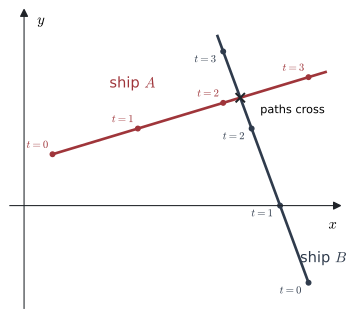
(a) Use different parameters, \(s\) for \(A\) and \(u\) for \(B\):
\[ 1 + 3s = 10 - u \quad (1), \qquad 2 + s = -3 + 3u \quad (2) . \]
From \((2)\): \(s = 3u - 5\). Into \((1)\): \(\;1 + 9u - 15 = 10 - u \Rightarrow 10u = 24 \Rightarrow u = 2.4\), and \(s = 2.2\).
In two dimensions there is no third equation to check, so the paths cross at \(\boldsymbol{r}_A(2.2) = \begin{pmatrix} 1 + 6.6 \\ 2 + 2.2 \end{pmatrix}\), the point \((7.6, 4.2)\).
(b) Ship \(A\) is at this point when \(t = 2.2\), and ship \(B\) when \(t = 2.4\). They are never there at the same time, so they do not collide (Figure 4).
(c)
\[ \boldsymbol{r}_B - \boldsymbol{r}_A = \begin{pmatrix} 9 - 4t \\ -5 + 2t \end{pmatrix}, \qquad |\boldsymbol{r}_B - \boldsymbol{r}_A|^2 = (9 - 4t)^2 + (2t - 5)^2 = 20t^2 - 92t + 106 . \]
The minimum of this quadratic is at \(t = \dfrac{92}{2 \times 20} = 2.3\) hours. Then
\[ \boldsymbol{r}_B - \boldsymbol{r}_A = \begin{pmatrix} -0.2 \\ -0.4 \end{pmatrix}, \qquad \text{distance} = \sqrt{0.04 + 0.16} = \sqrt{0.2} \approx 0.447 \text{ km} . \]
The ships are closest after \(2.3\) hours (2 hours 18 minutes), when they are about \(447\) m apart.
At the closest approach, the relative position \(\boldsymbol{r}_B - \boldsymbol{r}_A\) is perpendicular to the relative velocity \(\boldsymbol{v}_B - \boldsymbol{v}_A\). So you can also solve \((\boldsymbol{r}_B - \boldsymbol{r}_A) \cdot (\boldsymbol{v}_B - \boldsymbol{v}_A) = 0\). In Example 10: \(\begin{pmatrix} 9 - 4t \\ -5 + 2t \end{pmatrix} \cdot \begin{pmatrix} -4 \\ 2 \end{pmatrix} = 20t - 46 = 0\), so \(t = 2.3\) again.
Common errors
| ✗ Wrong | ✓ Right | Why |
|---|---|---|
| Using \(\lambda\) for both lines | \(\lambda\) for \(l_1\), \(\mu\) for \(l_2\) | The lines usually reach the common point at different parameter values. |
| Solving two equations and stopping | Always check the third equation | Two equations in \(\lambda, \mu\) almost always have a solution, even for skew lines. |
| “Not parallel, so they intersect” | Not parallel → intersecting or skew | In 3D, non-parallel lines need not meet. |
| \(\cos\theta = \dfrac{\boldsymbol{b}_1 \cdot \boldsymbol{b}_2}{|\boldsymbol{b}_1||\boldsymbol{b}_2|} = -\dfrac{1}{\sqrt{2}}\), so \(\theta = 135^\circ\) | Use \(|\boldsymbol{b}_1 \cdot \boldsymbol{b}_2|\): \(\theta = 45^\circ\) | The angle between two lines is normally the acute one. |
| Using the position vectors \(\boldsymbol{a}_1, \boldsymbol{a}_2\) to find the angle | Use the directions \(\boldsymbol{b}_1, \boldsymbol{b}_2\) | The angle depends only on the directions. |
| Paths cross, so the ships collide | Check that it is the same time | A collision needs the same point at the same \(t\). |
Exercises
1 Show that the lines \(\boldsymbol{r} = \begin{pmatrix} 1 \\ 0 \\ 2 \end{pmatrix} + \lambda \begin{pmatrix} 1 \\ 3 \\ -2 \end{pmatrix}\) and \(\boldsymbol{r} = \begin{pmatrix} 0 \\ 4 \\ 1 \end{pmatrix} + \mu \begin{pmatrix} 4 \\ 0 \\ 2 \end{pmatrix}\) are perpendicular.
\(\begin{pmatrix} 1 \\ 3 \\ -2 \end{pmatrix} \cdot \begin{pmatrix} 4 \\ 0 \\ 2 \end{pmatrix} = 4 + 0 - 4 = 0\), so the lines are perpendicular.
2 The lines with directions \(\begin{pmatrix} 2 \\ -4 \\ k \end{pmatrix}\) and \(\begin{pmatrix} -1 \\ m \\ 3 \end{pmatrix}\) are parallel. Find \(k\) and \(m\).
The first components show the multiplier: \(2 = -2 \times (-1)\). So \(\begin{pmatrix} 2 \\ -4 \\ k \end{pmatrix} = -2\begin{pmatrix} -1 \\ m \\ 3 \end{pmatrix}\).
\(-4 = -2m \Rightarrow m = 2\), and \(k = -2 \times 3 = -6\).
3 Determine whether the lines \(l_1: \boldsymbol{r} = \begin{pmatrix} 2 \\ 1 \\ 0 \end{pmatrix} + \lambda \begin{pmatrix} 1 \\ -2 \\ 3 \end{pmatrix}\) and \(l_2: \boldsymbol{r} = \begin{pmatrix} 0 \\ 5 \\ -5 \end{pmatrix} + \mu \begin{pmatrix} -2 \\ 4 \\ -6 \end{pmatrix}\) are coincident or parallel and distinct.
\(\begin{pmatrix} -2 \\ 4 \\ -6 \end{pmatrix} = -2\begin{pmatrix} 1 \\ -2 \\ 3 \end{pmatrix}\), so the lines are parallel.
Test \((0, 5, -5)\) on \(l_1\): \(2 + \lambda = 0 \Rightarrow \lambda = -2\); \(y = 1 + 4 = 5\) ✓; \(z = -6 \ne -5\) ✗. The point is not on \(l_1\), so the lines are parallel and distinct.
4 Show that the lines \(\boldsymbol{r} = \begin{pmatrix} 2 \\ 0 \\ 1 \end{pmatrix} + \lambda \begin{pmatrix} 1 \\ 1 \\ -1 \end{pmatrix}\) and \(\boldsymbol{r} = \begin{pmatrix} 3 \\ 4 \\ -4 \end{pmatrix} + \mu \begin{pmatrix} 1 \\ -2 \\ 3 \end{pmatrix}\) intersect, and find the point of intersection.
\(2 + \lambda = 3 + \mu\) (1), \(\;\lambda = 4 - 2\mu\) (2), \(\;1 - \lambda = -4 + 3\mu\) (3).
Substitute (2) into (1): \(6 - 2\mu = 3 + \mu \Rightarrow \mu = 1\), \(\lambda = 2\). Check (3): \(1 - 2 = -1\) and \(-4 + 3 = -1\) ✓.
The point of intersection is \((4, 2, -1)\).
5 Show that the lines \(\boldsymbol{r} = \begin{pmatrix} 0 \\ 1 \\ 2 \end{pmatrix} + \lambda \begin{pmatrix} 1 \\ 1 \\ 0 \end{pmatrix}\) and \(\boldsymbol{r} = \begin{pmatrix} 1 \\ 0 \\ 4 \end{pmatrix} + \mu \begin{pmatrix} 0 \\ 1 \\ 1 \end{pmatrix}\) are skew.
Not parallel: the first direction has \(z\)-component \(0\) but the second does not, and the second has \(x\)-component \(0\) but the first does not.
\(x\): \(\lambda = 1\). \(\;y\): \(1 + \lambda = \mu \Rightarrow \mu = 2\). \(\;z\): \(2 = 4 + \mu = 6\) ✗.
No common point and not parallel, so the lines are skew.
6 The lines \(l_1: \dfrac{x - 1}{2} = y + 1 = \dfrac{z - 3}{-1}\) and \(l_2: x - 4 = \dfrac{y + 2}{-2} = \dfrac{z - 4}{2}\) intersect.
(a) Find the point of intersection.
(b) Find the acute angle between the lines.
(a) In vector form, \(l_1: \begin{pmatrix} 1 \\ -1 \\ 3 \end{pmatrix} + \lambda \begin{pmatrix} 2 \\ 1 \\ -1 \end{pmatrix}\) and \(l_2: \begin{pmatrix} 4 \\ -2 \\ 4 \end{pmatrix} + \mu \begin{pmatrix} 1 \\ -2 \\ 2 \end{pmatrix}\).
\(1 + 2\lambda = 4 + \mu\), \(\;-1 + \lambda = -2 - 2\mu\). From the second, \(\lambda = -1 - 2\mu\); then \(1 - 2 - 4\mu = 4 + \mu \Rightarrow \mu = -1\), \(\lambda = 1\). Check \(z\): \(3 - 1 = 2\) and \(4 - 2 = 2\) ✓. The point is \((3, 0, 2)\).
(b) \(\boldsymbol{b}_1 \cdot \boldsymbol{b}_2 = 2 - 2 - 2 = -2\), \(|\boldsymbol{b}_1| = \sqrt{6}\), \(|\boldsymbol{b}_2| = 3\). \(\cos\theta = \dfrac{2}{3\sqrt{6}}\), so \(\theta \approx 74.2^\circ\).
7 Find the acute angle between the lines \(\boldsymbol{r} = \lambda \begin{pmatrix} 1 \\ 1 \\ 0 \end{pmatrix}\) and \(\boldsymbol{r} = \begin{pmatrix} 2 \\ 0 \\ 1 \end{pmatrix} + \mu \begin{pmatrix} 1 \\ 0 \\ -1 \end{pmatrix}\).
\(\cos\theta = \dfrac{|1 + 0 + 0|}{\sqrt{2}\sqrt{2}} = \dfrac{1}{2}\), so \(\theta = 60^\circ\).
8 Find the acute angle between the line \(\boldsymbol{r} = \begin{pmatrix} 3 \\ -1 \\ 0 \end{pmatrix} + t \begin{pmatrix} 2 \\ 3 \\ 6 \end{pmatrix}\) and the \(x\)-axis.
Use \(\boldsymbol{i}\): \(\;\cos\theta = \dfrac{|2|}{\sqrt{4 + 9 + 36} \times 1} = \dfrac{2}{7}\), so \(\theta \approx 73.4^\circ\).
9 \(P\) is \((1, 0, 2)\) and \(Q\) is \((4, 5, -1)\). Find the length of projection of \(\overrightarrow{PQ}\) onto a line with direction \(\begin{pmatrix} 1 \\ 2 \\ 2 \end{pmatrix}\).
\(\overrightarrow{PQ} = \begin{pmatrix} 3 \\ 5 \\ -3 \end{pmatrix}\). Length \(= \dfrac{|3 + 10 - 6|}{\sqrt{1 + 4 + 4}} = \dfrac{7}{3}\).
10 Two particles move with constant velocities. At time \(t\) seconds their positions, in metres, are \(\boldsymbol{r}_A = t\begin{pmatrix} 1 \\ 2 \\ 2 \end{pmatrix}\) and \(\boldsymbol{r}_B = \begin{pmatrix} 6 \\ 0 \\ 3 \end{pmatrix} + t\begin{pmatrix} 0 \\ 2 \\ 1 \end{pmatrix}\).
(a) Find the speed of \(A\).
(b) Find the minimum distance between the particles, and the time when it occurs. Hence explain why they never collide.
(a) \(\sqrt{1 + 4 + 4} = 3\) m s⁻¹.
(b) \(\boldsymbol{r}_B - \boldsymbol{r}_A = \begin{pmatrix} 6 - t \\ 0 \\ 3 - t \end{pmatrix}\), so \(|\boldsymbol{r}_B - \boldsymbol{r}_A|^2 = (6 - t)^2 + (3 - t)^2 = 2t^2 - 18t + 45 = 2(t - 4.5)^2 + 4.5\).
The minimum is at \(t = 4.5\) s, and the minimum distance is \(\sqrt{4.5} = \dfrac{3}{\sqrt{2}} \approx 2.12\) m. The distance is never \(0\), so the particles never collide.