20.1 Scalars, Vectors and Vector Operations
AHL 3.12
- the difference between a scalar and a vector
- how to write and draw vectors: \(\boldsymbol{a}\), \(\overrightarrow{AB}\), directed line segments
- the words position vector, displacement vector, zero vector, negative vector, magnitude and unit vector
- how to add and subtract vectors (triangle rule and parallelogram rule)
- how to multiply a vector by a scalar, and the rules of vector algebra
- how to decide when two vectors are parallel, and how to use non-parallel vectors to compare coefficients
Scalars and vectors
| Scalar | Vector |
|---|---|
| A quantity with size only (magnitude). | A quantity with size and direction. |
| It follows the usual rules of algebra for numbers. | It follows the rules of vector algebra in this unit. |
| Examples: mass, distance, speed, time, temperature. | Examples: displacement, velocity, force, acceleration. |
For example, “\(60\) km/h” is a speed (a scalar). “\(60\) km/h due north” is a velocity (a vector).
Representing a vector
We draw a vector as a directed line segment: a line segment with an arrowhead.
- The length of the segment shows the magnitude of the vector.
- The arrow shows the direction.
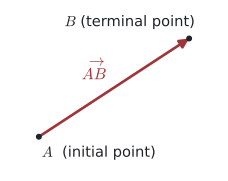
The segment from \(A\) to \(B\) is written \(\overrightarrow{AB}\). The tail \(A\) is the initial point and the head \(B\) is the terminal point. We also name vectors with single bold letters, such as \(\boldsymbol{a}\), \(\boldsymbol{b}\), \(\boldsymbol{v}\). In handwriting, underline the letter: \(\underline{a}\).
Kinds of vectors
Free vector. A free vector has no fixed position. Any segment with the same length and the same direction represents it. Most vectors in this unit are free vectors.
Position vector. The position vector of a point \(P\) is \(\overrightarrow{OP}\), where \(O\) is the origin. It tells us where \(P\) is. We usually write \(\overrightarrow{OA} = \boldsymbol{a}\), \(\overrightarrow{OB} = \boldsymbol{b}\), and so on.
Displacement vector. The vector from one point to another, for example \(\overrightarrow{AB}\). It tells us how to move from \(A\) to \(B\). In Section 20.2 we will see that \(\overrightarrow{AB} = \boldsymbol{b} - \boldsymbol{a}\).
Zero vector. The vector with magnitude \(0\) is the zero vector \(\boldsymbol{0}\). It has no direction. For any point \(A\), \(\overrightarrow{AA} = \boldsymbol{0}\). Note that \(\boldsymbol{0}\) (a vector) is not the same as the number \(0\).
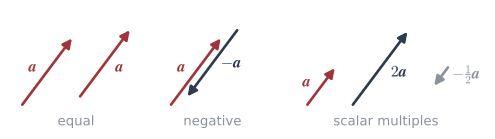
Equal vectors. Two vectors are equal if they have the same magnitude and the same direction. Their positions do not matter.
Negative vector. The vector \(-\boldsymbol{a}\) has the same magnitude as \(\boldsymbol{a}\) but the opposite direction. In particular,
\[ \overrightarrow{BA} = -\overrightarrow{AB} . \]
Magnitude (modulus). The magnitude of \(\boldsymbol{a}\) is its length, written \(|\boldsymbol{a}|\). The magnitude of \(\overrightarrow{AB}\) is \(\big|\overrightarrow{AB}\big|\), which is the distance \(AB\).
Unit vector. A unit vector has magnitude \(1\). The unit vector in the direction of \(\boldsymbol{a}\) is written \(\hat{\boldsymbol{a}}\) (“\(a\) hat”).
Unit vector in the direction of \(\boldsymbol{a}\) Not in the formula booklet
\[ \hat{\boldsymbol{a}} = \frac{\boldsymbol{a}}{|\boldsymbol{a}|} \qquad\qquad \text{in the direction of } \overrightarrow{AB}: \quad \frac{\overrightarrow{AB}}{\big|\overrightarrow{AB}\big|} \]
- \(\hat{\boldsymbol{a}}\): the unit vector in the direction of \(\boldsymbol{a}\)
- \(\boldsymbol{a}\): a non-zero vector
- \(|\boldsymbol{a}|\): the magnitude (length) of \(\boldsymbol{a}\)
- \(\overrightarrow{AB}\): the vector from point \(A\) to point \(B\)
- \(\big|\overrightarrow{AB}\big|\): the magnitude of \(\overrightarrow{AB}\) (the distance from \(A\) to \(B\))
Dividing by \(|\boldsymbol{a}|\) keeps the direction and makes the length exactly \(1\).
Adding and subtracting vectors
The triangle rule
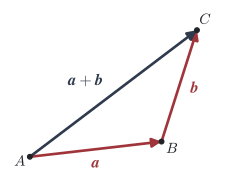
To add \(\boldsymbol{a}\) and \(\boldsymbol{b}\), draw \(\boldsymbol{b}\) starting at the head of \(\boldsymbol{a}\). The sum \(\boldsymbol{a} + \boldsymbol{b}\) goes from the tail of \(\boldsymbol{a}\) to the head of \(\boldsymbol{b}\). It is also called the resultant.
Triangle rule Not in the formula booklet
\[ \overrightarrow{AB} + \overrightarrow{BC} = \overrightarrow{AC} \]
- \(A\), \(B\), \(C\): any three points
- \(\overrightarrow{AB}\): the vector from \(A\) to \(B\)
The inside letters must match: \(\overrightarrow{A\color{#9F353A}{B}} + \overrightarrow{\color{#9F353A}{B}C}\). You can join any number of vectors in a chain: \(\overrightarrow{PQ} + \overrightarrow{QR} + \overrightarrow{RS} = \overrightarrow{PS}\).
The parallelogram rule
Draw \(\boldsymbol{a} = \overrightarrow{AB}\) and \(\boldsymbol{b} = \overrightarrow{AD}\) from the same point \(A\), and complete the parallelogram \(ABCD\). The diagonal \(\overrightarrow{AC}\) is \(\boldsymbol{a} + \boldsymbol{b}\).
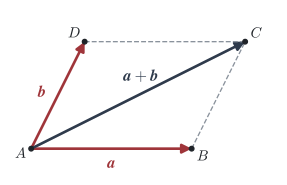
This is the same as the triangle rule, because \(\overrightarrow{BC} = \overrightarrow{AD}\) (opposite sides of a parallelogram are equal vectors):
\[ \overrightarrow{AC} = \overrightarrow{AB} + \overrightarrow{BC} = \overrightarrow{AB} + \overrightarrow{AD} = \boldsymbol{a} + \boldsymbol{b} . \]
Subtraction
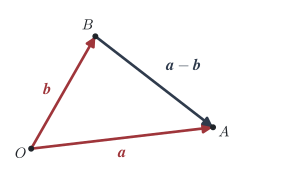
Subtracting means adding the negative: \(\boldsymbol{a} - \boldsymbol{b} = \boldsymbol{a} + (-\boldsymbol{b})\). If \(\overrightarrow{OA} = \boldsymbol{a}\) and \(\overrightarrow{OB} = \boldsymbol{b}\), then
\[ \overrightarrow{BA} = \overrightarrow{BO} + \overrightarrow{OA} = -\boldsymbol{b} + \boldsymbol{a} = \boldsymbol{a} - \boldsymbol{b} . \]
In the parallelogram of Figure 4, one diagonal is \(\boldsymbol{a} + \boldsymbol{b}\) and the other diagonal, \(\overrightarrow{DB}\), is \(\boldsymbol{a} - \boldsymbol{b}\).
Multiplying a vector by a scalar
For a scalar \(\lambda\), the vector \(\lambda\boldsymbol{a}\) is defined as follows.
| Value of \(\lambda\) | Direction of \(\lambda\boldsymbol{a}\) | Magnitude of \(\lambda\boldsymbol{a}\) |
|---|---|---|
| \(\lambda > 0\) | same direction as \(\boldsymbol{a}\) | \(\lambda\,\vert\boldsymbol{a}\vert\) |
| \(\lambda < 0\) | opposite direction to \(\boldsymbol{a}\) | \(\vert\lambda\vert\,\vert\boldsymbol{a}\vert\) |
| \(\lambda = 0\) | — | \(0\boldsymbol{a} = \boldsymbol{0}\) |
So \(3\boldsymbol{a}\) is three times as long as \(\boldsymbol{a}\), and \(-\frac{1}{2}\boldsymbol{a}\) is half as long and points the other way.
Rules of vector algebra
Rules for vector operations Not in the formula booklet
For vectors \(\boldsymbol{a}\), \(\boldsymbol{b}\), \(\boldsymbol{c}\) and scalars \(\lambda\), \(\mu\):
- Commutative: \(\boldsymbol{a} + \boldsymbol{b} = \boldsymbol{b} + \boldsymbol{a}\)
- Associative: \((\boldsymbol{a} + \boldsymbol{b}) + \boldsymbol{c} = \boldsymbol{a} + (\boldsymbol{b} + \boldsymbol{c})\)
- Distributive: \(\lambda(\boldsymbol{a} + \boldsymbol{b}) = \lambda\boldsymbol{a} + \lambda\boldsymbol{b}\) \(\quad\) and \(\quad\) \((\lambda + \mu)\boldsymbol{a} = \lambda\boldsymbol{a} + \mu\boldsymbol{a}\)
- \(\lambda(\mu\boldsymbol{a}) = (\lambda\mu)\boldsymbol{a}\)
- \(\boldsymbol{a} + \boldsymbol{0} = \boldsymbol{a}\) \(\quad\) and \(\quad\) \(\boldsymbol{a} + (-\boldsymbol{a}) = \boldsymbol{0}\)
- \(\boldsymbol{a}\), \(\boldsymbol{b}\), \(\boldsymbol{c}\): vectors
- \(\lambda\), \(\mu\): scalars (real numbers)
- \(\boldsymbol{0}\): the zero vector
- \(-\boldsymbol{a}\): the vector with the same magnitude as \(\boldsymbol{a}\) but the opposite direction
These rules mean that you can simplify vector expressions just like algebra: expand brackets and collect like terms.
Example 1 Given that \(\boldsymbol{p} = 3\boldsymbol{a} + 2\boldsymbol{b}\) and \(\boldsymbol{q} = \boldsymbol{a} - 4\boldsymbol{b}\), express \(2\boldsymbol{p} - 5\boldsymbol{q}\) in terms of \(\boldsymbol{a}\) and \(\boldsymbol{b}\).
\[ \begin{aligned} 2\boldsymbol{p} - 5\boldsymbol{q} &= 2(3\boldsymbol{a} + 2\boldsymbol{b}) - 5(\boldsymbol{a} - 4\boldsymbol{b}) \\ &= 6\boldsymbol{a} + 4\boldsymbol{b} - 5\boldsymbol{a} + 20\boldsymbol{b} \\ &= \boldsymbol{a} + 24\boldsymbol{b} \end{aligned} \]
Example 2 \(OABC\) is a parallelogram with \(\overrightarrow{OA} = \boldsymbol{a}\) and \(\overrightarrow{OC} = \boldsymbol{c}\). \(M\) is the midpoint of \(BC\). Express in terms of \(\boldsymbol{a}\) and \(\boldsymbol{c}\):
(a) \(\overrightarrow{OB}\)
(b) \(\overrightarrow{AC}\)
(c) \(\overrightarrow{OM}\)
(d) \(\overrightarrow{AM}\)
In a parallelogram, opposite sides are equal vectors: \(\overrightarrow{AB} = \overrightarrow{OC} = \boldsymbol{c}\) and \(\overrightarrow{CB} = \overrightarrow{OA} = \boldsymbol{a}\).
(a) \(\overrightarrow{OB} = \overrightarrow{OA} + \overrightarrow{AB} = \boldsymbol{a} + \boldsymbol{c}\).
(b) \(\overrightarrow{AC} = \overrightarrow{AO} + \overrightarrow{OC} = -\boldsymbol{a} + \boldsymbol{c} = \boldsymbol{c} - \boldsymbol{a}\).
(c) \(\overrightarrow{CM} = \frac{1}{2}\overrightarrow{CB} = \frac{1}{2}\boldsymbol{a}\), so \(\overrightarrow{OM} = \overrightarrow{OC} + \overrightarrow{CM} = \boldsymbol{c} + \frac{1}{2}\boldsymbol{a}\).
(d) \(\overrightarrow{AM} = \overrightarrow{AO} + \overrightarrow{OM} = -\boldsymbol{a} + \boldsymbol{c} + \frac{1}{2}\boldsymbol{a} = \boldsymbol{c} - \frac{1}{2}\boldsymbol{a}\).
Parallel and non-parallel vectors
Parallel vectors
Two non-zero vectors are parallel if they have the same direction or opposite directions. Then one is a scalar multiple of the other.
Parallel vectors Not in the formula booklet
\[ \boldsymbol{a} \parallel \boldsymbol{b} \iff \boldsymbol{a} = k\boldsymbol{b} \quad \text{for some scalar } k \neq 0 \]
If \(k > 0\) they point the same way; if \(k < 0\) they point opposite ways.
- \(\boldsymbol{a}\), \(\boldsymbol{b}\): non-zero vectors
- \(k\): a non-zero scalar (real number)
Non-parallel vectors
Suppose \(\boldsymbol{a}\) and \(\boldsymbol{b}\) are non-zero and not parallel. If \(m\boldsymbol{a} = k\boldsymbol{b}\), then \(m = k = 0\) (otherwise \(\boldsymbol{a}\) would be a multiple of \(\boldsymbol{b}\)). This gives a very useful method.
Comparing coefficients Not in the formula booklet
If \(\boldsymbol{a}\) and \(\boldsymbol{b}\) are non-zero and non-parallel, and
\[ \alpha\boldsymbol{a} + \beta\boldsymbol{b} = \gamma\boldsymbol{a} + \delta\boldsymbol{b}, \]
then \(\alpha = \gamma\) and \(\beta = \delta\).
- \(\boldsymbol{a}\), \(\boldsymbol{b}\): non-zero, non-parallel vectors
- \(\alpha\), \(\beta\), \(\gamma\), \(\delta\): scalars (real numbers)
(Reason: \((\alpha - \gamma)\boldsymbol{a} = (\delta - \beta)\boldsymbol{b}\), so both coefficients must be \(0\).)
Example 3 The vectors \(\boldsymbol{a}\) and \(\boldsymbol{b}\) are non-zero and non-parallel. Let
\[ \boldsymbol{p} = 2\boldsymbol{a} + m(\boldsymbol{a} - 3\boldsymbol{b}) \qquad\text{and}\qquad \boldsymbol{q} = 5\boldsymbol{a} - 6\boldsymbol{b} + n\boldsymbol{a}, \]
where \(m\) and \(n\) are constants.
(a) Given that \(\boldsymbol{p} = \boldsymbol{q}\), find \(m\) and \(n\).
(b) Given that \(\boldsymbol{p}\) and \(\boldsymbol{q}\) are parallel, find \(n\) in terms of \(m\).
First collect the terms: \(\boldsymbol{p} = (2 + m)\boldsymbol{a} - 3m\boldsymbol{b}\) and \(\boldsymbol{q} = (5 + n)\boldsymbol{a} - 6\boldsymbol{b}\).
(a) Compare coefficients. \(\boldsymbol{b}\): \(\;-3m = -6\), so \(m = 2\). \(\boldsymbol{a}\): \(\;2 + m = 5 + n\), so \(4 = 5 + n\) and \(n = -1\).
(b) Parallel means \(\boldsymbol{p} = k\boldsymbol{q}\) for some \(k\):
\[ (2 + m)\boldsymbol{a} - 3m\boldsymbol{b} = k(5 + n)\boldsymbol{a} - 6k\boldsymbol{b} . \]
\(\boldsymbol{b}\): \(\;-3m = -6k\), so \(k = \dfrac{m}{2}\). \(\qquad\) \(\boldsymbol{a}\): \(\;2 + m = \dfrac{m}{2}(5 + n)\).
Multiply by \(2\): \(\;4 + 2m = 5m + mn\), so \(mn = 4 - 3m\) and
\[ n = \frac{4 - 3m}{m} = \frac{4}{m} - 3 \qquad (m \neq 0). \]
(If \(m = 0\), then \(\boldsymbol{p} = 2\boldsymbol{a}\), which cannot be parallel to \(\boldsymbol{q}\) because \(\boldsymbol{q}\) contains \(-6\boldsymbol{b}\).)
Common errors
| ✗ Wrong | ✓ Right | Why |
|---|---|---|
| \(\overrightarrow{AB} + \overrightarrow{CB} = \overrightarrow{AC}\) | \(\overrightarrow{AB} + \overrightarrow{BC} = \overrightarrow{AC}\) | In the triangle rule the inside letters must match. Here \(\overrightarrow{CB} = -\overrightarrow{BC}\). |
| \(\overrightarrow{BA} = \overrightarrow{AB}\) | \(\overrightarrow{BA} = -\overrightarrow{AB}\) | Same length, but opposite direction. |
| \(\vert-3\boldsymbol{a}\vert = -3\vert\boldsymbol{a}\vert\) | \(\vert-3\boldsymbol{a}\vert = 3\vert\boldsymbol{a}\vert\) | A magnitude is never negative: \(\vert\lambda\boldsymbol{a}\vert = \vert\lambda\vert\,\vert\boldsymbol{a}\vert\). |
| \(\boldsymbol{a} - \boldsymbol{a} = 0\) | \(\boldsymbol{a} - \boldsymbol{a} = \boldsymbol{0}\) | The answer is the zero vector, not the number \(0\). |
| Comparing coefficients when \(\boldsymbol{a} \parallel \boldsymbol{b}\) | Only compare when \(\boldsymbol{a}\), \(\boldsymbol{b}\) are non-zero and non-parallel | If \(\boldsymbol{b} = 2\boldsymbol{a}\), then \(2\boldsymbol{a} + 0\boldsymbol{b} = 0\boldsymbol{a} + \boldsymbol{b}\) although \(2 \neq 0\). |
Exercises
1 State whether each quantity is a scalar or a vector.
(a) a mass of \(3\) kg
(b) a force of \(20\) N acting vertically downwards
(c) a speed of \(12\) m/s
(d) a displacement of \(5\) km to the east
(e) a temperature of \(30\,^\circ\)C
(f) a velocity of \(12\) m/s due south
Scalars (size only): (a), (c), (e). \(\qquad\) Vectors (size and direction): (b), (d), (f).
2 Given \(\boldsymbol{p} = 4\boldsymbol{a} - \boldsymbol{b}\) and \(\boldsymbol{q} = \boldsymbol{a} + 3\boldsymbol{b}\), express in terms of \(\boldsymbol{a}\) and \(\boldsymbol{b}\):
(a) \(3\boldsymbol{p} - 2\boldsymbol{q}\)
(b) \(\frac{1}{2}(\boldsymbol{p} + \boldsymbol{q})\)
(a) \(12\boldsymbol{a} - 3\boldsymbol{b} - 2\boldsymbol{a} - 6\boldsymbol{b} = 10\boldsymbol{a} - 9\boldsymbol{b}\).
(b) \(\frac{1}{2}(5\boldsymbol{a} + 2\boldsymbol{b}) = \frac{5}{2}\boldsymbol{a} + \boldsymbol{b}\).
3 Write each expression as a single vector.
(a) \(\overrightarrow{AB} + \overrightarrow{BC} + \overrightarrow{CD}\)
(b) \(\overrightarrow{PQ} - \overrightarrow{RQ}\)
(c) \(\overrightarrow{OA} + \overrightarrow{AB} - \overrightarrow{CB}\)
(a) \(\overrightarrow{AD}\) (a chain of triangle rules).
(b) \(\overrightarrow{PQ} - \overrightarrow{RQ} = \overrightarrow{PQ} + \overrightarrow{QR} = \overrightarrow{PR}\).
(c) \(\overrightarrow{OA} + \overrightarrow{AB} = \overrightarrow{OB}\), and \(-\overrightarrow{CB} = \overrightarrow{BC}\). So the sum is \(\overrightarrow{OB} + \overrightarrow{BC} = \overrightarrow{OC}\).
4 The vector \(\boldsymbol{a}\) has magnitude \(6\).
(a) Find \(|-3\boldsymbol{a}|\) and \(\big|\frac{1}{2}\boldsymbol{a}\big|\).
(b) Write down the unit vector in the direction of \(\boldsymbol{a}\).
(c) Find the vector of magnitude \(10\) in the direction opposite to \(\boldsymbol{a}\).
(a) \(|-3\boldsymbol{a}| = 3 \times 6 = 18\) and \(\big|\frac{1}{2}\boldsymbol{a}\big| = 3\).
(b) \(\hat{\boldsymbol{a}} = \dfrac{\boldsymbol{a}}{6} = \dfrac{1}{6}\boldsymbol{a}\).
(c) \(-10\hat{\boldsymbol{a}} = -\dfrac{10}{6}\boldsymbol{a} = -\dfrac{5}{3}\boldsymbol{a}\).
5 In triangle \(OAB\), \(\overrightarrow{OA} = \boldsymbol{a}\) and \(\overrightarrow{OB} = \boldsymbol{b}\). \(M\) is the midpoint of \(AB\). Express \(\overrightarrow{AB}\), \(\overrightarrow{AM}\) and \(\overrightarrow{OM}\) in terms of \(\boldsymbol{a}\) and \(\boldsymbol{b}\).
\(\overrightarrow{AB} = \overrightarrow{AO} + \overrightarrow{OB} = \boldsymbol{b} - \boldsymbol{a}\).
\(\overrightarrow{AM} = \frac{1}{2}\overrightarrow{AB} = \frac{1}{2}(\boldsymbol{b} - \boldsymbol{a})\).
\(\overrightarrow{OM} = \overrightarrow{OA} + \overrightarrow{AM} = \boldsymbol{a} + \frac{1}{2}\boldsymbol{b} - \frac{1}{2}\boldsymbol{a} = \frac{1}{2}(\boldsymbol{a} + \boldsymbol{b})\).
6 \(ABCDEF\) is a regular hexagon with \(\overrightarrow{AB} = \boldsymbol{a}\) and \(\overrightarrow{BC} = \boldsymbol{b}\). You may use the fact that \(\overrightarrow{AD} = 2\overrightarrow{BC}\) (the long diagonal \(AD\) is parallel to \(BC\) and twice as long). Express \(\overrightarrow{AC}\), \(\overrightarrow{AD}\), \(\overrightarrow{CD}\) and \(\overrightarrow{DE}\) in terms of \(\boldsymbol{a}\) and \(\boldsymbol{b}\).
\(\overrightarrow{AC} = \boldsymbol{a} + \boldsymbol{b}\). \(\qquad\) \(\overrightarrow{AD} = 2\boldsymbol{b}\).
\(\overrightarrow{CD} = \overrightarrow{CA} + \overrightarrow{AD} = -(\boldsymbol{a} + \boldsymbol{b}) + 2\boldsymbol{b} = \boldsymbol{b} - \boldsymbol{a}\).
\(DE\) is the opposite side to \(AB\) in the hexagon, so it is parallel to \(AB\) with the opposite direction: \(\overrightarrow{DE} = -\boldsymbol{a}\).
7 The vectors \(\boldsymbol{a}\) and \(\boldsymbol{b}\) are non-zero and non-parallel. Find \(x\) and \(y\) such that \((x + 2y)\boldsymbol{a} + (3x - y)\boldsymbol{b} = 5\boldsymbol{a} + \boldsymbol{b}\).
Compare coefficients: \(x + 2y = 5\) and \(3x - y = 1\).
From the second, \(y = 3x - 1\). Then \(x + 6x - 2 = 5\), so \(x = 1\) and \(y = 2\).
8 The vectors \(\boldsymbol{a}\) and \(\boldsymbol{b}\) are non-zero and non-parallel. Given that \(\boldsymbol{a} + 2\boldsymbol{b}\) is parallel to \(3\boldsymbol{a} + k\boldsymbol{b}\), find \(k\).
\(3\boldsymbol{a} + k\boldsymbol{b} = \lambda(\boldsymbol{a} + 2\boldsymbol{b})\). Comparing \(\boldsymbol{a}\): \(\lambda = 3\). Comparing \(\boldsymbol{b}\): \(k = 2\lambda = 6\).
9 The vectors \(\boldsymbol{a}\) and \(\boldsymbol{b}\) are non-zero and non-parallel. \(\boldsymbol{p} = (m + 1)\boldsymbol{a} + 4\boldsymbol{b}\) and \(\boldsymbol{q} = 2\boldsymbol{a} + (m - 1)\boldsymbol{b}\). Find the values of \(m\) for which \(\boldsymbol{p}\) and \(\boldsymbol{q}\) are parallel. For each value, state whether they point in the same or opposite directions.
\(\boldsymbol{p} = k\boldsymbol{q}\) gives \(m + 1 = 2k\) and \(4 = k(m - 1)\).
Then \(k = \dfrac{m + 1}{2}\), so \(4 = \dfrac{(m + 1)(m - 1)}{2}\), \(\;m^2 - 1 = 8\), \(\;m = \pm 3\).
\(m = 3\): \(\boldsymbol{p} = 4\boldsymbol{a} + 4\boldsymbol{b} = 2\boldsymbol{q}\) (\(k = 2 > 0\)), same direction.
\(m = -3\): \(\boldsymbol{p} = -2\boldsymbol{a} + 4\boldsymbol{b}\), \(\boldsymbol{q} = 2\boldsymbol{a} - 4\boldsymbol{b}\), so \(\boldsymbol{p} = -\boldsymbol{q}\), opposite directions.
10 \(OABC\) is any quadrilateral, with \(\overrightarrow{OA} = \boldsymbol{a}\), \(\overrightarrow{OB} = \boldsymbol{b}\) and \(\overrightarrow{OC} = \boldsymbol{c}\). \(P\), \(Q\), \(R\), \(S\) are the midpoints of \(OA\), \(AB\), \(BC\), \(CO\). Show that \(\overrightarrow{PQ} = \overrightarrow{SR}\), and explain what this tells you about \(PQRS\).
Using Exercise 5, the midpoint of a side has position vector “half the sum”: \(\overrightarrow{OP} = \frac{1}{2}\boldsymbol{a}\), \(\overrightarrow{OQ} = \frac{1}{2}(\boldsymbol{a} + \boldsymbol{b})\), \(\overrightarrow{OR} = \frac{1}{2}(\boldsymbol{b} + \boldsymbol{c})\), \(\overrightarrow{OS} = \frac{1}{2}\boldsymbol{c}\).
\[ \overrightarrow{PQ} = \tfrac{1}{2}(\boldsymbol{a} + \boldsymbol{b}) - \tfrac{1}{2}\boldsymbol{a} = \tfrac{1}{2}\boldsymbol{b}, \qquad \overrightarrow{SR} = \tfrac{1}{2}(\boldsymbol{b} + \boldsymbol{c}) - \tfrac{1}{2}\boldsymbol{c} = \tfrac{1}{2}\boldsymbol{b} . \]
So \(\overrightarrow{PQ} = \overrightarrow{SR}\): the sides \(PQ\) and \(SR\) are parallel and equal in length. A quadrilateral with one pair of opposite sides parallel and equal is a parallelogram. So \(PQRS\) is always a parallelogram.