16.4 Venn Diagrams and Tree Diagrams
SL 4.5 SL 4.6
- how to fill in a Venn diagram with numbers or probabilities, starting from the middle
- how to read probabilities such as \(\mathrm{P}(A \cup B)\), \(\mathrm{P}(A \cap B')\) and \(\mathrm{P}(A' \cap B')\) from a Venn diagram
- how to draw a tree diagram for a sequence of events, and the rules “multiply along, add down”
- how to handle selections with and without replacement
- how to use a tree diagram to find an unknown probability
Probabilities using Venn diagrams
A Venn diagram is the clearest way to see combinations of two events, such as \(A \cup B\), \(A \cap B'\) (“\(A\) but not \(B\)”) or \(A' \cap B'\) (“neither”). The rectangle is the sample space \(U\), and the four regions are mutually exclusive, so their values add up to the total (\(1\) for probabilities, or the total number for counts).
Filling in a two-set Venn diagram
- Write \(A \cap B\) in the overlap first.
- “\(A\) only” \(= \mathrm{P}(A) - \mathrm{P}(A \cap B)\), and “\(B\) only” \(= \mathrm{P}(B) - \mathrm{P}(A \cap B)\).
- “Neither” \(= 1 - (\text{the three values inside the circles})\).
Example 1 In a group of 40 students, 22 study French, 15 study Spanish and 8 study neither language.
(a) Draw a Venn diagram.
(b) A student is chosen at random. Find the probability that the student studies French only.
(c) A student who studies French is chosen at random. Find the probability that this student also studies Spanish.
(a) \(40 - 8 = 32\) students study at least one language. Then \(22 + 15 - 32 = 5\) study both. French only: \(22 - 5 = 17\). Spanish only: \(15 - 5 = 10\).
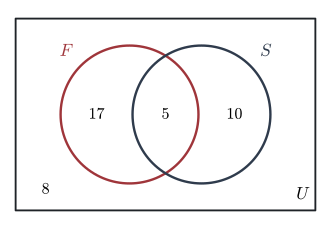
(b) \(\mathrm{P}(F \cap S') = \dfrac{17}{40}\).
(c) Given French, the sample space is the \(22\) French students: \(\;\mathrm{P}(S \mid F) = \dfrac{5}{22}\).
Example 2 \(A\) and \(B\) are events with \(\mathrm{P}(A) = 0.6\), \(\mathrm{P}(B) = 0.35\) and \(\mathrm{P}(A \cap B) = 0.2\). Find
(a) \(\mathrm{P}(A \cup B)\),
(b) \(\mathrm{P}(A \text{ but not } B)\),
(c) \(\mathrm{P}(\text{neither } A \text{ nor } B)\).
Fill in the diagram from the middle: \(A\) only \(= 0.6 - 0.2 = 0.4\), \(B\) only \(= 0.35 - 0.2 = 0.15\), neither \(= 1 - (0.4 + 0.2 + 0.15) = 0.25\).
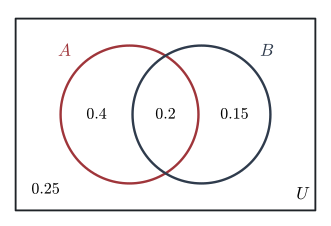
(a) \(\mathrm{P}(A \cup B) = 0.4 + 0.2 + 0.15 = 0.75\) (or \(0.6 + 0.35 - 0.2\)).
(b) \(\mathrm{P}(A \cap B') = 0.4\).
(c) \(\mathrm{P}(A' \cap B') = 0.25\).
Example 3 Ravi answers the first two questions of a quiz. The probability that his first answer is correct is \(0.7\), the probability that his second answer is correct is \(0.65\), and the probability that both are correct is \(0.5\). Find the probability that
(a) the second answer is correct, given that the first is correct,
(b) the first answer is correct and the second is wrong,
(c) the first answer is wrong and the second is correct,
(d) the second answer is wrong, given that the first is wrong.
Let \(F\) = “first correct” and \(S\) = “second correct”. The Venn diagram regions are: \(F \cap S = 0.5\); \(\;F\) only \(= 0.7 - 0.5 = 0.2\); \(\;S\) only \(= 0.65 - 0.5 = 0.15\); \(\;\)neither \(= 1 - 0.85 = 0.15\).
(a) \(\mathrm{P}(S \mid F) = \dfrac{0.5}{0.7} = \dfrac{5}{7}\).
(b) \(\mathrm{P}(F \cap S') = 0.2\).
(c) \(\mathrm{P}(F' \cap S) = 0.15\).
(d) \(\mathrm{P}(S' \mid F') = \dfrac{\mathrm{P}(F' \cap S')}{\mathrm{P}(F')} = \dfrac{0.15}{0.3} = 0.5\).
Probabilities using tree diagrams
A tree diagram is useful when there is a sequence of events, and especially when the probabilities at a later stage depend on what happened earlier.
- Each set of branches from one point shows all the possibilities, so their probabilities add to 1.
- Probabilities on the second set of branches are conditional: \(\mathrm{P}(\text{second} \mid \text{first})\).
Rules for tree diagrams
- Multiply along a path: \(\mathrm{P}(A \cap B) = \mathrm{P}(A)\,\mathrm{P}(B \mid A)\).
- Add the probabilities of different paths that give the outcome you want (the paths are mutually exclusive).
With and without replacement
When objects are chosen one after another:
- With replacement: the object is put back, so the probabilities are the same at every stage (independent events).
- Without replacement: the object is not put back, so the total goes down by \(1\) and the probabilities change at the next stage.
Example 4 A bag contains 5 orange sweets and 4 lemon sweets. Two sweets are taken at random, one after the other. Find the probability that both sweets are the same flavour if
(a) the first sweet is put back before the second is taken,
(b) the first sweet is eaten.
(c) In case (b), find the probability that at least one lemon sweet is taken.
(a) With replacement, both draws have \(\mathrm{P}(O) = \dfrac{5}{9}\) and \(\mathrm{P}(L) = \dfrac{4}{9}\):
\[ \mathrm{P}(\text{same}) = \frac{5}{9} \times \frac{5}{9} + \frac{4}{9} \times \frac{4}{9} = \frac{25 + 16}{81} = \frac{41}{81} . \]
(b) Without replacement there are only \(8\) sweets for the second draw.
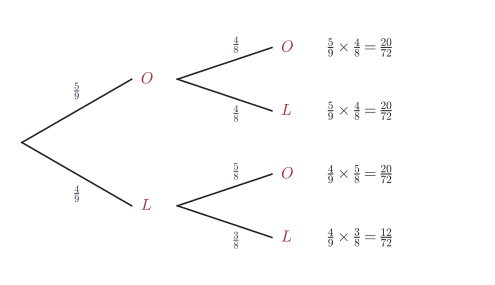
\[ \mathrm{P}(\text{same}) = \mathrm{P}(OO) + \mathrm{P}(LL) = \frac{20}{72} + \frac{12}{72} = \frac{32}{72} = \frac{4}{9} . \]
(c) \(\mathrm{P}(\text{at least one } L) = 1 - \mathrm{P}(OO) = 1 - \dfrac{20}{72} = \dfrac{52}{72} = \dfrac{13}{18}\).
Example 5 A box contains 3 blue and 7 white counters. A counter is taken at random. If it is blue, it is not replaced; if it is white, it is put back. A second counter is then taken at random. Let \(X\) be the event “the first counter is blue” and \(Y\) the event “the second counter is blue”. Find
(a) \(\mathrm{P}(X)\),
(b) \(\mathrm{P}(Y \mid X)\),
(c) \(\mathrm{P}(Y)\),
(d) the probability that exactly one of \(X\) and \(Y\) happens.
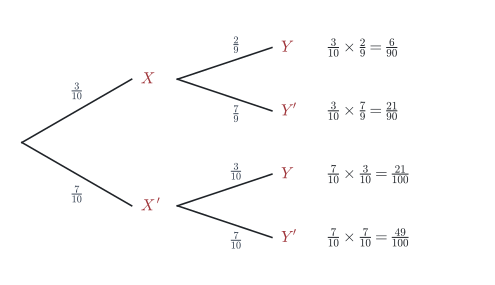
(a) \(\mathrm{P}(X) = \dfrac{3}{10}\).
(b) After a blue counter is removed, 2 blue remain out of 9: \(\;\mathrm{P}(Y \mid X) = \dfrac{2}{9}\).
(c) Add the two paths ending in \(Y\):
\[ \mathrm{P}(Y) = \frac{3}{10} \times \frac{2}{9} + \frac{7}{10} \times \frac{3}{10} = \frac{1}{15} + \frac{21}{100} = \frac{20 + 63}{300} = \frac{83}{300} . \]
(d) \(\mathrm{P}(X \cap Y') + \mathrm{P}(X' \cap Y) = \dfrac{21}{90} + \dfrac{21}{100} = \dfrac{70 + 63}{300} = \dfrac{133}{300}\).
Example 6 Ana and Ben often play a board game. When Ana starts, the probability that Ana wins is \(0.5\) and the probability that Ben wins is \(0.3\). When Ben starts, the probability that Ben wins is \(0.5\) and the probability that Ana wins is \(0.2\). A game that nobody wins is a draw.
(a) They toss a fair coin to decide who starts. Find the probability that the game is a draw.
(b) They change the way they decide who starts, so that Ana starts with probability \(p\). Find the value of \(p\) that gives Ana and Ben equal chances of winning.
The draw probabilities are \(1 - 0.5 - 0.3 = 0.2\) (Ana starts) and \(1 - 0.5 - 0.2 = 0.3\) (Ben starts).
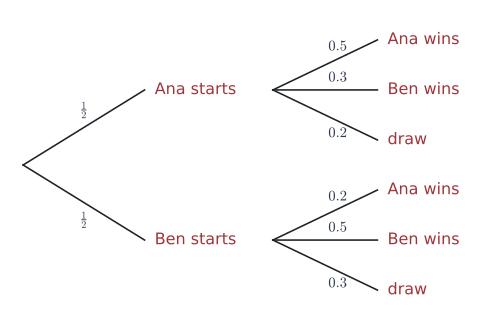
(a) \(\mathrm{P}(\text{draw}) = 0.5 \times 0.2 + 0.5 \times 0.3 = 0.25\).
(b) Now the first branches are \(p\) and \(1 - p\).
\[ \mathrm{P}(\text{Ana wins}) = 0.5p + 0.2(1 - p) = 0.2 + 0.3p \]
\[ \mathrm{P}(\text{Ben wins}) = 0.3p + 0.5(1 - p) = 0.5 - 0.2p \]
Equal chances: \(0.2 + 0.3p = 0.5 - 0.2p\), so \(0.5p = 0.3\) and \(p = 0.6\). (Check: each then wins with probability \(0.38\).)
Common errors
| ✗ Wrong | ✓ Right | Why |
|---|---|---|
| Writing \(\mathrm{P}(A) = 0.6\) in the “\(A\) only” region | Write \(\mathrm{P}(A \cap B)\) first, then \(0.6 - 0.2\) | The whole circle \(A\) is \(0.6\), not one region. |
| Forgetting the “neither” region | Values in all four regions add to 1 | The region outside the circles is part of \(U\). |
| Without replacement, second branch \(\frac{4}{9}\) again | \(\frac{4}{8}\) or \(\frac{3}{8}\) | One sweet has gone, so the denominator is \(8\). |
| Adding along a path | Multiply along, add between paths | Along a path both events happen (“and”). |
| “Same flavour” \(= \mathrm{P}(OO)\) only | \(\mathrm{P}(OO) + \mathrm{P}(LL)\) | Include every path that gives the outcome. |
Exercises
1 Of 50 people, 28 drink tea, 30 drink coffee and 6 drink neither. Draw a Venn diagram, and find the probability that a person chosen at random
(a) drinks tea but not coffee,
(b) drinks coffee, given that they drink tea.
Both: \(28 + 30 + 6 - 50 = 14\). Tea only \(14\), coffee only \(16\), neither \(6\).
(a) \(\dfrac{14}{50} = \dfrac{7}{25}\).
(b) \(\dfrac{14}{28} = \dfrac{1}{2}\).
2 \(\mathrm{P}(A) = 0.55\), \(\mathrm{P}(B) = 0.35\) and \(\mathrm{P}(A \cup B) = 0.7\). Draw a Venn diagram and find
(a) \(\mathrm{P}(A' \cap B)\), \(\qquad\) (b) \(\mathrm{P}(B \mid A')\).
\(\mathrm{P}(A \cap B) = 0.55 + 0.35 - 0.7 = 0.2\). Regions: \(A\) only \(0.35\), both \(0.2\), \(B\) only \(0.15\), neither \(0.3\).
(a) \(0.15\).
(b) \(\mathrm{P}(A') = 0.45\), so \(\mathrm{P}(B \mid A') = \dfrac{0.15}{0.45} = \dfrac{1}{3}\).
3 \(\mathrm{P}(A) = 0.45\), \(\mathrm{P}(A \cap B) = 0.15\) and \(\mathrm{P}(A \cup B) = 0.8\).
(a) Find the probabilities of the four regions of a Venn diagram.
(b) Find \(\mathrm{P}(B)\).
(c) Are \(A\) and \(B\) independent? Give a reason.
(a) \(A\) only: \(0.45 - 0.15 = 0.3\). \(\;\) Both: \(0.15\). \(\;\) \(B\) only: \(0.8 - 0.45 = 0.35\). \(\;\) Neither: \(1 - 0.8 = 0.2\).
(b) \(\mathrm{P}(B) = 0.15 + 0.35 = 0.5\).
(c) \(\mathrm{P}(A)\,\mathrm{P}(B) = 0.45 \times 0.5 = 0.225 \neq 0.15\), so they are not independent.
4 A bag contains 3 red and 7 blue beads. A bead is taken, its colour noted, and it is replaced. A second bead is then taken. Find the probability of (a) two red beads, \(\;\) (b) one bead of each colour.
(a) \(0.3 \times 0.3 = 0.09\).
(b) \(0.3 \times 0.7 + 0.7 \times 0.3 = 0.42\).
5 A box holds 8 light bulbs, of which 2 are faulty. Two bulbs are taken at random without replacement. Find the probability that
(a) both are faulty, \(\qquad\) (b) at least one is faulty.
(a) \(\dfrac{2}{8} \times \dfrac{1}{7} = \dfrac{2}{56} = \dfrac{1}{28}\).
(b) \(1 - \mathrm{P}(\text{both good}) = 1 - \dfrac{6}{8} \times \dfrac{5}{7} = 1 - \dfrac{30}{56} = \dfrac{13}{28}\).
6 A bag contains 4 red and 5 blue marbles. Three marbles are taken without replacement. Find the probability that all three are the same colour.
\[ \mathrm{P}(RRR) + \mathrm{P}(BBB) = \frac{4}{9} \cdot \frac{3}{8} \cdot \frac{2}{7} + \frac{5}{9} \cdot \frac{4}{8} \cdot \frac{3}{7} = \frac{24 + 60}{504} = \frac{84}{504} = \frac{1}{6} . \]
7 An archer shoots two arrows. The probability that the first arrow hits is \(0.7\). If an arrow hits, the probability that the next one hits is \(0.8\); if it misses, the probability that the next one hits is \(0.5\). Find
(a) the probability that the second arrow hits,
(b) the probability that the first hit, given that the second hit.
(a) \(0.7 \times 0.8 + 0.3 \times 0.5 = 0.56 + 0.15 = 0.71\).
(b) \(\dfrac{0.56}{0.71} = \dfrac{56}{71}\).
8 The probability of rain on match day is \(0.25\). A football team wins with probability \(0.4\) if it rains and \(0.6\) if it does not. Find the probability that the team does not win.
\(\mathrm{P}(\text{win}) = 0.25 \times 0.4 + 0.75 \times 0.6 = 0.1 + 0.45 = 0.55\), so \(\mathrm{P}(\text{not win}) = 0.45\).
9 Two players, \(A\) and \(B\), play a match of at most three sets; the first to win two sets wins the match. The probability that \(A\) wins the first set is \(0.6\). After \(A\) wins a set, \(A\) wins the next set with probability \(0.7\); after \(A\) loses a set, \(A\) wins the next set with probability \(0.4\). Find the probability that \(A\) wins the match.
\(A\) wins in three ways: WW, WLW, LWW.
\[ 0.6 \times 0.7 + 0.6 \times 0.3 \times 0.4 + 0.4 \times 0.4 \times 0.7 = 0.42 + 0.072 + 0.112 = 0.604 . \]
10 \(\mathrm{P}(A) = 0.5\), \(\mathrm{P}(B) = 0.4\) and \(\mathrm{P}(A \mid B) = 0.25\). Find
(a) \(\mathrm{P}(A \cap B)\),
(b) \(\mathrm{P}(A \cup B)\),
(c) \(\mathrm{P}(B \mid A)\).
(a) \(0.4 \times 0.25 = 0.1\).
(b) \(0.5 + 0.4 - 0.1 = 0.8\).
(c) \(\dfrac{0.1}{0.5} = 0.2\).