16.1 The Language of Probability
SL 4.5
- what a probability measures, and the probability scale from \(0\) to \(1\)
- the words trial, outcome, sample space \(U\) and event
- set notation for events: \(A \cup B\), \(A \cap B\), \(A'\), and mutually exclusive events
- theoretical probability for equally likely outcomes, \(\mathrm{P}(A) = \dfrac{n(A)}{n(U)}\)
- how to use sample space diagrams (lists and tables) to find probabilities
- relative frequency, and the expected number of outcomes \(np\)
- the basic rules of probability, including \(\mathrm{P}(A') = 1 - \mathrm{P}(A)\)
Introduction
Probability began with questions about games of chance. In the 1600s, letters between mathematicians about a dice game started the modern theory. Today probability is used in insurance, medicine, genetics, weather forecasting, quality control and many other areas.
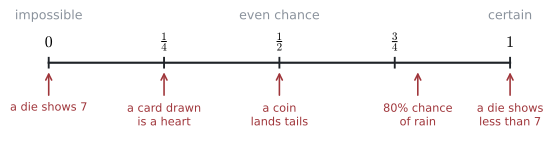
The probability of an event is a number that measures how likely the event is to happen. It is always between \(0\) and \(1\). It can be written as a fraction, a decimal or a percentage.
- A probability of \(0\) means the event is impossible.
- A probability of \(1\) (or \(100\%\)) means the event is certain.
- Every other event has a probability between \(0\) and \(1\). A probability of \(\frac{1}{2}\) is an “even chance”.
Terminology
Trials and outcomes
A random experiment (or trial) is an action whose result depends on chance, for example tossing a coin, rolling a die or choosing a card. We can repeat a trial many times under the same conditions. We cannot say what one particular result will be, but we can list all the possible results. Each possible result is an outcome.
When a trial is repeated many times, the results look random in the short run, but a clear pattern appears in the long run.
Sample space
Sample space Not in the formula booklet
The sample space \(U\) is the set of all possible outcomes of a trial. Each member of \(U\) is one outcome (also called a sample point).
(Some books use \(S\) for the sample space. The IB uses \(U\), like the universal set in set notation.)
| Trial | Sample space \(U\) |
|---|---|
| Spin a spinner with 5 equal sectors coloured red, blue, green, yellow, white | \(\{\text{R}, \text{B}, \text{G}, \text{Y}, \text{W}\}\) |
| Toss a coin three times | \(\{\text{HHH}, \text{HHT}, \text{HTH}, \text{THH}, \text{HTT}, \text{THT}, \text{TTH}, \text{TTT}\}\) |
| Roll a die until a 6 appears; record the number of rolls | \(\{1, 2, 3, 4, \ldots\}\) (infinite) |
| Measure the time, in hours, until a phone battery runs out | \(\{t : t \in \mathbb{R},\ t \geq 0\}\) |
Events
Event Not in the formula booklet
An event is a subset of the sample space: a collection of some of the outcomes.
For example, toss a coin three times and let \(A\) be the event “at least two tails”. Then
\[ A = \{\text{TTH}, \text{THT}, \text{HTT}, \text{TTT}\} \subseteq U . \]
The symbol \(\subseteq\) means “is a subset of”: \(A \subseteq U\) says that every outcome in \(A\) is also in \(U\).
The whole sample space \(U\) is a certain event, and the empty set \(\varnothing\) is an impossible event.
Combining events
Because events are sets, we use set notation. If \(A\) and \(B\) are events of the same trial:
| Notation | Read as | The event happens when … |
|---|---|---|
| \(A \cup B\) | “\(A\) union \(B\)” | \(A\) or \(B\) or both happen |
| \(A \cap B\) | “\(A\) intersection \(B\)” | \(A\) and \(B\) both happen |
| \(A'\) | “\(A\) complement” or “not \(A\)” | \(A\) does not happen |
Mutually exclusive events Not in the formula booklet
\(A\) and \(B\) are mutually exclusive if they cannot happen at the same time, that is
\[ A \cap B = \varnothing . \]
- \(A\), \(B\): two events
- \(A \cap B\): the event “\(A\) and \(B\)” (both happen)
- \(\varnothing\): the empty set (no outcomes)
Example 1 Let \(U = \{x : x \in \mathbb{Z},\ 20 < x < 36\}\) and define the events
\[ \begin{gathered} A = \{x : x \text{ is a prime number}\}, \\ B = \{x : x \text{ is a multiple of } 4\}, \\ C = \{x : 2x - 5 > 50\} . \end{gathered} \]
(a) Find \(n(B \cap C)\). \(\qquad\) (b) Find \(A \cap B\). \(\qquad\)
(c) List the elements \(x\) such that \(x \in (B \cup C)'\) and \(x \notin A\).
First list each set. \(U = \{21, 22, 23, \ldots, 35\}\).
- \(A = \{23, 29, 31\}\)
- \(B = \{24, 28, 32\}\)
- \(2x - 5 > 50 \Rightarrow x > 27.5\), so \(C = \{28, 29, 30, 31, 32, 33, 34, 35\}\)
(a) \(B \cap C = \{28, 32\}\), so \(n(B \cap C) = 2\).
(b) No prime is a multiple of 4, so \(A \cap B = \varnothing\). (The events \(A\) and \(B\) are mutually exclusive.)
(c) \(B \cup C = \{24, 28, 29, 30, 31, 32, 33, 34, 35\}\), so \((B \cup C)' = \{21, 22, 23, 25, 26, 27\}\). Remove the prime \(23\): the elements are \(21, 22, 25, 26, 27\).
Theoretical probability
If all the outcomes in \(U\) are equally likely, we can find a probability by counting.
Probability of an event \(A\) (equally likely outcomes) In the formula booklet
\[ \mathrm{P}(A) = \frac{n(A)}{n(U)} \]
- \(\mathrm{P}(A)\): the probability of the event \(A\)
- \(n(A)\): the number of outcomes in \(A\)
- \(n(U)\): the total number of outcomes in the sample space \(U\)
Since \(0 \leq n(A) \leq n(U)\), it follows that \(0 \leq \mathrm{P}(A) \leq 1\).
- A fair spinner has 8 equal sectors numbered 1 to 8. \(\;\mathrm{P}(\text{multiple of } 3) = \dfrac{n(\{3, 6\})}{8} = \dfrac{2}{8} = \dfrac{1}{4}\).
- Toss a fair coin three times (8 outcomes, listed above). \(\;\mathrm{P}(\text{exactly two heads}) = \dfrac{n(\{\text{HHT}, \text{HTH}, \text{THH}\})}{8} = \dfrac{3}{8}\).
Words such as “fair”, “unbiased” and “at random” tell you that the outcomes are equally likely.
Sample space diagrams
When a trial has two stages (two dice, two spinners, a coin and a die, …), a table of outcomes shows the whole sample space at once. This is a sample space diagram.
Example 2 Two fair six-sided dice are rolled. Find the probability that
(a) the sum is \(8\),
(b) the sum is less than \(6\),
(c) the sum is at least \(10\),
(d) the product is odd,
(e) the product is greater than \(12\),
(f) the product is at most \(8\).
There are \(6 \times 6 = 36\) equally likely outcomes. Make one table for the sums and one for the products.
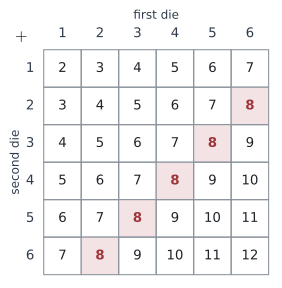
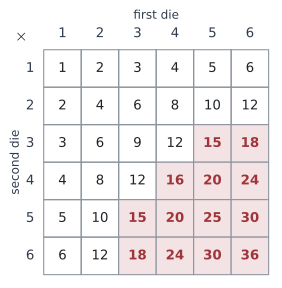
(a) The sum is \(8\) in \(5\) cells (Figure 2): \(\;\mathrm{P} = \dfrac{5}{36}\).
(b) Sums \(2, 3, 4, 5\) appear \(1 + 2 + 3 + 4 = 10\) times: \(\;\mathrm{P} = \dfrac{10}{36} = \dfrac{5}{18}\).
(c) Sums \(10, 11, 12\) appear \(3 + 2 + 1 = 6\) times: \(\;\mathrm{P} = \dfrac{6}{36} = \dfrac{1}{6}\).
(d) The product is odd only when both dice are odd: \(3 \times 3 = 9\) cells. \(\;\mathrm{P} = \dfrac{9}{36} = \dfrac{1}{4}\).
(e) Count the shaded cells in Figure 3: \(13\). \(\;\mathrm{P} = \dfrac{13}{36}\).
(f) Products \(\leq 8\): row by row (second die \(1\) to \(6\)) there are \(6, 4, 2, 2, 1, 1\) cells, a total of \(16\). \(\;\mathrm{P} = \dfrac{16}{36} = \dfrac{4}{9}\).
For a trial with more stages, you can often count the outcomes instead of listing them, using the multiplication principle from Unit 5.
Example 3 Three cards are taken at random, one after another and without replacement, from an ordinary pack of 52 playing cards (26 red and 26 black). Find the probability that all three cards are the same colour.
Count ordered selections of three cards.
\[ n(U) = 52 \times 51 \times 50 . \]
For “all the same colour”: the first card can be any card (\(52\) ways). The second must match its colour (\(25\) cards left of that colour), and the third too (\(24\) left).
\[ n(A) = 52 \times 25 \times 24 . \]
\[ \mathrm{P}(A) = \frac{52 \times 25 \times 24}{52 \times 51 \times 50} = \frac{600}{2550} = \frac{4}{17} . \]
Relative frequency
Sometimes the outcomes are not equally likely (a bent coin, a drawing pin, a real person’s behaviour). Then we estimate the probability from an experiment or from data.
Relative frequency Not in the formula booklet
If a trial is repeated \(n\) times and the event \(A\) happens \(f\) times, then
\[ \mathrm{P}(A) \approx \frac{f}{n} = \frac{\text{number of times } A \text{ happened}}{\text{number of trials}} . \]
The larger \(n\) is, the better the estimate usually is.
For example, a hospital records \(3200\) births in one year, and \(40\) of them are twin births. An estimate of the probability of a twin birth is \(\dfrac{40}{3200} = \dfrac{1}{80}\).
Expected number of outcomes
If the probability of an event is \(p\) and the trial is repeated \(n\) times, we expect the event to happen about \(np\) times.
Expected number of occurrences Not in the formula booklet
\[ \text{expected number} = n \times p \]
The answer does not have to be a whole number. It is an average, not a prediction of one result.
- \(n\): the number of trials
- \(p\): the probability of the event in one trial
Example 4 (a) A die is suspected to be biased. It is rolled \(500\) times and shows a six \(140\) times. Estimate the probability of a six, and find the expected number of sixes in \(75\) more rolls.
(b) The probability that a seed germinates is \(0.85\). A gardener plants \(240\) seeds. Find the expected number that germinate.
(c) A fair die is rolled \(50\) times. Find the expected number of fives.
(a) Relative frequency: \(\mathrm{P}(\text{six}) \approx \dfrac{140}{500} = 0.28\). Expected number of sixes in \(75\) rolls: \(75 \times 0.28 = 21\).
(For a fair die we would expect only \(75 \times \frac{1}{6} = 12.5\), so the die probably is biased.)
(b) \(240 \times 0.85 = 204\) seeds.
(c) \(50 \times \dfrac{1}{6} = \dfrac{25}{3} \approx 8.33\). This is not a whole number, and that is fine.
Basic rules of probability
For any events \(A\) and \(B\) in a sample space \(U\):
Basic results Partly in the formula booklet
- \(\mathrm{P}(U) = 1\) and \(\mathrm{P}(\varnothing) = 0\)
- \(0 \leq \mathrm{P}(A) \leq 1\)
- Complementary events: \(\mathrm{P}(A) + \mathrm{P}(A') = 1\), so \(\mathrm{P}(A') = 1 - \mathrm{P}(A)\) In the booklet
- If \(A \subseteq B\), then \(\mathrm{P}(A) \leq \mathrm{P}(B)\)
- \(U\): the sample space
- \(\varnothing\): the empty set (an impossible event)
- \(A\), \(B\): events
- \(A'\): the complement of \(A\) (“not \(A\)”)
- \(A \subseteq B\): every outcome in \(A\) is also in \(B\)
The complement rule is very useful for “at least one” questions: \(\mathrm{P}(\text{at least one}) = 1 - \mathrm{P}(\text{none})\). For example, with two dice, \(\mathrm{P}(\text{at least one six}) = 1 - \dfrac{25}{36} = \dfrac{11}{36}\).
The rules for \(\mathrm{P}(A \cup B)\) and \(\mathrm{P}(A \cap B)\) are in Section 16.2. The next example uses the same idea with counting: when you add \(n(A)\) and \(n(B)\), the outcomes in both are counted twice, so subtract them once.
\[ n(A \cup B) = n(A) + n(B) - n(A \cap B) \]
Example 5 A whole number is chosen at random from \(1, 2, 3, \ldots, 400\). Find the probability that it is a multiple of \(4\) or a multiple of \(6\).
Let \(A\) = “multiple of 4” and \(B\) = “multiple of 6”.
- \(n(A) = \dfrac{400}{4} = 100\)
- \(n(B) = 66\) (since \(6 \times 66 = 396\))
- \(A \cap B\) = multiples of \(12\) (the lowest common multiple): \(n(A \cap B) = 33\) (since \(12 \times 33 = 396\))
\[ n(A \cup B) = 100 + 66 - 33 = 133, \qquad \mathrm{P}(A \cup B) = \frac{133}{400} . \]
Common errors
| ✗ Wrong | ✓ Right | Why |
|---|---|---|
| Two dice: sample space \(\{2, 3, \ldots, 12\}\), so \(\mathrm{P}(\text{sum } 8) = \frac{1}{11}\) | \(\frac{5}{36}\) | The 11 sums are not equally likely. Use the 36 equally likely ordered pairs. |
| Counting \((2, 6)\) and \((6, 2)\) as one outcome | Two different outcomes | The dice are different (first and second); a table shows both. |
| Multiples of 4 or 6: \(100 + 66 = 166\) | \(100 + 66 - 33 = 133\) | Multiples of 12 were counted twice. |
| “Expected number \(= 8.33\), so round to \(8\)” | Leave it as \(8.33\) | An expected value is an average; it need not be a whole number. |
| \(\mathrm{P}(A) = 1.2\) | Check your working | A probability can never be greater than \(1\) or less than \(0\). |
Exercises
1 A fair spinner has 10 equal sectors numbered \(1\) to \(10\). Find the probability that the score is
(a) a prime number, \(\qquad\) (b) not a multiple of \(4\).
(a) Primes: \(2, 3, 5, 7\). \(\;\mathrm{P} = \dfrac{4}{10} = \dfrac{2}{5}\).
(b) Multiples of 4: \(4, 8\). \(\;\mathrm{P} = 1 - \dfrac{2}{10} = \dfrac{4}{5}\).
2 A fair coin is tossed three times. Find the probability of
(a) at least two heads,
(b) no tails,
(c) the same result on all three tosses.
\(U = \{\text{HHH}, \text{HHT}, \text{HTH}, \text{THH}, \text{HTT}, \text{THT}, \text{TTH}, \text{TTT}\}\), 8 outcomes.
(a) HHH, HHT, HTH, THH: \(\;\dfrac{4}{8} = \dfrac{1}{2}\).
(b) Only HHH: \(\;\dfrac{1}{8}\).
(c) HHH or TTT: \(\;\dfrac{2}{8} = \dfrac{1}{4}\).
3 Let \(U = \{1, 2, 3, \ldots, 15\}\), \(A = \{\text{odd numbers}\}\) and \(B = \{\text{multiples of } 3\}\).
(a) List \(A \cap B\).
(b) Find \(n(A \cup B)\).
(c) A number is chosen at random from \(U\). Find \(\mathrm{P}(A' \cap B')\).
\(A = \{1, 3, 5, 7, 9, 11, 13, 15\}\), \(B = \{3, 6, 9, 12, 15\}\).
(a) \(A \cap B = \{3, 9, 15\}\).
(b) \(n(A \cup B) = 8 + 5 - 3 = 10\).
(c) \(A' \cap B' = (A \cup B)'\) has \(15 - 10 = 5\) elements (\(2, 4, 8, 10, 14\)). \(\;\mathrm{P} = \dfrac{5}{15} = \dfrac{1}{3}\).
4 Two fair six-sided dice are rolled. Use a sample space diagram to find the probability that
(a) the sum is \(9\),
(b) at least one die shows a six,
(c) the two scores differ by \(2\).
(a) \((3,6), (4,5), (5,4), (6,3)\): \(\;\dfrac{4}{36} = \dfrac{1}{9}\).
(b) \(1 - \mathrm{P}(\text{no six}) = 1 - \dfrac{25}{36} = \dfrac{11}{36}\).
(c) \((1,3), (2,4), (3,5), (4,6)\) and the reverse of each: \(8\) outcomes. \(\;\dfrac{8}{36} = \dfrac{2}{9}\).
5 One letter is chosen at random from the word PROBABILITY. Find the probability that it is
(a) a B, \(\qquad\) (b) a vowel, \(\qquad\) (c) not an I.
The word has 11 letters: P, R, O, B, A, B, I, L, I, T, Y.
(a) Two B’s: \(\dfrac{2}{11}\).
(b) O, A, I, I: \(\dfrac{4}{11}\).
(c) \(1 - \dfrac{2}{11} = \dfrac{9}{11}\).
6 A bag contains only red, green and blue counters. A counter is taken at random. \(\mathrm{P}(\text{red}) = 0.35\) and \(\mathrm{P}(\text{green}) = 0.4\). There are \(10\) blue counters. Find the number of red counters in the bag.
\(\mathrm{P}(\text{blue}) = 1 - 0.35 - 0.4 = 0.25\). So \(0.25 \times (\text{total}) = 10\) and the total is \(40\).
Red counters: \(0.35 \times 40 = 14\).
7 A drawing pin is dropped \(400\) times. It lands point up \(252\) times.
(a) Estimate the probability that it lands point up.
(b) The pin is dropped another \(1500\) times. How many times would you expect it to land point up?
(a) \(\dfrac{252}{400} = 0.63\).
(b) \(1500 \times 0.63 = 945\) times.
8 The probability that a school bus is late on a given day is \(0.08\). Find the expected number of days on which the bus is late in a school year of \(185\) days.
\(185 \times 0.08 = 14.8\) days.
9 Two cards are taken at random, one after the other and without replacement, from an ordinary pack of 52 cards. Find the probability that
(a) both are aces, \(\qquad\) (b) both are red.
Ordered selections: \(n(U) = 52 \times 51 = 2652\).
(a) \(n = 4 \times 3 = 12\), so \(\mathrm{P} = \dfrac{12}{2652} = \dfrac{1}{221}\).
(b) \(n = 26 \times 25 = 650\), so \(\mathrm{P} = \dfrac{650}{2652} = \dfrac{25}{102}\).
10 A whole number is chosen at random from \(1\) to \(250\) inclusive. Find the probability that it is a multiple of \(5\) or a multiple of \(7\).
Multiples of 5: \(50\). Multiples of 7: \(35\) (\(7 \times 35 = 245\)). Multiples of 35: \(7\) (\(35 \times 7 = 245\)).
\(n = 50 + 35 - 7 = 78\), so \(\mathrm{P} = \dfrac{78}{250} = \dfrac{39}{125}\).