14.9 Reciprocal and Inverse Trigonometric Functions
AHL 3.9
- the definitions of the reciprocal trigonometric functions \(\sec\theta\), \(\mathrm{cosec}\,\theta\) and \(\cot\theta\)
- how to find exact values of \(\sec\), \(\mathrm{cosec}\) and \(\cot\)
- the graphs of \(y = \mathrm{cosec}\,x\), \(y = \sec x\) and \(y = \cot x\)
- the inverse trigonometric functions \(\arcsin x\), \(\arccos x\) and \(\arctan x\): their domains, ranges and graphs
Cosecant, secant and cotangent
We already have three trigonometric functions, \(\sin\theta\), \(\cos\theta\) and \(\tan\theta\), for any angle \(\theta\). Their reciprocals (\(1\) divided by them) give three more functions: the cosecant, the secant and the cotangent.
Reciprocal trigonometric functions Partly in the HL formula booklet
\[ \sec\theta = \frac{1}{\cos\theta}, \;\; \cos\theta \neq 0 \qquad \mathrm{cosec}\,\theta = \frac{1}{\sin\theta}, \;\; \sin\theta \neq 0 \]
In the HL booklet
\[ \cot\theta = \frac{1}{\tan\theta} = \frac{\cos\theta}{\sin\theta}, \;\; \sin\theta \neq 0 \]
- \(\theta\): an angle (usually in radians)
- \(\sec\): secant; \(\;\mathrm{cosec}\): cosecant; \(\;\cot\): cotangent
You must know \(\cot\theta\) (AHL 3.9 gives only \(\sec\theta\) and \(\mathrm{cosec}\,\theta\)).
Some books and calculators write \(\csc\theta\) instead of \(\mathrm{cosec}\,\theta\).
To remember which is which, look at the third letter: sec goes with cos, and cosec goes with sin.
Notice that \(\cot\theta = \dfrac{\cos\theta}{\sin\theta}\) is defined when \(\tan\theta\) is not. For example, \(\cot\dfrac{\pi}{2} = \dfrac{0}{1} = 0\).
Example 1 Without using a calculator, find the exact values of \(\mathrm{cosec}\dfrac{4\pi}{3}\), \(\;\sec\dfrac{4\pi}{3}\) and \(\cot\dfrac{4\pi}{3}\).
\(\dfrac{4\pi}{3}\) is in the third quadrant, with reference angle \(\dfrac{\pi}{3}\) (see Section 14.6). Sine and cosine are negative there, and tangent is positive:
\[ \sin\frac{4\pi}{3} = -\frac{\sqrt{3}}{2}, \qquad \cos\frac{4\pi}{3} = -\frac{1}{2}, \qquad \tan\frac{4\pi}{3} = \sqrt{3} . \]
So
\[ \mathrm{cosec}\,\frac{4\pi}{3} = -\frac{2}{\sqrt{3}} = -\frac{2\sqrt{3}}{3}, \qquad \sec\frac{4\pi}{3} = -2, \qquad \cot\frac{4\pi}{3} = \frac{1}{\sqrt{3}} = \frac{\sqrt{3}}{3} . \]
A reciprocal always has the same sign as the original function.
Example 2 (a) Find the exact values of \(\mathrm{cosec}\left(-\dfrac{\pi}{4}\right)\), \(\;\sec\left(-\dfrac{\pi}{4}\right)\) and \(\cot\left(-\dfrac{\pi}{4}\right)\).
(b) Which of \(\mathrm{cosec}\,\pi\), \(\;\sec\pi\) and \(\cot\pi\) are defined? Find the values of those that are.
(a) \(\sin\left(-\dfrac{\pi}{4}\right) = -\dfrac{\sqrt{2}}{2}\), \(\;\cos\left(-\dfrac{\pi}{4}\right) = \dfrac{\sqrt{2}}{2}\), \(\;\tan\left(-\dfrac{\pi}{4}\right) = -1\). So
\[ \mathrm{cosec}\left(-\frac{\pi}{4}\right) = -\sqrt{2}, \quad \sec\left(-\frac{\pi}{4}\right) = \sqrt{2}, \quad \cot\left(-\frac{\pi}{4}\right) = -1 . \]
(b) \(\sin\pi = 0\) and \(\cos\pi = -1\).
- \(\mathrm{cosec}\,\pi = \dfrac{1}{0}\): not defined.
- \(\sec\pi = \dfrac{1}{-1} = -1\).
- \(\cot\pi = \dfrac{\cos\pi}{\sin\pi} = \dfrac{-1}{0}\): not defined.
- Check that the screen shows RAD at the top right (click on it to switch if it shows DEG).
- On a Calculator page, type the reciprocal directly, for example
1/cos(4π/3), and press enter. This gives \(-2\). - In the same way, use
1/sin(…)for \(\mathrm{cosec}\) and1/tan(…)(orcos(…)/sin(…)) for \(\cot\). - The trig key also offers
sec,cscandcot. Do not use thesin⁻¹key for cosec: that is the inverse function arcsin.
Reciprocal trigonometric functions
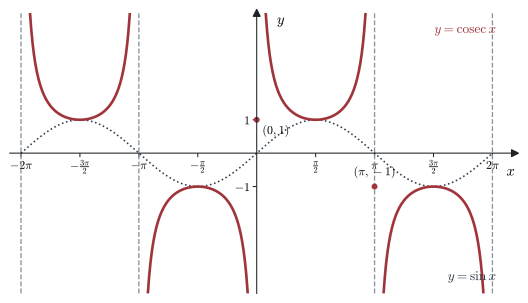
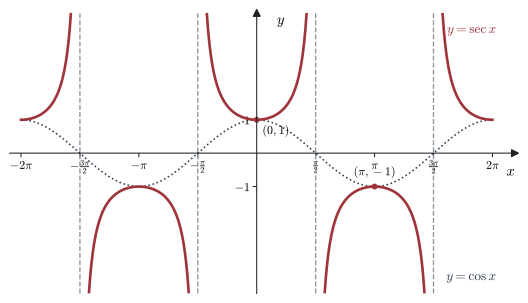
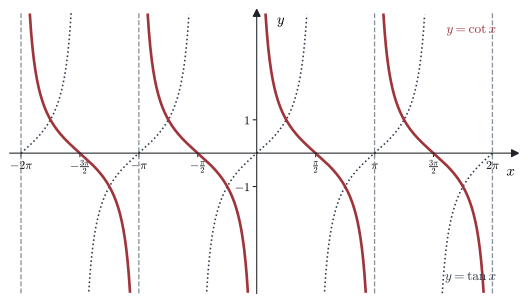
We sketch \(y = \mathrm{cosec}\,x\), \(y = \sec x\) and \(y = \cot x\) from the graphs of \(\sin x\), \(\cos x\) and \(\tan x\), using the method for \(y = \dfrac{1}{f(x)}\) from Section 12.5.
Sketching \(y = \dfrac{1}{f(x)}\) from \(y = f(x)\)
- A zero of \(f\) gives a vertical asymptote of \(\frac{1}{f}\).
- Where \(f(x) = 1\) or \(f(x) = -1\), the reciprocal has the same value; a maximum of \(f\) becomes a minimum of \(\frac{1}{f}\), and the other way round.
- \(\frac{1}{f}\) has the same sign as \(f\).
- Where \(|f(x)|\) is large, \(\left|\frac{1}{f(x)}\right|\) is small, and where \(|f(x)|\) is small, \(\left|\frac{1}{f(x)}\right|\) is large.
Example 3 Sketch the following graphs for \(-2\pi \le x \le 2\pi\).
(a) \(y = \mathrm{cosec}\,x\)
(b) \(y = \sec x\)
(c) \(y = \cot x\)
(a) Start from \(y = \sin x\) (dotted). Its zeros \(x = 0, \pm\pi, \pm 2\pi\) become asymptotes. The maxima \(\left(\frac{\pi}{2}, 1\right)\), \(\left(-\frac{3\pi}{2}, 1\right)\) become minima of the “U” branches, and the minima \(\left(-\frac{\pi}{2}, -1\right)\), \(\left(\frac{3\pi}{2}, -1\right)\) become maxima of the “∩” branches.
(b) Start from \(y = \cos x\) (dotted). Its zeros \(x = \pm\frac{\pi}{2}, \pm\frac{3\pi}{2}\) become asymptotes. The graph touches \(y = 1\) at \(x = 0, \pm 2\pi\) and \(y = -1\) at \(x = \pm\pi\).
(c) Start from \(y = \tan x\) (dotted). Where \(\tan x = 0\) (\(x = 0, \pm\pi, \pm 2\pi\)), \(\cot x\) has asymptotes. Where \(\tan x\) has asymptotes (\(x = \pm\frac{\pi}{2}, \pm\frac{3\pi}{2}\)), \(\cot x = 0\). The two graphs cross where \(\tan x = \pm 1\). Every branch of \(y = \cot x\) decreases.
Key features of the reciprocal functions Not in the formula booklet
| Function | Domain | Range | Period | Vertical asymptotes |
|---|---|---|---|---|
| \(y = \mathrm{cosec}\,x\) | \(x \neq k\pi\) | \(y \le -1\) or \(y \ge 1\) | \(2\pi\) | \(x = k\pi\) |
| \(y = \sec x\) | \(x \neq \frac{\pi}{2} + k\pi\) | \(y \le -1\) or \(y \ge 1\) | \(2\pi\) | \(x = \frac{\pi}{2} + k\pi\) |
| \(y = \cot x\) | \(x \neq k\pi\) | \(y \in \mathbb{R}\) | \(\pi\) | \(x = k\pi\) |
- \(k\): any integer (\(k \in \mathbb{Z}\))
Inverse trigonometric functions
Suppose we want to solve \(\sin x = \dfrac{1}{2}\). To get \(x\) on its own we need the inverse of the sine function. It is called arcsine, written \(\arcsin x\) (on calculators \(\sin^{-1}\)).
But \(\sin x\) is a many-to-one function: many values of \(x\) give \(\sin x = \frac{1}{2}\). A function must be one-to-one to have an inverse (Section 9.3). So we restrict the domain to a piece of the graph where every \(y\)-value appears once.
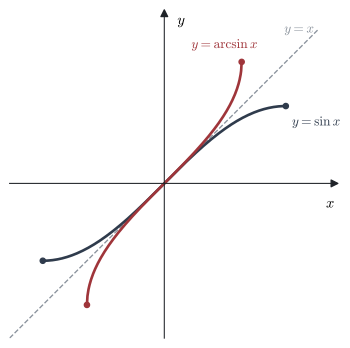
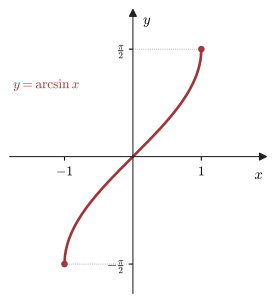
For sine we use \(-\dfrac{\pi}{2} \le x \le \dfrac{\pi}{2}\). On this interval sine is increasing and takes every value from \(-1\) to \(1\) exactly once. As for any inverse function, the graph of \(y = \arcsin x\) is the reflection of this piece in the line \(y = x\).
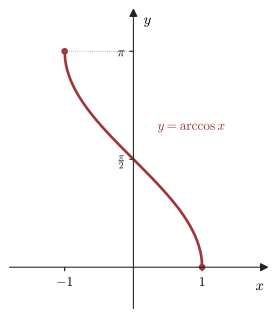
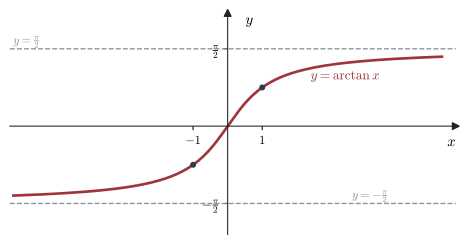
In the same way we use \(0 \le x \le \pi\) for cosine, and \(-\dfrac{\pi}{2} < x < \dfrac{\pi}{2}\) for tangent.
The inverse trigonometric functions Not in the formula booklet
| Function | Definition | Domain | Range |
|---|---|---|---|
| \(y = \arcsin x\) | \(x = \sin y\) | \(-1 \le x \le 1\) | \(-\frac{\pi}{2} \le y \le \frac{\pi}{2}\) |
| \(y = \arccos x\) | \(x = \cos y\) | \(-1 \le x \le 1\) | \(0 \le y \le \pi\) |
| \(y = \arctan x\) | \(x = \tan y\) | \(x \in \mathbb{R}\) | \(-\frac{\pi}{2} < y < \frac{\pi}{2}\) |
- \(x\): the value of the sine, cosine or tangent
- \(y\): the angle (in radians) that has this value; it must lie in the range shown
The value given by an inverse function is called the principal value:
\[ -\frac{\pi}{2} \le \arcsin x \le \frac{\pi}{2}, \qquad 0 \le \arccos x \le \pi, \qquad -\frac{\pi}{2} < \arctan x < \frac{\pi}{2} . \]
Be careful with the notation: \(\sin^{-1}x\) means \(\arcsin x\). It does not mean \(\dfrac{1}{\sin x}\), which is \(\mathrm{cosec}\,x\).
Example 4 Sketch the graphs of the following functions. State the coordinates of the end points, and any asymptotes.
(a) \(y = \arcsin x\)
(b) \(y = \arccos x\)
(c) \(y = \arctan x\)
(a) Reflect \(y = \sin x\), \(-\frac{\pi}{2} \le x \le \frac{\pi}{2}\), in \(y = x\). End points \(\left(-1, -\frac{\pi}{2}\right)\) and \(\left(1, \frac{\pi}{2}\right)\); it passes through the origin and is increasing.
(b) Reflect \(y = \cos x\), \(0 \le x \le \pi\), in \(y = x\). End points \((-1, \pi)\) and \((1, 0)\); it crosses the \(y\)-axis at \(\left(0, \frac{\pi}{2}\right)\) and is decreasing.
(c) Reflect \(y = \tan x\), \(-\frac{\pi}{2} < x < \frac{\pi}{2}\), in \(y = x\). The vertical asymptotes \(x = \pm\frac{\pi}{2}\) become horizontal asymptotes \(y = \pm\frac{\pi}{2}\). It passes through \(\left(-1, -\frac{\pi}{4}\right)\), \((0, 0)\) and \(\left(1, \frac{\pi}{4}\right)\), and is increasing. There are no end points: the domain is \(\mathbb{R}\).
Example 5 Find the exact value of
(a) \(\arcsin\left(-\dfrac{\sqrt{3}}{2}\right)\)
(b) \(\arccos\left(-\dfrac{1}{2}\right)\)
(c) \(\arctan\left(\dfrac{\sqrt{3}}{3}\right)\)
(d) \(\arcsin\left(\sin\dfrac{5\pi}{6}\right)\)
(e) \(\cos\left(\arcsin\dfrac{3}{5}\right)\)
(a) We need \(y\) in \(\left[-\frac{\pi}{2}, \frac{\pi}{2}\right]\) with \(\sin y = -\frac{\sqrt{3}}{2}\): \(\;y = -\dfrac{\pi}{3}\).
(b) We need \(y\) in \([0, \pi]\) with \(\cos y = -\frac{1}{2}\). The reference angle is \(\frac{\pi}{3}\) and cosine is negative in the second quadrant: \(y = \pi - \dfrac{\pi}{3} = \dfrac{2\pi}{3}\). (Not \(-\frac{\pi}{3}\): it is outside the range of \(\arccos\).)
(c) \(\tan\dfrac{\pi}{6} = \dfrac{1}{\sqrt{3}} = \dfrac{\sqrt{3}}{3}\), so the answer is \(\dfrac{\pi}{6}\).
(d) \(\sin\dfrac{5\pi}{6} = \dfrac{1}{2}\), so the answer is \(\arcsin\dfrac{1}{2} = \dfrac{\pi}{6}\). The answer is not \(\frac{5\pi}{6}\), because \(\frac{5\pi}{6}\) is outside \(\left[-\frac{\pi}{2}, \frac{\pi}{2}\right]\).
(e) Let \(\theta = \arcsin\dfrac{3}{5}\). Then \(\sin\theta = \dfrac{3}{5}\) and \(0 < \theta < \dfrac{\pi}{2}\), so \(\cos\theta > 0\). Draw a right-angled triangle with opposite side \(3\) and hypotenuse \(5\). The adjacent side is \(\sqrt{25 - 9} = 4\), so
\[ \cos\left(\arcsin\frac{3}{5}\right) = \frac{4}{5} . \]
Common errors
| ✗ Wrong | ✓ Right | Why |
|---|---|---|
| \(\sec x = \dfrac{1}{\sin x}\) | \(\sec x = \dfrac{1}{\cos x}\) | Third letter: sec ↔︎ cos, cosec ↔︎ sin. |
| \(\sin^{-1}x = \dfrac{1}{\sin x}\) | \(\sin^{-1}x = \arcsin x\); \(\;(\sin x)^{-1} = \mathrm{cosec}\,x\) | The \(^{-1}\) on the function name means the inverse function. |
| \(\cot\frac{\pi}{2}\) is undefined | \(\cot\frac{\pi}{2} = \frac{0}{1} = 0\) | Use \(\cot x = \frac{\cos x}{\sin x}\) when \(\tan x\) is undefined. |
| \(\arccos\left(-\frac{1}{2}\right) = -\frac{\pi}{3}\) | \(\arccos\left(-\frac{1}{2}\right) = \frac{2\pi}{3}\) | The range of \(\arccos\) is \(0 \le y \le \pi\). |
| \(\arcsin\left(\sin\frac{5\pi}{6}\right) = \frac{5\pi}{6}\) | \(= \frac{\pi}{6}\) | \(\arcsin\) always gives an angle in \(\left[-\frac{\pi}{2}, \frac{\pi}{2}\right]\). |
| The domain of \(\arcsin x\) is \(\mathbb{R}\) | It is \(-1 \le x \le 1\) | \(\sin y\) is never greater than \(1\) or less than \(-1\). |
Exercises
1 Find the exact values of \(\mathrm{cosec}\dfrac{\pi}{6}\), \(\;\sec\dfrac{\pi}{4}\) and \(\cot\dfrac{\pi}{3}\).
\(\mathrm{cosec}\dfrac{\pi}{6} = 1 \div \dfrac{1}{2} = 2\), \(\;\sec\dfrac{\pi}{4} = \dfrac{2}{\sqrt{2}} = \sqrt{2}\), \(\;\cot\dfrac{\pi}{3} = \dfrac{1}{\sqrt{3}} = \dfrac{\sqrt{3}}{3}\).
2 Find the exact values of \(\sec\dfrac{5\pi}{6}\), \(\;\mathrm{cosec}\dfrac{3\pi}{2}\) and \(\cot\left(-\dfrac{2\pi}{3}\right)\).
\(\cos\dfrac{5\pi}{6} = -\dfrac{\sqrt{3}}{2}\), so \(\sec\dfrac{5\pi}{6} = -\dfrac{2}{\sqrt{3}} = -\dfrac{2\sqrt{3}}{3}\).
\(\sin\dfrac{3\pi}{2} = -1\), so \(\mathrm{cosec}\dfrac{3\pi}{2} = -1\).
\(-\dfrac{2\pi}{3}\) is in the third quadrant, where tangent is positive: \(\tan\left(-\dfrac{2\pi}{3}\right) = \sqrt{3}\), so \(\cot\left(-\dfrac{2\pi}{3}\right) = \dfrac{\sqrt{3}}{3}\).
3 Which of these are defined? Give the value of each one that is defined.
(a) \(\sec\dfrac{3\pi}{2}\)
(b) \(\mathrm{cosec}(-\pi)\)
(c) \(\cot\dfrac{3\pi}{2}\)
(a) \(\cos\dfrac{3\pi}{2} = 0\): not defined.
(b) \(\sin(-\pi) = 0\): not defined.
(c) \(\cot\dfrac{3\pi}{2} = \dfrac{\cos\frac{3\pi}{2}}{\sin\frac{3\pi}{2}} = \dfrac{0}{-1} = 0\): defined, value \(0\).
4 Find the equations of the vertical asymptotes of \(y = \mathrm{cosec}\,2x\) for \(0 < x < 2\pi\), and write down its range.
Asymptotes where \(\sin 2x = 0\): \(2x = k\pi\), so \(x = \dfrac{k\pi}{2}\). For \(0 < x < 2\pi\): \(\;x = \dfrac{\pi}{2},\; \pi,\; \dfrac{3\pi}{2}\).
Range: \(y \le -1\) or \(y \ge 1\).
5 Write down the range of \(y = 3\sec x\), and the coordinates of the minimum point of the branch that crosses the \(y\)-axis.
\(\sec x \le -1\) or \(\sec x \ge 1\), so \(3\sec x \le -3\) or \(3\sec x \ge 3\). Range: \(y \le -3\) or \(y \ge 3\).
At \(x = 0\): \(\;3\sec 0 = 3\). The minimum point is \((0, 3)\).
6 Solve \(\mathrm{cosec}\,x = 2\) for \(0 \le x \le 2\pi\).
\(\mathrm{cosec}\,x = 2 \iff \sin x = \dfrac{1}{2}\). So \(x = \dfrac{\pi}{6}\) or \(x = \pi - \dfrac{\pi}{6} = \dfrac{5\pi}{6}\).
7 Find the exact values of \(\arcsin\dfrac{1}{2}\), \(\;\arccos\left(-\dfrac{\sqrt{2}}{2}\right)\) and \(\arctan\left(-\sqrt{3}\right)\).
\(\arcsin\dfrac{1}{2} = \dfrac{\pi}{6}\).
\(\arccos\left(-\dfrac{\sqrt{2}}{2}\right) = \pi - \dfrac{\pi}{4} = \dfrac{3\pi}{4}\) (in \([0, \pi]\)).
\(\arctan\left(-\sqrt{3}\right) = -\dfrac{\pi}{3}\) (in \(\left(-\frac{\pi}{2}, \frac{\pi}{2}\right)\)).
8 Find the exact value of \(\arccos\left(\cos\left(-\dfrac{\pi}{3}\right)\right)\). Explain why the answer is not \(-\dfrac{\pi}{3}\).
\(\cos\left(-\dfrac{\pi}{3}\right) = \cos\dfrac{\pi}{3} = \dfrac{1}{2}\), and \(\arccos\dfrac{1}{2} = \dfrac{\pi}{3}\).
The answer cannot be \(-\dfrac{\pi}{3}\), because \(\arccos\) always gives a value in \(0 \le y \le \pi\).
9 Write down the domain and the range of
(a) \(f(x) = 2\arcsin x\)
(b) \(g(x) = \arctan x + \dfrac{\pi}{2}\).
(a) Domain \(-1 \le x \le 1\). The range of \(\arcsin x\) is doubled: \(-\pi \le f(x) \le \pi\).
(b) Domain \(x \in \mathbb{R}\). The range of \(\arctan x\) moves up \(\dfrac{\pi}{2}\): \(0 < g(x) < \pi\).
10 Find the exact values of
(a) \(\sin\left(\arccos\dfrac{5}{13}\right)\)
(b) \(\tan\left(\arcsin\left(-\dfrac{3}{5}\right)\right)\).
(a) Let \(\theta = \arccos\dfrac{5}{13}\), so \(\cos\theta = \dfrac{5}{13}\) and \(0 \le \theta \le \pi\). Then \(\sin\theta \ge 0\), and
\[ \sin\theta = \sqrt{1 - \frac{25}{169}} = \sqrt{\frac{144}{169}} = \frac{12}{13} . \]
(b) Let \(\theta = \arcsin\left(-\dfrac{3}{5}\right)\), so \(\sin\theta = -\dfrac{3}{5}\) and \(-\dfrac{\pi}{2} \le \theta \le 0\). Then \(\cos\theta = \sqrt{1 - \dfrac{9}{25}} = \dfrac{4}{5}\) (positive), and
\[ \tan\theta = -\frac{3}{5} \div \frac{4}{5} = -\frac{3}{4} . \]