14.5 Radians, Arc Length and Sector Area
SL 3.4
- what a radian is, and why \(\pi\) radians \(= 180^\circ\)
- how to convert between degrees and radians
- that angles measured anticlockwise are positive and angles measured clockwise are negative
- the formulae for the length of an arc, \(l = r\theta\), and the area of a sector, \(A = \frac{1}{2}r^2\theta\)
- how to find the area and perimeter of a segment of a circle
What is a radian?
Angles can be measured in degrees or in radians. Radians are the natural unit in higher mathematics, and from this section on we use them most of the time.
Definition of a radian Not in the formula booklet
One radian (1 rad) is the angle at the centre \(O\) of a circle when the arc it cuts off is equal in length to the radius.
- \(O\): the centre of the circle
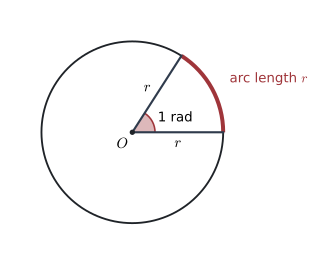
If an arc of length \(l\) is \(2\) radii long, the angle is \(2\) rad; if it is \(3.5\) radii long, the angle is \(3.5\) rad. In general
\[ \theta \text{ (in radians)} = \frac{\text{arc length}}{\text{radius}} = \frac{l}{r} . \]
For a semicircle, the arc is half the circumference, \(\frac{1}{2}(2\pi r) = \pi r\). So the angle of a semicircle is
\[ \theta = \frac{\pi r}{r} = \pi \text{ rad}. \]
But the angle of a semicircle is also \(180^\circ\). Therefore \(\pi\) rad \(= 180^\circ\), and a full turn is \(2\pi\) rad \(= 360^\circ\). One radian is \(\dfrac{180^\circ}{\pi} \approx 57.3^\circ\).
Converting between degrees and radians
Converting between degrees and radians Not in the formula booklet
\[ \pi \text{ rad} = 180^\circ \]
- degrees \(\to\) radians: multiply by \(\dfrac{\pi}{180}\)
- radians \(\to\) degrees: multiply by \(\dfrac{180}{\pi}\)
These angles appear again and again. Learn them in both units.
| Degrees | \(0^\circ\) | \(30^\circ\) | \(45^\circ\) | \(60^\circ\) | \(90^\circ\) | \(120^\circ\) | \(135^\circ\) | \(180^\circ\) | \(270^\circ\) | \(360^\circ\) |
|---|---|---|---|---|---|---|---|---|---|---|
| Radians | \(0\) | \(\frac{\pi}{6}\) | \(\frac{\pi}{4}\) | \(\frac{\pi}{3}\) | \(\frac{\pi}{2}\) | \(\frac{2\pi}{3}\) | \(\frac{3\pi}{4}\) | \(\pi\) | \(\frac{3\pi}{2}\) | \(2\pi\) |
A quick way: think of each angle as a fraction of \(180^\circ\). For example \(60^\circ = \frac{1}{3} \times 180^\circ\), so \(60^\circ = \frac{\pi}{3}\).
Example 1 (a) Convert to radians, giving exact answers: \(\;150^\circ\), \(\;225^\circ\), \(\;20^\circ\).
(b) Convert to degrees: \(\;\dfrac{7\pi}{12}\), \(\;2.4\) rad (give this answer to 1 decimal place).
(a) \(150^\circ = 150 \times \dfrac{\pi}{180} = \dfrac{5\pi}{6}\), \(\quad 225^\circ = \dfrac{225\pi}{180} = \dfrac{5\pi}{4}\), \(\quad 20^\circ = \dfrac{20\pi}{180} = \dfrac{\pi}{9}\).
(b) \(\dfrac{7\pi}{12} = \dfrac{7\pi}{12} \times \dfrac{180^\circ}{\pi} = 7 \times 15^\circ = 105^\circ\).
\(2.4 \text{ rad} = 2.4 \times \dfrac{180^\circ}{\pi} = 137.509\ldots^\circ \approx 137.5^\circ\).
When an angle has no degree sign, it is in radians. In IB examinations radians are used unless the question says otherwise.
- Look at the top right of the screen. It shows DEG or RAD.
- Click on it to switch. Use RAD for questions in radians (arc length, sector area, and all of calculus).
- Check: in RAD mode,
sin(π/6)gives \(0.5\). In DEG mode,sin(30)gives \(0.5\).
The angle mode can also be changed in Document Settings (the Angle box).
Positive and negative angles
We often measure an angle from the positive \(x\)-axis.
- An angle measured anticlockwise is positive.
- An angle measured clockwise is negative.
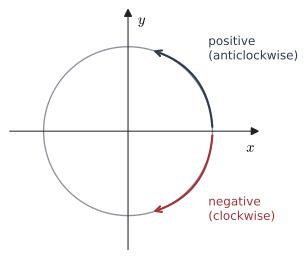
For example, \(-\dfrac{\pi}{2}\) means a quarter turn clockwise. Angles can also be bigger than \(2\pi\): an angle of \(\dfrac{5\pi}{2}\) is one full turn plus a quarter turn. We use these ideas in Section 14.6.
Length of an arc
Since \(\theta = \dfrac{l}{r}\) when \(\theta\) is in radians, the arc length is \(l = r\theta\). This is much simpler than the degree version, \(l = \dfrac{\theta}{360} \times 2\pi r\).
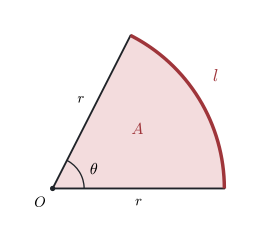
Length of an arc In the formula booklet
\[ l = r\theta \]
- \(l\): the length of the arc
- \(r\): the radius
- \(\theta\): the angle at the centre, measured in radians
The perimeter of a sector is the arc plus the two radii: \(\;P = 2r + r\theta\).
Example 2 (a) A sector has radius \(6\) cm and angle \(\dfrac{5\pi}{6}\). Find the exact arc length and the exact perimeter of the sector.
(b) An arc of length \(14\) cm is cut from a circle of radius \(8\) cm. Find the angle at the centre in radians, and in degrees.
(a) \(l = r\theta = 6 \times \dfrac{5\pi}{6} = 5\pi\) cm. The perimeter is \(2(6) + 5\pi = 12 + 5\pi\) cm (\(\approx 27.7\) cm).
(b) \(\theta = \dfrac{l}{r} = \dfrac{14}{8} = 1.75\) rad. In degrees, \(1.75 \times \dfrac{180^\circ}{\pi} = 100.3^\circ\) (1 d.p.).
Area of a sector
A sector with angle \(\theta\) is the fraction \(\dfrac{\theta}{2\pi}\) of the whole circle, so its area is
\[ A = \frac{\theta}{2\pi} \times \pi r^2 = \frac{1}{2}r^2\theta . \]
Area of a sector In the formula booklet
\[ A = \frac{1}{2}r^2\theta \]
- \(A\): the area of the sector
- \(r\): the radius
- \(\theta\): the angle at the centre, measured in radians
Example 3 A sector has radius \(10\) cm and angle \(0.6\) rad. Find its area and its perimeter.
\[ A = \frac{1}{2} \times 10^2 \times 0.6 = 30 \text{ cm}^2, \qquad P = 2(10) + 10 \times 0.6 = 26 \text{ cm}. \]
Example 4 A sector of a circle has perimeter \(30\) cm and area \(50\) cm². Find the possible values of the radius \(r\) and the angle \(\theta\).
\[ 2r + r\theta = 30 \quad (1) \qquad\qquad \frac{1}{2}r^2\theta = 50 \quad (2) \]
From (1), \(r\theta = 30 - 2r\). Write (2) as \(\frac{1}{2}r\,(r\theta) = 50\) and substitute:
\[ \begin{aligned} \frac{1}{2}r(30 - 2r) = 50 \;&\Longrightarrow\; 15r - r^2 = 50 \\ &\Longrightarrow\; r^2 - 15r + 50 = 0 \\ &\Longrightarrow\; (r - 5)(r - 10) = 0 . \end{aligned} \]
- If \(r = 5\): \(\;5\theta = 20\), so \(\theta = 4\) rad.
- If \(r = 10\): \(\;10\theta = 10\), so \(\theta = 1\) rad.
Both angles are less than \(2\pi\), so both answers are possible.
Segments
A chord cuts a circle into two parts. The smaller part is the minor segment. Its area is the area of the sector minus the area of the triangle formed by the two radii and the chord.
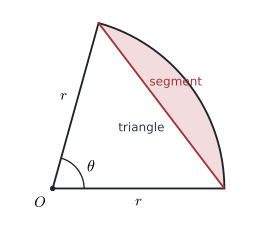
The triangle has two sides \(r\) with angle \(\theta\) between them, so its area is \(\frac{1}{2}r^2\sin\theta\) (see Section 14.3).
Area of a segment Not in the formula booklet
\[ \text{Area of segment} = \frac{1}{2}r^2\theta - \frac{1}{2}r^2\sin\theta = \frac{1}{2}r^2(\theta - \sin\theta) \]
- \(r\): the radius
- \(\theta\): the angle at the centre, in radians
Build this from the booklet formulae for the sector, \(\frac{1}{2}r^2\theta\), and the triangle, \(\frac{1}{2}ab\sin C\).
The perimeter of a segment is the arc \(r\theta\) plus the chord. Find the chord with right-angled trigonometry or the cosine rule.
Example 5 A circle has radius \(8\) cm. A chord \(AB\) makes an angle of \(\dfrac{\pi}{3}\) at the centre \(O\). Find, in exact form,
(a) the area of the minor segment
(b) the perimeter of the minor segment.
(a)
\[ \begin{aligned} \text{sector} &= \frac{1}{2}(8^2)\left(\frac{\pi}{3}\right) = \frac{32\pi}{3} \\[4pt] \text{triangle} &= \frac{1}{2}(8^2)\sin\frac{\pi}{3} = 32 \times \frac{\sqrt{3}}{2} = 16\sqrt{3} \\[4pt] \text{segment} &= \frac{32\pi}{3} - 16\sqrt{3} \text{ cm}^2 \;\;(\approx 5.80 \text{ cm}^2) \end{aligned} \]
(b) Triangle \(OAB\) has \(OA = OB\) and angle \(\dfrac{\pi}{3} = 60^\circ\) at \(O\), so it is equilateral and \(AB = 8\). The arc is \(8 \times \dfrac{\pi}{3} = \dfrac{8\pi}{3}\). The perimeter is \(\dfrac{8\pi}{3} + 8\) cm.
Example 6 A circle has radius \(5\) cm. A chord cuts off a minor segment of area \(10\) cm². Find the angle \(\theta\) at the centre.
\[ \frac{1}{2}(5^2)(\theta - \sin\theta) = 10 \;\Longrightarrow\; \theta - \sin\theta = 0.8 . \]
This equation cannot be solved by algebra, so we use a GDC (in RAD mode): \(\theta = 1.78\) rad (3 s.f.).
- Check that RAD shows at the top right of the screen.
- Open a Graphs page. Enter \(f_1(x) = x - \sin(x)\) and \(f_2(x) = 0.8\).
- Menu → Window / Zoom → Window Settings and choose a window such as \(0 \leq x \leq 3\), \(-1 \leq y \leq 3\).
- Menu → Analyze Graph → Intersection, then select the left and right bounds around the crossing point.
- Read the \(x\)-coordinate: \(x = 1.7785\ldots\), so \(\theta = 1.78\) rad.
Common errors
| ✗ Wrong | ✓ Right | Why |
|---|---|---|
| \(l = r\theta\) with \(\theta = 60\) | \(\theta = \frac{\pi}{3}\) | The formulae \(l = r\theta\) and \(A = \frac{1}{2}r^2\theta\) work only in radians. |
| \(A = \frac{1}{2}r\theta^2\) | \(A = \frac{1}{2}r^2\theta\) | The radius is squared, not the angle. |
| Perimeter of a sector \(= r\theta\) | \(2r + r\theta\) | Do not forget the two straight edges. |
| Segment area \(= \frac{1}{2}r^2\theta - \frac{1}{2}r^2\) | \(\frac{1}{2}r^2(\theta - \sin\theta)\) | The triangle’s area needs \(\sin\theta\). |
| \(\sin\theta\) calculated in DEG mode | RAD mode | With \(\theta\) in radians, the calculator must be in radians too. |
| \(1\) rad \(= 1^\circ\) | \(1\) rad \(\approx 57.3^\circ\) | \(\pi\) rad \(= 180^\circ\). |
Exercises
1 Convert to radians, giving exact answers:
(a) \(72^\circ\)
(b) \(300^\circ\)
(c) \(135^\circ\)
(a) \(\dfrac{72\pi}{180} = \dfrac{2\pi}{5}\)
(b) \(\dfrac{300\pi}{180} = \dfrac{5\pi}{3}\)
(c) \(\dfrac{135\pi}{180} = \dfrac{3\pi}{4}\)
2 Convert to degrees:
(a) \(\dfrac{11\pi}{6}\)
(b) \(\dfrac{4\pi}{9}\)
(c) \(1.2\) rad (to 1 d.p.)
(a) \(11 \times 30^\circ = 330^\circ\)
(b) \(4 \times 20^\circ = 80^\circ\)
(c) \(1.2 \times \dfrac{180^\circ}{\pi} = 68.8^\circ\)
3 A sector has radius \(9\) cm and angle \(\dfrac{2\pi}{3}\). Find the exact arc length and the exact perimeter.
\(l = 9 \times \dfrac{2\pi}{3} = 6\pi\) cm. Perimeter \(= 18 + 6\pi\) cm.
4 Find the exact area of a sector with radius \(12\) cm and angle \(\dfrac{5\pi}{12}\).
\(A = \dfrac{1}{2} \times 144 \times \dfrac{5\pi}{12} = 30\pi\) cm².
5 An arc of length \(15\) cm is on a circle of radius \(6\) cm. Find the angle of the sector (in radians) and the area of the sector.
\(\theta = \dfrac{15}{6} = 2.5\) rad. \(\;A = \dfrac{1}{2} \times 36 \times 2.5 = 45\) cm². (Or use \(A = \frac{1}{2}rl = \frac{1}{2} \times 6 \times 15 = 45\).)
6 A sector has area \(48\) cm² and angle \(1.5\) rad. Find the radius and the perimeter of the sector.
\(\dfrac{1}{2}r^2(1.5) = 48 \Rightarrow r^2 = 64 \Rightarrow r = 8\) cm. Perimeter \(= 2(8) + 8(1.5) = 28\) cm.
7 A sector has perimeter \(40\) cm and area \(100\) cm². Find \(r\) and \(\theta\).
\(r\theta = 40 - 2r\), and \(\dfrac{1}{2}r(r\theta) = 100\):
\[ \frac{1}{2}r(40 - 2r) = 100 \;\Longrightarrow\; r^2 - 20r + 100 = 0 \;\Longrightarrow\; (r - 10)^2 = 0 . \]
So \(r = 10\) cm and \(\theta = \dfrac{40 - 20}{10} = 2\) rad (only one solution).
8 A chord subtends a right angle at the centre of a circle of radius \(6\) cm. Find the exact area of the minor segment.
\[ \frac{1}{2}(6^2)\left(\frac{\pi}{2} - \sin\frac{\pi}{2}\right) = 18\left(\frac{\pi}{2} - 1\right) = 9\pi - 18 \text{ cm}^2 . \]
9 A chord \(AB\) of a circle with centre \(O\) and radius \(10\) cm has \(\angle AOB = \dfrac{2\pi}{3}\).
(a) Find the exact area of the minor segment.
(b) Show that \(AB = 10\sqrt{3}\) cm, and find the perimeter of the minor segment to 3 s.f.
(a) \(\dfrac{1}{2}(100)\left(\dfrac{2\pi}{3}\right) - \dfrac{1}{2}(100)\sin\dfrac{2\pi}{3} = \dfrac{100\pi}{3} - 25\sqrt{3}\) cm² (\(\approx 61.4\) cm²).
(b) The perpendicular from \(O\) bisects \(AB\) and the angle, giving a right-angled triangle with angle \(\dfrac{\pi}{3}\) and hypotenuse \(10\). Half the chord is \(10\sin\dfrac{\pi}{3} = 5\sqrt{3}\), so \(AB = 10\sqrt{3}\). Perimeter \(= \dfrac{20\pi}{3} + 10\sqrt{3} = 38.3\) cm (3 s.f.).
10 The minute hand of a clock is \(14\) cm long. In \(25\) minutes, find
(a) the distance travelled by the tip of the hand
(b) the area swept out by the hand.
Give your answers to 3 s.f.
In \(60\) minutes the hand turns \(2\pi\), so in \(25\) minutes it turns \(\dfrac{25}{60} \times 2\pi = \dfrac{5\pi}{6}\).
(a) \(l = 14 \times \dfrac{5\pi}{6} = \dfrac{35\pi}{3} = 36.7\) cm.
(b) \(A = \dfrac{1}{2}(14^2)\left(\dfrac{5\pi}{6}\right) = \dfrac{245\pi}{3} = 257\) cm².